Alalgura - Emu Country, 1992
Emily Kam Kngwarreye
synthetic polymer paint on linen
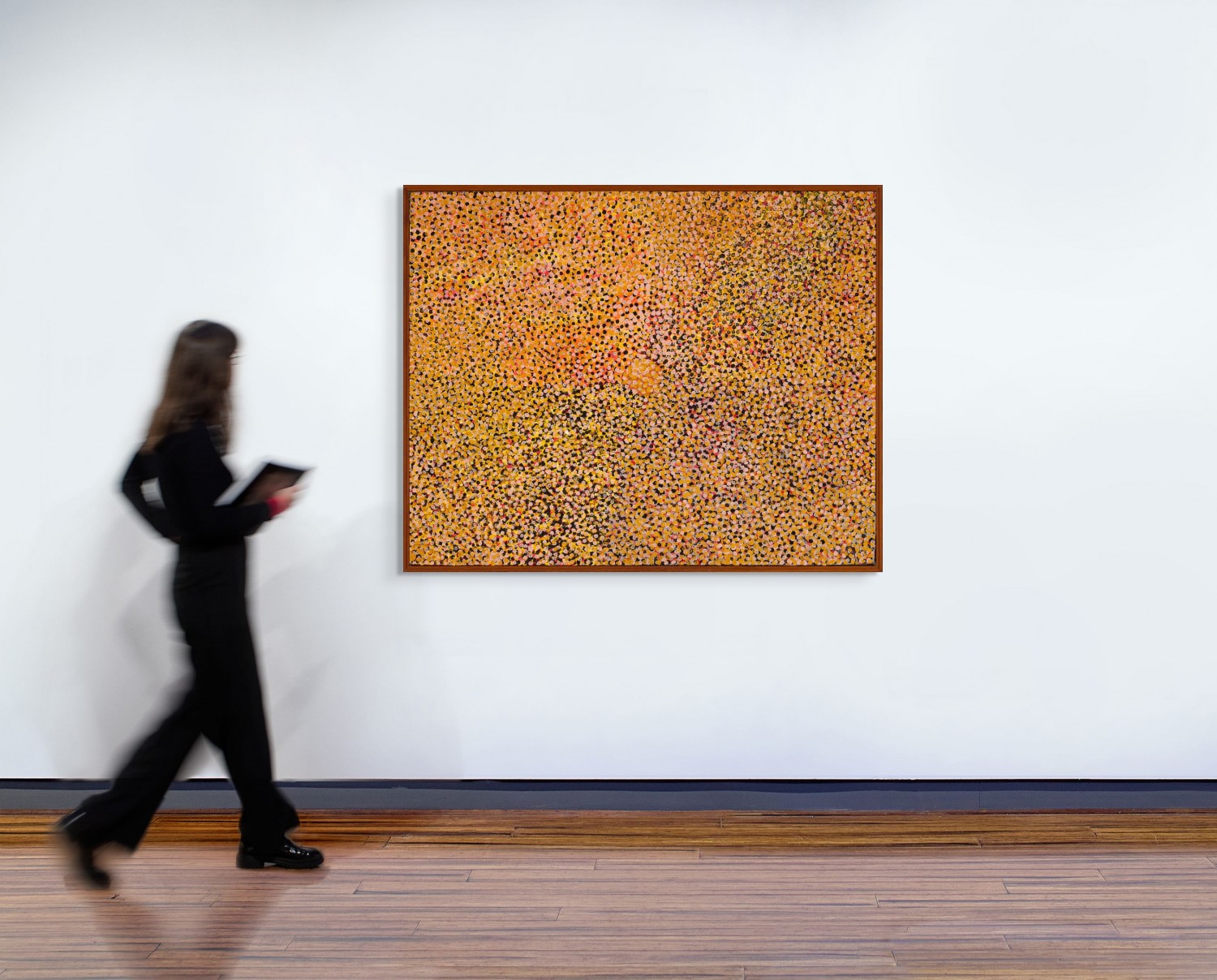
122.0 x 152.5 cm
bears inscription verso: artist’s name and Delmore Gallery cat. 92L69
Commissioned by Delmore Gallery, via Alice Springs in December 1992
Chapman Gallery, Canberra
Lin Bloomfield, New South Wales, acquired from the above on 26 August 1994
Thence by descent
Private collection, New South Wales
Emily Kame Kngwarreye, Chapman Gallery, Canberra, 26 August – 19th September 1994
This work is accompanied by a certificate of authenticity from Delmore Gallery.
Emily - painting 1.jpg
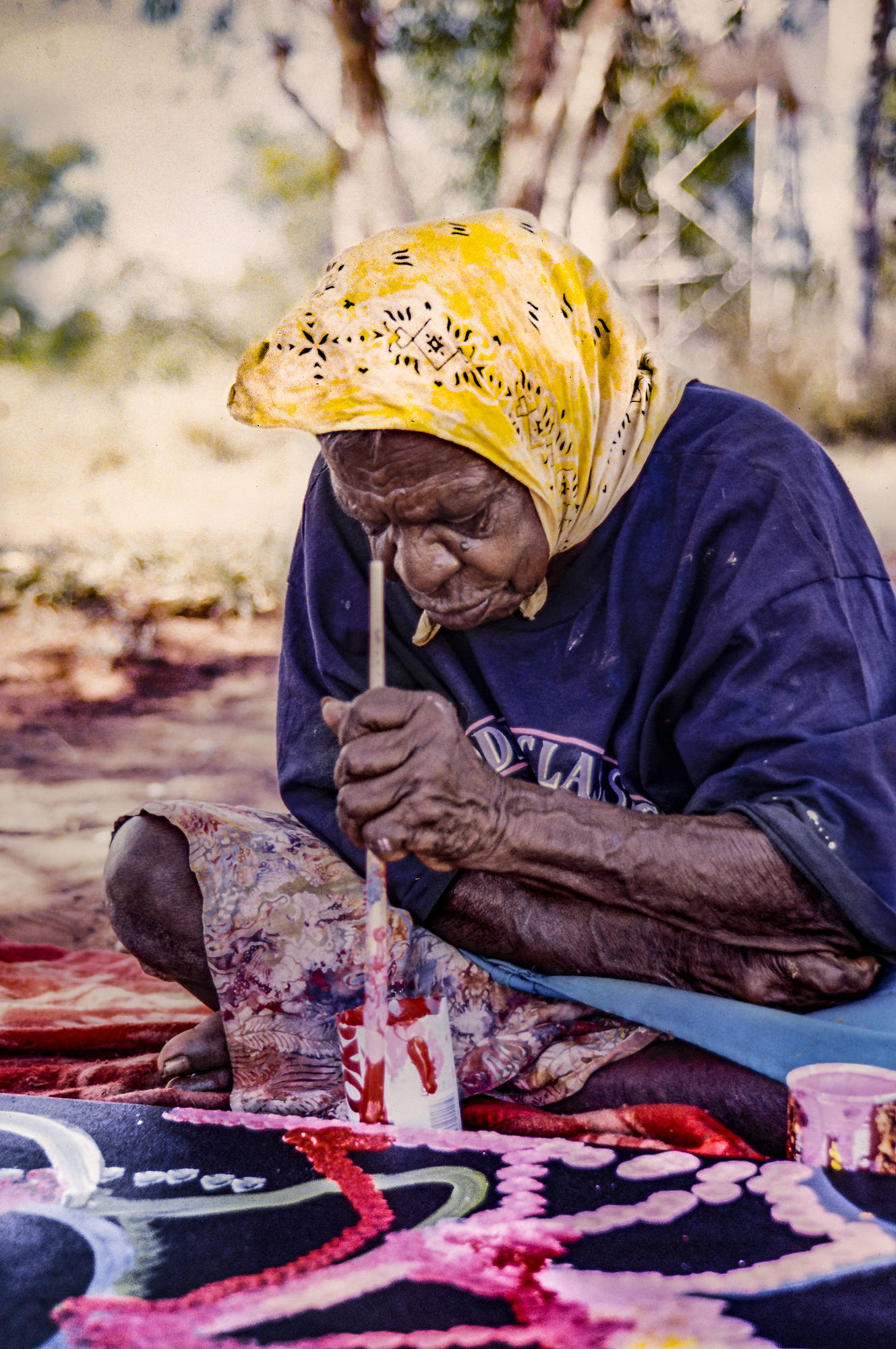
Emily Kam Kngwarreye painting,
Delmore Downs Station, c.1992
photographer: Steve Strike
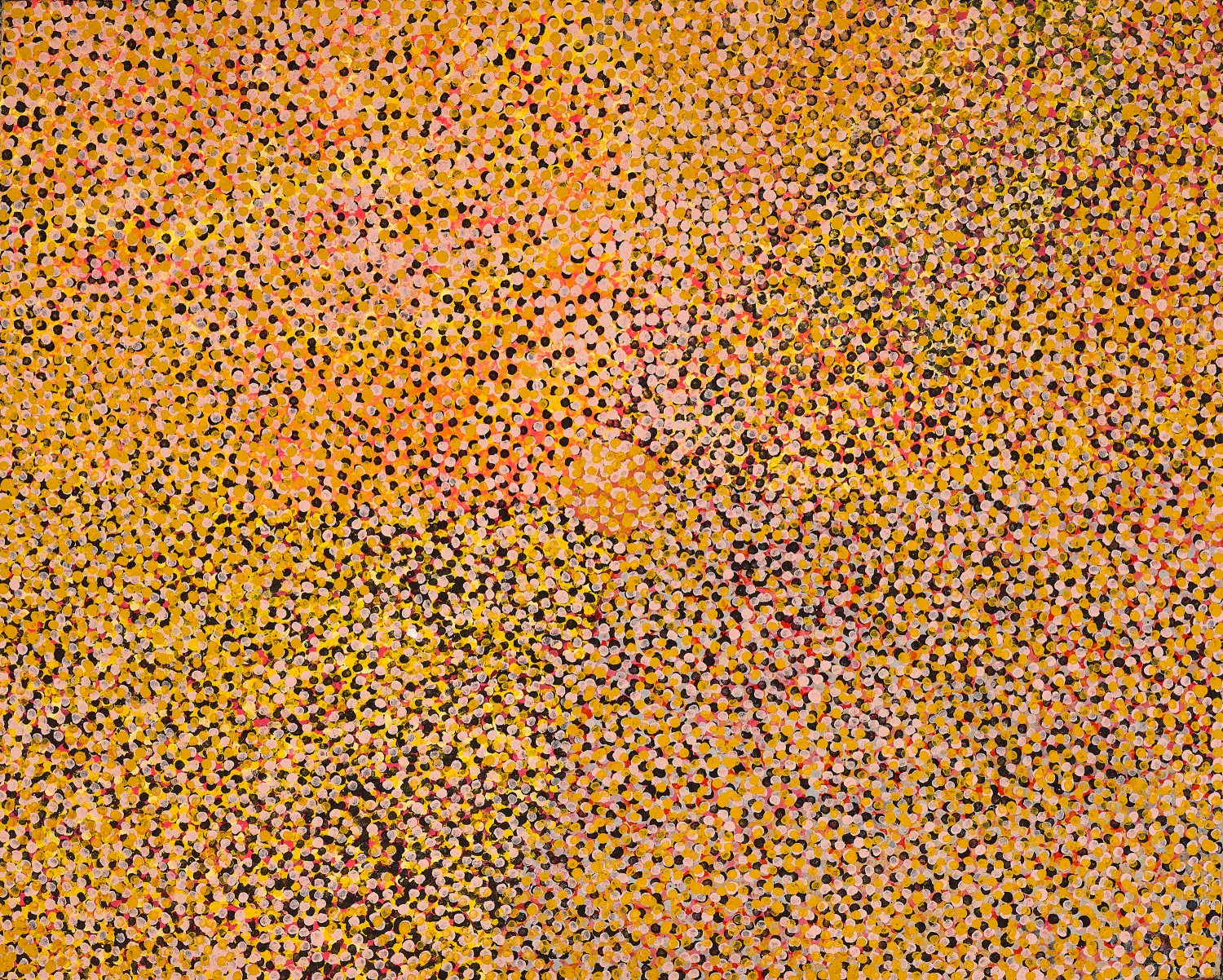
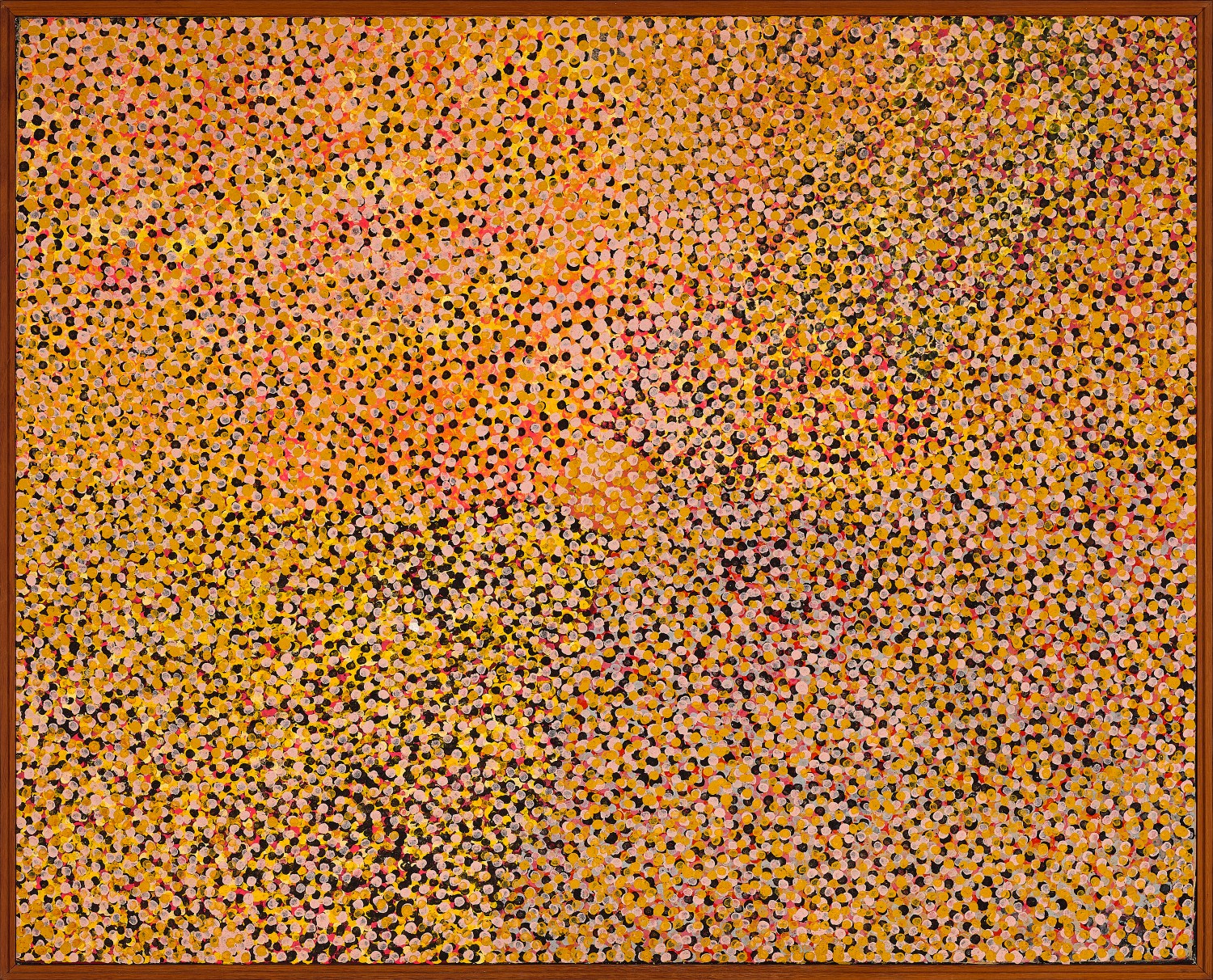
A dense and radiant veil of finely dotted pink, orange, yellow, blue, and burnt umber flowers and seeds, Emily Kam Kngwarreye’s Alalgura – Emu Country, 1992 is a joyous and lyrical explosion of high-key colour signifying a bountiful harvest in Alhalker Country, the site of the artist’s birth. In 1992, although only three years into her brief, yet prolific, professional painting practice, the diminutive 80-year-old Kngwarreye received from Paul Keating an Australian Artists Creative Fellowship – an award affectionately known as a ‘Keating’, recognising the cultural contributions of twelve leading contemporary artists. Noted in the press as a ‘surprise’ recipient, having won without an application, she was the first Aboriginal Australian to be recognised for this honour.1
A master colourist, Kngwarreye was in full flight, poetically mapping her country at the unique intersection of ancient Aboriginal cultural traditions and Western abstract formalism. In contrast to the established narrative traditions of contemporary painting practiced by male elders at Papunya, Kngwarreye painted an intimate view of country, focussing on its specific phenomena. She painted totemic elements of flora and fauna over which she held special custodial rights on Alhalker Country in Central Australia. A leading figure in eastern Anmatyerr ceremony, and the caretaker of important religious cultural knowledge, Kngwarreye presided over women’s ceremonies (awelye) in which she danced, making reference to the emu travelling along and bending down to eat the fan flower and desert raisin fruits.
Following on from Kngwarreye’s astounding first painting, dense with underlying skeletal frameworks and body painting designs, Emu woman, 1989 (The Holmes à Court Collection, Heytesbury), the emu subject appeared frequently in the first few years of her painting practice, evidencing the special role of the emu (ankerr) in awelye songs. Many of her earliest paintings featured an underlying linear web of cracked earth and emu tracks, with arrow symbols signifying the animal’s footprints in the sand. Emu fat was mixed in with local ochres to create the ceremonial body paint placed on the breasts, upper chest and shoulders of dancers; the fluency and rapidity of this paintwork was later directly translated by Kngwarreye onto her canvas works.2
Only reaching artistic maturity in her 70s, Emily Kam Kngwarreye’s decades of experience in ceremonial painting provided the bedrock of her painting practice, giving her, amongst others, the codified songlines of the emu and its movement through the landscape to find suitable grazing locations and nesting sites. Terry Smith noted that while the Emu dreaming was primarily a male dreaming, Emily held custodial responsibility over the anwerlarr pencil yam, a creeping plant with edible roots and yellow flowers, on which the emu fed.3 ‘The emu he likes that kame (flower)... that flower is mainly white, sometimes a little bit yellow, pink too… it changes colour a bit’, explained Kngwarreye’s kinswoman Lindsay Bird.4 Another food source favoured by the emu is the yellow, oval-shaped fruit of the intekw (the camel-weed, fan-flower), significant to the cultural context of Alhalker country.
Alhalker Country is characterised by ridges of sandstone and quartzite concealing a sanctuary of springs beyond which extend spinifex sand plains punctuated by soakages and desert country where the emu roam and hardy plants spring into bloom after rains. Alalgura – Emu Country is a painting of great seasonal change, when the contours of Alhalker Country are suddenly carpeted with flowering yam according to the natural rhythms of indigenous agriculture crucial to livelihood of local peoples.
The paintings produced by Kngwarreye between 1990 and 1992 featured finely stippled, shimmering clouds of dots, each individually painted with a small brush in clearly delineated colours – an extraordinarily concentrated effort for an elderly painter. This was soon to change, the artist’s imminent adoption of larger brushes and broader brushstrokes driven by the need to accommodate reducing levels of energy and diminishing eyesight.5 In Alalgura – Emu Country, the fastidious all-over dotting of uniform size, submerges the underlying tracery of dreaming lines. Instead, successive waves of overlaid dots provide tonal variations, with colours coalescing in streaks and patches beneath the dots, providing a sense of depth. The increasing reductionism in her painted works coincided with Kngwarreye’s reticence to provide explanations for her artworks – a reductive story incapable of encapsulating the ineffable interconnectedness of land, natural energies and cultural expression found in her practice. While certain hues refer to specific natural phenomena, such as the changing ripeness of yam seeds, the whole composition of Kngwarreye’s artworks is more expansive, representing on one plane the flux of seasons, the land and the sky. Hers was an art of multiplicities, of a ‘wholeness of experience.’6
In the final prolific years of her life, Kngwarreye spent time at Delmore Downs Station in a remote north-western corner of the Simpson Desert south of Utopia where this painting was produced. In association with Delmore, it was then exhibited at Chapman Galleries in Canberra in 1994, where it was purchased by Lin Bloomfield, respected author, gallerist and arts advocate, in whose family it has since remained. Never previously offered to the market and not seen in public for over three decades, indeed Alalgura – Emu Country is a rare example of the artist at the peak of her powers.
1. Neale, M. (ed.) Utopia: The Genius of Emily Kame Kngwarreye, National Museum of Australia Press, Canberra, 2008, p. 259, and Maklin, R. ‘Keatings give focus’, Canberra Times, 8 October 1992, p. 1
2. Perkins, H., and Cole, K., Emily Kam Kngwarray, National Gallery of Australia, Canberra, 2023, p. 184
3. Smith, T., ‘Kngwarreye Woman Abstract Painter’ in Isaacs, J. (et al.), Emily Kngwarreye Paintings,
Craftsman House, Sydney, 1998, p. 29
4. Ibid., p. 16
5. ibid., p. 21
6. Hart, D., Emily Kame Kngwarreye. Paintings from 1989 – 1995. Works from the Delmore Collection,
Parliament House Publishing, Canberra, 1995, n. p.
LUCIE REEVES-SMITH