The Blackwood tree, 1911
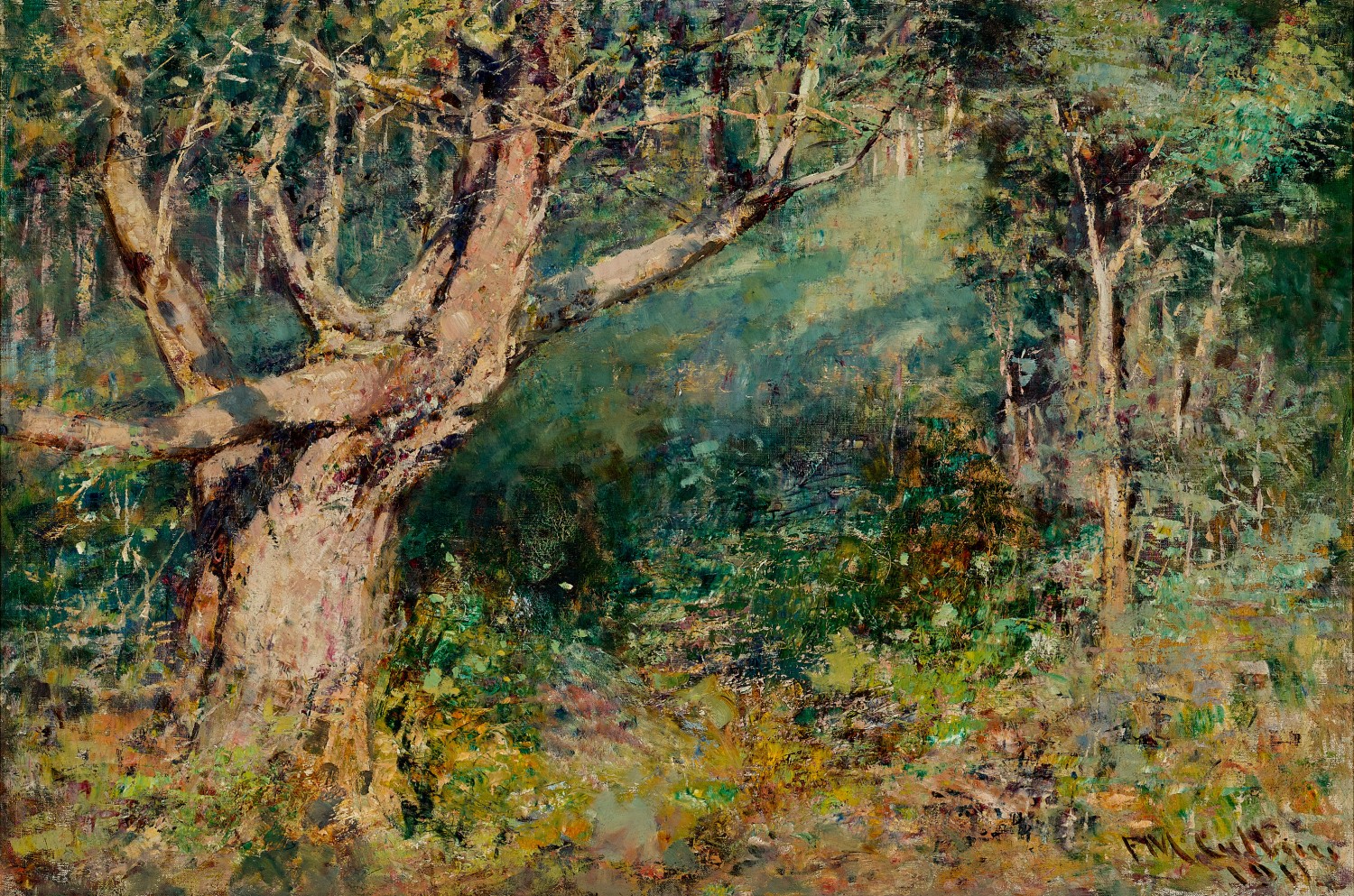
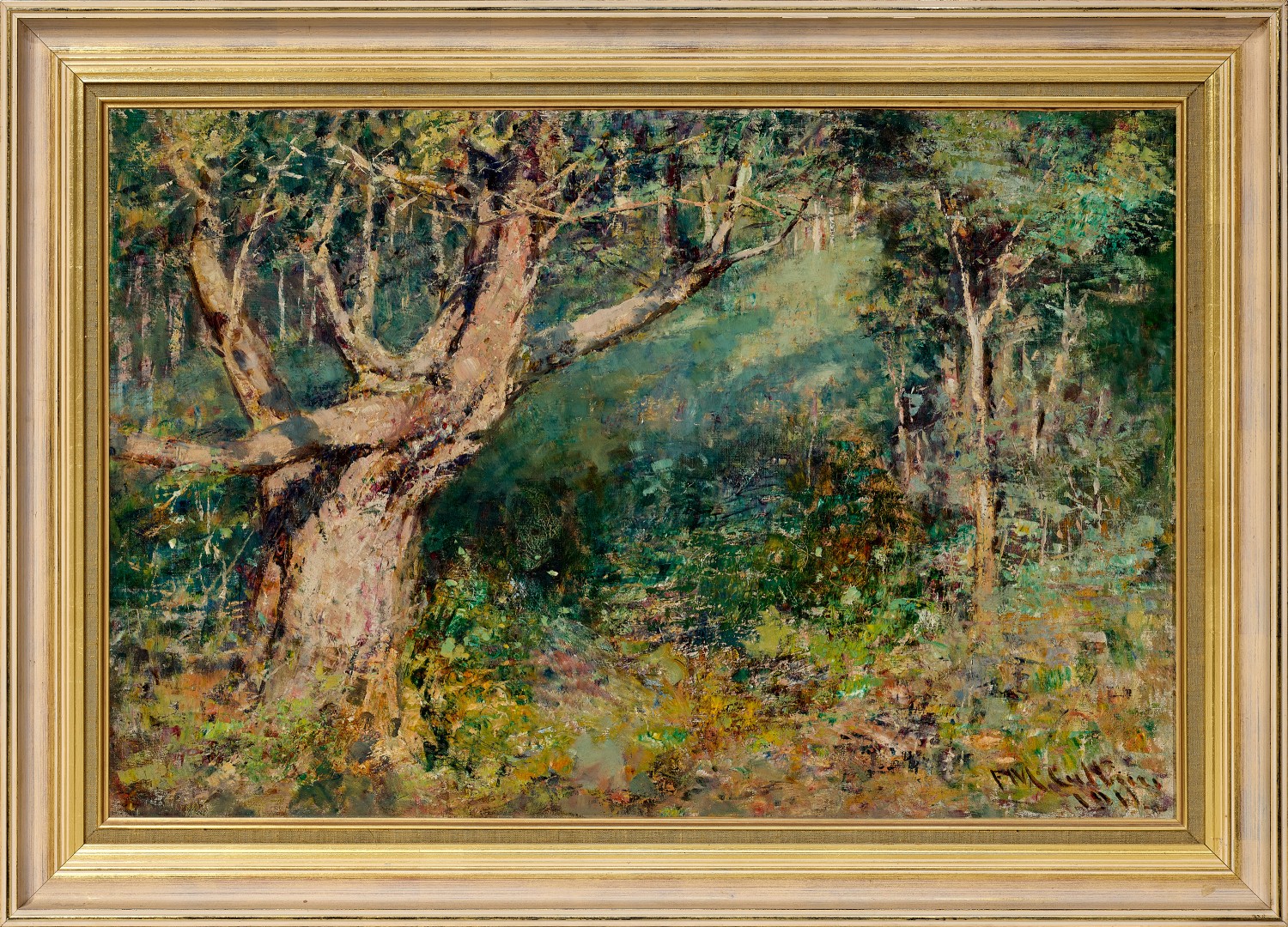
Frederick Mccubbin
oil on canvas on composition board
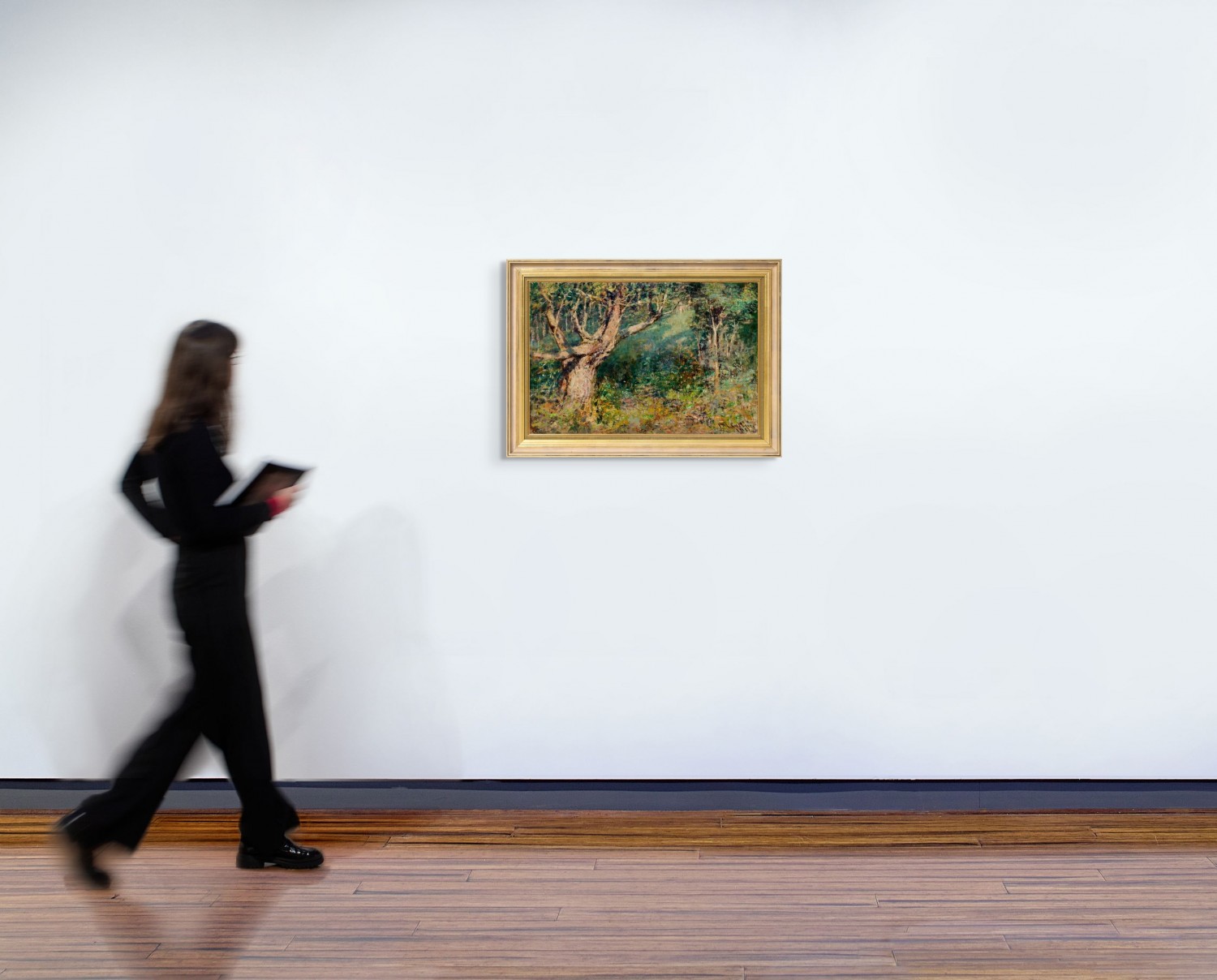
50.5 x 76.5 cm
signed and dated lower right: F McCubbin / 1911
bears inscription on handwritten label verso: Col & Mrs. E. H. B. Neill / ‘The Blackwood Tree’/ No: 79. Fred McCubbin
Lieutenant Colonel and Mrs E. H. B. Neill, Melbourne (inscribed on label verso)
Thence by descent
Private collection, United Kingdom
The Paintings of the Late Frederick McCubbin, The New Gallery, Melbourne, 25 November - 9 December 1924, cat. 1
In the distinguished three-quarter-length self-portrait that Frederick McCubbin painted the year after The Blackwood tree, 1911, the artist is shown as he was fondly remembered by his Gallery School students – a wise and gracious presence, enlivened by a luxuriant moustache. McCubbin was then at a stable yet inspired period of his life. Previously, on his sole journey to Europe in 1907, he had seen significant works by masters such as Rubens, Turner, and Constable, whom he felt had ‘caught it alive’1 and upon his return to Australia, his palette changed as he pursued these new understandings. Further, ‘McCubbin no longer found it necessary to tell narratives, or to people the landscape. Instead he painted images radiant with colour and energy.’2 Close friend Arthur Streeton saw this as an ongoing quest for ‘freedom and fresh knowledge’3, and the transformation was also popular with gallery audiences, with one critic noting in 1911 that McCubbin’s ‘colour is fuller and richer than ever, and each canvas reveals his sensitiveness [sic.] to the beauties which are offered often in apparently the most commonplace subjects.'4
All such elements may be found in The Blackwood tree, which was painted the same year as the magnificent Violet and gold (National Gallery of Australia) where ‘there are portions in which he handled his paint so freely that he almost splattered it over the coarse canvas – animating it with flecks of colour, layering pure colour upon colour.’5 A similar strategy appears in The Blackwood tree and similarly, both were painted near the McCubbin family’s country property ‘Fontainebleau’ at Mt Macedon – a place where ‘he didn’t need to wander very far because there were so many paintable pictures right there close to the cottage.’6 McCubbin adored Mt. Macedon and it is likely that this particular blackwood grew on the hill behind ‘Fontainebleau’ as indicated by the flash of illumination upper centre which reveals the steep incline beyond. This land belonged to William McGregor’s property ‘Ard choile’ (meaning ‘height of the woods’), and McCubbin masterworks such as The pioneer, 1904 (in the collection of the National Gallery of Victoria), were painted there amidst the mountain ash, manna gums and blackwood – a tree that thrives in wet forests and gullies. In the current painting, the blackwood claims its position, the twisted limbs attenuated to the space around it.
In these same years, the McCubbins also lived at South Yarra amidst a second tangled garden where he painted another masterwork in 1911, The old stone crusher (the quarry), (Art Gallery of South Australia); and its companion, Rainbow over Burnley, 1910, formerly owned by Sir Keith and Dame Elisabeth Murdoch.7 In an obituary following the artist’s death in 1917, he was lauded for his ‘remarkable skill in dealing with and realising the intricacies, colour and atmosphere of the Australian bush; especially the artistic tangle of the undergrowth, and the charm of solitude and silence.’8 Sadly, the landscape of McGregor’s farm no longer exists having been virtually stripped of its larger trees, as was much of the Mt Macedon area. Bushfires have also raged and much has now been subdivided into cleared paddocks for grazing horses.
1. Clark, J., ‘A happy life’: Frederick McCubbin’s small paintings and oil sketches, National Gallery of Victoria touring exhibition, City of Ballarat Fine Art Gallery, Victoria, 1991, p. 6
2. Gray, A. (ed.), McCubbin: Last impressions 1907 – 17, National Gallery of Australia, Canberra, 2009, p. 45
3. Arthur Streeton, 1921, cited ibid., p. 102
4. ‘Art notes. Mr. Fred McCubbin’s exhibition of pictures’, The Age, Melbourne, 8 April 1911, p. 14
5. Sullivan, L., Frederick McCubbin: whispering in the wattle boughs, Geelong Art Gallery, Victoria, 2021, p. 31
6. Kathleen Mangan, cited in McKenzie, A., Frederick McCubbin 1855 – 1917: ‘The Proff’ and his art, Mannagum Press, Melbourne, 1990, p. 144
7. See Important Australian and International Art, Deutscher and Hackett, Melbourne, 28 August 2024, lot 7
8. ‘Mr F. McCubbin. A distinguished artist’, The Argus, Melbourne, 21 December 1917, p. 11
ANDREW GAYNOR