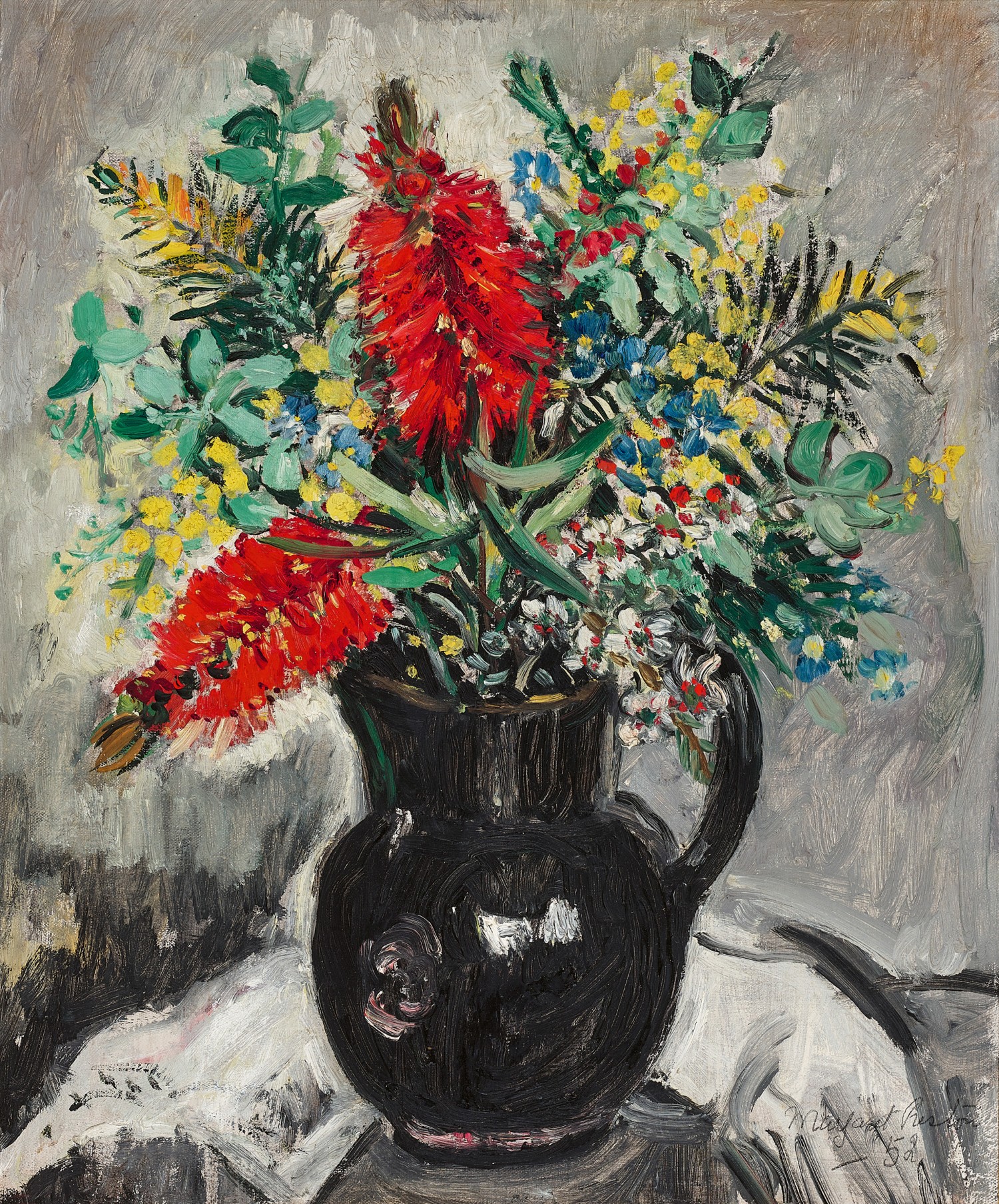
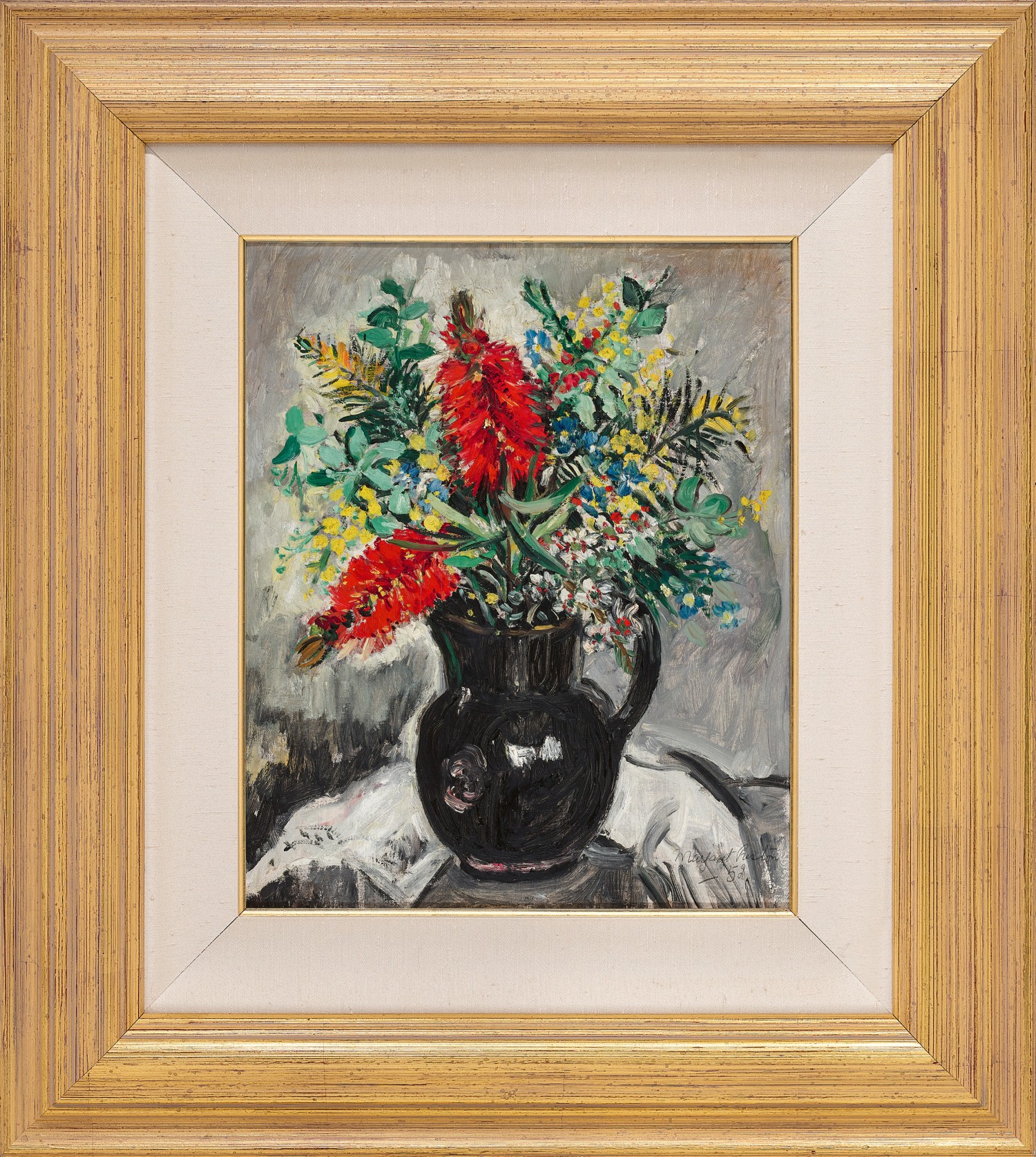
Bottlebrush, 1952
Margaret Preston
oil on canvas
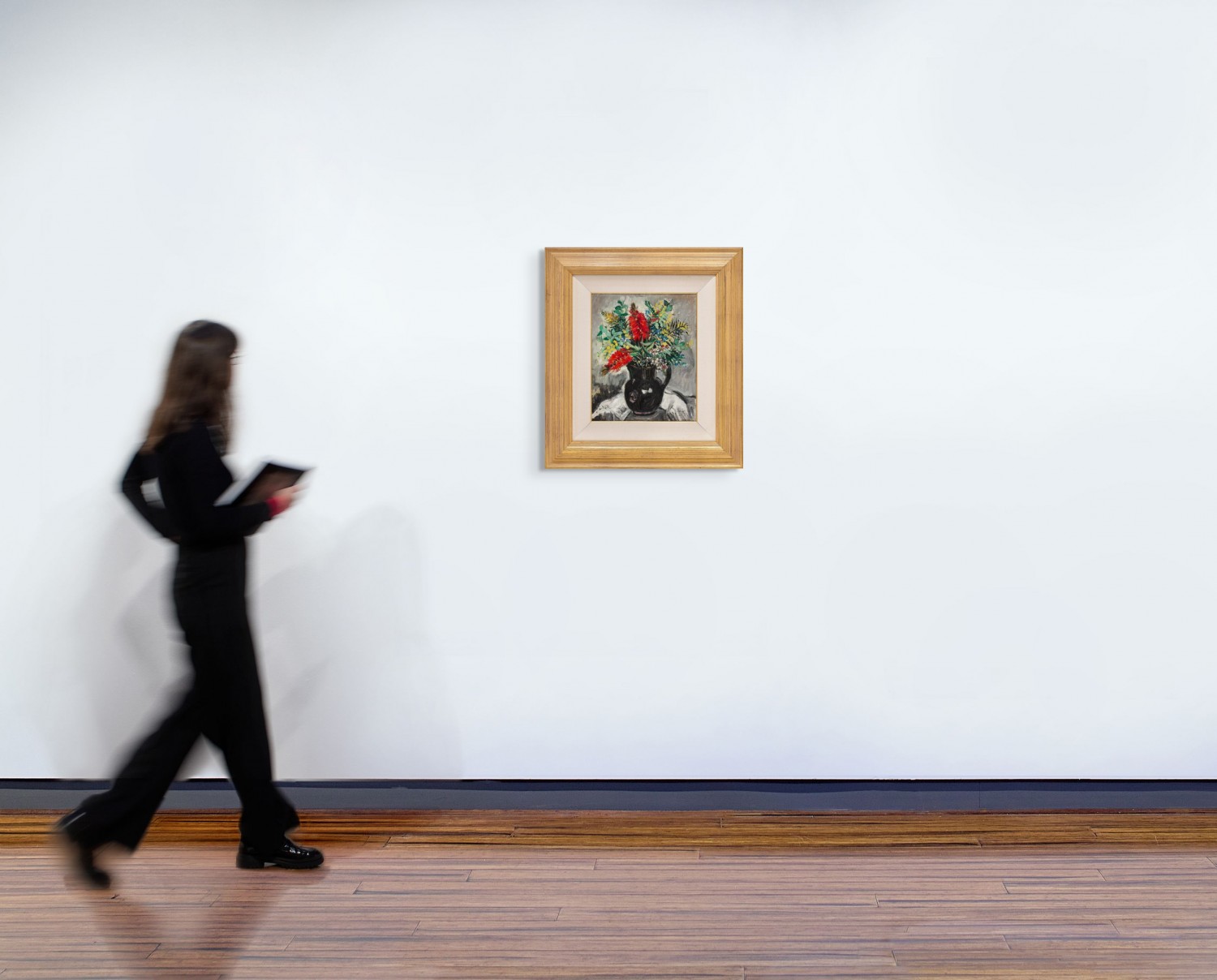
42.0 x 34.0 cm
signed and dated lower right: Margaret Preston / -52
Macquarie Galleries, Sydney
Private collection
John Martin & Co., Adelaide (labels attached verso)
Joseph Brown Gallery, Melbourne
Queensland Fine Art Auctioneers, Brisbane, 1989
Sotheby's, Melbourne, 22 April 1996, lot 134 (as ‘Still life of native flowers’)
Henry Krongold, Melbourne
Thence by descent
Private collection, Melbourne
Macquarie Galleries Exhibition: Sydney painting 1952, Finney’s Gallery, Brisbane, 15 - 25 July 1952, cat. 43
Fine paintings, Queensland Fine Art Auctioneers, Brisbane, 25 February – 2 March 1989, lot 68 (as ‘Native flowers’)
Margaret Preston Catalogue Raisonné of paintings, monotypes and ceramics, Art Gallery of New South Wales, Sydney, 2005, CD-Rom compiled by Mimmocchi, D., with Edwards, D., and Peel, R. cat. 1952.01 (illus.)
Flowers proliferate throughout Margaret Preston’s oeuvre, set within striking still life arrangements though none are merely pretty. They are decorative in the modernist sense of the word but were never dashed off in the afternoon over a nice pot of tea. Preston approached each canvas as an exercise unto itself, one which built on lessons gleaned over the course of her long and sustained career. For noted historian Humphrey McQueen, ‘Margaret Preston was Modernism in Australia between the wars… because she was the one artist who persistently attempted to engage, in various media, the complex of problems which gave rise to Modernism.’1 Preston saw art as being ‘a problem of relationships… where every form or shape realized on the canvas alters the nature and character of the original stimulus.’2 Her paintings from the mid-1920s bear testament to such ideas with, for example, Gum blossom (or eucalyptus), 1928 (Art Gallery of Western Australia), which contrasts spikey Australian flora set against a streamlined background informed by contemporary interior design, or those from the 1940s, infused by her selective understanding of the palette integral to Australian Indigenous art.
Echoes from each of these stages may be found in Bottlebrush, 1952, painted at the artist’s home in Mosman, NSW. In related paintings such as Western Australian wildflowers, c.1951 (private collection), the table outline is bold and uninterrupted, whilst in Bottlebrush and flannel flower, c.1951 (private collection), there is no line at all – space is only delineated by tone and vigorous brushwork. These steps underscore the later painting, Flannel flowers, 1952 (collection unknown), where Preston now has the table-top merging directly into the backyard lawn through an orchestrated pattern of strokes in a myriad choice of greens. Between these three extremes sits Bottlebrush, whose black jug is set against its own fugitive background of indeterminate space, the table’s surface anchored only by minimal brushwork to the right which, by its very fluidity, seems to follow direction – the curved sweep of white cloth – rather than demarcation of the actual edge. By contrast, to the left, the background implodes into an entropic space of three tonal regions, black, white and grey. This causes the black jug to visually step forward, its own surface agitated by expressive but controlled brushwork. The plants also stand out from the dissolve, their red, green, yellow and blue flowers – so distinctive of Australian flora – coming to the fore.
The blooms in Bottlebrush are bottlebrush, wattle, yellow pea, and Dampiera (fan flower), and since these all favour Spring to early Summer for their flowers, the painting was likely begun late in 1951 but completed in the first months of 1952 before exhibition at the Macquarie Galleries-affiliated Finney’s Gallery, Brisbane, in July. Throughout her career, Preston was often dismissed by critics due to her gender and, as Art Gallery of New South Wales director, Hal Missingham, noted upon her death that ‘if Margaret Preston had been a man, I feel sure she would have enjoyed a public reputation equally as great as Dobell, Drysdale or Nolan.’3 Time has eased this view of the status quo, and Preston is now rightly regarded – and loved – for the strength, vigour and intelligence of her art.
1. Humphrey McQueen, 1979, cited in Edwards, D., Mimmocchi, D., and Peel, R., Margaret Preston, Art Gallery of New South Wales, Sydney, 2005, p. 9
2. Margaret Preston, ‘Aphorisms 25 & 27’, in Gellert, L., and Ure Smith, S., (eds), Margaret Preston: recent paintings 1929, Art in Australia, Sydney, 1929, non-paginated
3. Missingham, H., ‘Margaret Preston’, Art and Australia, Sydney, vol.1, no. 2, August 1963, p. 100
ANDREW GAYNOR