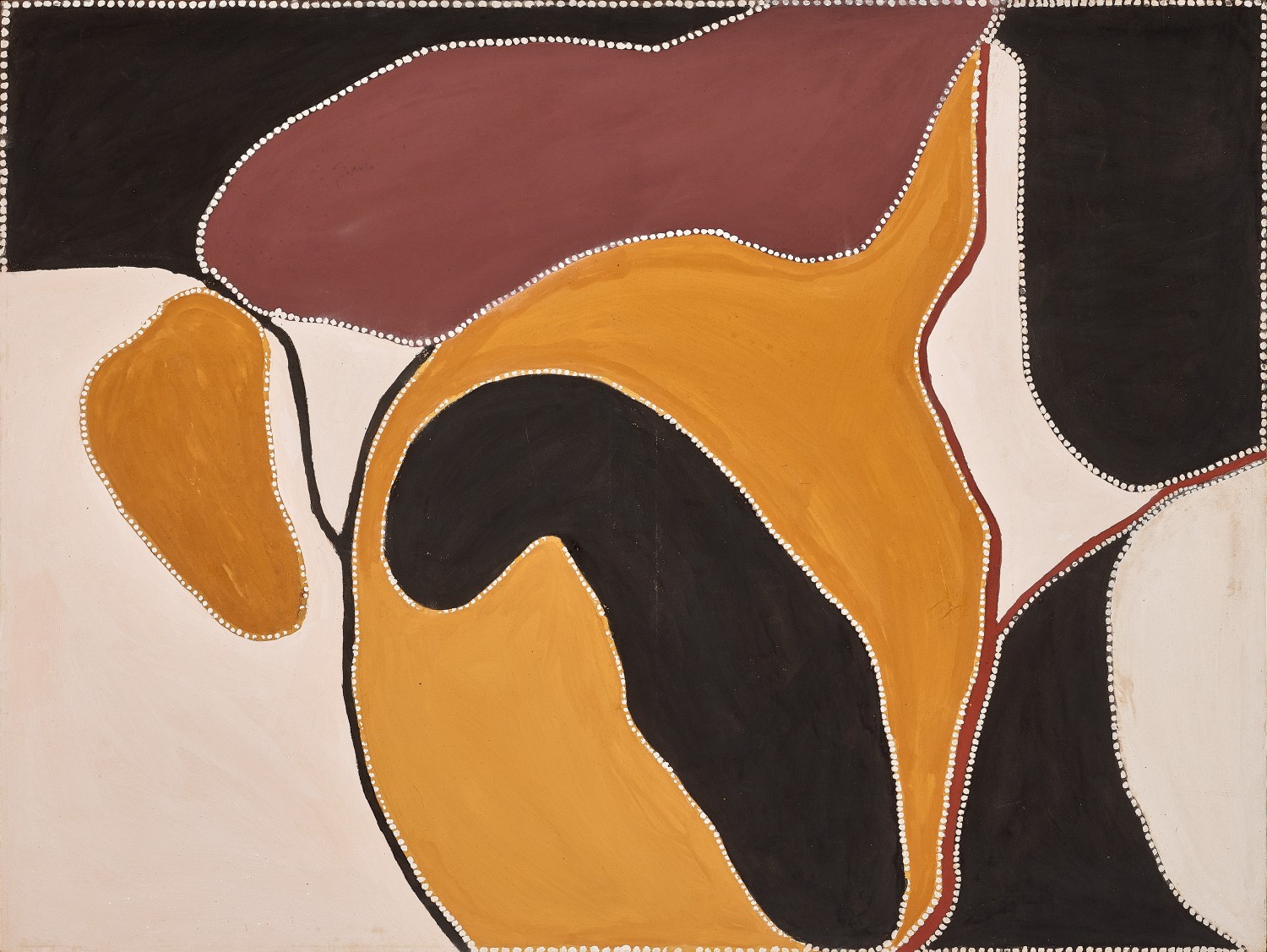
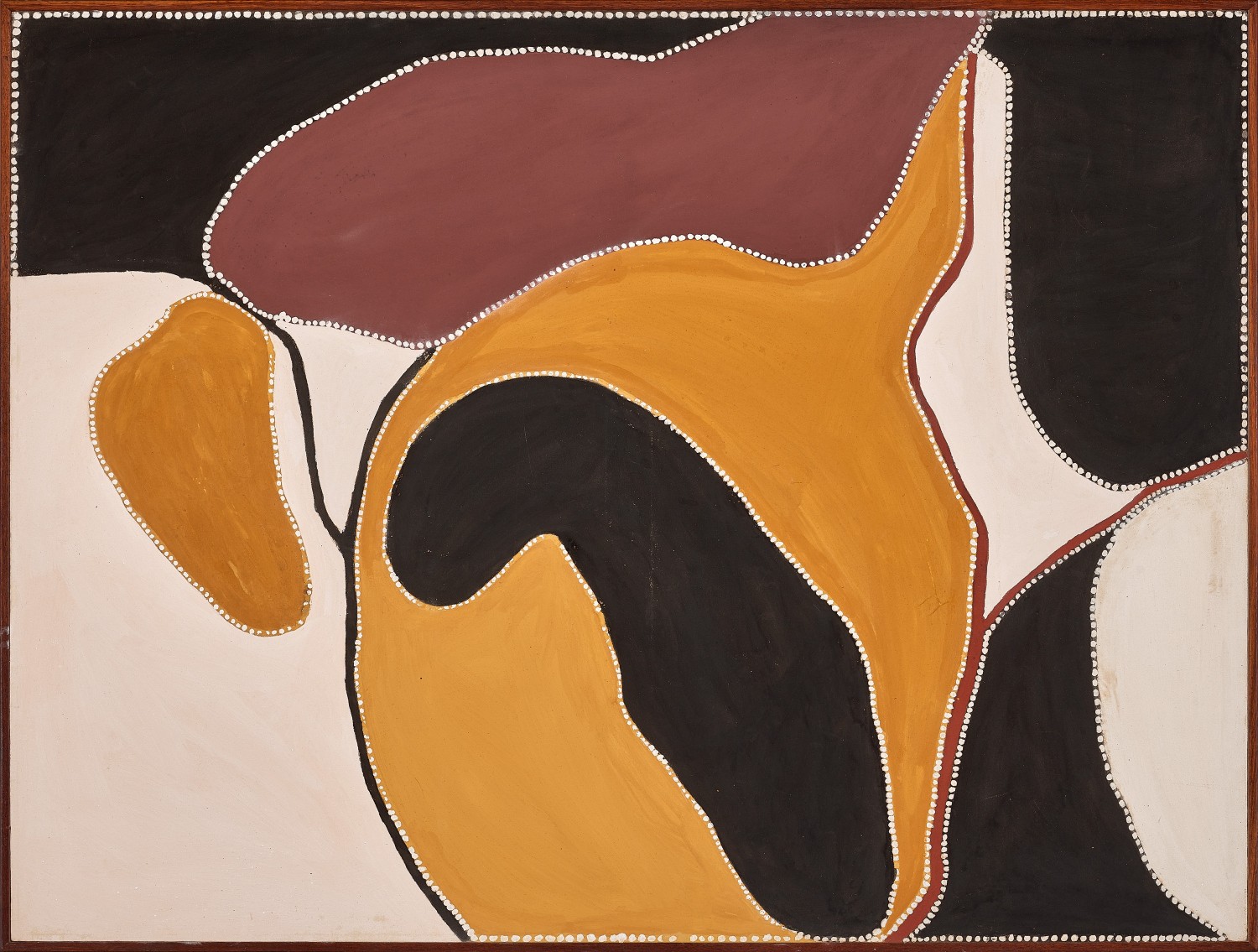
Mandangala, north of Turkey Creek, 1990
Freddie Timms
ochres and pigment with synthetic binder on canvas
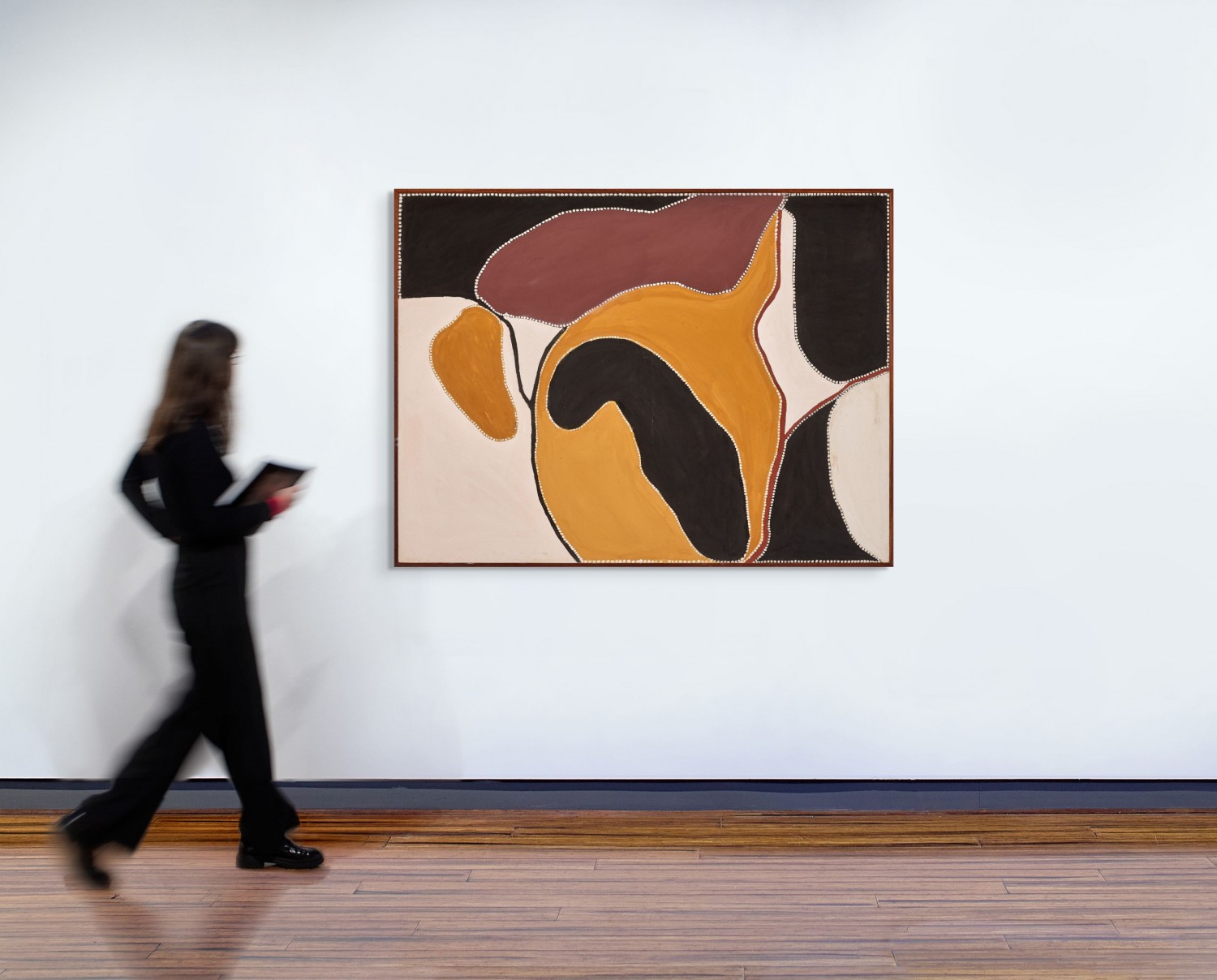
120.0 x 160.0 cm
bears inscription on backing verso: artist's name, size and Waringarri Aboriginal Arts cat. S2700 and AP33200
Painted for Waringarri Aboriginal Arts, Kununurra, Western Australia in 1990
Gallery Gabrielle Pizzi, Melbourne (labels attached verso)
Private collection, USA
Sotheby's, Melbourne, 25 July 2005, lot 45 (as ‘Mandangala, North Turkey Creek’)
Private collection, Sydney
Aratjara Art of the First Australians, Kunstsammlung Nordrhein-Westfalen, Düsseldorf, Germany, 24 April - 4 July 1993; The Hayward Gallery, London, 23 July - 10 October 1993; Louisiana Museum, Humlebaek, Denmark, 11 February - 23 May 1994; National Gallery of Victoria, Melbourne, 23 June - 15 August 1994, cat. 76 (label attached verso)
Luthi, B. (ed.), Aratjara Art of the First Australians: Traditional and Contemporary Works by Aboriginal and Torres Strait Islander Artists, DuMont Buchverlag, Cologne, 1993, cat. 76, pp. 218 (illus.), 343
The accompanying catalogue entry for the Aratjara exhibition notes that this painting shows country in the area of Glen Hill (Mandangala) and the Argyle diamond mine to the north of Turkey Creek.
While the first forms of modern, transportable art from the Kimberley region of Western Australia were paintings of Wandjina spirits derived from local and ancient rock art, the emergence of a contemporary painting practice of ochre-on-canvas at Warmun (Turkey Creek) was inextricably linked to the development the Goorirr Goorirr (Kurrirr-Kurrirr/Gurrir Gurrir/Krill Krill/Kuril Kuril) narrative ceremonial cycle in the 1970s.1 Male Gija elders painted the first hand-held wooden boards used in the corroboree, including Jack Britten, George Mung Mung and Paddy Jaminji, a classificatory uncle of Joolama Rover Thomas (the dreamer and owner of the Gorrir Gorrir cycle) and, who subsequently became a classificatory father-in-law to Ngarrmaliny Freddie Timms (who danced in early Goorrir Goorrir performances).2 Both of these artists, who settled in Warmun and started painting in 1983 and 1986 respectively, would become internationally known artists and powerful advocates for representation of Indigenous artists and cross-cultural relationships.
The dramatic landscape of Gija Country in the East Kimberley was parcelled by white pastoral settlements in the early 20th century. Large swathes of this land were later submerged with the Ord River Irrigation Scheme, which, in 1971, created Lake Argyle, Australia’s largest man-made freshwater reservoir. Painted in the same year that Thomas and Trevor Nickolls (1949 – 2012) became the first Aboriginal artists to represent Australia at the Venice Biennale, Mandangala, north of Turkey Creek, 1990, is an acclaimed early work by Freddie Timms painted in specific local ochres, depicting from memory the landscape of Mandangala, a remote area north-east of Warmun flooded beneath Lake Argyle.
Contemporary Kimberley artists Paddy Jaminji, Rover Thomas, Queenie MacKenzie and Freddie Timms all came to artmaking relatively late in life, following many decades of outdoor labour and travelling across vast tracts of Kimberley country enclosed in Texas Downs and Bedford Downs. Employment as stockmen and drovers on these great Kimberley cattle stations and pastoral properties, although entailing hard physical labour, allowed the artists to remain close to ancestral lands and able to travel for ceremonial purposes. ‘I think about the country where I was walking and camping, all the main waterholes, all the camping areas. I remember the places where I used to go mustering and I follow them up with my painting’, Timms explained of his artworks.3
A detailed and intimate working knowledge of the land combined with recollections of distant ancestral places provided the foundation for Timms’ radically stylised artworks. His textural chalky surface of local ochres, carefully contoured with ‘the ubiquitous East Kimberley line of white dots’, contain the soft traces of his lived experience.4 Aged in his early forties, Timms took to painting at the point when Paddy Jaminji’s career was ending, becoming a generational bridge within the Turkey Creek school of painters, and following in Rover Thomas’ stylistic lineage. Like the elder artist, Timms’ early paintings are characterised by a certain graphic austerity: a reduced palette and clearly outlined shapes far removed from human scale. The wide areas of delicately modulated solid colour in hues of brown, ochre and chalk are spare of ornament or detail. They convey with precision an aerial view of this spacious and significant site for the artist, an organic real-world structure which provides a symbolic rhythm to the painted surface.
1. Stanton, J., ‘Ceremonial Art of the East Kimberley’, in Perkins, H. et al., One Sun One Moon: Aboriginal Art in Australia, Art Gallery of New South Wales, Sydney, 2007, pp. 240 – 241
2. McLean, I., Rattling Spears. A History of Australian Indigenous Art, Reaktion Books, London, 2016, p. 190
3. Freddie Timms cited in Kofod, F., ‘Freddie Timms’ in Kleinert, S., and Neale, M. (eds.), The Oxford Companion to Aboriginal Art and Culture, Oxford University Press, Melbourne, 2000, p. 716
4. Mclean, op. cit., p. 191
LUCIE REEVES-SMITH