(Study for a bird's nest), 1973
Brett Whiteley
ink, pencil and a leaf on ruled paper on card
72.0 x 52.0 cm
dated lower centre: 7/9/73
dated lower right: 6/9/73
inscribed lower right: David / Genius…inventions.
stamped lower right with artist’s chop
Private collection
Lasseter’s Gallery, Canberra, from 1989
Private collection, Canberra
Private collection, Sydney
Sutherland, K., Brett Whiteley: Catalogue Raisonné, Schwartz Publishing, Melbourne, 2020, cat. 111.73, vol. 7, p. 281
Upon Brett Whiteley’s return to Australia in 1969, he left behind the surrealism, violence and social activism of his works produced in America, and stimulated by a brief sojourn in Fiji, henceforth devoted his art to ‘Baudelairean poems of the landscape’, dreams of a natural paradise, and self-reflexive ideas of life, death and artistic genius.1 Images of birds watching over their fragile eggs were central to these balancing, lyrical works of the 1970s, with Whiteley viewing the motif as a potent symbol of life force and creative renewal. As a young boy, Whiteley had been fascinated with birds’ eggs, collecting them obsessively and storing them in tiny cotton nests within a compartmented wooden case, which was later incorporated into the artwork The egg within, 1983.
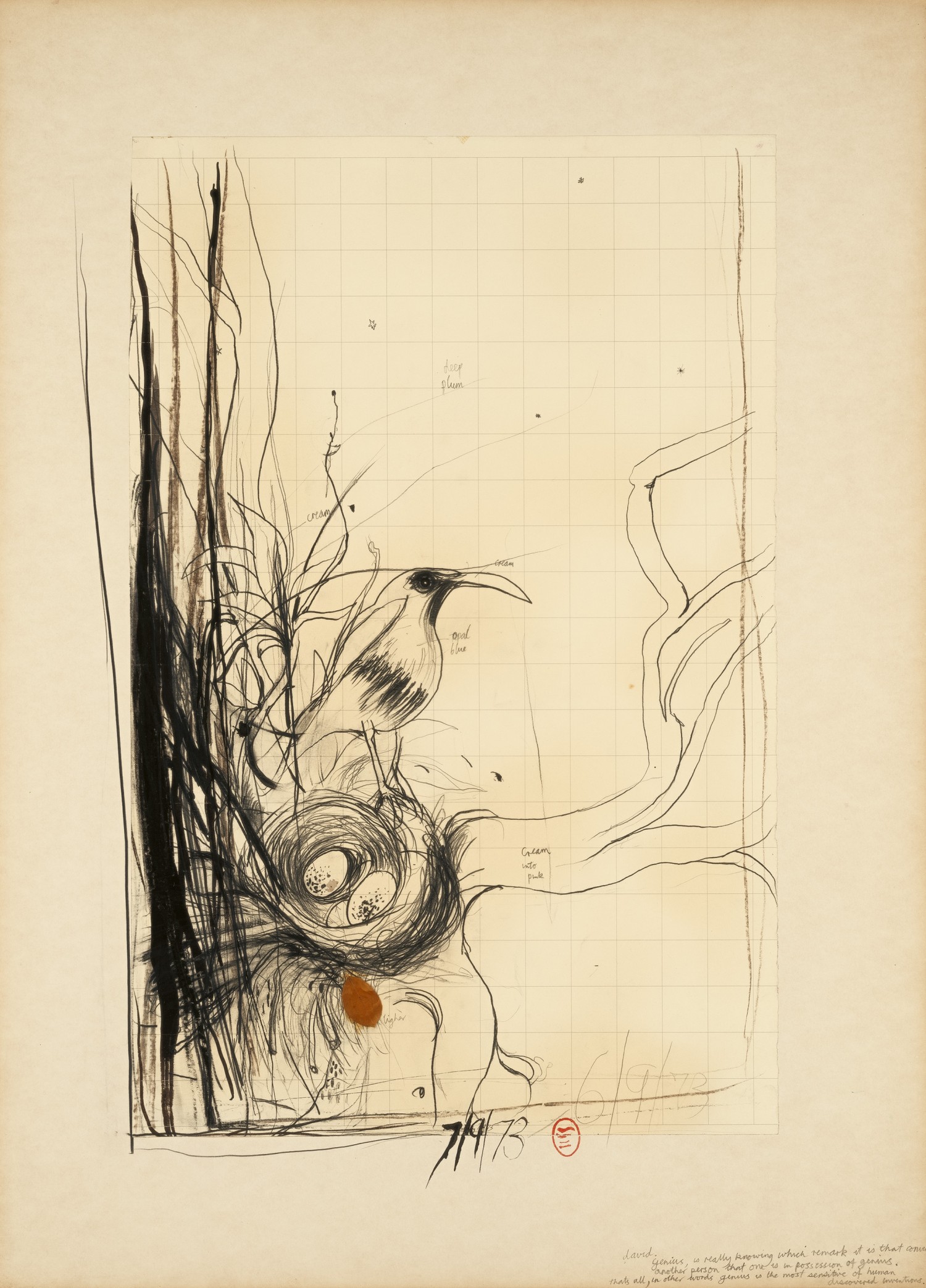
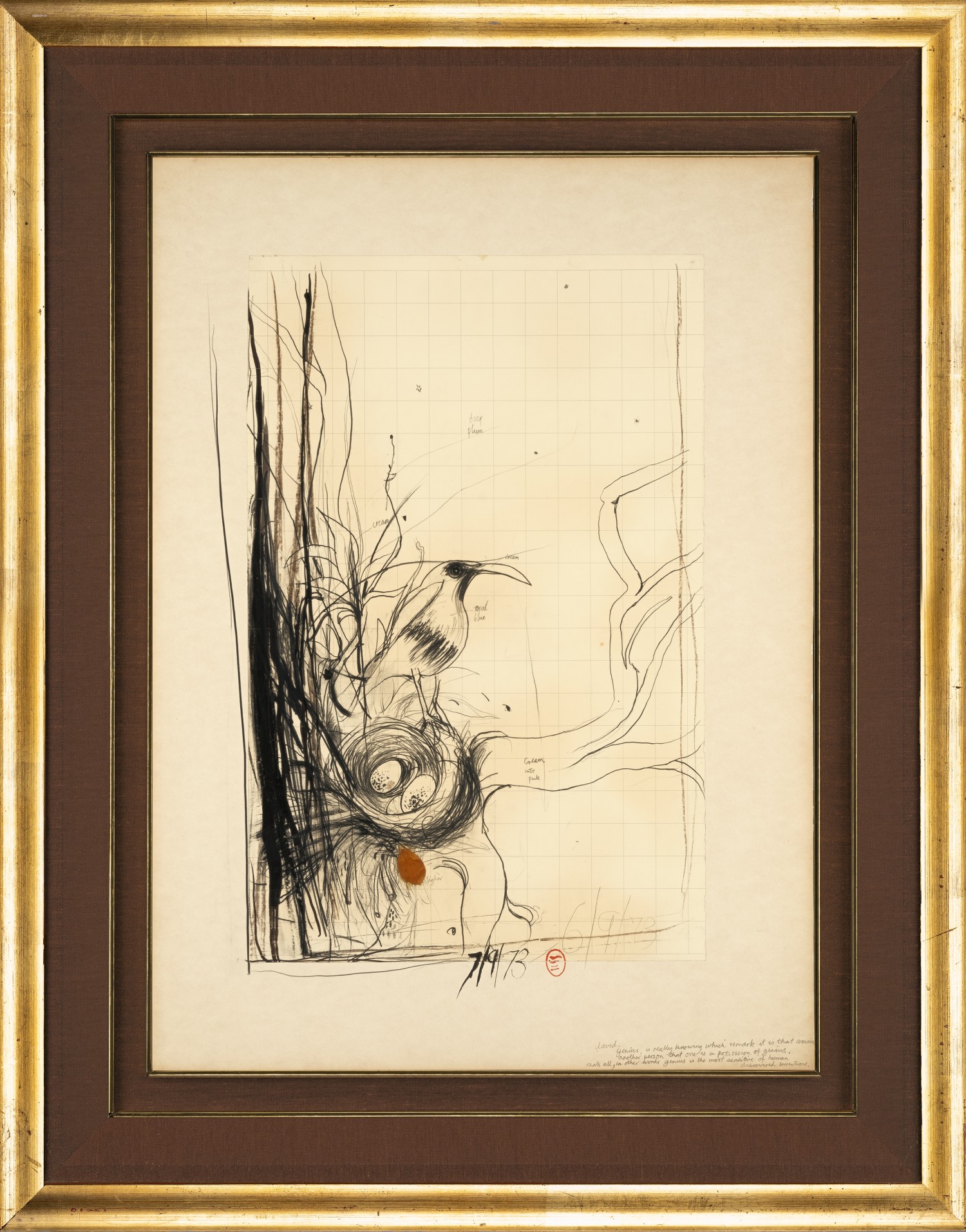
(Study for a bird’s nest), 1973, drawn vigorously and freely in ink and pencil on graph paper and annotated with colour notes, is a large preparatory study for a painting that is yet to be identified, or was perhaps never realised. Drawing was a cornerstone of Brett Whiteley’s artistic practice and, for him, an activity ‘as normal as breathing.’2 Striking in its compositional simplicity, the titular bird with the large curved beak of a honeyeater or bee-eater guards proudly her nest tucked in the junction of thick, snaking branches of a tree. These branches are drawn authoritatively with the ‘quick + daring + precise’ medium of pencil on paper, counterbalanced by a series of emphatic, long black lines running down the right-hand side of the image. As can be ascertained from Whiteley’s hand-written notes, the background of the subsequent painting was intended to be a deep, monochrome plum hue against which the cream limbs of the tree would stand out. Depicted from above and tilted towards the viewer to provide a clear view, the concentric spirals of the bird’s nest are a clear focal point of this composition. They contain two or three speckled eggs, which gleam like precious stones against their mother’s streaked plumage. Inserting a degree of authenticity to this sketch, Whiteley has affixed a real leaf to the drawing’s surface, linking it to a large suite of bird paintings of the 1970s and 1980s featuring collaged physical tree branches, birds’ nests, eggs and taxidermied animals.
The post-card decorative perfection of Whiteley’s bird paintings and drawings concealed psychological subject matter beyond the visible. Indeed, in the catalogue to his exhibition in 1979 at Robin Gibson Gallery, Whiteley explained that his paintings on the avian theme were linked to ‘states of mind.’3 (Study for a bird’s nest) was created shortly after two international trips taken by the Whiteleys: to Africa in June 1973, and to France in August 1973. Both trips brought Whiteley to places of significance in the lives of Charles Baudelaire and Arthur Rimbaud, luminary figures for the artist, to whom they represented the creative spirit – that of a tortured and romantic hero. Continuing his new-found habit of including written messages, warnings, presentiments and predictions within the picture plane, Whiteley has written a revelatory note in the lower right-hand corner of this sketch, linking the image of the egg to the idea of creative genius. ‘David / Genius is really knowing which remark it is that convinces another person that one is in possession of genius. That’s all, in other words, genius is the most sensitive of human discovered inventions’, Whiteley writes, reflecting on the weight and responsibility of these qualities he admired in others and hoped to find in himself.4
1. McGrath, S., Brett Whiteley, Bay Books, Sydney, 1980, p. 94
2. Sutherland, K., Brett Whiteley: Catalogue Raisonné, Schwartz Publishing, Melbourne, 2020, vol. 7, p. 3
3. Brett Whiteley, cited in McQueen, H., ‘Brett Whiteley’, Art and Australia, Fine Arts Press, Sydney, vol. 17, no. 1, September 1979, p. 51
4. Wendy Whiteley has suggested that this reference could be to David Schaffer, a friend from London days with whom Brett reconnected later, in New York, email correspondence with Kathie Sutherland, March 2026
LUCIE REEVES-SMITH