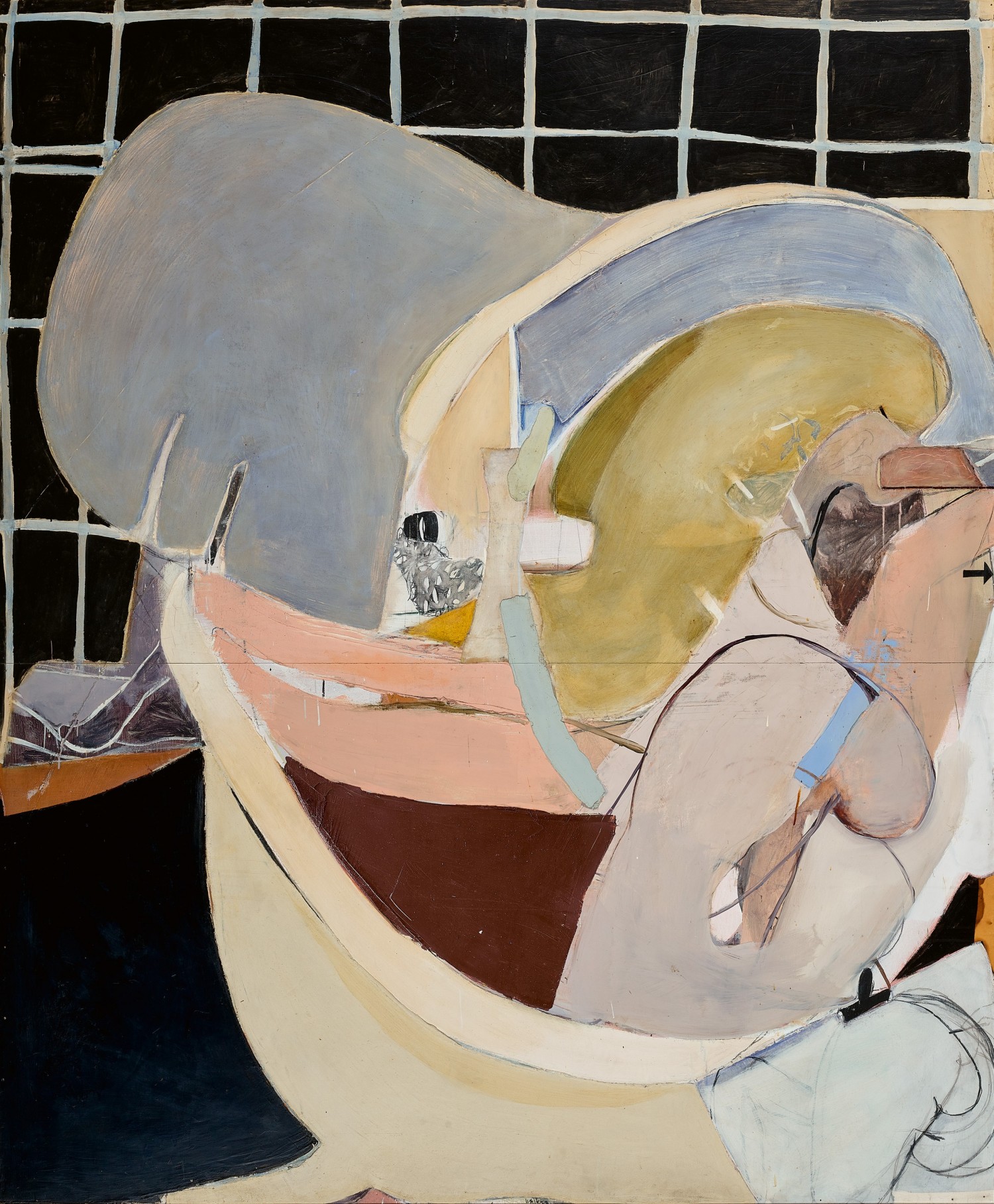
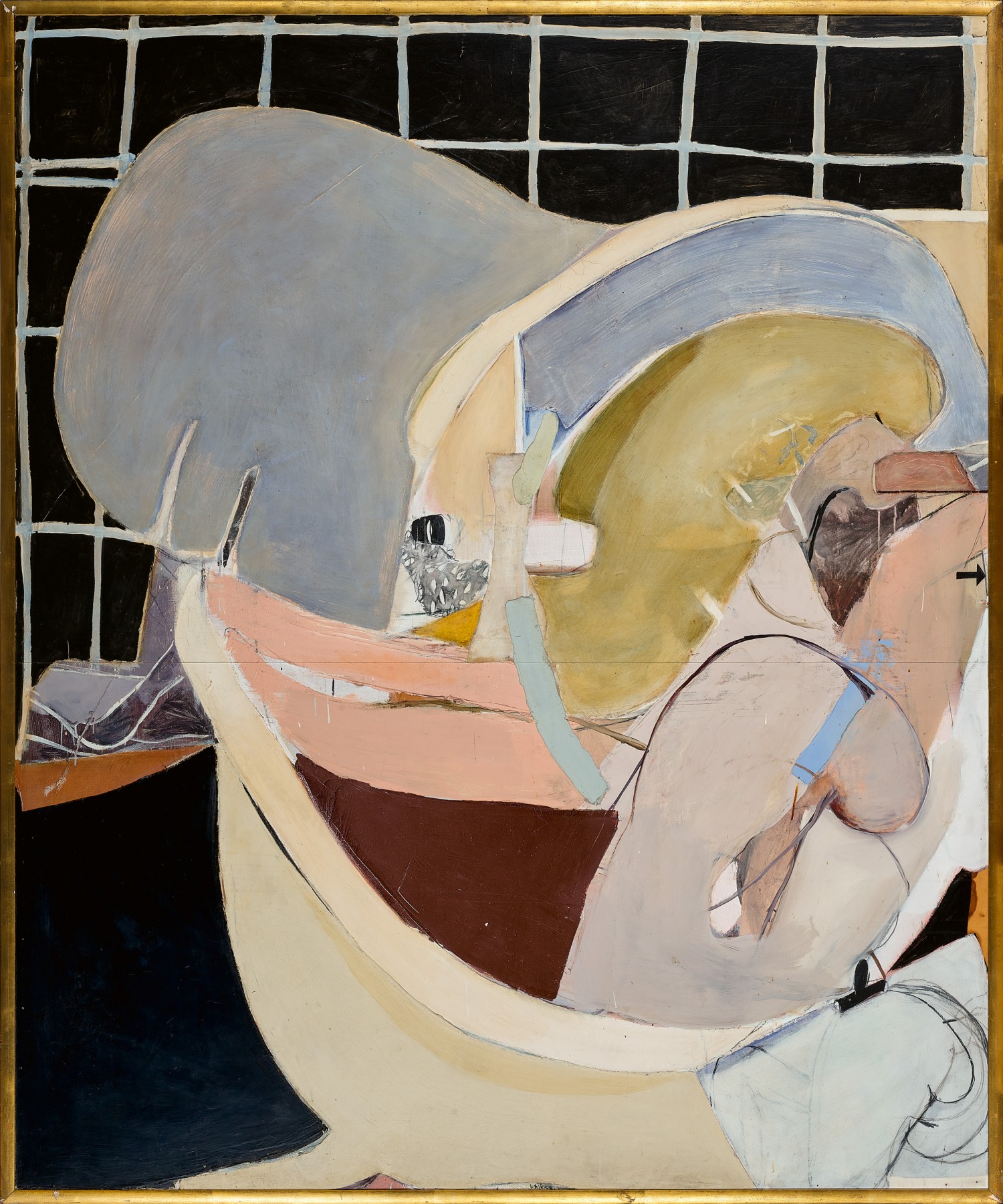
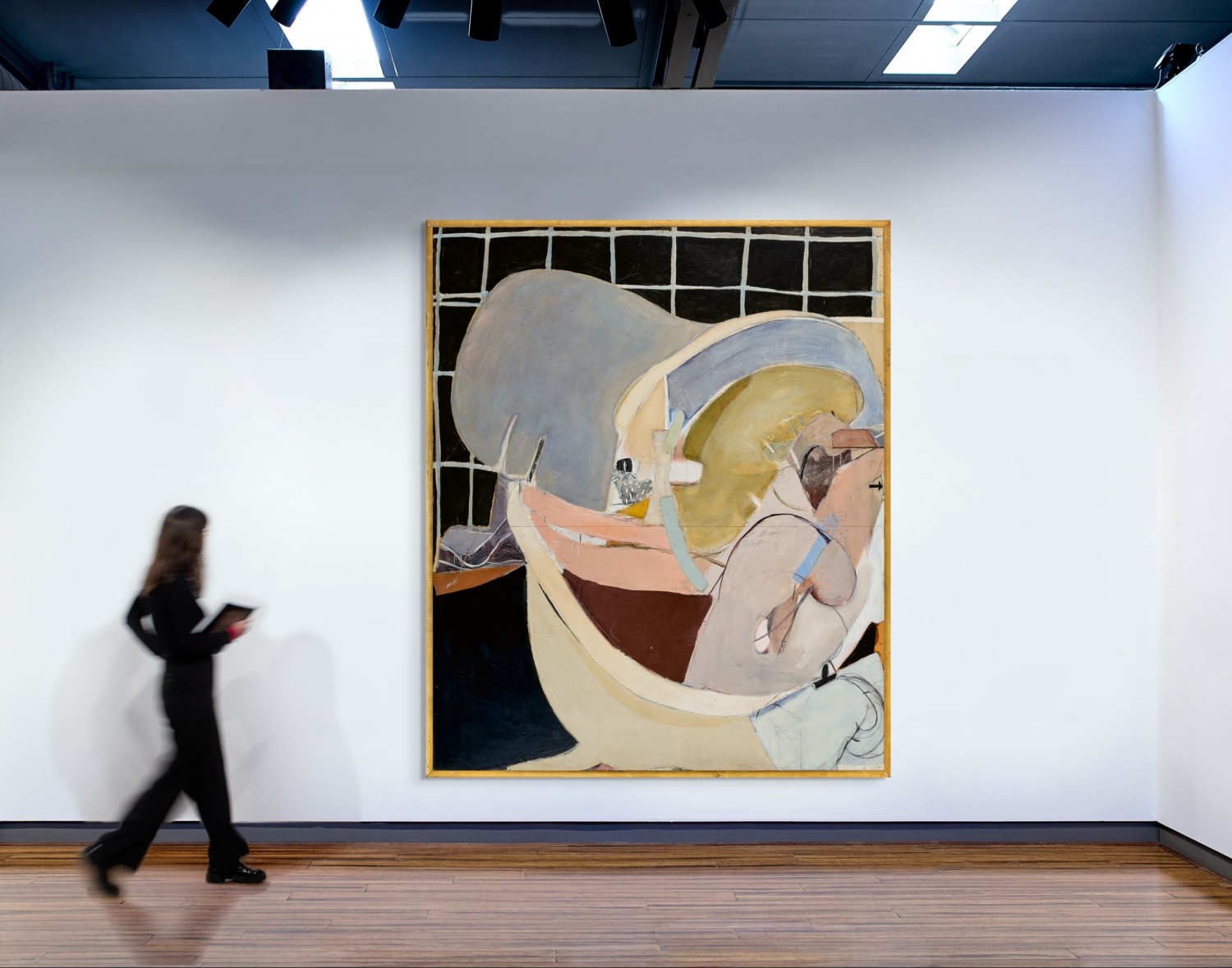
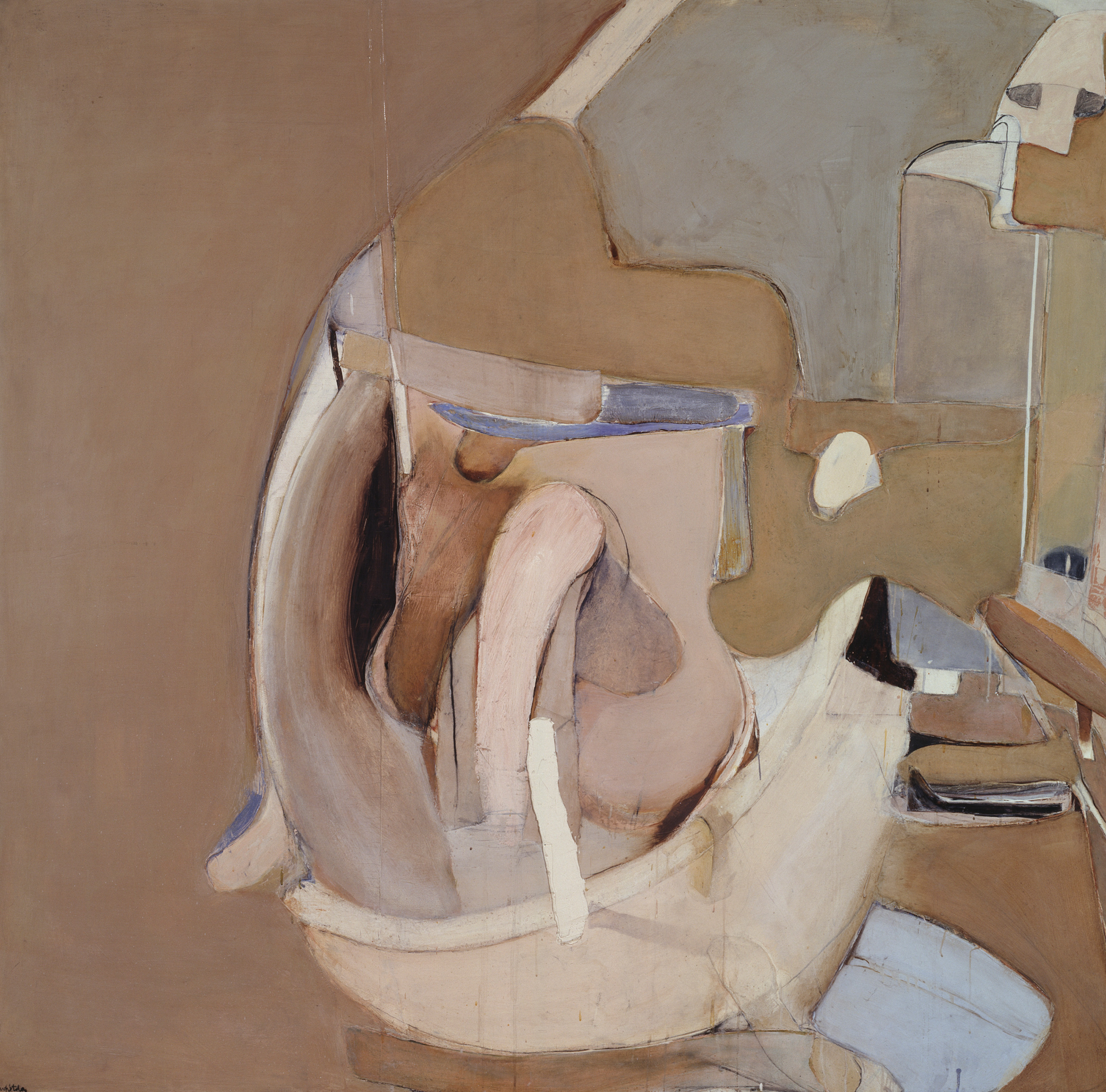
Woman in a bath 5, 1963 – 64
Brett Whiteley
oil, tempera and collage on board
213.0 x 183.0 cm
signed lower centre: Whiteley
signed, dated and inscribed with title verso: "WOMAN IN A BATH" 5 1963 - 64 / OIL, TEMPERA + COLLAGE / Brett Whiteley
inscribed verso: FOR Whitechapel
Marlborough-Gerson Gallery, New York (label attached verso, as 'Woman in a Bath No. 5')
Marlborough Fine Art, London
Nevill Keating Pictures, London, acquired from the above in July 1985
Private collection, Melbourne, acquired from the above in 1985
Brett Whiteley, Marlborough New London Gallery, London, 1964 (exhibited but not catalogued in the 1964 exhibition)
The New Generation: 1964, Whitechapel Gallery, London, March - May 1964, cat. 45 (illus. in exhibition catalogue)
On Loan Private Collection, Bendigo Art Gallery, Victoria, December 2005 - May 2006
on long term loan to Bendigo Art Gallery from 1985
Pearce, B., Brett Whiteley: Art and Life, Art Gallery of New South Wales, Sydney, 1995, pl. 31 (illus.), p. 227
Sutherland, K., Brett Whiteley: A Sensual Line 1957 - 67, Macmillan Art Publishing, Melbourne, 2010, cat. LL2, pp. 100, 101 (illus.), 270
Wilson, A., Brett Whiteley: Art, Life and the Other Thing, Text Publishing, Melbourne, 2016, p. 105
Sutherland, K., Brett Whiteley: Catalogue Raisonné, Schwartz Publishing, Melbourne, 2020, cat. 69.63, vol. 1, p. 171 (illus.), vol. 7, pp. 138 - 139
260076 Brett Whiteley.jpg
Brett Whiteley
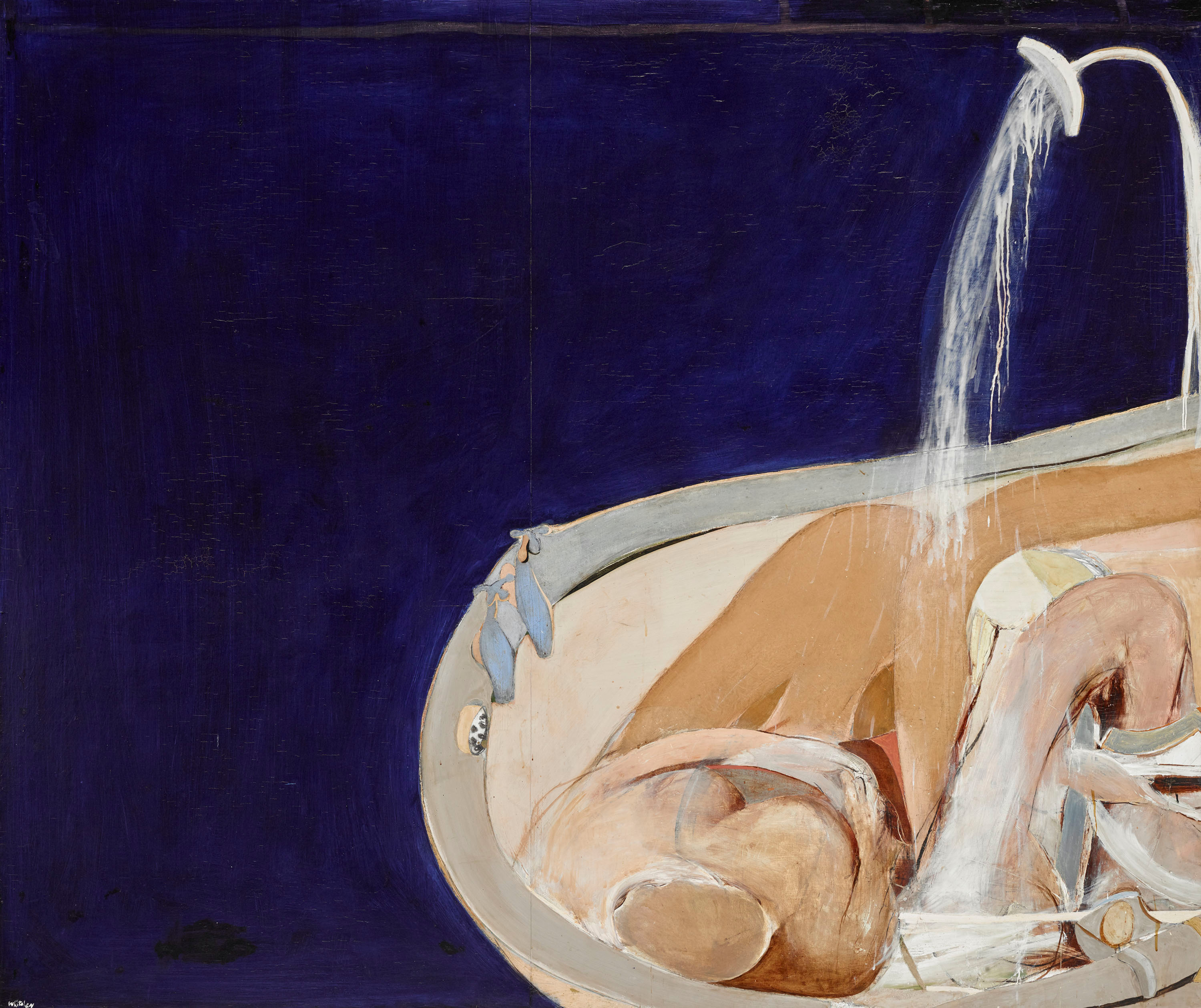
Woman in a bath 4, 1963, re-worked 1964
oil, paper, fabric collage, graphite and
tempera on plywood
183.1 x 218.7 cm
Art Gallery of New South Wales, Sydney
© Wendy Whiteley/Copyright Agency, 2026
The sophistication of Brett Whiteley’s abstract paintings astounded audiences upon his arrival in London in November of 1960, quickly drawing the attention of fellow artists, influential curators and directors of museums. The late inclusion of three of his paintings, as a ‘perfect youthful climax... serving as its focal point’ to Bryan Robertson’s survey exhibition of Recent Australian Art at Whitechapel Gallery in June 1961, and the subsequent acquisition of one of these by the Tate collection, secured without a doubt the noticeable arrival of the young Australian into the international art scene.1 In October 1959, the wunderkind Whiteley had won the Flotto Lauro Italian Government Travelling Art Scholarship, enabling him to travel from Australia to Florence and Rome with a ten-month bursary. The wholly original abstract paintings that came from Whiteley’s exposure to the Italian landscape and the influence of its Renaissance masters resonated with an astounding authority and a material richness that would continue to develop throughout his career. The pivotal professional opportunity provided by this scholarship, however, came at the cost of a physical separation from Wendy Julius, a young arts student in Sydney with whom he had begun a passionate relationship.
260076 Brett Whiteley bath.jpg
Brett Whiteley
Woman in a bath 2, 1963
oil and tempera on board, with collage
of canvas strips
183.0 x 188.0 cm
Tate, London
© Wendy Whiteley/Copyright Agency, 2026
Whiteley’s first sustained body of work, painted in London, was a suite of thirty-one abstractions of the landscape, executed in a restrained and sonorous palette of Italian sienna reds and creams, and composed of layered blocks of collaged textures. In March 1962, this large suite of paintings was exhibited in Whiteley’s first one-man exhibition at Matthiesen Gallery in London’s Bond St. While ostensibly working in the contemporary idiom of abstraction, Whiteley’s early paintings were undeniably sensual. Within their flat interlocking arrangements of voluptuous forms, they revealed the ever-present idea of her, the artist’s lover with whom he had reunited in June 1960. The presence of Whiteley’s eternal muse by his side in London, and their marriage in March 1962, became catalysts for the artist’s daring first steps towards figuration and provided the genesis of what would become his celebrated series of ‘the most sacred of secular subjects’ – a suite of nudes known as the ‘Bathroom series.’2
260076 Wendy in bath.jpg
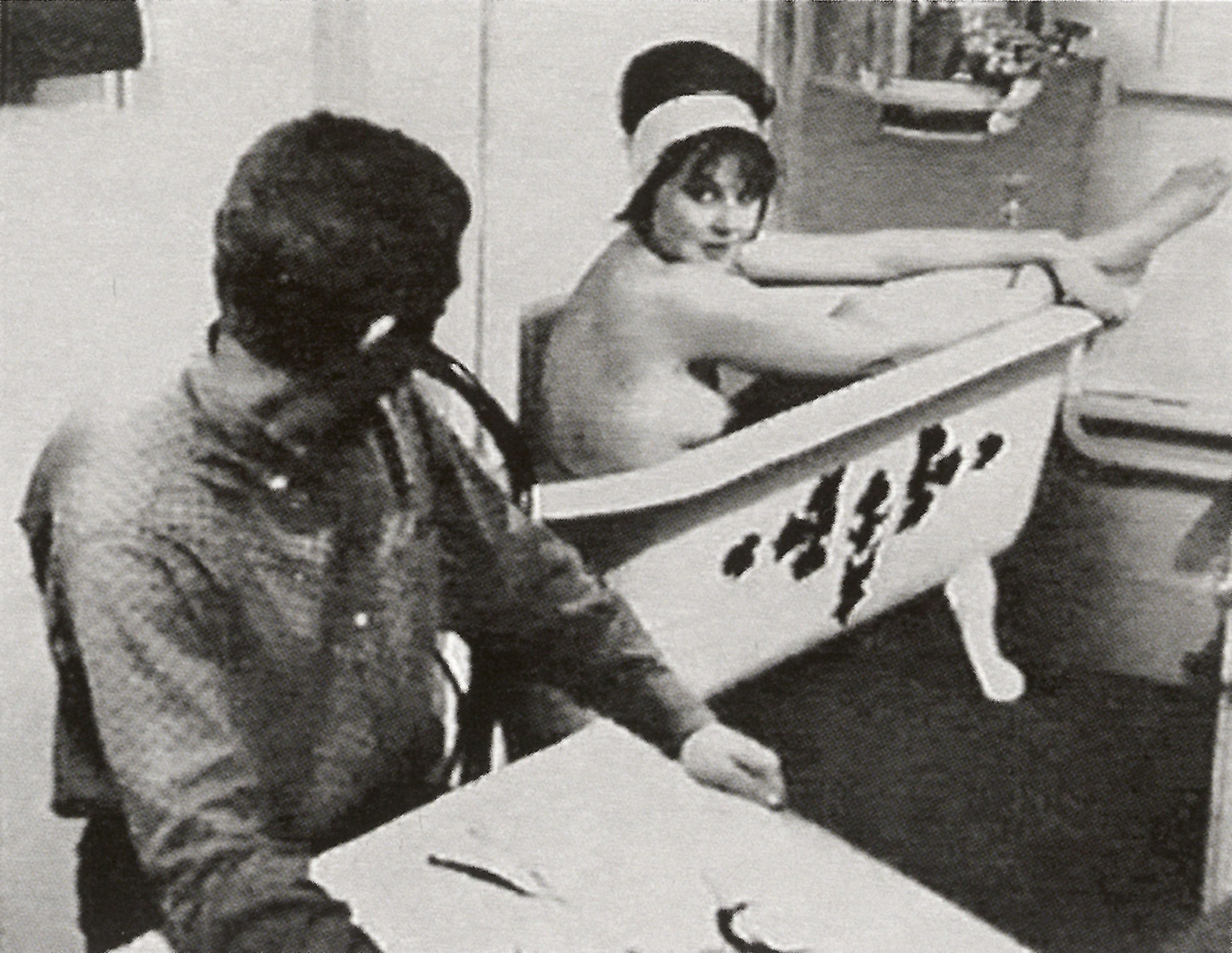
Drawing Wendy in the bath, 1963
photographer unknown
Brett Whiteley Estate
With its fusion of ambiguous, anatomically derived forms and bold monochrome and patterned planes, Woman in a bath 5, 1963 – 64 is the last in a suite of five monumental compositions of a female nude in a bathtub – the culmination of Whiteley’s most lyrical and intimate expression of matrimonial love and domestic harmony. Compressed within a shallow pictorial space, the rounded and simplified forms of Wendy’s naked body are curled in the right-hand corner of the frame, surrounded by sweeping blue arcs of water, barely contained by the graceful contours of an Edwardian clawfoot bathtub. The series of five interrelated paintings of Woman in a bath created between 1962 and 1964 were supported by a sequence of dynamic, large-scale charcoal drawings executed in situ and then later worked into major semi-abstract and collaged paintings in the studio. As evidenced by Whiteley’s self-referential inclusion of a sheet of paper fixed to a board with a bulldog clip in the lower right-hand corner of Woman in a bath 5, the artist’s paintings record in one plane the observed cumulative movements of daily sessions of his wife bathing in their London flat at 13 Pembridge Crescent.
260076 Brett Whiteley Bath.jpg
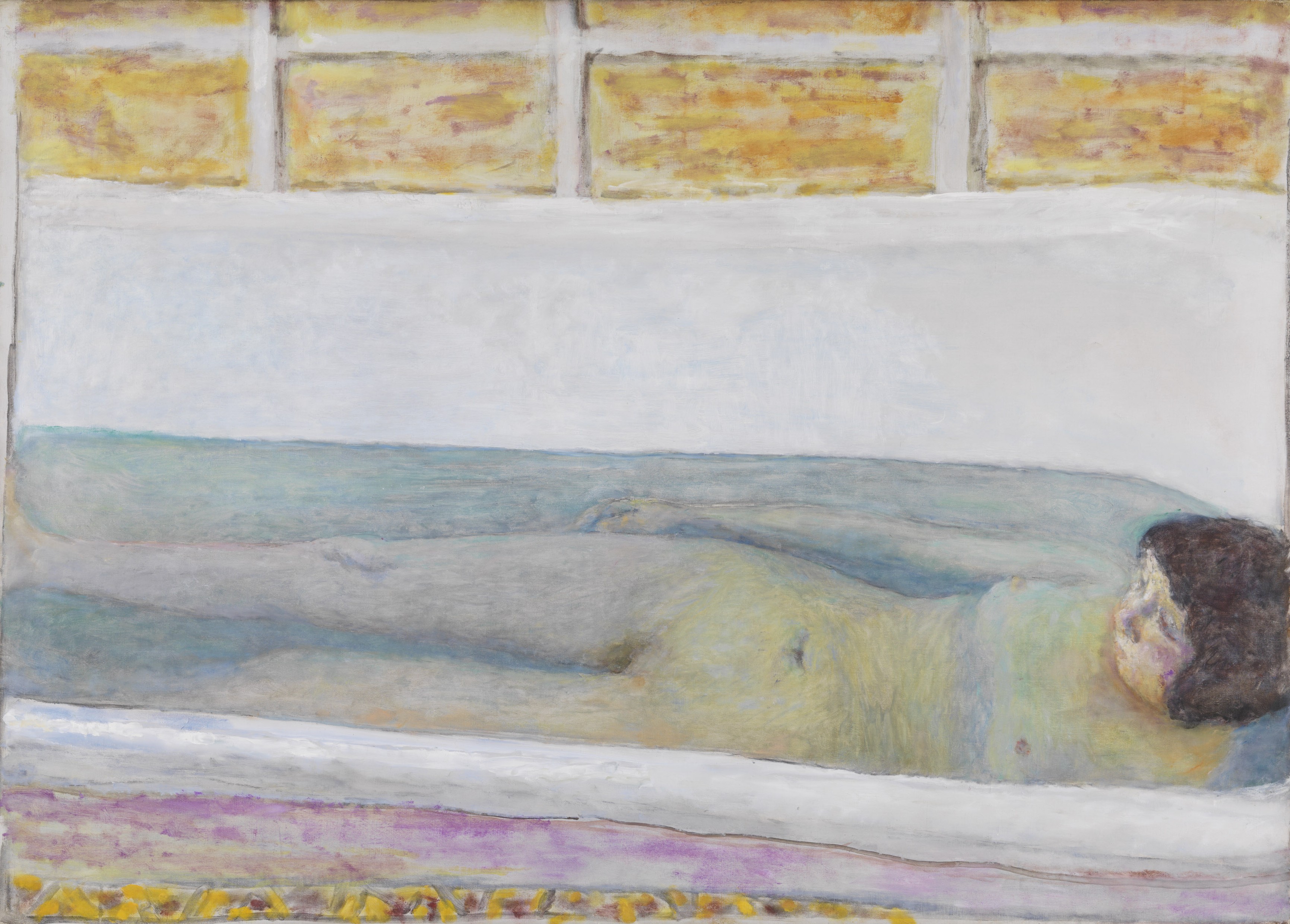
Pierre Bonnard
Baignoire or Le bain (The bath), 1925
oil on canvas
86.0 x 120.5 cm
Tate, London
The fragmented forms within Woman in a bath 5 oscillate between representation and abstraction, the human figure not as easily discernible as in other versions of Woman in a bath. Anchored by the curved shapes of her back, Wendy’s arms move through the spray of water, creating an active and dynamic figurative composition. These textured and collaged slabs are reminiscent of the shapes within Whiteley’s earlier abstractions, which ‘yearned to become figurative’ and seemed to encapsulate a sense of passing time.3 A startling Pop Art inclusion into the picture plane – a small black arrow on the right-hand edge – indicates an attempt to depict movement and fluidity among the artist’s collection of compressed, flat shapes. A graphic device the artist would put to emphatic use in later works, such as Alchemy, 1972 – 73, the semiotic power of the arrow is explained another associated painting of the series, Bather showing arm movement, 1963, where at least five arrows are arranged in a clock-wise formation atop the centre of the painted image, accompanied by a note handwritten in pencil on the picture plane ‘arrows show the arm movement’. As noted by the critic from the Times reviewing the suite of Bathroom paintings when they were exhibited in Marlborough Galleries in April 1964, Whiteley’s emphasis on the flat and compact functionality of the apartment’s bathroom, devoid of ‘decorative overtones’, emphasised the ‘sensuous impact of the movements of the human body which occupies it.’4
260076 whiteley.jpg
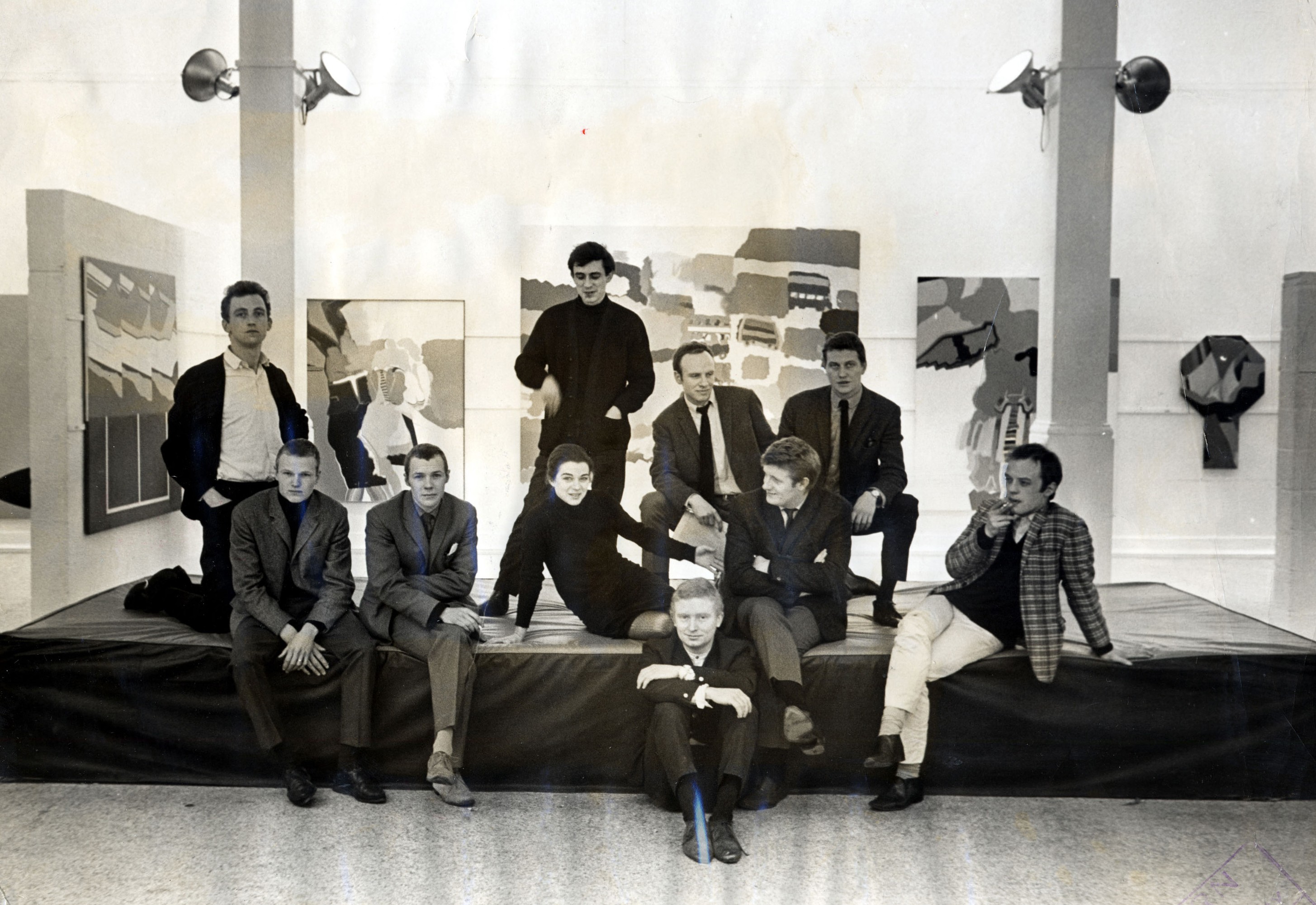
Brett Whiteley (centre front) with Bridget Riley, Patrick Caulfield and other
artists included in the Whitechapel Art Gallery’s 1964 exhibition
‘The New Generation’
photographer: Philip Jackson
In March 1964, Woman in a bath 5 was selected alongside three large bathroom sketches on paper and board by Whiteley (Bather and mirror, 1964, Figure at the basin, 1963 and Sketch for large mirror painting, 1964) for inclusion in the inaugural exhibition of ‘The New Generation’ of British painters under thirty years old at Whitechapel Gallery, joining works by David Hockney, John Hoyland and Bridget Riley. Reviewers noted amongst these ambitious and confident large-scale works, a tendency for ‘extreme precision’ and ‘clear, flat colours.’5 Mostly devoid of modelling, the organic shapes within Woman in a bath 5, are presented as a collage of pure coloured blocks, brought to the front of the canvas, towards the viewer and the artist as he’s recording the scene, close enough to ‘reach out and tenderly caress the forms of his beloved.’6 Although Whiteley wrote in a statement for the catalogue of the Whitechapel exhibition in 1964, ‘all the paintings I have made in the last four years have been concerned one way or another with sex and the desire to record sensual behaviour’7, the disarticulated, awkward pose of Wendy in the bath here is intimate, but not erotic. His studies of her mundane, unguarded actions are reminiscent of Edgar Degas’ renowned series of pastel drawings of bathers produced circa 1890 – 1900. Like the French Impressionist had done, Whiteley’s obsessional recording of this domestic scene from an adjoining room explored a restless series of variations in posture and position, her human form anchored by its relationship to the fixed objects of furniture in the room, and, in this version, the regular, graphic cross-hatching of black tiles in the background.
260076 Brett Whiteley, Francis Bacon.jpg
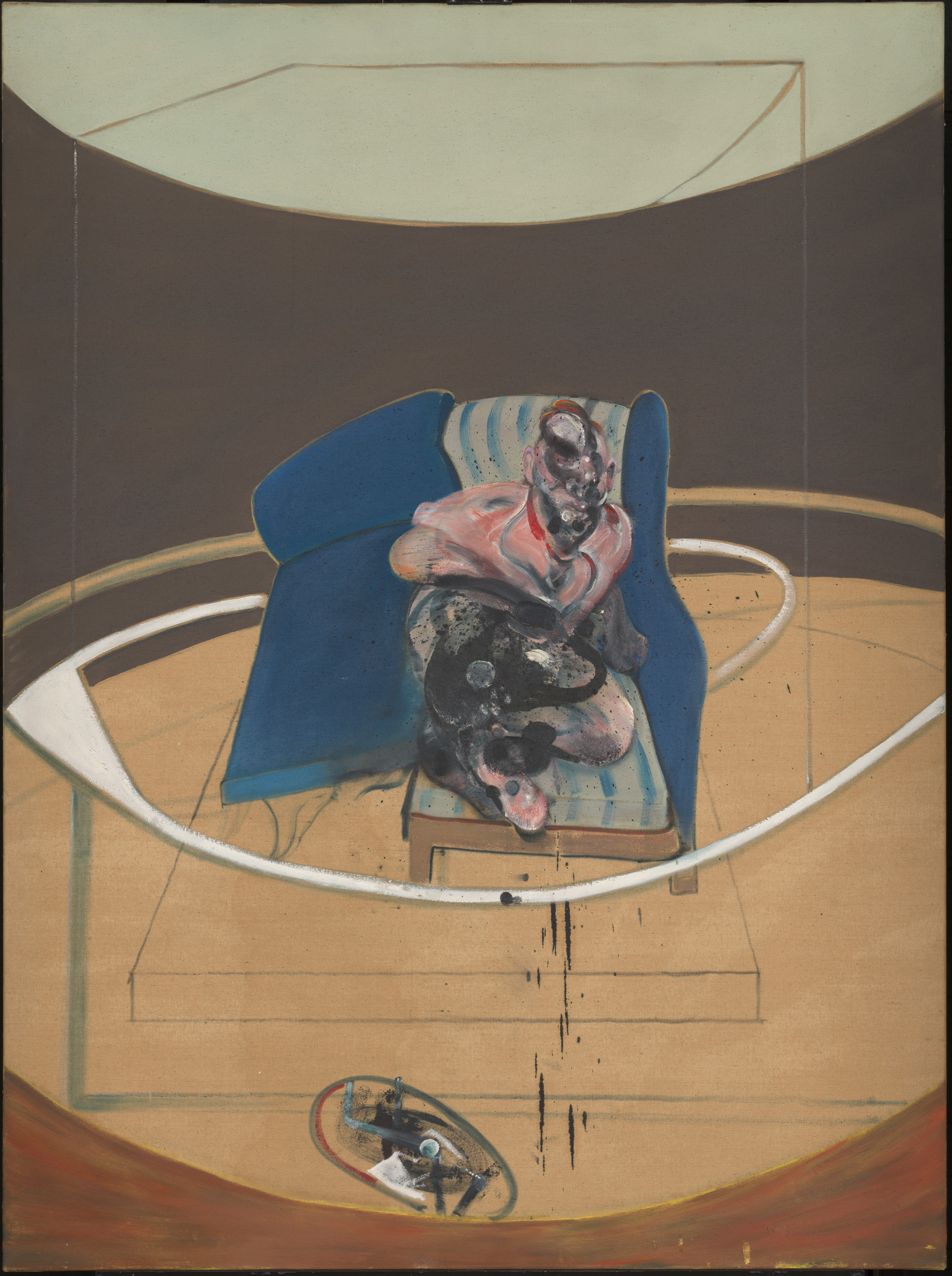
Francis Bacon
Study for Portrait on folding bed, 1963
oil and sand on canvas
78.0 x 58.0 cm
Tate, London
© The Estate of Francis Bacon
Whiteley’s departure from Australia and his travels through Italy, France, the UK and America between 1960 and 1964 had brought him into physical contact with the works of European Masters of the Italian Renaissance (according to Robert Hughes, reproductions of Piero della Francesca littered Whiteley’s London studio), alongside close collegiate contact with major figures in the artworld at the time such as William Scott, Willem de Kooning, Roger Hilton, Philip Guston and Francis Bacon – all of whom would have a stylistic impact on Whiteley’s Bathroom series as he was finding his feet between abstraction and figuration. From these peers he adopted jarring passages between floating forms, a containment of a wild figurative energy, a childlike simplification of the human body and a fragmented manipulation of the human form within a contained space. The formidable presence of Francis Bacon in particular, is keenly felt within these paintings. Whiteley had been introduced to the titanic figure of contemporary figurative painting in 1961 following the opening of the Whitechapel exhibition, and the elder artist went on to actively mentor Whiteley throughout the 1960s. Both artists during this time were applying themselves to the observation of mundane actions of everyday life, striking a balance between abstraction and figuration, consciously highlighting the vulnerability of the isolated human body with their raw, flowing and muscular manipulations of form. Reviewers of Whiteley’s exhibition of the Bathroom series in Marlborough Gallery in April 1964 were quick to point out what Sandra McGrath described as the ‘Bonnard-Bacon axis.’8 Indeed, for all the stylistic distortions inherited from his peers practising a post-abstract revival of figuration, Whiteley’s avowed ‘compromise between abstraction and sensuality’ was imbued with the warm and candid adoration of Pierre Bonnard’s portraits of his new wife, Marthe at her toilette.9
260076 Brett Whiteley bath photo v2.jpg
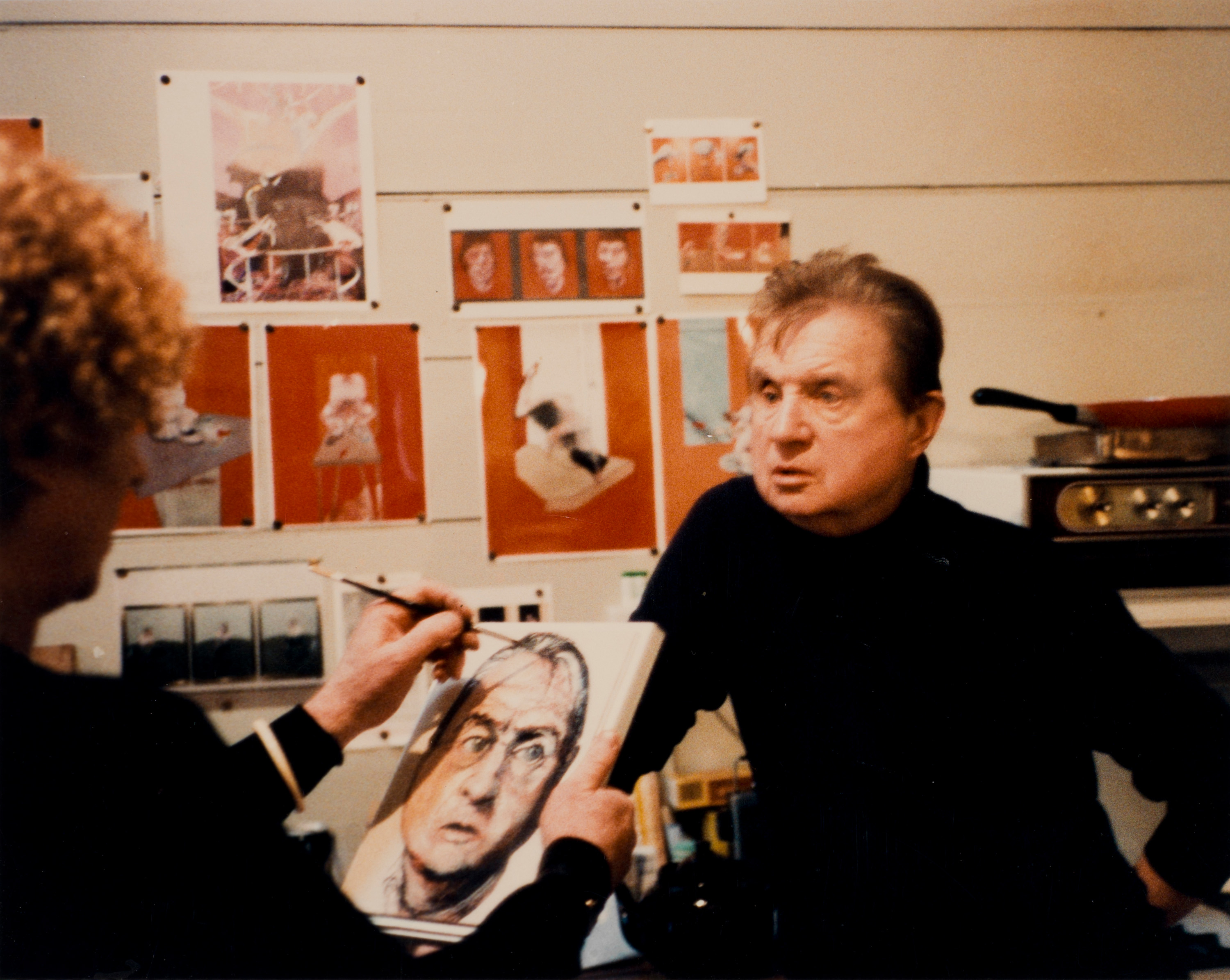
Brett Whiteley Painting Francis Bacon’s Portrait
at Bacon’s studio, 7 Reece Mews, October 1984
photographer: John Edwards
Hugh Lane Gallery, Dublin
© The Estate of Francis Bacon
Whiteley’s association in London with the British painter William Scott provided the context for a crucial encounter with Bonnard’s daring investigations into the theme of the bathing nude. Wendy recalled that soon after their arrival in London, ‘we visited Bill Scott and there was the most amazing copy of that reclining Martha [sic] in the bath, the one that lies down, the Tate one... so it was incredible, but of course, Bonnard taught all of these people, Bill Scott, Brett, everyone.’10 Pierre Bonnard’s 1925 masterpiece, The bath, 1925 held in the collection of London’s Tate Gallery but first viewed by Whiteley as a painted copy, was Bonnard’s first realisation of a full-length reclining nude in the bath, an image that would preoccupy him over the next twenty years. Whiteley was undoubtedly struck by Bonnard’s fresh and confident manipulation of perspective in this image, replicating it within his own Woman in a bath suite. Painted the same year Bonnard married Marthe, the quotidian regularity of his wife’s ablutions provided a stable subject for endless variations on a theme, as it did for Whiteley some thirty years later. As Bonnard had in versions of this theme, Whiteley has also inserted himself as an observer into the picture frame, not with a glimpse of his body but instead with the tools of his trade left evident in the foreground. Woman in a bath 5, replicates the patterning of The bath in particular its strong background of square tiles in the background, the cross hatching of its white grout loosely painted. The inky darkness of these tiles, and within sections of the bath in the foreground provide a recessive counterpoint to the apricot yellows, salmon pink and cream hues of the human forms viewed from above.
Brett Whiteley’s tender and confidently experimental suite of paintings of his new wife Wendy in the bath in their London flat, painted as his star was rising on the international art scene, constitute an early high point in their creative partnership. They were Whiteley’s first forays into figuration and reveal his confident adoption of a myriad of artistic influences, both historical and contemporary. These paintings of a time-honoured tradition would become the first series in the theme of the female nude, which became the most celebrated and persistent motif within Whiteley’s extensive oeuvre.
1. Robertson, B., ‘The London Years’, in Pearce, B., Brett Whiteley: Art and Life, Art Gallery of New South Wales, Sydney, 2000, p. 9
2. Sutherland, K., Brett Whiteley. A Sensual Line, 1957 – 67, Macmillan Art Publishing, Melbourne, 2010, p. 91
3. McGrath, S., Brett Whiteley, Bay Books, Sydney, 1979, p. 35
4. ‘Painters New and Old from Three Continents’, The Times, London, 13 May 1964, p. 16
5. Wallis, N., ‘New Generation: 1964’, The Spectator, London, 3 April 1964, p. 18
6. Pearce, op. cit., p. 23
7. Brett Whiteley, cited in Recent Australian Painting, Whitechapel Gallery, London, 1961, n.p.
8. McGrath, op. cit., p. 40
9. Brett Whiteley, cited in a letter to George Sheridan, April 1964, cited in Sutherland, K., ‘The Nude: the Bathroom, the Bedroom and the Beach’ Sutherland, K., Brett Whiteley: Catalogue Raisonné, Schwartz Publishing, Melbourne, 2020, vol. 7, p. 12
10. Wendy Whiteley, cited in Sutherland, 2010, op. cit., p. 91
LUCIE REEVES-SMITH