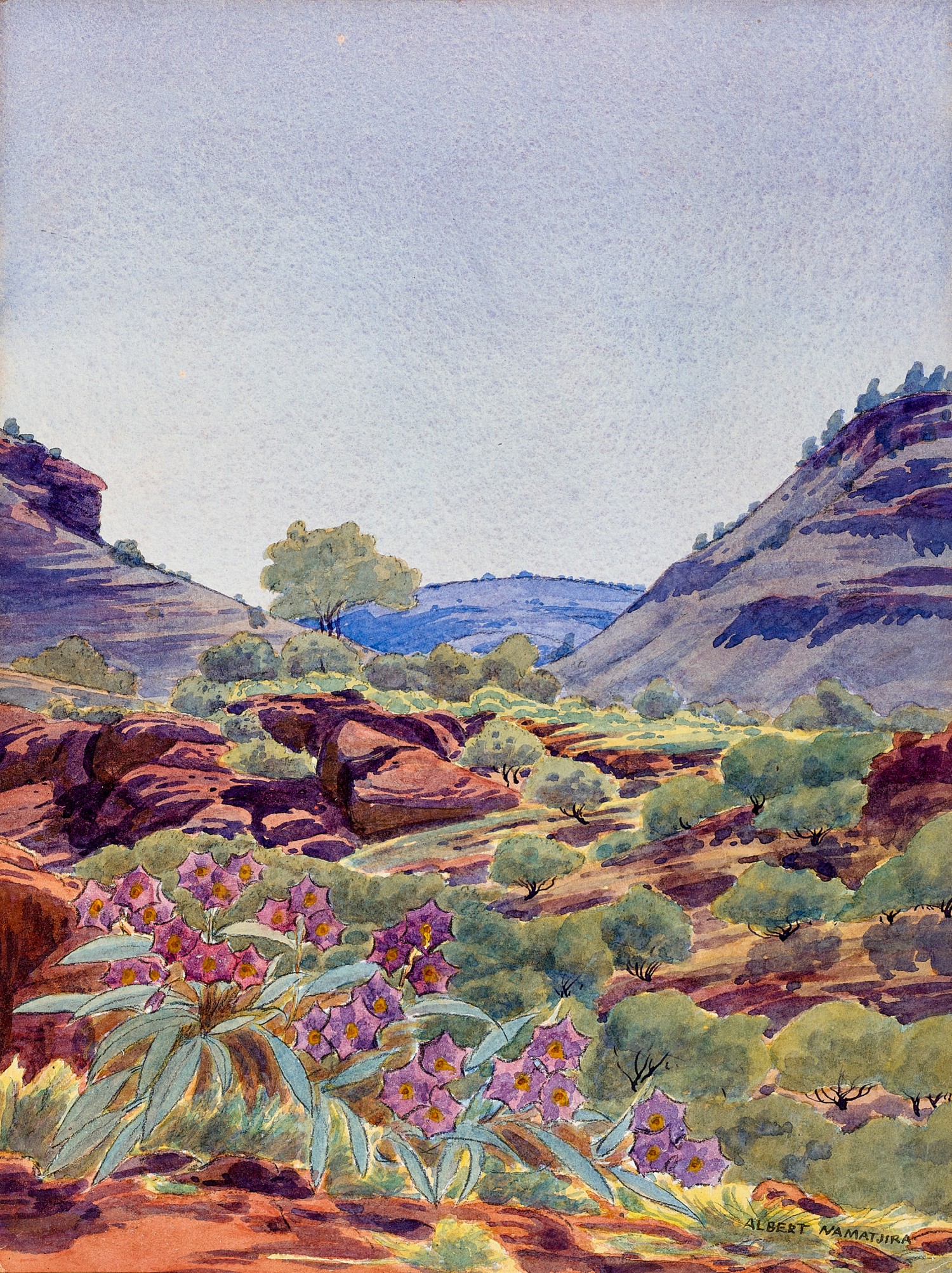
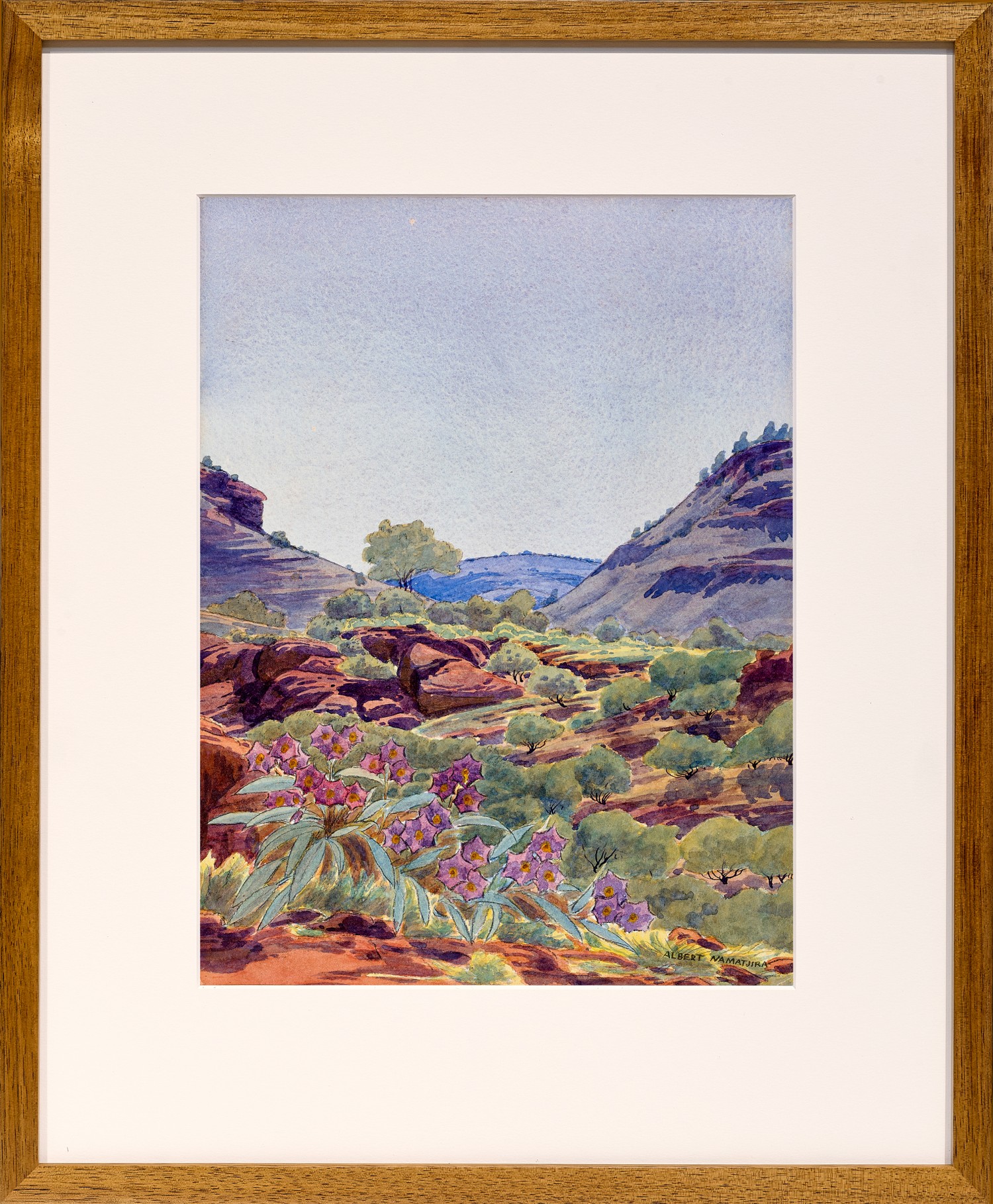
Central Australian landscape, c.1944
Albert Namatjira
watercolour on paper on card
38.0 x 28.0 cm
signed lower right: ALBERT NAMATJIRA
Private collection, South Australia, acquired at Hermannsburg Mission in August 1944 by the vendor's grandfather while travelling through the Northern Territory on return from military service on Thursday Island in the Torres Strait
Thence by descent
Private collection, Melbourne
By 1944, the year in which this artwork was purchased at Hermannsburg Mission, in Central Australia, Albert Namatjira had experienced a swift rise to national prominence. He had been included in the 1944 Who’s Who in Australia and was honoured with the publication of a monograph, the first of its kind devoted to an Indigenous artist, and which would be published in 8 successive editions between 1944 – 1955. An accomplished craftsman of pokerwork woomeras, boomerangs and wooden plaques, Namatjira had only adopted the methods and materials of Western landscape painting in earnest in 1936, stimulated by exchanges with Victorian artists Rex Battarbee and John Gardner visiting the Hermannsburg Mission. Namatjira would go on to present his first solo exhibition of watercolour paintings in Melbourne only two years later in 1938.
Taught by Battarbee to sketch the landscape en plein air, many of Namatjira’s landscapes depicted the topography of the region around his hometown of Hermannsburg (Ntaria) and, in particular, the many peaks of the surrounding MacDonnell, Krichauff and James Ranges. Namatjira also employed modern tools, such as a camera’s viewfinder, to isolate dramatic aspects of the larger landscape. With it he could condense vast distances into cropped vistas, often framed by contrapuntal ghost gums in the foreground. Here, the landscape view is compacted to focus on the gap between two peaks, through which we glimpse a distant blue mountain and a lone tall tree. By comparison to the rocky mountains, whose organic contours are balanced ‘between the pyramid and the circle’, to use Hans Heysen’s phrase, the middle ground is quite densely vegetated. While Namatjira’s style was one of pictorial realism, his simplified forms and heightened colours show suggestions of modernism. His naturalistic palette was dominated by sonorous reds, ochres and deep browns, enlivened here with highlights of lime-green vegetation and in the foreground – a group of purple flowering bush tomatoes (merne akatyerre). As autumn rain swept across the plains of central Australia, the bush tomato would break out of the soil for the first time in months. Patiently waiting as seeds or tubers, they would take advantage of the sudden moisture to bloom with startling vibrancy against the arid, ochre-rich backdrop of mountain ranges.
Each painting by Namatjira was specific in its location, containing precise geographic and cultural reference points. Throughout the 1940s, he mainly painted the country around Hermannsburg and the Finke River Mission where he grew up – a parcel of land in Central Australia nestled between three groups of mountains. Beyond introducing the ‘Red Centre’ of Australia in an easily readable and digestible format to white urban audiences in the latter half of the 20th century, Namatjira’s luminous watercolours provided the artists with a continued patrilineal connection to Arrernte country north of Glen Helen (Yalpalpe) and of the Finke River (Lherre pirntea), a location of deep and continued significance to the artist. While communicating layered cultural meanings for the First Nations audiences who could interpret them, Albert Namatjira sought to convey to a broad audience the spiritual link existing between Aboriginal peoples and the land.
LUCIE REEVES-SMITH