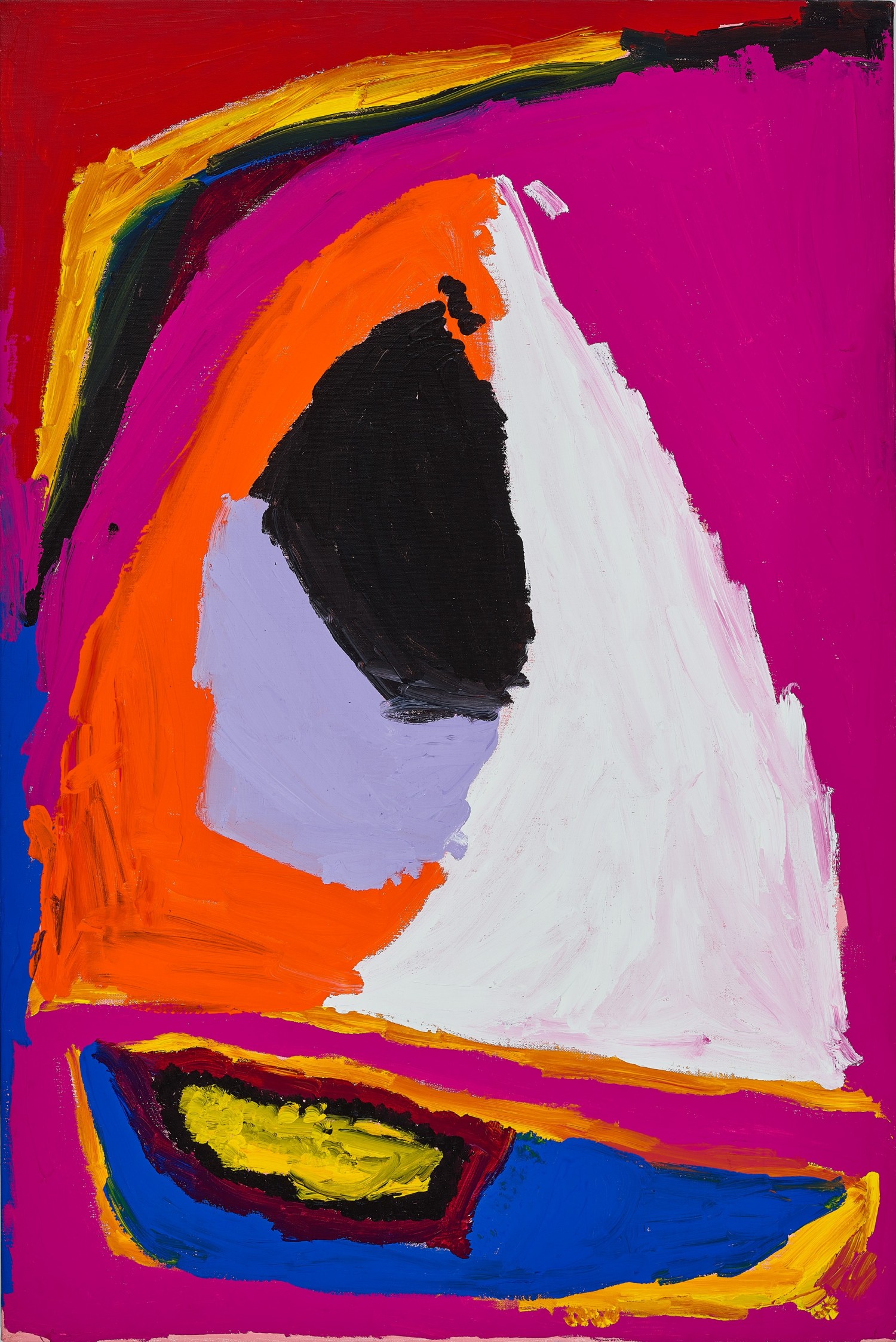
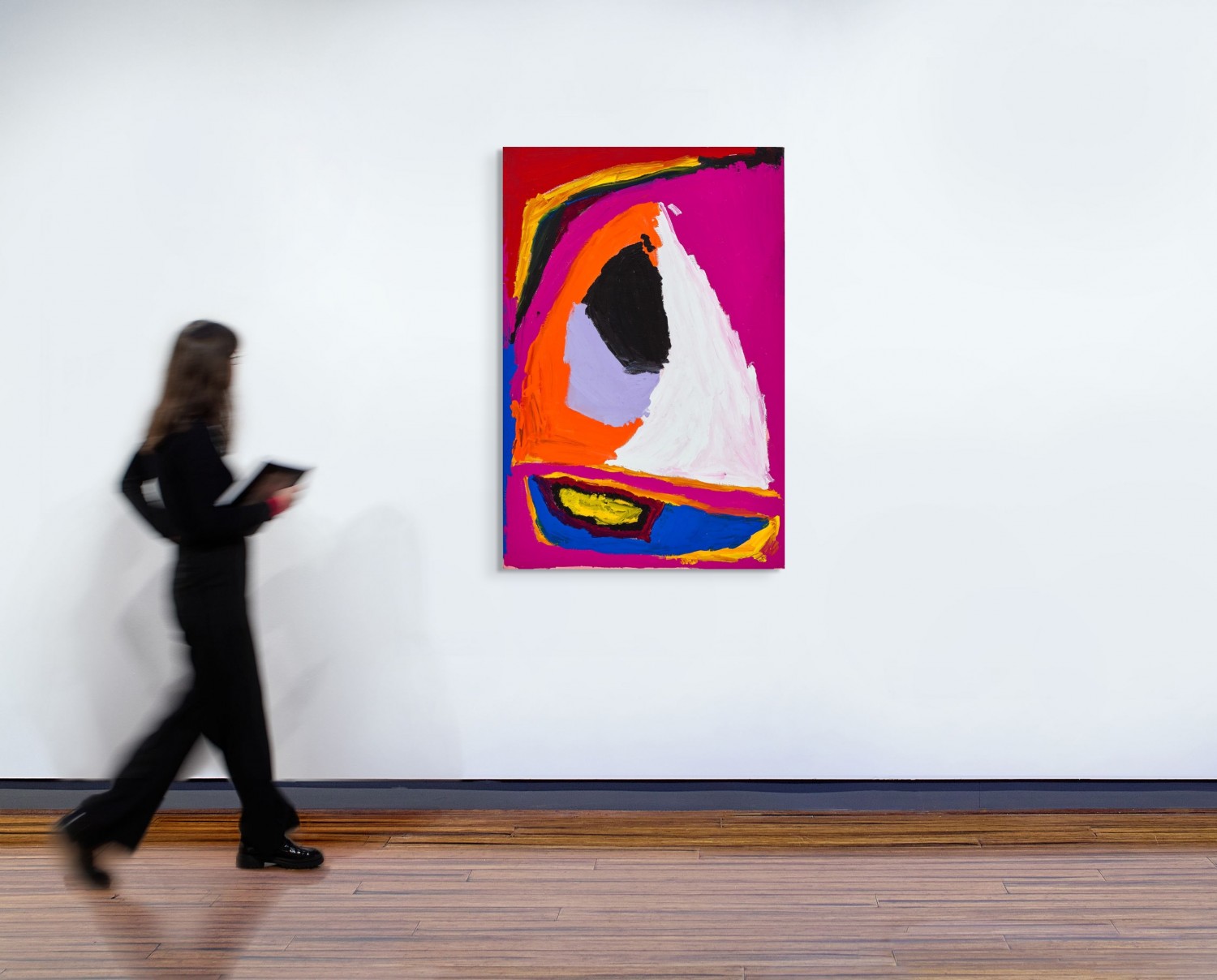
Big river at My Father's Country, 2006
Mirdidingkingathi Juwarnda Sally Gabori
synthetic polymer paint on canvas
137.5 x 91.5 cm
bears inscription verso: artist’s name, title, medium, Mornington Island Arts and Crafts cat. 1639-L-SG-0906 and Alcaston Gallery cat. AK13102
Mornington Island Arts and Crafts, Mornington Island, Queensland (stamped verso)
Alcaston Gallery, Melbourne (stamped verso)
Private collection, Melbourne, acquired from the above in January 2007
Dibirdibi Country, Alcaston Gallery, Melbourne, 9 January - 3 February 2007
This work is accompanied by a certificate of authenticity from Mornington Island Arts and Crafts which states:
'My Father's country has a big river that runs through it. This is the river.'
Born beside a creek in one of Australia’s most remote regions, Mirdidingkingathi Juwarnda Sally Gabori grew up on Bentinck Island in northern Queensland. She was a member of the Kaiadilt people, whose lives were sustained almost entirely by marine resources and who had minimal contact with the outside world. Following a devastating drought and tidal surge that rendered the island uninhabitable, Gabori, then aged 24, was persuaded to relocate with her family to Mornington Island – a move that resulted in profound dislocation and loss for the Kaiadilt community.
Her names reflect her deep connection to place and ancestry: Mirdidingkingathi refers to being born at the Mirdidingki River, while Juwarnda is her totem, the dolphin. Remarkably, Gabori only began painting at the age of 85, and Judith Ryan of the National Gallery of Victoria has compared her extraordinary innovation and meteoric rise to that of other celebrated late starters, including Emily Kam Kngwarreye and Lorna Fencer Napurrula.1 Yet unlike many other Aboriginal language groups, the Kaiadilt had no established tradition of mark-making on tools, objects, or bark. Given this cultural background, Gabori’s visual language was thus entirely self-fashioned – conjured from the mental maps she carried of Bentinck Island and the Country she loved.
Big river at My Father's Country, 2006 is a vibrant, gestural homage to the landscape and history of Thundi, located at the northern tip of Bentinck Island – her father’s Country. Much of this terrain is low-lying, marked by a river that flows into a vast saltpan that fills during the wet season and is bordered by mangroves. Nearby, a ridge of tall sandhills traces the island’s north-eastern edge.2
Gabori is renowned for her luminous, brightly coloured canvases, of which the present is a stunning example. Set against a soft pink ground, expansive fields of crimson, orange, red, and yellow imbue the composition with a palpable vitality - each intuitive, gestural brushstroke boldly executed and purposeful. When Gabori paints her country, the meanings layer in multitudes – she is at once painting the saltpans of the land, the Ancestor Dreamings of Country, and finally, her own longing, loss and memory.
1. Ryan, J., ‘Broken Colour and Unbounded Space’, Mirdidingkingathi Juwarnda Sally Gabori: dulka warngiid: Land of All, Queensland Art Gallery I Gallery of Modern Art, Brisbane, 2016, pp. 33 – 34
2. McLean, B., ‘Dulka Warngiid; The Whole World’ in Mirdidingkingathi Juwarnda Sally Gabori Dulka Warngiid: Land of All, ibid., p. 22
CRISPIN GUTTERIDGE