The wet, 1994
Ginger Riley Munduwalawala
synthetic polymer paint on canvas
145.0 x 149.0 cm
signed lower left centre: GINGER RILEY
bears inscription verso: artist's name, date and Alcaston Gallery cat. AK2436
Alcaston Gallery, Melbourne (stamped verso)
Private collection, Melbourne, acquired from the above in July 1995
This work is accompanied by a copy of the certificate of authenticity from Alcaston Gallery which states in part:
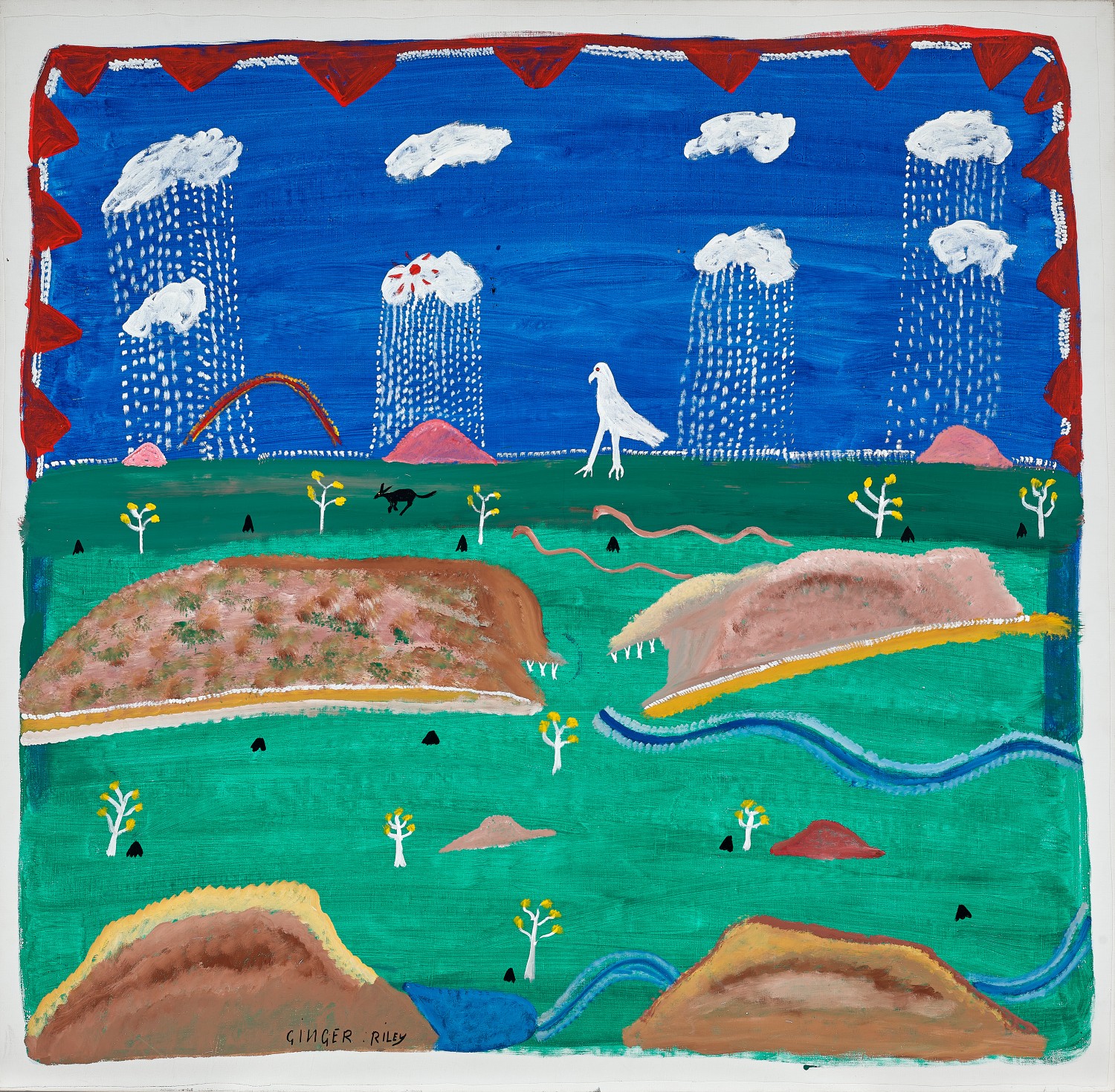
'After the long wet comes the rainbow and with it vigorous new life and energy which is most apparent in this vibrant painting.'
‘My mother’s country is in my mind.’1
Distinguished by their daring palette, dynamic energy and strongly flattened forms, Riley’s bold, brilliantly-coloured depictions celebrating the landscape and mythology of his mother’s country are admired among the finest in contemporary Indigenous art. Emerging at a time when barks were the familiar output for his Arnhem Land country and Papunya Tula paintings were considered the norm, his striking interpretations not only challenged, but irrevocably changed, preconceived notions of Indigenous art – thus earning him the moniker ‘the boss of colour’ by artist David Larwill. Notably influential upon such idiom was Riley’s chance encounter during his adolescence with celebrated watercolourist Albert Namatjira, whose non-traditional aesthetic and concept of ‘colour country’ left an indelible impression upon the young artist. Although encouraged by ‘…the idea that the colours of the land as seen in his imagination could be captured in art with munanga (white fella) paints’2, it was not until three decades later that Riley would have the opportunity to fully explore his talent when the Northern Territory Open College of TAFE established a printmaking workshop in the Ngukurr Aboriginal Community (formerly known as the Roper River Mission). Notwithstanding his mature age of 50, Riley rapidly developed his own highly sophisticated style and distinct iconography and, after initially exhibiting with the other Ngukurr-based painters, soon established an independent career at Alcaston Gallery. Enjoying tremendous success both locally and abroad over the following sixteen years before his untimely death in 2002, Riley received a plethora of awards including the inaugural National Heritage Commission Aboriginal and Torres Strait Islander Art Award in 1993 and an Australia Council Fellowship in 1997 – 98, and in 1997, was the first living indigenous artist to be honoured with a retrospective at the National Gallery of Victoria, Melbourne.
Capturing the saltwater area extending from the coast of the Gulf of Carpentaria along the Limmen Bight River to the weather-worn rocky outcrops known as the ‘Four Arches’, The wet, 1994 offers a stunning example of Riley’s heroic landscapes. Pivotal to the composition is Garimala, the mythological Taipan who, according to the ancestral dreaming, created the Four Arches – an area regarded as ‘…the centre of the earth, where all things start and finish’3 – and lives in the waterhole featured in the foreground. Here Garimala is depicted as a pair of snakes (a convention to denote him travelling) yet also manifests as the ‘Rainbow Serpent’ associated with the life-giving properties of fresh water, the monsoon season and the continuing cycle of life. Presiding over the landscape on the horizon is the totemic, white-breasted sea eagle, Ngak Ngak, who fulfils the role of a sentinel or guardian protecting the country, while above, heavy, rain-filled clouds not only herald the fertile abundance of the wet season but poignantly symbolise the artist’s mother. As typical of Riley’s oeuvre, the landscape offers an aerial overview informed by the artist’s strong sense of place; as he observes, he often paints ‘…on a cloud, on top of the world looking down… In my mind, I have to go up to the top and look down to see where I’ve come from, not very easy for somebody else, but all right for me. I just think in my mind and paint from top to bottom, I like that’.4
A vibrant celebration of the joy of belonging to the saltwater country of the Mara people, indeed the work embodies Riley’s powerful vision of his mother’s country as a mythic space – a mindscape whose kaleidoscope of dazzling colours and symbols continually evoke wonder and mystery in the viewer with each new encounter.
1. Riley cited in Ryan, J., Ginger Riley, National Gallery of Victoria, Melbourne, 1997, p. 15
2. Riley cited ibid.
3. ibid., p. 29
4. ibid., p. 27
VERONICA ANGELATOS