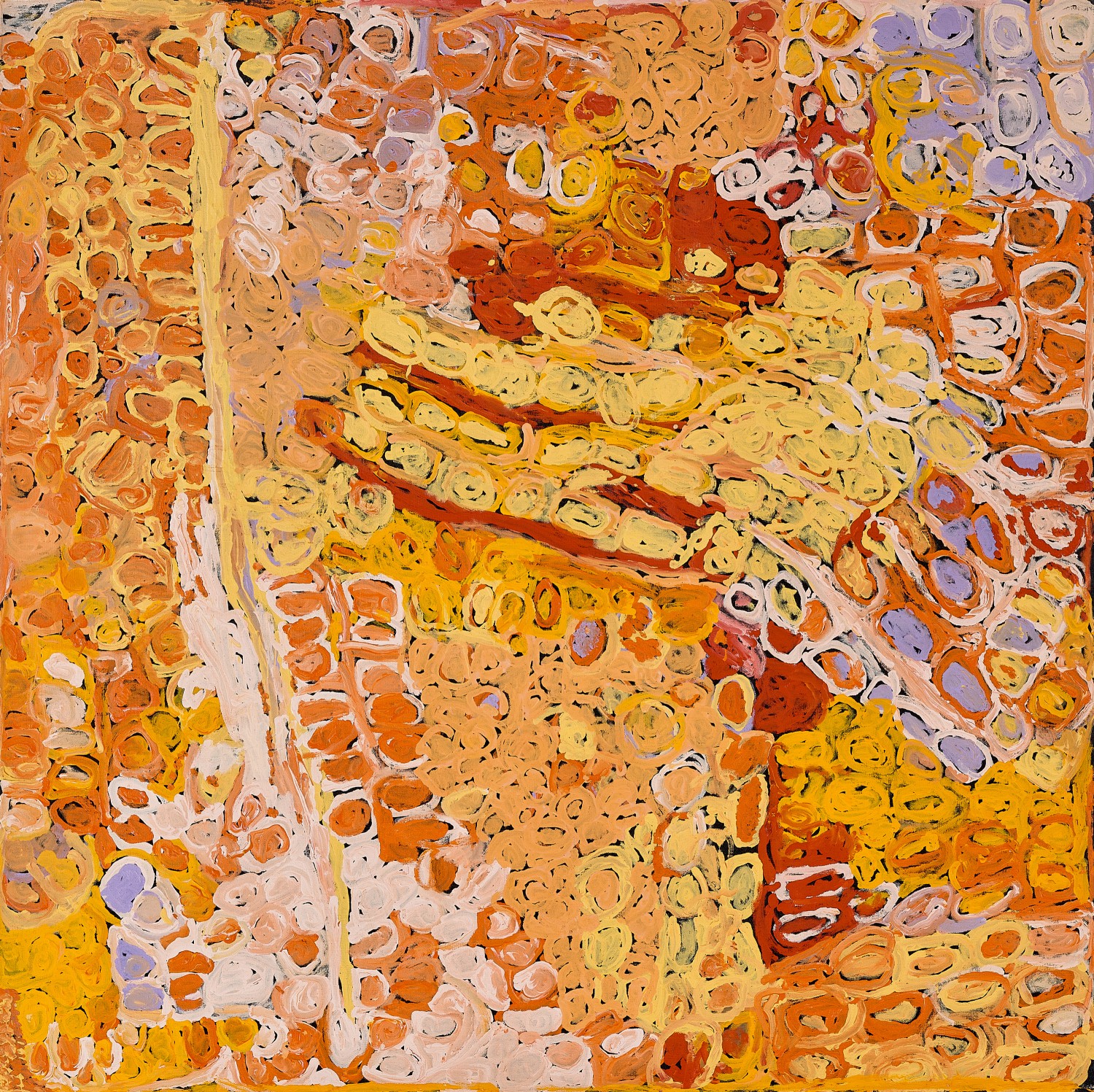
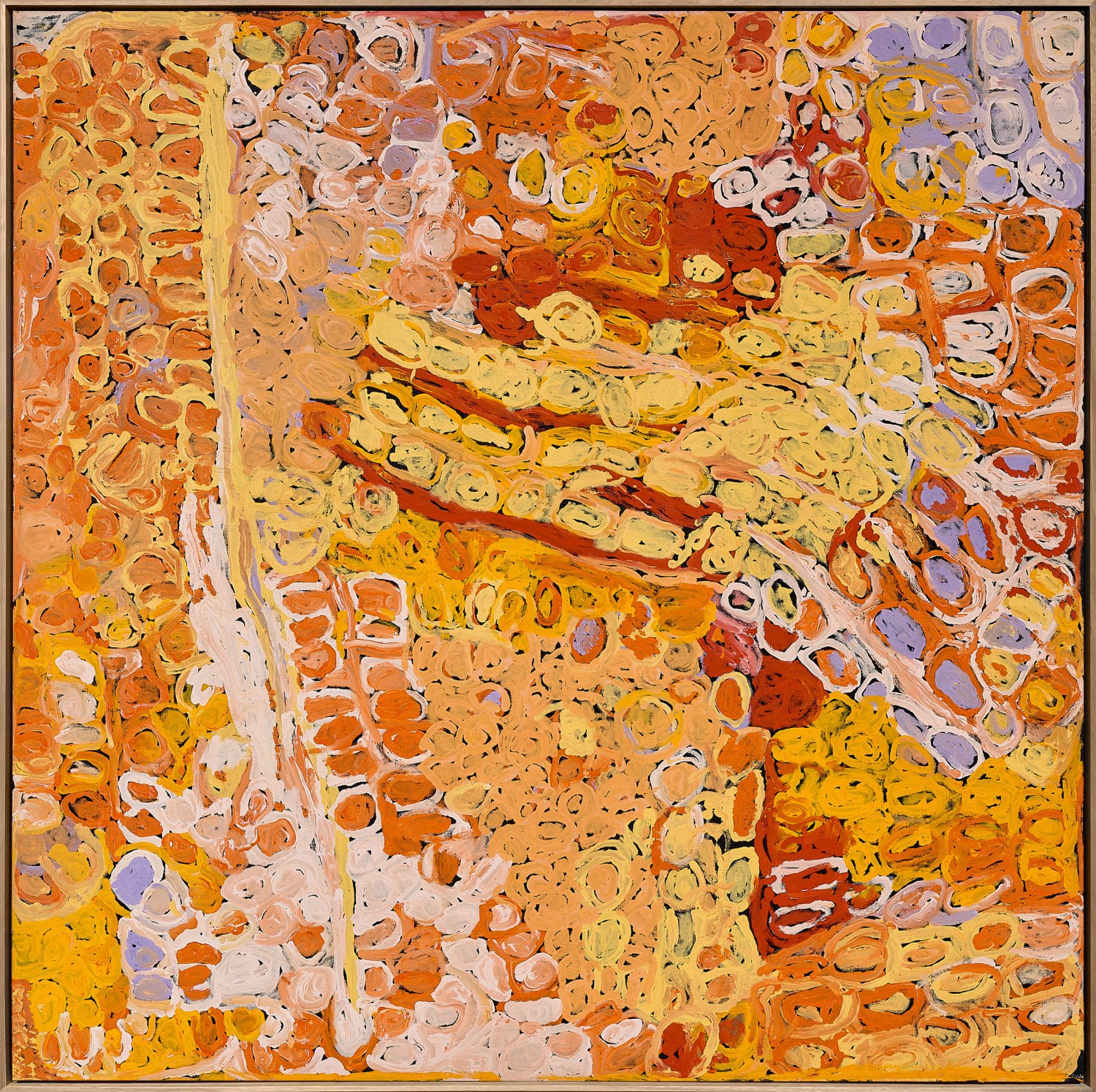
Untitled (Kungka Kujarra - two women), 1998

Makinti Napanangka
synthetic polymer paint on linen
122.0 x 122.0 cm
bears inscription verso: artist’s name, size and Papunya Tula Artists cat. MN980530
Commissioned by Papunya Tula Artists, Alice Springs, Northern Territory in May 1998
Framed Gallery, Darwin
Palya Art, Darwin
Private collection, France
Luminous: Contemporary Art from The Australian Desert - Travelling Exhibition, Manly Art Gallery & Museum, Sydney, 17 June – 24 July 2005, and touring to: Bundoora Homestead Art Centre, Melbourne, 19 August – 2 October 2005; La Trobe Regional Gallery, Victoria, 29 October – 4 December 2005; Flinders University Art Museum, Adelaide, 15 December 2005 – 12 February 2006; Bathurst Regional Art Gallery, New South Wales, 24 March – 7 May 2006; Manning Regional Art Gallery, New South Wales, 13 June – 25 July 2006; Grafton Regional Art Gallery, New South Wales, 16 August – 10 September 2006 and Tamworth Regional Gallery, New South Wales, 11 November 2006 – 4 February 2007, cat. 17 (illus. in exhibition catalogue, front cover, p. 28)
Luminous: Desert Masterpieces from the Helen Read Collection, The Australian Embassy, Paris, 10 October 2012 – 6 May 2013
The history of Papunya Tula Artists can be understood as two intertwined narratives: first, that of the men, which emerged from the settlement of Papunya in the early 1970s – its genesis all the more remarkable for its humble beginnings – and, more than a decade later, that of the women. This second chapter developed following a series of workshops attended by women artists from Kintore and Haast’s Bluff, supported by the Ikuntji Women’s Centre in 1994 – 95. Initiated by the women themselves, the Minyma Tjukurrpa Kintore/Haast’s Bluff canvas project resulted in the production of three large-scale collaborative canvases1, but more importantly, paved the way for women artists to introduce a new and distinctly painterly interpretation of both daily life and ancestral narratives, free from the ritual constraints and schematic formalism that had influenced many of the male artists of Papunya Tula.
Even among this collective – many of whom would later become renowned in their own right – the work of Makinti Napanangka stood out. From 1996, when she began painting for the company, she was a familiar presence at the Papunya Tula art centre in Walungurru. Often the first to arrive, led by the hand to the studio by one of her daughters and accompanied by her pack of camp dogs, she was ready to begin a day of intense painting.2 From her earliest, initially small-scale canvases, Makinti’s intuitive connection to her medium was evident. Unlike many of the other women, who adopted dotting techniques observed and learned from the company’s founding male artists, Makinti applied thick layers of paint in a fluid and highly individual manner, using brush, fingers, or hands.3 The result was a series of evocative depictions of her Country and its potent sites: her birthplace of Magarri, south-west of Kintore; the rockhole site of Lupulnga; the salt lake of Karrkurutintja (Lake MacDonald); and Lampintja on its southern side – each overlaid with ancestral women’s stories. Even when her eyesight deteriorated due to debilitating cataracts, Napanangka’s enthusiasm for painting remained undiminished.
A poetic and painterly evocation of the Kungka Kujarra (Two Women) story, Untitled (Kungka Kujarra – Two Women), 1998 chronicles an episode in which two ancestral women – one older, one younger – travel through the artist’s Country on a vast journey stretching across the Central Deserts of Australia, pausing at the southern side of Karrkurutintja (Lake MacDonald). Along their travels, the women shaped the landscape and embedded valuable knowledge within it, encoded in their story for countless generations to follow. Widely exhibited and reproduced on the cover of the catalogue for Luminous: Contemporary Art from the Australian Desert – a travelling exhibition that toured regional galleries in New South Wales, Victoria, and South Australia in 2005 – 06 – the painting is layered with colour and texture and bears all the hallmarks of Napanangka’s style, owing much to the gestural application of ochre onto the body during women’s ceremonies.
Following cataract surgery in 2000 which restored her sight, Makinti produced a series of celebrated, luminous canvases characterised by free, expressive brushwork, strong saturated colour, and richly textured surfaces. She remained one of the most senior women painting with Papunya Tula until her death in 2011. In 2000, her innovative and energetic work was included in the major retrospective Papunya Tula: Genesis and Genius at the Art Gallery of New South Wales, Sydney; in 2003, she was featured in the Clemenger Contemporary Art Award at the National Gallery of Victoria. In 2008, Napanangka won the National Aboriginal and Torres Strait Islander Art Award for her untitled painting of Lupulnga, which judge Judy Watson praised for its ‘inner light’ that ‘outshines everything else.’4
1. Exhibited together with smaller paintings at Tandanya [National Aboriginal Cultural Institute], Adelaide in June 1995 where two of these canvases are acquired for the collection of National Gallery of Victoria, Melbourne.
2. Perkins H., ‘Makinti Napanangka’ in Tradition Today: Indigenous Art in Australia, Art Gallery of New South Wales, Sydney, 2014, p. 98
3. Johnson, V., Lives of the Papunya Tula Artists, IAD Press, Alice Springs, 2008, p. 153
4. The Courier Mail, Brisbane, 17 August 2008
CRISPIN GUTTERIDGE