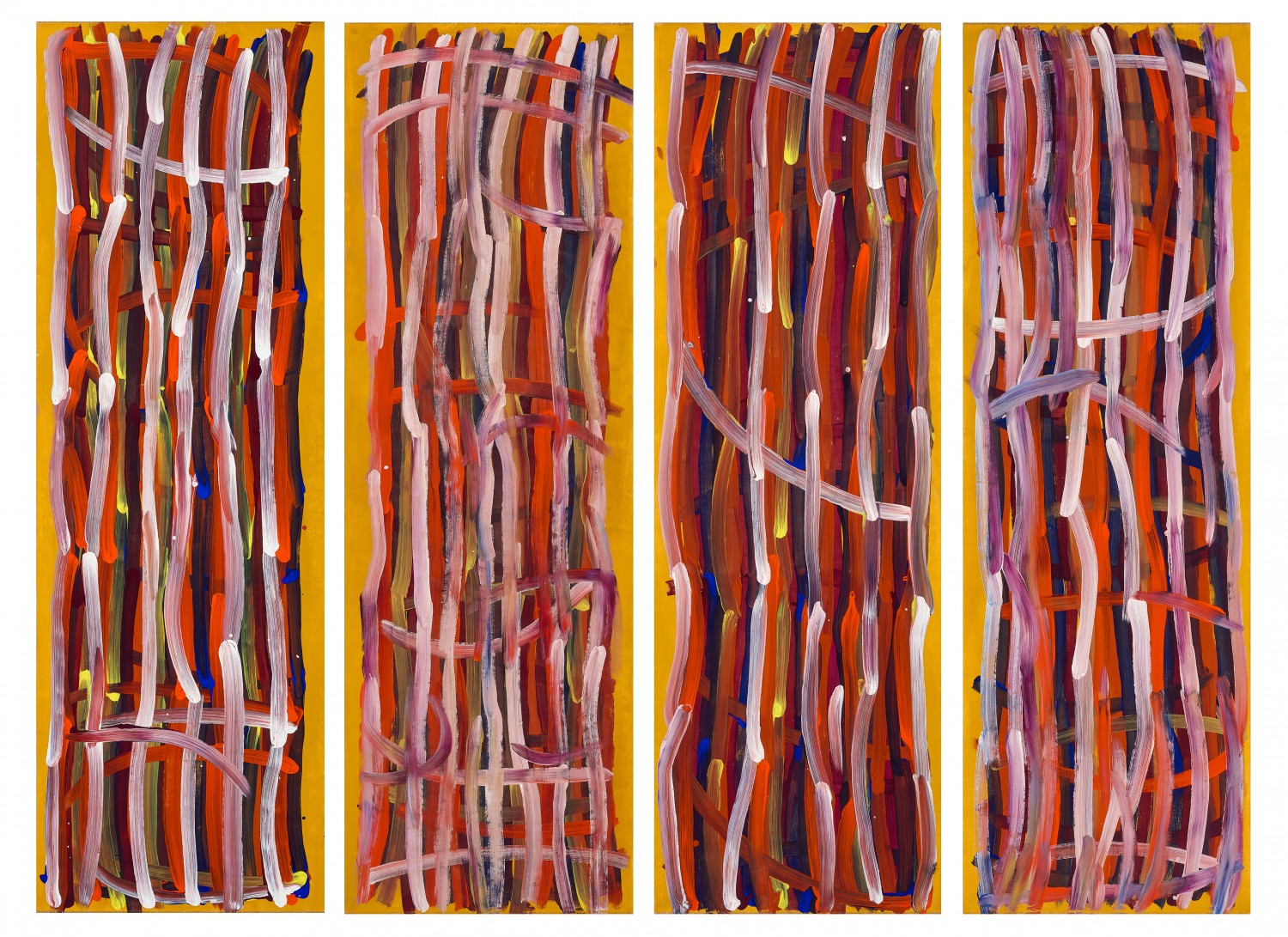
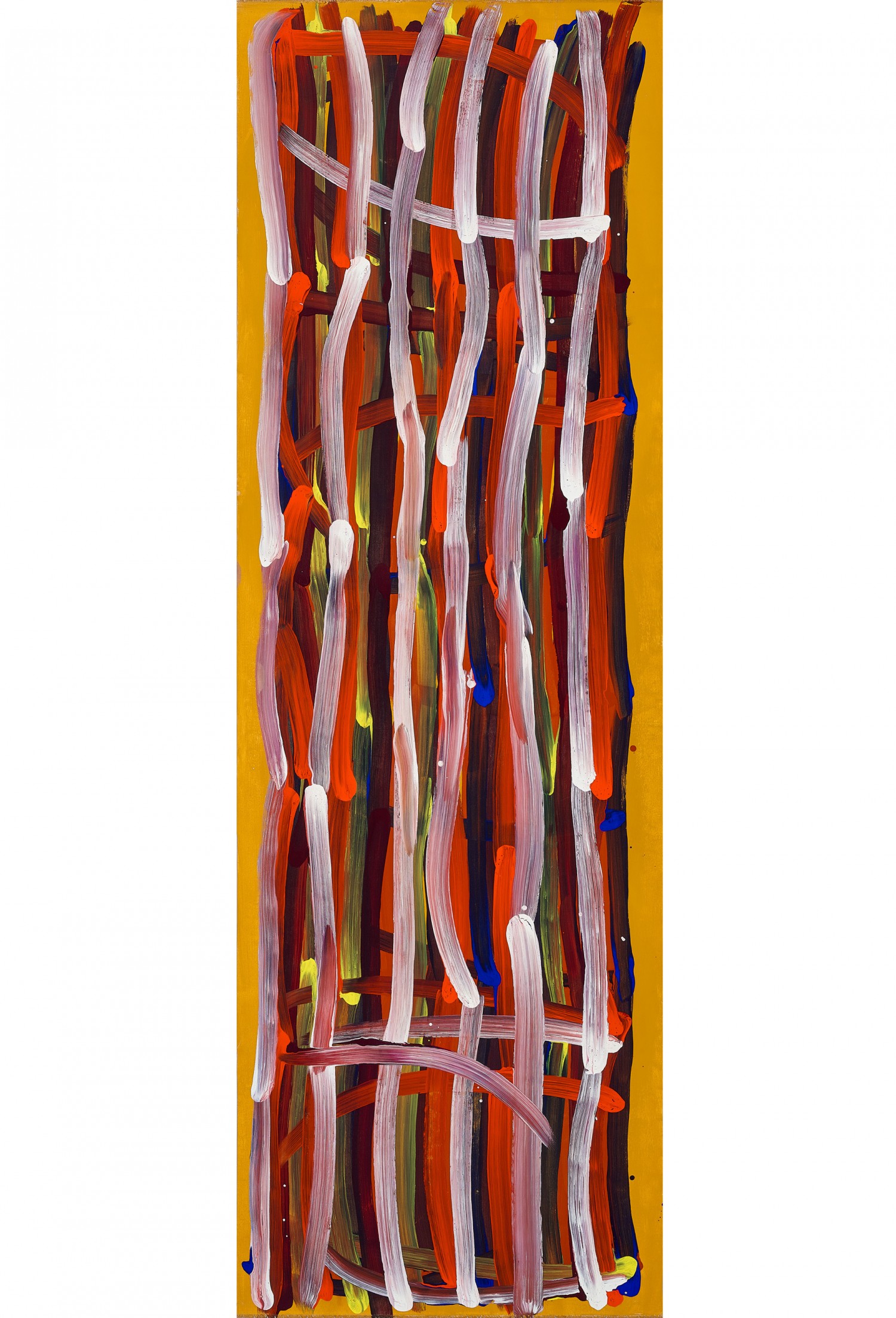
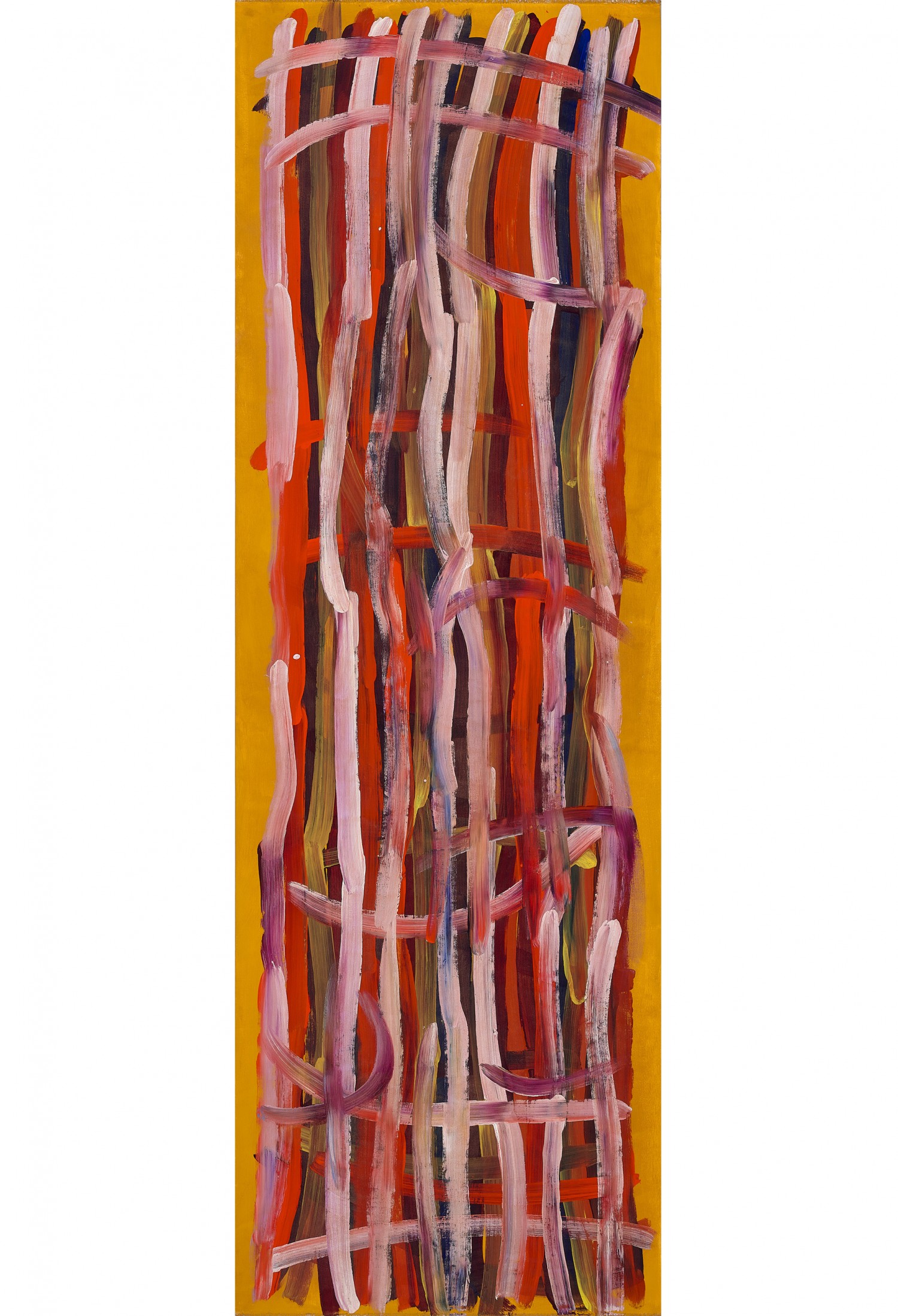
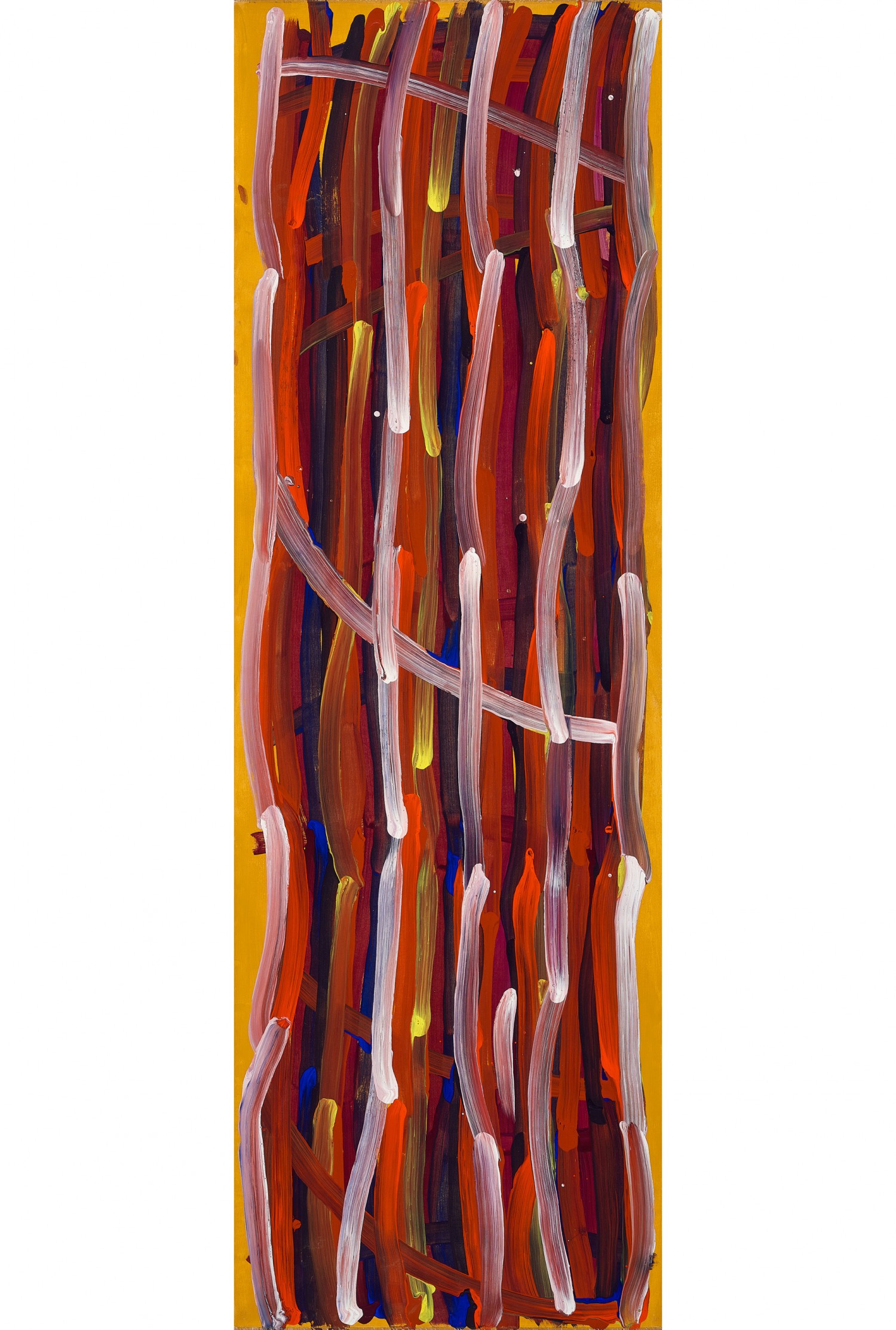
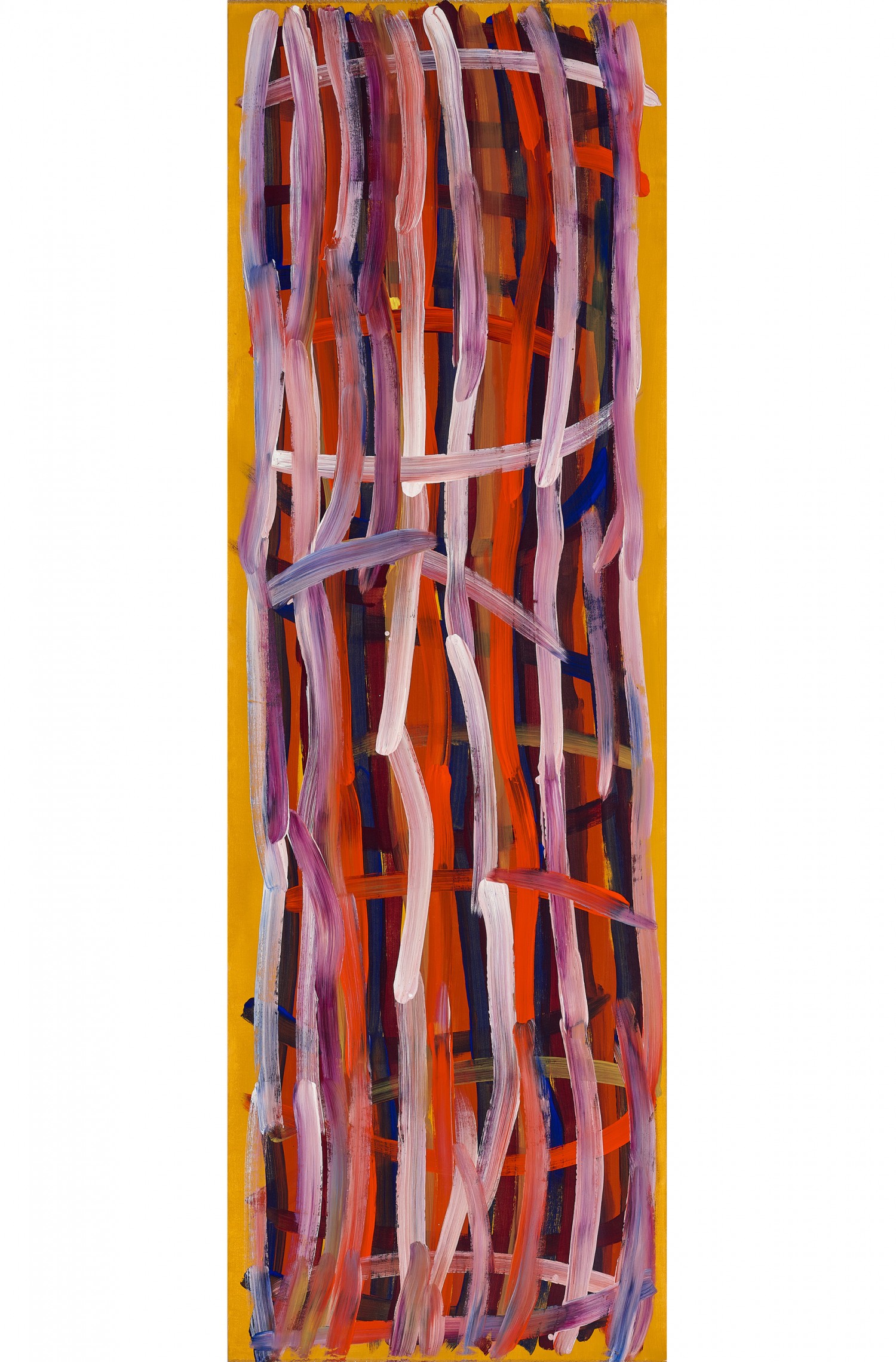
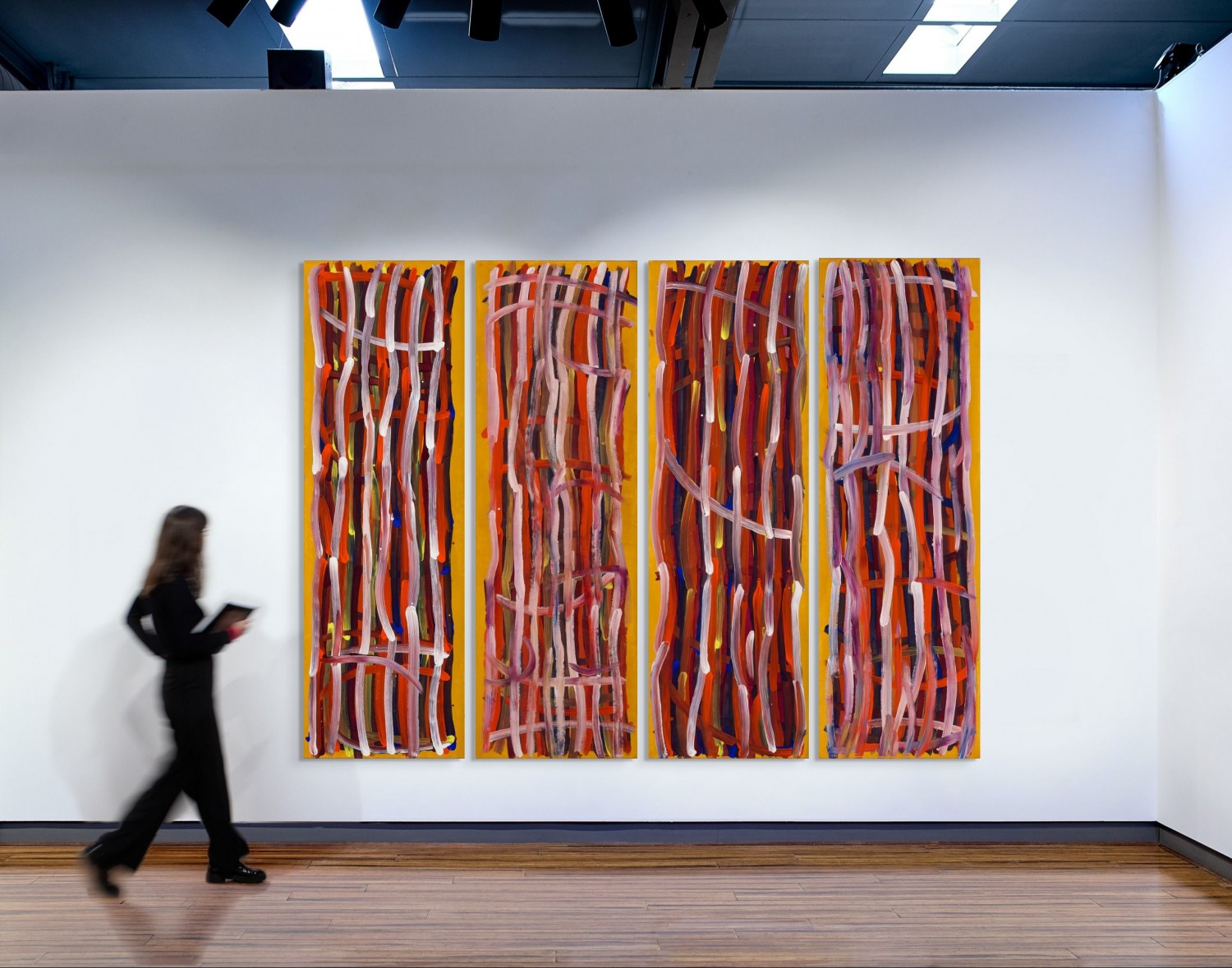
Awelye I, II, III & IV, 1995
Emily Kam Kngwarreye
synthetic polymer paint on canvas
i. 202.0 x 60.0 cm
ii. 202.0 x 61.0 cm
iii. 203.0 x 62.0 cm
iv. 203.0 x 62.0 cm
203.0 x 245.0 cm (overall)
bears inscription on each verso: artist’s name, date and Rodney Gooch cats. 7.1096, 8.1096, 9.1096, 10.1096
Commissioned by Rodney Gooch, Alice Springs in October 1995
Aboriginal Dreamings Gallery, Canberra
Private collection, Canberra
Thence by descent
Private collection, Canberra
In the summer of 1988 – 89, Rodney Gooch, under the auspices of the Central Australian Aboriginal Media Association, provided to the women of Utopia, already endowed with a decades’ experience of wax batik painting, 100 small canvases and boards and acrylic paints on which to translate their designs. It was as part of this ‘Summer Project’ that Emily Kam Kngwarreye, the eldest member of the Utopia Women’s Batik Group, painted her first painting on a two-dimensional support, Awely, 1989 (National Gallery of Victoria), featuring a design of women’s ceremonial breast markings, painted spontaneously with an urgent confidence.
Responding to a commission from Gooch in October 1995, Kngwarreye, now aged in her mid-80s, painted the present Awelye, 1995, an immersive polyptych of rhythmic cross-hatched body paint marks. Radically departing from the veils of shimmering dots for which she had found rapid fame, here she has returned to her beginnings in applying the ochre arkleny (body painting markings) to the chest and upper arms for the awleye (women’s ceremony), covering this series of canvases with a complex weave. Kngwarreye’s major custodial responsibility for the dreaming of the pencil yam, the Arlatyeye plant (Vigna lanceolata), whose meandering subterranean roots became the prime motif of her awelye designs and a constant central theme within her art, energetically reinvented throughout her career.
'The stripe is mobile, moving forward and backward, up and down, spontaneous, forceful and gestural. It is a mark that is globally occurring, like a word in a language we can all understand’, wrote Hetti Perkins in 1997, in the catalogue of Fluent, accompanying Kngwarreye’s posthumous representation of Australia at the Venice Biennale.1 While Emily Kam Kngwarreye’s bold abstract markings happened to transcend cultural boundaries to resonate with broader international modernism predicated on the grid, her lines remained inseparable from the sacred cultural context of Anmatyerre dreaming ceremonies thousands of years old. As is the case for many Indigenous artists, authorised collective cultural knowledge formed the basis of her artistic repertoire, and particularly, the strong, unbroken thread of matrilineal knowledge in the striped painted body designs and dances of the awelye became, in 1995, the dominant theme of her artistic practice. Margo Neale explained this radical change ‘was the result of an accumulation of similar experiences related to her age, her exposure to the art market and her personal development.’2
One of the last great stylistic innovations of Emily Kam Kngwarreye’s brief and prolific career, the beginnings of body line works can be traced to late 1993, when the artist was supplied with paper as an alternative painting support requiring less physical exertion. A drastically simplified gesture of parallel horizontal lines, simply and organically placed against a monochrome background characterised the first examples of Kngwarreye’s body paint works. By 1995, and this Awelye, however, the minimal austerity and mesmerising monochromatic palette had been abandoned, the artist now working her way back to the dense and complex layers that had been found in her most sophisticated dotted works.
In the present polyptych, the surface of each panel is covered in crossing horizontal and vertical lines, painted in an extraordinary variety of colours. Body paint lines of the awleye span the chest horizontally, while those on the breasts and arms were often vertical; here they are combined. With a poetry of association common in Kngwarreye’s practice, the cross-hatched lines refer to the rhizomatic subterranean systems of the yam roots and to the animal that eats it, the emu. Kngwarreye’s early dotted works incorporated an underlying skeletal structure of a grid to evoke the connection between the yam and the emu. Here, the regular and rhythmic cross hatching is also suggestive of weaving practice, Indigenous Australia being home to the longest continuous weaving traditions in the world. The ladder motif also appeared in Kngwarreye’s earliest painted batiks.
The expansive scale and serial sequence of the four panels of Awelye creates an immersive and captivating screen of layered marks. The rapidly applied colourful stripes merge and cross over each other, reverberating with light and colour. With the paint applied wet-on-wet and never revised, Kngwarreye’s pigments are opaque at the start of each brushstroke, becoming transparent and colour-mixed as they join other strokes. This creates an effect of flickering dashes of pure colour, appearing intermittently throughout the dense, netted weave. The metre-wide slender panels allowed the artist to work easily from either side of the canvas, the full, monumental effect created when the panels are joined into one panoramic sequence. In this, Awelye, joins other major monumental yam paintings all painted in 1995, with lines increasingly gesturally tangled, including the monumental 8-metre Anwerlarr Anganenty (Big Yam Dreaming) (National Gallery of Victoria), the almost five metre long Yam Awely (National Gallery of Australia), and Wild Yam V (Hassall collection, New South Wales).
The surface of Kngwarreye’s canvas can be likened to the ceremonial ground on which she performed the awelye, where rhythmic patterns of danced footprints are left in the sand. A collective term for women’s songs and ceremonies, Awelye are performed to ‘look after Country’, with knowledge transmitted from mother to daughter. In 1976, it formed an important part of cultural evidence submitted for the Utopia Land Claim, which successfully returned the lease of Utopia station to the traditional owners of Alyawarre and Kaytetye country, also benefiting the people of Alhalker. Emily recalled the celebrations ‘The Judge gave the Country back after everybody had shown it to him. Then we painted ourselves with the designs from the Country. After that we danced, ‘This is the Country.’’3
1. Perkins, H., Fluent: Emily Kame Kngwarreye, Yvonne Koolmatrie, Judy Watson: XLVII esposizione internazionale d'arte La Biennale di Venezia, Art Gallery of New South Wales, Sydney, 1997, unpaginated
2. Neale, M., Utopia: the genius of Emily Kame Kngwarreye, National Museum of Australia Press, Canberra, 2008, p. 39
3. Emily Kam Kngwarreye, cited in Cole, K., Green, J., and Perkins, H. (eds.), Emily Kam Kngwarray, National Gallery of Australia, Canberra, 2023, p. 145
LUCIE REEVES-SMITH