Summer flowers I, 1991
Emily Kam Kngwarreye
synthetic polymer paint on canvas
150.0 x 90.0 cm
bears inscription verso: artist’s name and Delmore Gallery cat. 1T47
Commissioned by Delmore Gallery, Alice Springs, Northern Territory in March 1991
Don Holt, Northern Territory
Private collection, France, acquired from the above in June 2019
This work is accompanied by a certificate of authenticity from Delmore Gallery.
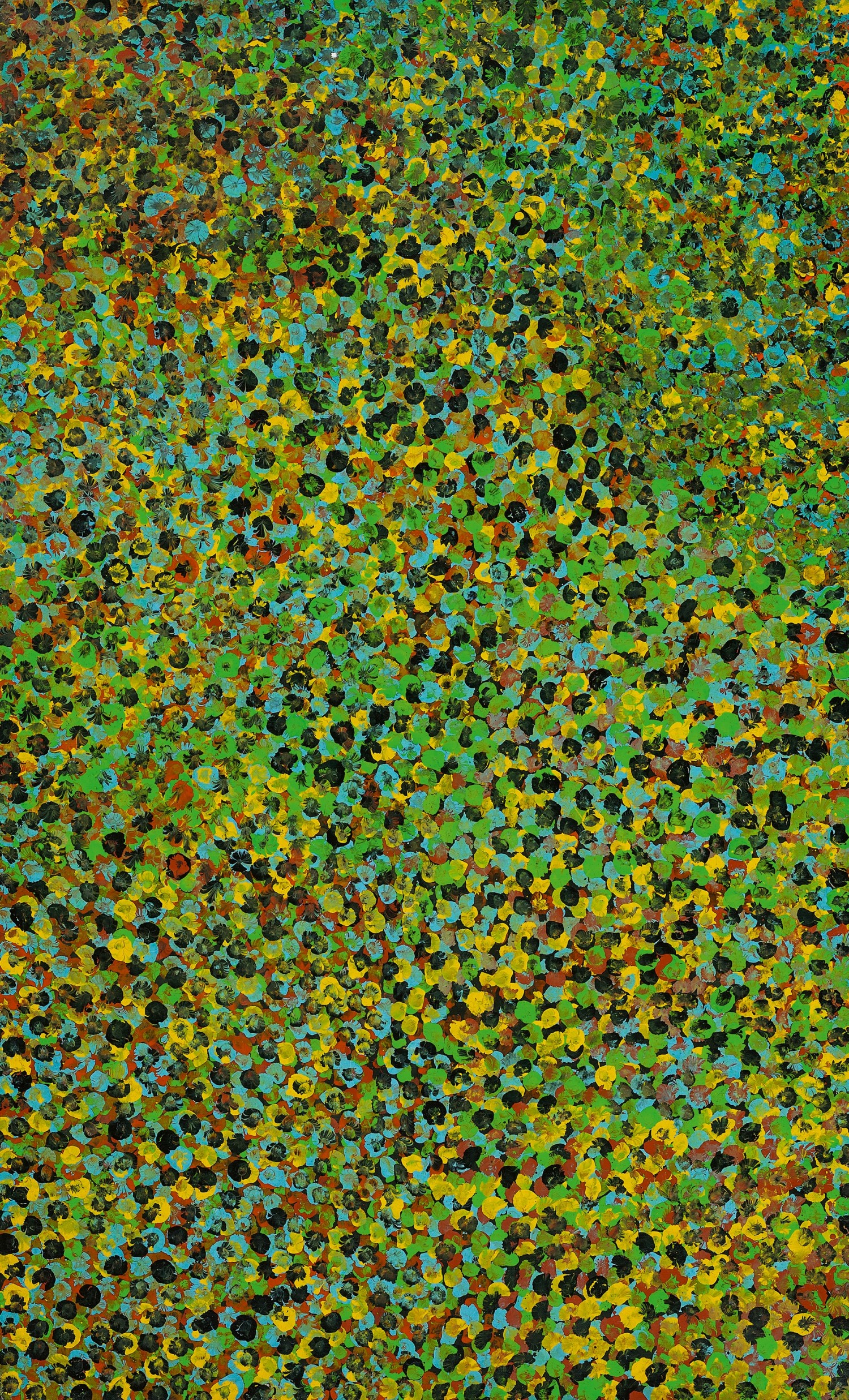
Using a rare and striking palette of aqua blues and lime green, Emily Kam Kngwarreye’s Summer flowers I was painted at the end of summer in 1991, at a point of extreme seasonal shift, bringing brief rains to desert Alhalker country. As Deborah Hart noted, reflecting on the continuous threads within Kngwarreye’s oeuvre, her Anmatyerr dreaming stories and their related paintings are about ‘being alive to weather patterns and seasons; to bush food that is raw or ripe, below or above ground; to light, wind and the desert earth. They are about a lifetime’s experience of her land, her country.’1
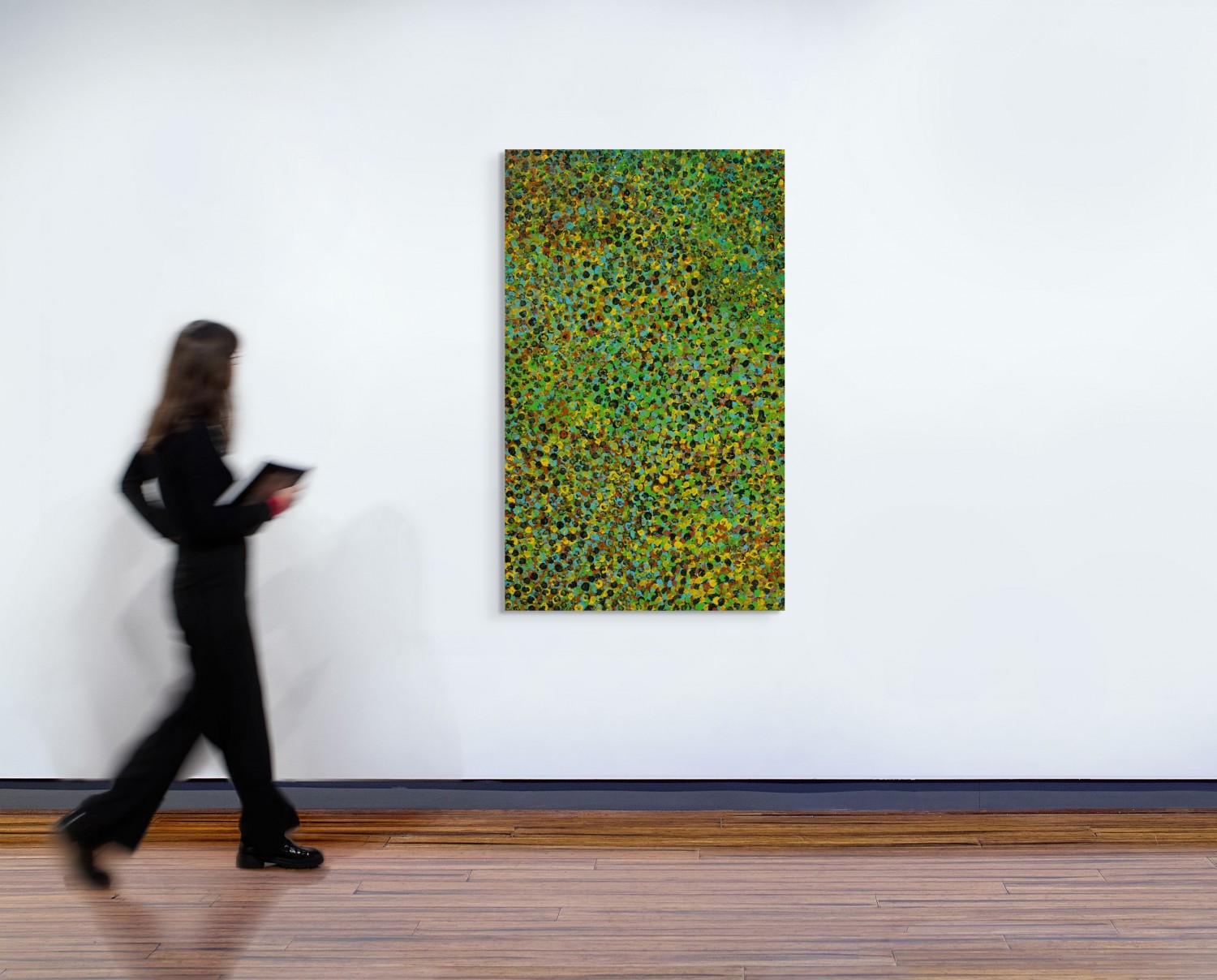
Painted on the cusp of Kngwarreye’s transition to large, uncontained brushstrokes, Summer flowers I features an all-over dotting of uniform sized daubs, layered from burnt sienna to canary yellow, duck-egg blue, vibrant green and topped with dark navy blue. While each colour is contained within separate dots, the complex layering of successive waves of colours creates a dense cloud of verdant, botanical explosion, with no discernible pictorial space such as background or foreground. The application of pure colour in patterns on the planar surface, Kngwarreye’s mixing of adjacent colours as an optical effect in the viewer’s eye inadvertently and organically replicates pointillist and op art techniques. The effect is one of full-frontal, abstract immersion.
Summer flowers I belongs to a sequence of major works painted by Kngwarreye at the Delmore Downs Station adjoining Utopia aboriginal land, over the summer of 1990 – 91, just two years into her painting career. The sequence includes Ntang Altyerr (seeds of abundance) (National Gallery of Australia, Canberra), painted in October 1990, and Early summer flowers (private collection), painted in December 1990 – each containing the powerful punchy combination of yellow, green and ochre hues evoking what the artist called the ‘green time’ of botanical abundance after a period of dormancy.2 Prior to this point, much of Kngwarreye’s oeuvre had been in subtler earthy tones, and henceforth the artist began to move into her ‘high-colourist phase.’ The swirling palette of blues, greens and yellow was later reprised by the artist to great effect, for her massive 6-metre masterpiece, The Earth’s creation, 1994 (private collection) which was exhibited in the 2015 Venice Biennale.
Like most of Emily Kam Kngwarreye’s paintings, working together as a cohesive interrelated continuum referring to the same lands and stories, Summer flowers I is an exaltation of rhythms of the natural world, and the sustenance they provide for the Anmatyerr people and their neighbours. Her choice of colours contains metaphysical associations with important ancestral beings, such as the emu, and plants over which Kngwarrreye held custodianship. With verve and creative boldness, Kngwarrye’s profusion of dots emphasises the varied colours of bush tucker, obscuring the linear tracery that previously underpinned her compositions. Summer flowers I expresses the tender feeling the artist had towards her country, and the continued link the Anmatyerr people had cultivated with Alhalker over tens of thousands of years. It is a testament to the rights and responsibilities Kngwarreye and her people had towards the sustainable use and care of the land, an issue of particular political importance in the mid-1990s.
1. Hart, D., Emily Kame Kngwarreye. Paintings from 1989 – 1995. Works from the Delmore Collection, Parliament House Publishing, Canberra, 1995, n. p.
2. Isaacs, J., ‘Amatyerre Woman’ in Isaacs, J. (et al.), Emily Kame Kngwarreye Paintings, Craftsman House, Sydney, 1998, p. 13
LUCIE REEVES-SMITH