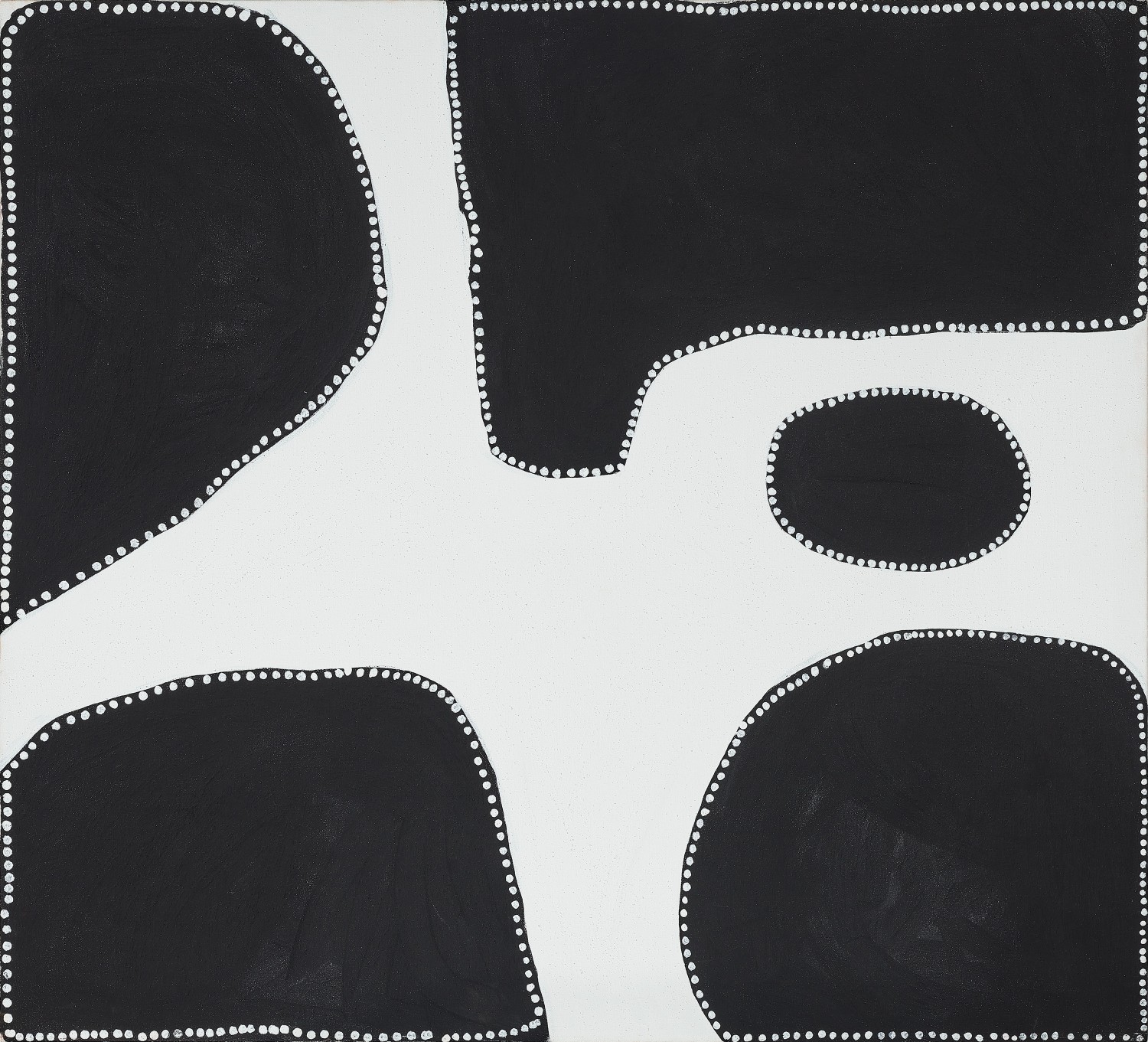
Biriyalji – Fish Hole, 1999
Paddy Nyunkuny Bedford
natural earth pigments and synthetic binder on Belgian linen
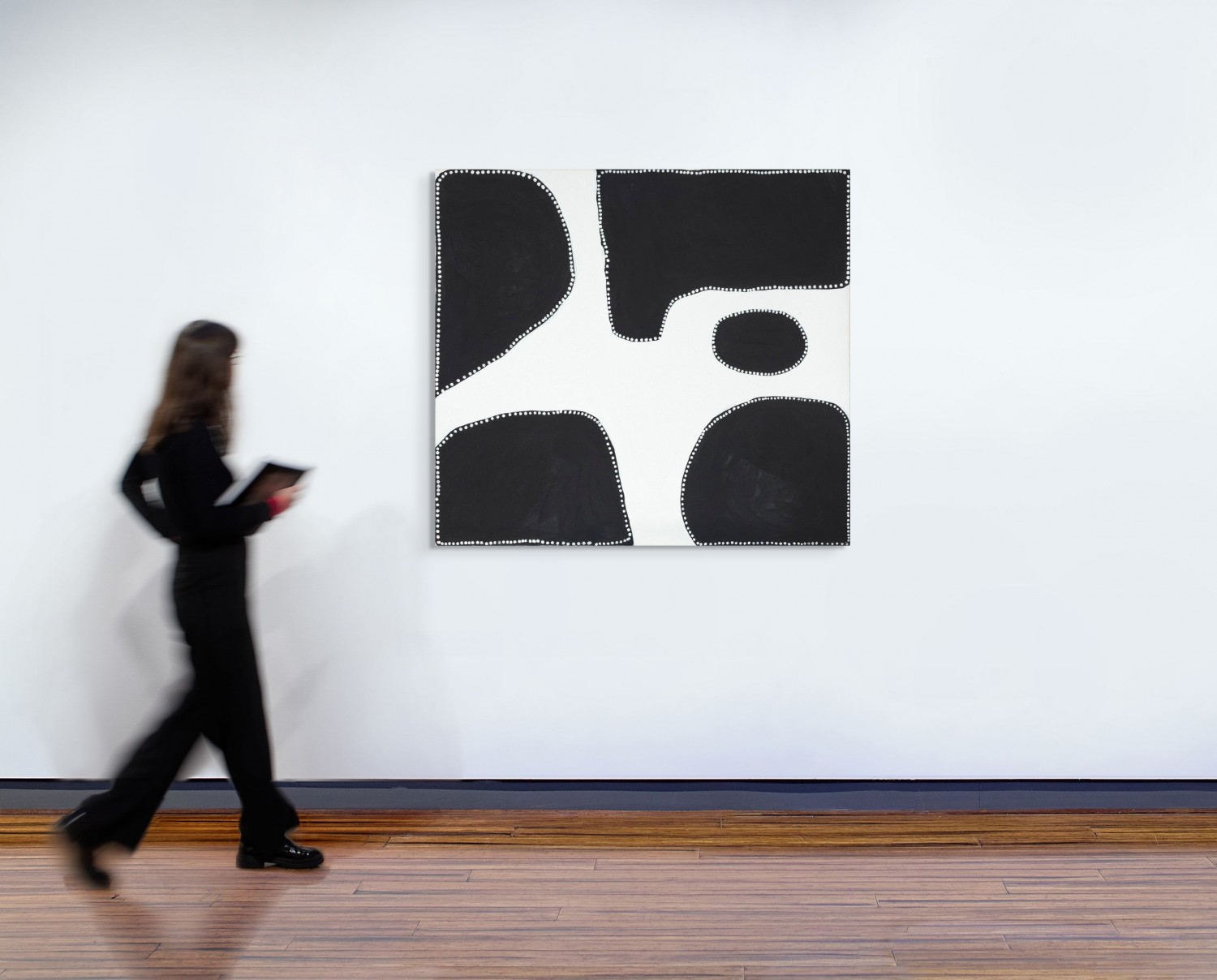
122.5 x 134.5 cm
signed with initials verso: PB
bears inscription verso: title and date
Jirrawun Arts, Kununurra, Western Australia (cat. PB 5 1999–41)
Framed Gallery, Darwin
Private collection, Canberra, acquired from the above in July 2001
Crocodile Hole: Paddy Bedford, Freddie Timms, Phylis Thomas and Goody Barrett, Framed Gallery, Darwin, 1 – 18 September 2000 (illus. on gallery invitation)
Michael, L. (ed.), Paddy Bedford, Museum of Contemporary Art, Sydney, 2006, p. 145 (illus. as ‘Red Bucket (Red Pocket) [sic] 1999, PB 5 1999.41’)
‘Paddy Bedford’s paintings articulate a complex dialectic between modern materials and traditional pictorial conventions, contemporary experience and ancient belief systems.’1
Drawing upon two distinct sources of knowledge, and painting with a profound sense of history and cultural responsibility, Bedford mapped the rich narratives of the East Kimberley through stories from his father’s, mother’s and uncle’s Country. Within his canvases, historical events and everyday accounts of life on cattle stations coexist with a lyrical and deeply informed understanding of the land and its creation stories. While recounting significant episodes from the region’s past, Bedford simultaneously painted the ‘bones’ of the landscape – its waterholes, stockyards and roads – tracing the sites he traversed throughout his life.
‘Fish Hole’, known to the local Gija people as Biriyalji (or Piriyalji), is one of two waterholes of that name depicted by the artist. Located a few kilometres south of the Springvale-Lansdowne Road, south-west of Bedford Downs Station on the Little Gold River in his mother’s Country, it is the Dreaming place of Biriyalji, the konkerberry (Carissa lanceolata) – a small, edible black fruit that ripens in the wet season and is also valued for its medicinal properties.
Painted in 1999, the second year of Bedford’s painting career, Biriyalji – Fish Hole, 1999 marks a significant evolution in his style. Moving beyond the familiar ochre-based representations of Country associated with earlier East Kimberley artists, he adopts a stark black-and-white palette. Dense monochromatic fields of black are pressed against the edges and corners of the canvas, while painterly passages of white flow between them. The composition evokes a compelling interplay of presence and absence, space and emptiness. As Michiel Dolk observes, this approach suggests an ‘acceptance of absence, of emptiness as a positive term, and is also an assertion of the material presence of painting as a surface and object.’2
Bedford’s early exploration of a monochromatic palette here heightens the tension between positive and negative space, foreground and background, through strong vertical and horizontal divisions within the composition. In doing so, it anticipates the further innovations in palette and technique that would come to define his mature practice.
1. Michael Dolk, cited in Storer, R., ‘Paddy Bedford’ in Michael, L., Paddy Bedford, Museum of Contemporary Art, Sydney, 2006, p. 11
2. ibid., p. 39
CRISPIN GUTTERIDGE