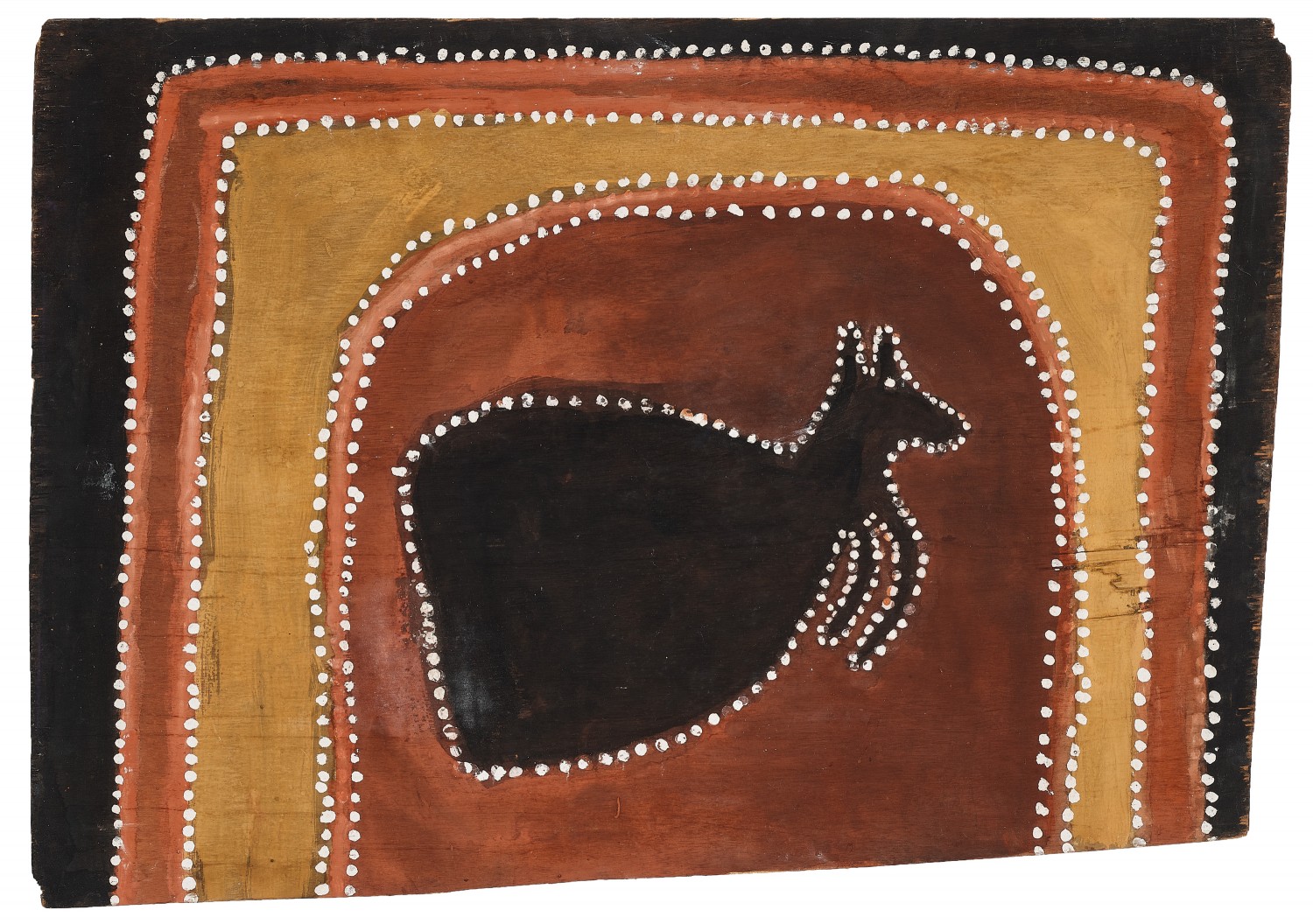
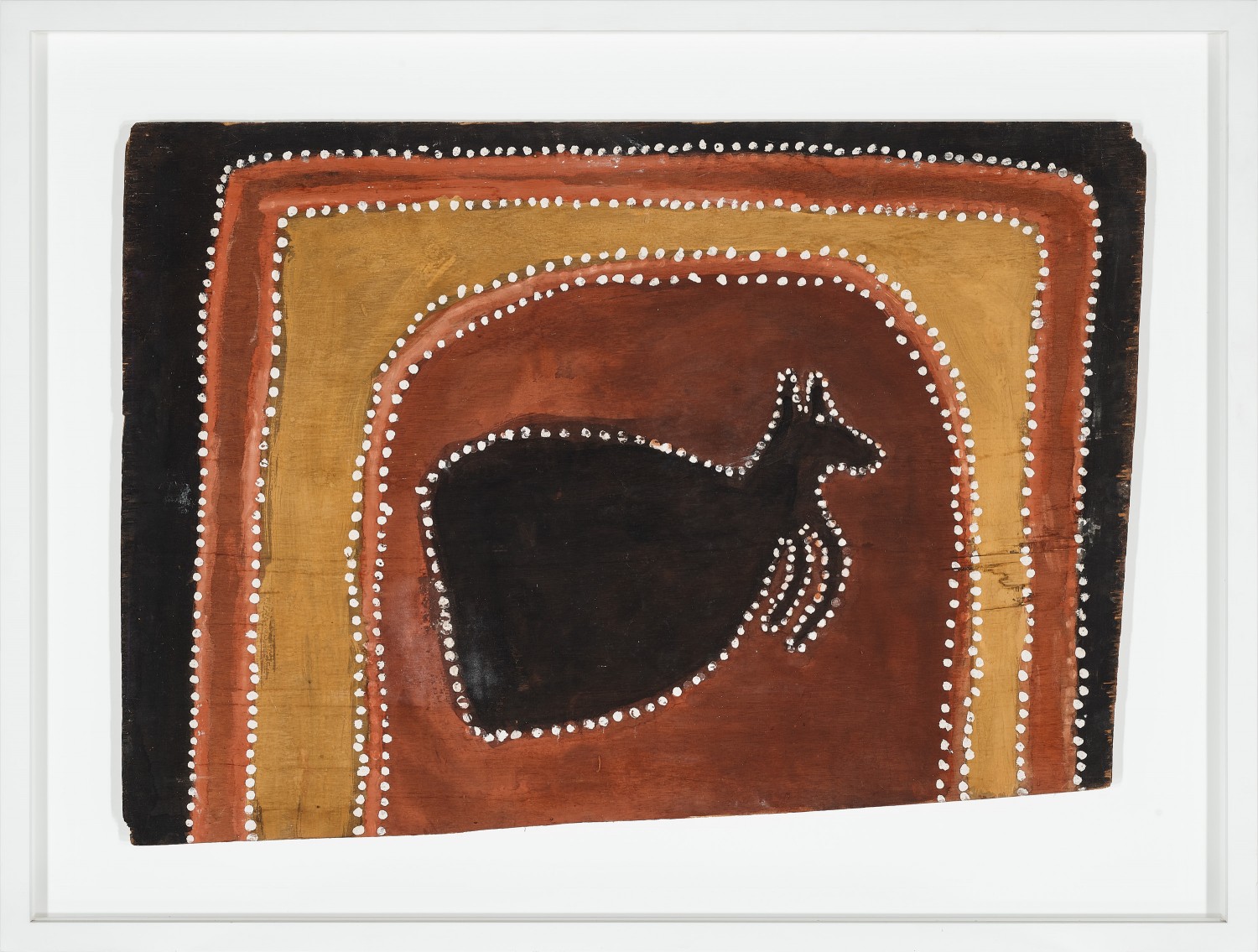
Elgee cliff, half kangaroo - Krilkril Country, 1985
Paddy Jaminji
natural earth pigments with bush gum on plywood
66.0 x 94.0 cm (irregular)
Mary Macha, Perth
Colin and Elizabeth Laverty, Sydney, acquired in July 1987
Deutscher and Hackett, Sydney, 8 March 2015, lot 32
Private collection, Sydney
Paddy Jaminji was a pioneer of the East Kimberley style of painting, developed in the nascent community of Warmun (Turkey Creek), Western Australia, throughout the late 1970s and 1980s. Jaminji’s Gija people had established the Warmun Aboriginal community, south of Kununurra, after government changes to pastoral wages (intended to instigate equal pay) forced stock workers, including Jaminji who was employed as a stockman on Bedford Downs Stations, off stations and reserves.1
Around this time, the destructive impact of Cyclone Tracy in the Northern Territory in 1974, was interpreted as a spiritual warning – instructions from the Rainbow Serpent to the Gija people to adhere to and strengthen their cultural practices.2 Paddy Jaminji’s nephew, Rover Thomas, experienced this warning as a series of dream visitations following the sudden death of elderly female relative (a classificatory mother, a Gija Wula speaker) in a car accident near Warmun on a road flooded following the cyclone. The episodes of Thomas’ dreaming acted as the catalyst for the efflorescence of the school of painting in the East Kimberly, codified by Thomas, Paddy Jaminji and George Mung Mung into an extraordinary contemporary corroboree song cycle accompanied by painted boards, known as the Goorirr Goorirr (Kurrirr-Kurrirr/Gurrir Gurrir/Krill Krill/Kuril Kuril) Ceremony.3 This new dreaming spoke of the old woman’s spirit taking an epic journey through the lands of East and Central Kimberley, linking sites of sacred and historical importance to several different language groups of the area.
Elgee Cliff, half kangaroo – Krilkril Country, 1985 features the single icon motif of painted boards held aloft during the ritual ceremony, painted with the solid textured blocks of natural earth pigments bound with natural resins and outlined with a single line of white dotting – features which later became the hallmarks of East Kimberley painting. This painted board depicts song #14 in the cycle, Kularrta-ura Kawurru Kampani, described as ‘the old woman ‘finds’ the half kangaroo, the legendary inhabitant of this place. She sees the metamorphosed remains and blood inside the cave.’4 The remains of Tawurr, the ancestral kangaroo, rest in a cave in these cliffs, visited by the woman’s spirit. Alongside Galiru, the rainbow serpent and a crocodile, Tawurr also appears in rock art painted on this cave’s walls, the lower half of which has been eroded. The concentric forms surrounding the half-kangaroo within this painted board depict the sandstone Elgee Cliffs (Kunmanturr), on Bedford Downs Station, a geological formation aged over 1.7 billion years old, of great cultural importance to the Gija people.
1. McCulloch, S., and McCulloch Childs, E., McCulloch's Contemporary Aboriginal Art: The Complete Guide, McCulloch & McCulloch Art Books, Melbourne, 2012, p. 155
2. Cubillo, F. and Reynolds, A. J., ‘Rusty Peters’, in Defying Empire. 3rd National Indigenous Art Triennial, National Gallery of Australia, Canberra, 2017, p. 102
3. Thomas, R. et al., Roads Cross, The Paintings of Rover Thomas, National Gallery of Australia, Canberra, 1994, p. 22
4. ibid., p. 26
LUCIE REEVES-SMITH