Emily Kam Kngwarreye Works: 1991 – 1995 (Lots 20 – 26)
Emily intro section.jpg
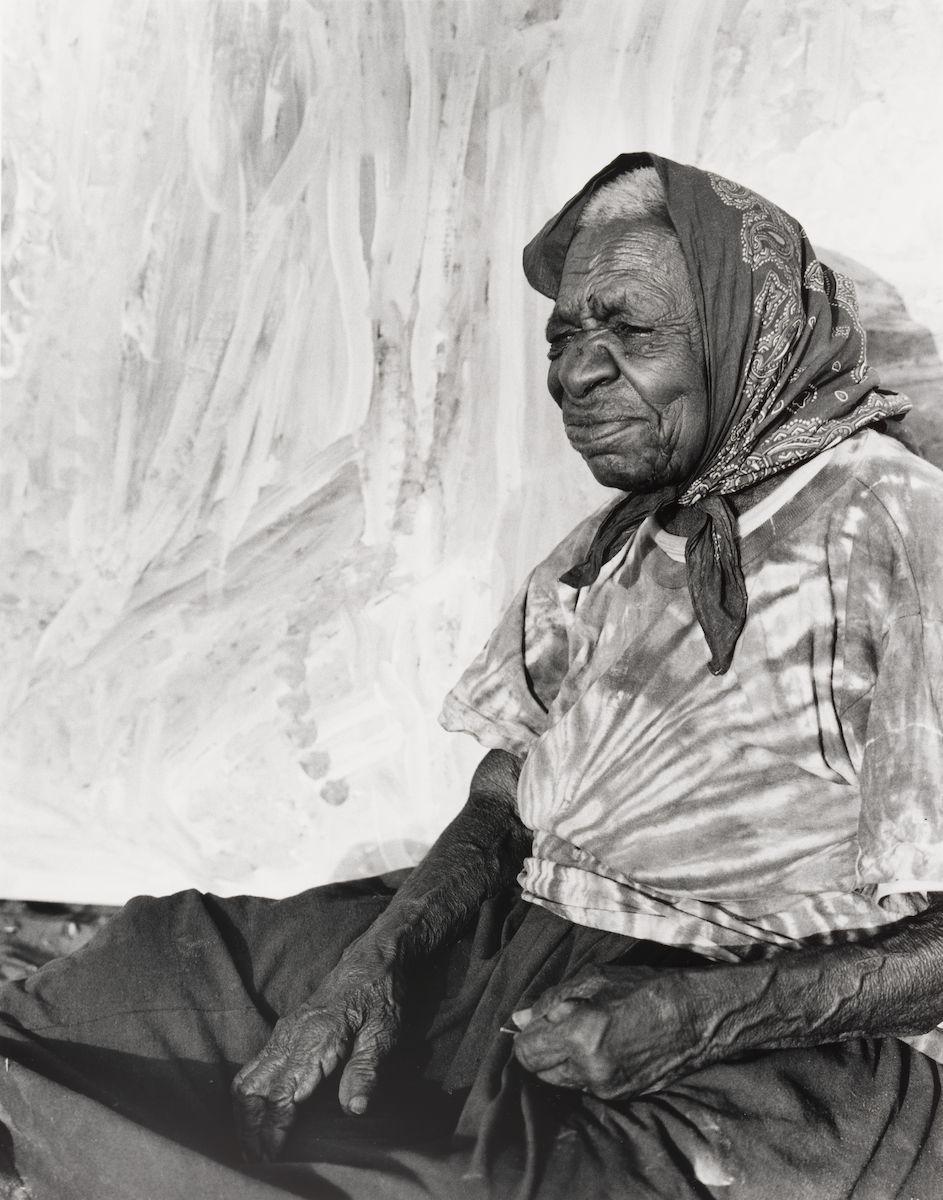
Emily Kngwarreye, 1994
photographer: Greg Weight
National Portrait Gallery, Canberra
© Greg Weight
Emily Kam Kngwarreye (c.1910 – 1996), known amongst her community simply as ‘the old woman’, was a unique figure in Australian art, today heralded as one of the world’s leading artists. Although she only started painting on canvas around 1988 – 89, aged in her late 70s, Kngwarreye’s extraordinarily passionate and prolific painting practice over the next eight years received immediate acclaim, catapulting the diminutive artist on to the world stage. She posthumously represented Australia at the 47th Venice Biennale in 1997 in Fluent: Emily Kame Kngwarreye, Yvonne Koolmatrie, Judy Watson, and again in Okwui Enwezor’s international pavilion, All the World’s Futures, at the 56th Venice Biennale in 2015. In 2025, she became the first Australian artist to be honoured with a solo retrospective exhibition at London’s Tate Modern gallery.
Kngwarreye’s story and art are inextricably linked to her Country, Alhalkere, in a remote desert region of Central Australia, 230 kilometres north-east of Alice Springs. It was here, on the lands of her people, the Anmatyerre, and those of neighbouring peoples, the Alyawarre and the Eastern Arrernte, that she was born and grew up in the traditional way, in an extended family group. The creation beliefs of Anmatyerre people are common to most desert communities and involve the Altyerre, the creative past that continues in the present, usually called the Dreaming, or in other parts of Australia the Tjukurrpa.1 Traditional Aboriginal culture uses visual and performative communication modes to transmit this dreaming, and in desert regions in particular, visual designs drawn in the sand are a key part of ceremony.2 Awelye, the women’s ceremonies, which Kngwarreye learnt from female elders and later performed as a ceremonial leader herself, include within their ritual dances and song cycles, ochre patterns of great cultural significance painted on the body and on dancing boards.
Anmatyerre women had intermittent contact with white people in pastoral homesteads after the first wave of station owners arrived in the 1920s and 1930s, and Kngwarreye spent most of her adult life working on these properties, as a shepherd and cameleer. She nevertheless continued elements of traditional life as it had been prior to European presence, including finding and hunting wild foods according to a deep understanding of seasonal changes.
From her earliest encounters with Western forms of art, as a founding member of the Utopia Women’s Batik Group, to her later canvases painted quickly and with supreme confidence, the altyerre was expressed in Kngwarreye’s art through the motifs of awelye body paint designs and sand stories, the tracks of animals, abundance of plants and patterns of seasonal changes, characteristically summed up by the artist as the ‘whole lot’. In the same way that notions of individualism are antithetical to Indigenous culture – tradition demands reciprocal rights and obligations in all matters concerning the group or clan – Kngwarreye’s art expresses her entire body of knowledge, acquired over a lifetime from elders connected to an unbroken culture tens of thousands of years old. The complex interrelationships of these many designs and stories are played out within each of her works and throughout her oeuvre as a whole.3
1. Isaacs, J. et al., Emily Kngwarreye Paintings, Craftsman House, 1998, p. 14
2. Smith, T., ‘Kngwarreye Woman. Abstract Painter’, in Isaacs, ibid., p. 24
3. Emily Kam Kngwarray Alhalkere, Paintings from Utopia, National Gallery of Australia, 1999 at: https://nga.gov.au/exhibitions/emily-kam-kngwarray-paintings-from-utopia/ (accessed 19 February 2026)
LUCIE REEVES-SMITH
RETURN TO CATALOGUE