Important bark paintings from the collection of Lance Bennett (Lots 37 – 43)
intro image for barks in this PDF.jpg
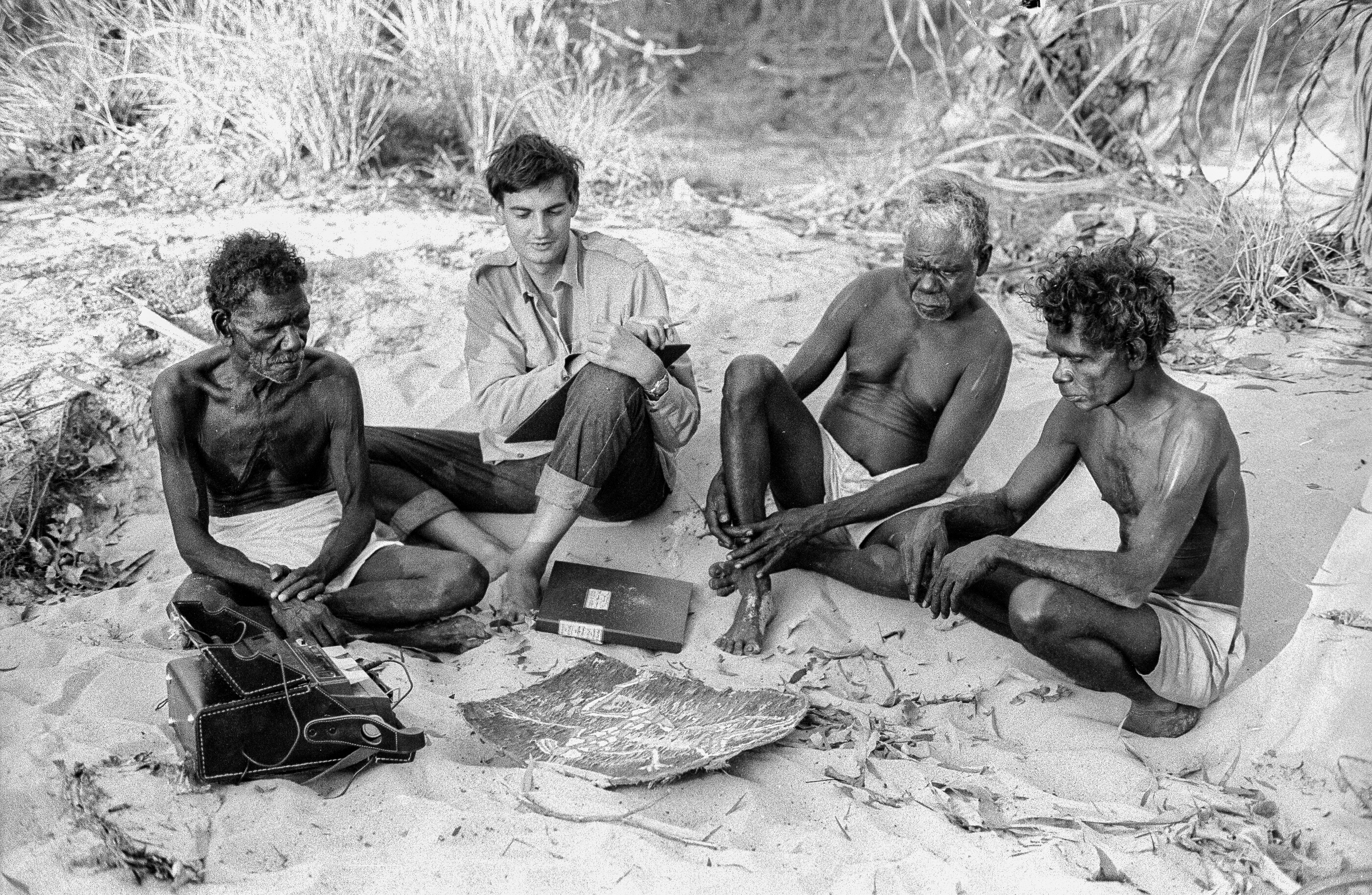
Nadjombolmi, Lance Bennett, Diidja and an interpreter
documenting Namarnde Frolicking at Mudjinbardi, 1966
© Estate of Lance Bennett
These extraordinary bark paintings were assembled in 1966 by the famous collector and interlocutor Lance Bennett (1938 – 2013) at the Mudjinbardi community in Arnhem Land, Northern Territory. During this time Bennett was making regular visits, sometimes with his mother, Dorothy, to remote areas of the Northern Territory to collect paintings, sculptures and objects from various Aboriginal groups. During the 1950s, Dorothy travelled widely in this region while she was medical secretary to the orthopaedic surgeon Dr Stuart Scougall. Scougall had a deep interest in Aboriginal art and advocated for the Art Gallery of New South Wales in Sydney to start collecting. Scougall and Bennett developed a relationship with the then deputy director of the AGNSW, Tony Tuckson, that resulted in joint collecting visits to north Australia and active collecting by the gallery. Prior to this, bark paintings were considered ethnographic curiosities belonging in museums as opposed to galleries.
The Mudjinbardi community developed in response to the establishment of a pastoral lease between the East Alligator and South Alligator Rivers. Much of the population had arrived from across the extended region of central Arnhem Land and the Alligator Rivers, seeking employment. Many of the men, including all the artists who painted for Bennett, had extensive knowledge of the spectacular rock art galleries of the region. It is likely that a number of these artists had produced rock paintings in their own lands prior to relocating to Mudjinbardi.1
Writing about these works previously, anthropologist Dr Luke Taylor explains how the lived experience of these men and the legacy of rock art in this region informed the unique aesthetic of the barks they created:
‘This particular art heritage provides an explanation for the characteristic style of these works. Many of the paintings have a pronounced use of white paint roughly applied as the background of the imagery. This kind of painting is called rungkalno and it is common in the rock art of central Arnhem Land where images can be displayed as a simple white silhouette without any interior infill. Also in central Arnhem Land, contrasting coloured dotting was occasionally used to modify such images. A number of central Arnhem Land artists have stated that they were most familiar with these techniques and used them in their early bark paintings. The use of detailed x-ray infill and multicoloured crosshatched banding are later influences.’2
Of course, the subjects and ancestral themes the men painted are common in rock art in Arnhem Land as well. Namarnde, a ghost-like being of the human dead, features strongly in the rock art galleries of the sandstone escarpments of central and western Arnhem Land. So too in the bark paintings of Baimunungbi, Diidja and Lanyirrda from 1966. Baimunungbi alluded to the sexual exploits of male and female Namarnde. Taylor asserts that ‘some special rock paintings were produced as a form of ‘love magic’’, suggesting that their depiction might conjure ‘a desired outcome for the artist and his secret beau.’3
Baimunungbi’s tall figures are painted in a style characteristic of southern Arnhem Land. Each figure is carefully decorated with gentle lines of yellow ochre. Some are shown naked as the male makes love to his wives; other figures have small pubic aprons, worn from the waist. Baimunungbi remained in Mudjinbardi for many years prior to returning to Maningrida in the 1980s, where he became well known for exquisite geometric works that drew upon his knowledge of body paintings of the Mardayin ceremony.
Diidja’s Namarnde figures, with elongated arms and fingers, have talon-like forms trailing from the back of the head. His gestural dotting provides form and substance to their white silhouetted bodies. Diidja, too, emphasises the Namarnde’s sexual activity, with exposed genitalia and descriptions provided to Bennett of them ‘making love’. Bennett described Diidja as ‘a good-natured friendly man with a boyish engaging grin and a keen enthusiasm for ritual life’.4
Lanyirrda’s depictions of Namarnde share a similar appearance to those of both Baimunungbi and Diidja. Fine yellow ochre outlines his figures. According to Bennett’s annotation of Namarnde circa 1965, ‘The long feather which the male spirit is wearing as decoration is a typical feature of paintings of spirits in the rock and bark art of West Arnhem Land.’
1. Haskovec, I. and Sullivan, H., ‘Nadjombolmi: reflections and rejections of an Aboriginal artist’, in Morphy, H., (ed.), Animals into Art, Unwin Hyman, London, 1989, pp. 57–74
2. Taylor, L., ‘The Lance Bennett Collection of Bark Paintings’, in Aboriginal Art, Sotheby’s, London, 10 June 2015
3. ibid.
4. Appel, M. (ed.), Inspired by Country: Bark Paintings from Northern Australia: the Gerd and Helga Plewig Collection, Hirmer Publishers, Munich, Germany, 2022, p. 357
LUKE SCHOLES
RETURN TO CATALOGUE