Dorset cottages, 1935
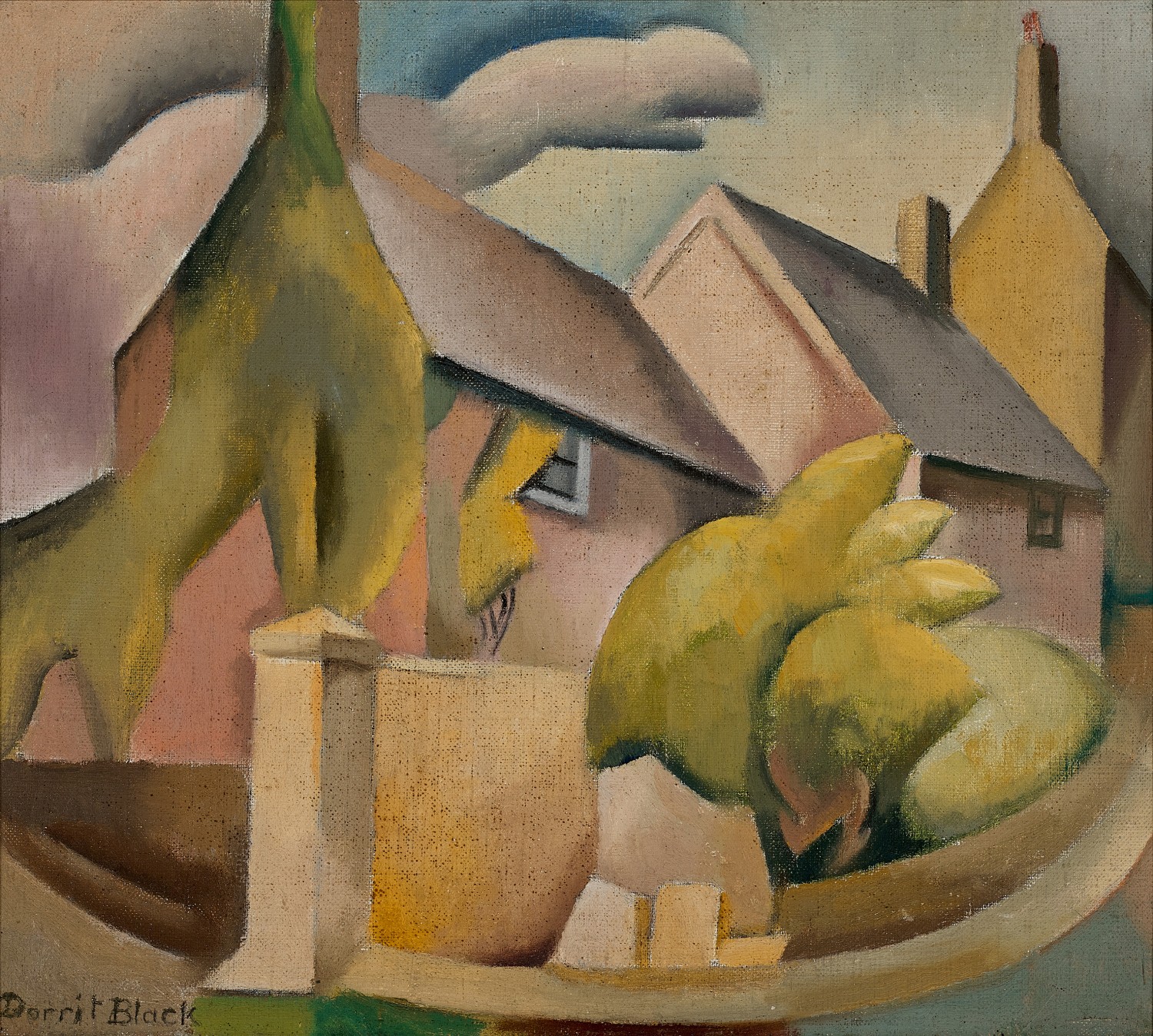


Dorrit Black
also known as Houses on the corner
oil on canvas on cardboard
33.5 x 37.5 cm
signed lower left: Dorrit Black
inscribed on label verso: Dorrit Black / Dudley Court Hotel / 13 Inverness Terrace / London W2 / No 6. / Dorset Cottages
Estate of the artist
Thence by descent
Mary Leask, Salisbury, England (inscribed on label verso)
Thence by descent
Private collection, Perth
Paintings by Dorrit Black, Macquarie Galleries, Sydney, 18 – 28 March 1936, cat. 25
Exhibition of Oils, Watercolours and Lino Cuts by Dorrit Black, Royal South Australian Society of the Arts, Adelaide, 7 – 23 July 1938, cat. 14
Dorrit Black Memorial Exhibition, Royal South Australian Society of the Arts, Adelaide, 1952, cat. 35
Dorrit Black: Unseen Forces, Art Gallery of South Australia, Adelaide, 14 June – 7 September 2014
North, I., The Art of Dorrit Black, Art Gallery of South Australia, Adelaide, and Macmillan, South Melbourne, 1979, cat. 0.51, p. 122 (as 'Houses on a Corner, c.1935')
Lock–Weir, T., Dorrit Black: Unseen Forces, Art Gallery of South Australia, Adelaide, 2014, pp. 79, 83 (illus.), 191 (illus.)
260090 Cottages-topaz-upscale-4x.jpg
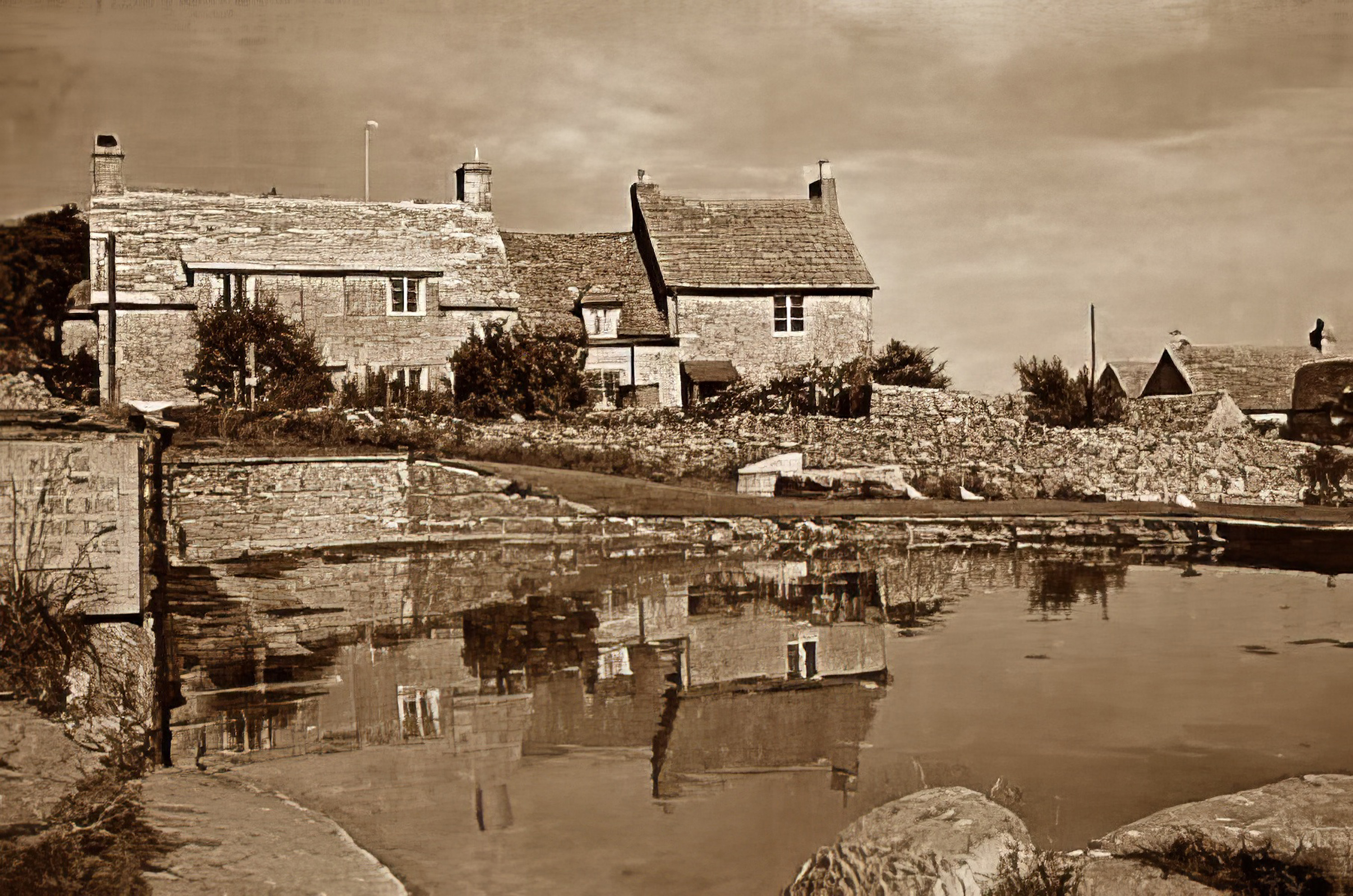
Cottages in Worth Matravers, Dorset
photographer unknown
Dorrit Black was a pioneer of Australian modernism. In London and Paris during the late 1920s she studied with key international figures, learning about contemporary developments in modern art at their source. At home – in both Adelaide and Sydney – she later shared her experiences, disseminating her knowledge and making a significant contribution to the evolution of the local iteration of modernism. A newspaper article published after her return in 1929 declared: ‘Miss Black… is a modern of moderns, and is all for the new school of painting’1 which, as she went on to explain, ‘does not aim at realism, [but] is founded on design, harmony, and rhythm in forms.’2
Black’s formal art education began at the Adelaide School of Design, and she undertook private watercolour painting lessons with Gwen Barringer before moving interstate to continue her studies at Julian Ashton’s Sydney Art School. It is likely that Black was introduced to the techniques of linocut printmaking by Thea Proctor, but her deepest engagement with the medium began in late 1927 at the Grosvenor School in London where she attended classes with Claude Flight, a passionate advocate for the colour linocut which he regarded as the modern medium for the modern age. Studying with Flight for several months, Black absorbed his example of the use of bold colour, the reduction of subject matter to simplified shapes, and patterns based on a dynamic system of opposing rhythmic lines and forms. Critical recognition of her efforts in the medium came early, with The pot plant, 1933 being purchased by the Victoria and Albert Museum, London.
260090 Dorrit Black.jpg
Dorrit Black
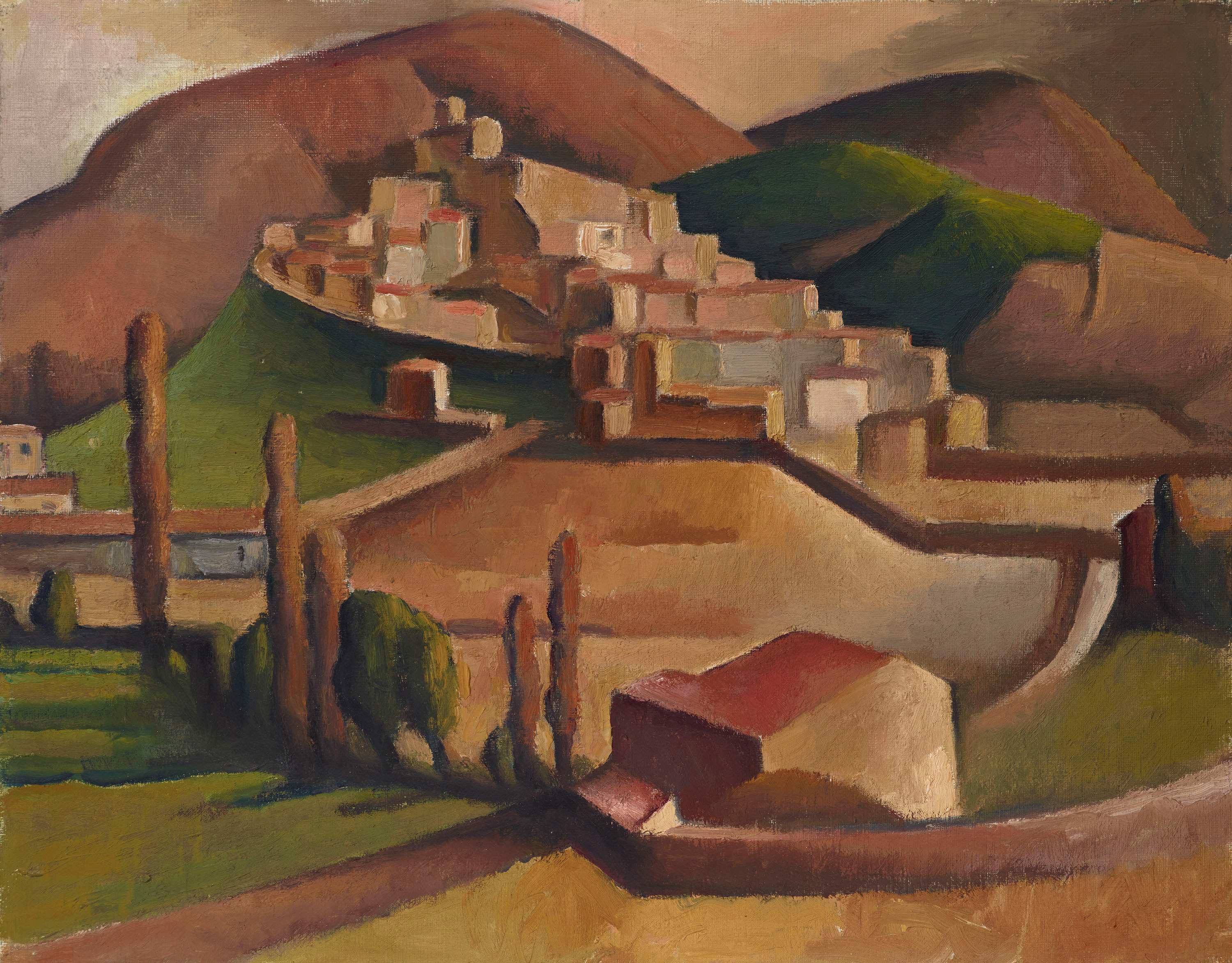
Mirmande (with surrounding hills), 1934
oil on canvas on paperboard
35.6 x 45.9 cm
Art Gallery of New South Wales, Sydney
Encouraged by her friends and fellow-artists, Anne Dangar and Grace Crowley, Black left London for Paris at the end of 1927, her intention being ‘to acquire a definite understanding of the aims and methods of the modern movement and, in particular – of the Cubists.’3 Her primary teacher in this undertaking was André Lhote, whose academy in Montparnasse (and summer school at Mirmande in the south of France) attracted students from all around the world. Lhote’s approach to Cubism incorporated the theory of dynamic symmetry and compositional principles based on the golden mean. Subjects were simplified according to geometry and organised into flattened, planar arrangements. As Black wrote, ‘He judges the work from standards of rhythm, balance, proportion and line, and applies these standards to its three properties – form, tone and colour.’4 Her understanding progressed further in mid-1929 when she and Crowley attended a series of classes with Albert Gleizes whose teaching ‘offered… a bridge from cubism to pure abstraction: from the static to the dynamic.’5
260090 Dorrit Black, House roofs and flowers.jpg
Dorrit Black
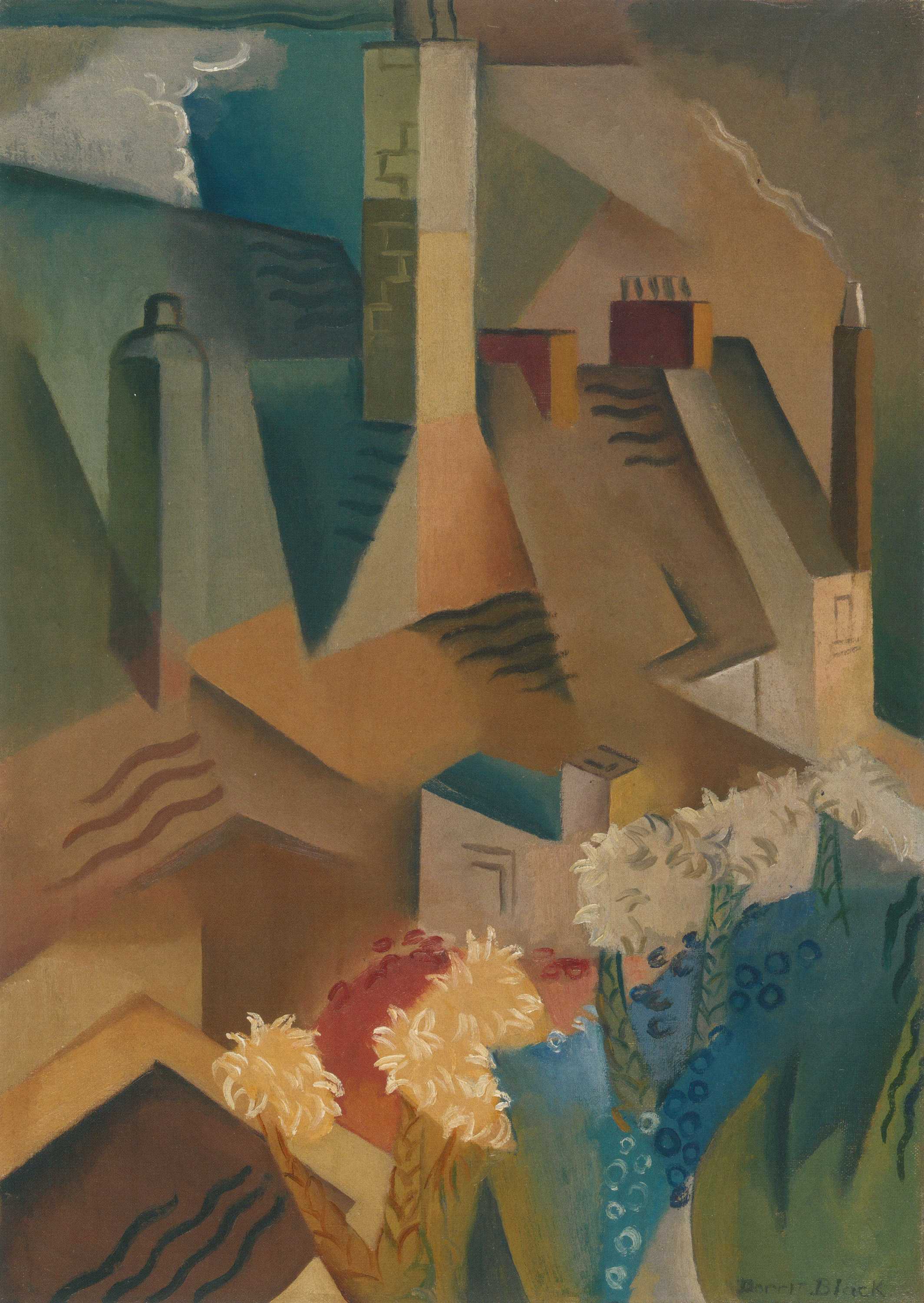
House-roofs and flowers, 1935
(painted London, England)
oil on canvas 50.2 x 38.0 cm
National Gallery of Australia, Canberra
Dorset cottages, 1935 was painted during an extensive overseas trip between March 1934 and September 1935 during which Black travelled with her mother in Continental Europe, England, Scotland, Wales, the United States and Canada. The places they visited sometimes feature in Black’s work, from Mirmande (with surrounding hills), 1934 (Art Gallery of New South Wales) to The mountain lake, 1935 (National Gallery of Victoria), a linocut depicting a view from Neuschwanstein Castle in the foothills of the Alps in the south of Germany. Black reconnected with friends during the trip and in the summer of 1934, she joined Claude Flight and his partner, Edith Lawrence, on a sketching holiday in Dorset. ‘I had one of the most enjoyable times of my life down there, such an awfully jolly & interesting lot of people. Claude got me painting rapid watercolour sketches most of the time, though I did do some of my usual careful constructed & deliberate oils.’6
They made day trips to Corfe Castle and to nearby swimming spots, including Chapman’s Pool which she depicted in a 1935 linocut, but staying in the village of Worth Matravers it was the limestone cottages that captured Black’s attention and which feature both here in Dorset cottages, 1935 and another related painting. The present work, thought to be the first she made of the subject, was painted in Salisbury following the visit to Dorset. Using a subdued palette of earthy colours, it describes the simple form of the cottages as they step up the hill, their angular architectural geometry contrasting with the stylised clouds and bushes, and the dramatic curve of the path which sweeps across the foreground, containing the view and introducing a sense of dynamic movement to the composition.
1. Leigh, E., ‘Disciple of modern art’, Register News Pictorial, 5 September 1929, cited in Lock-Weir, T., Dorrit Black: unseen forces, Art Gallery of South Australia, Adelaide, 2014, p. 57
2. ibid.
3. Black, D., ‘Account of travel and work 1927 – 29’, cited in North, I., The Art of Dorrit Black, Art Gallery of South Australia and The Macmillan Company of Australia, South Melbourne, 1979, p. 139
4. ibid.
5. Lock-Weir, op. cit., p. 56
6. Dorrit Black, postcard to her sister, 31 July 1934, cited in Lock-Weir, ibid., p. 79
KIRSTY GRANT