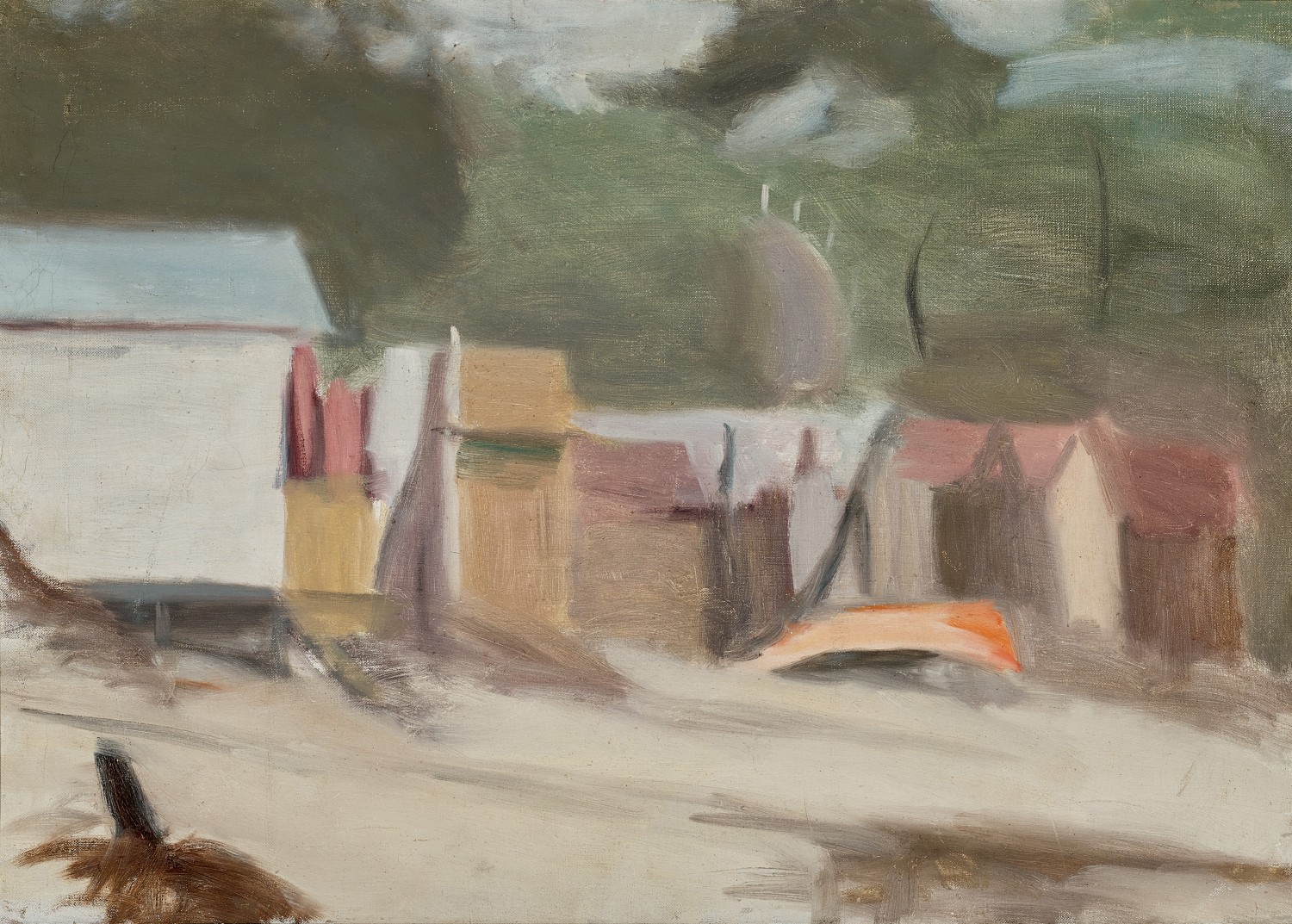
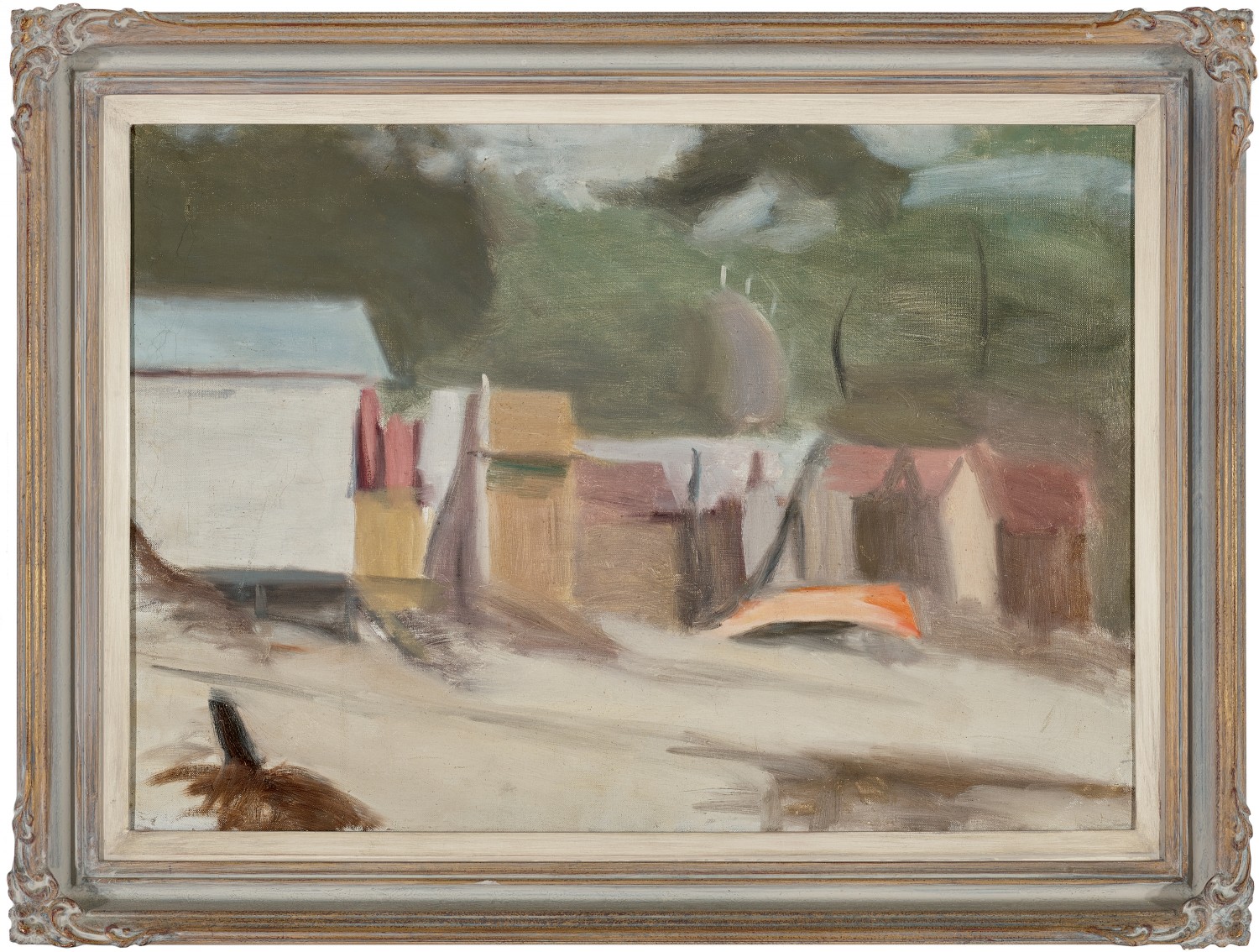
The bathing boxes, Watkins Bay, 1928
Clarice Beckett
oil on canvas
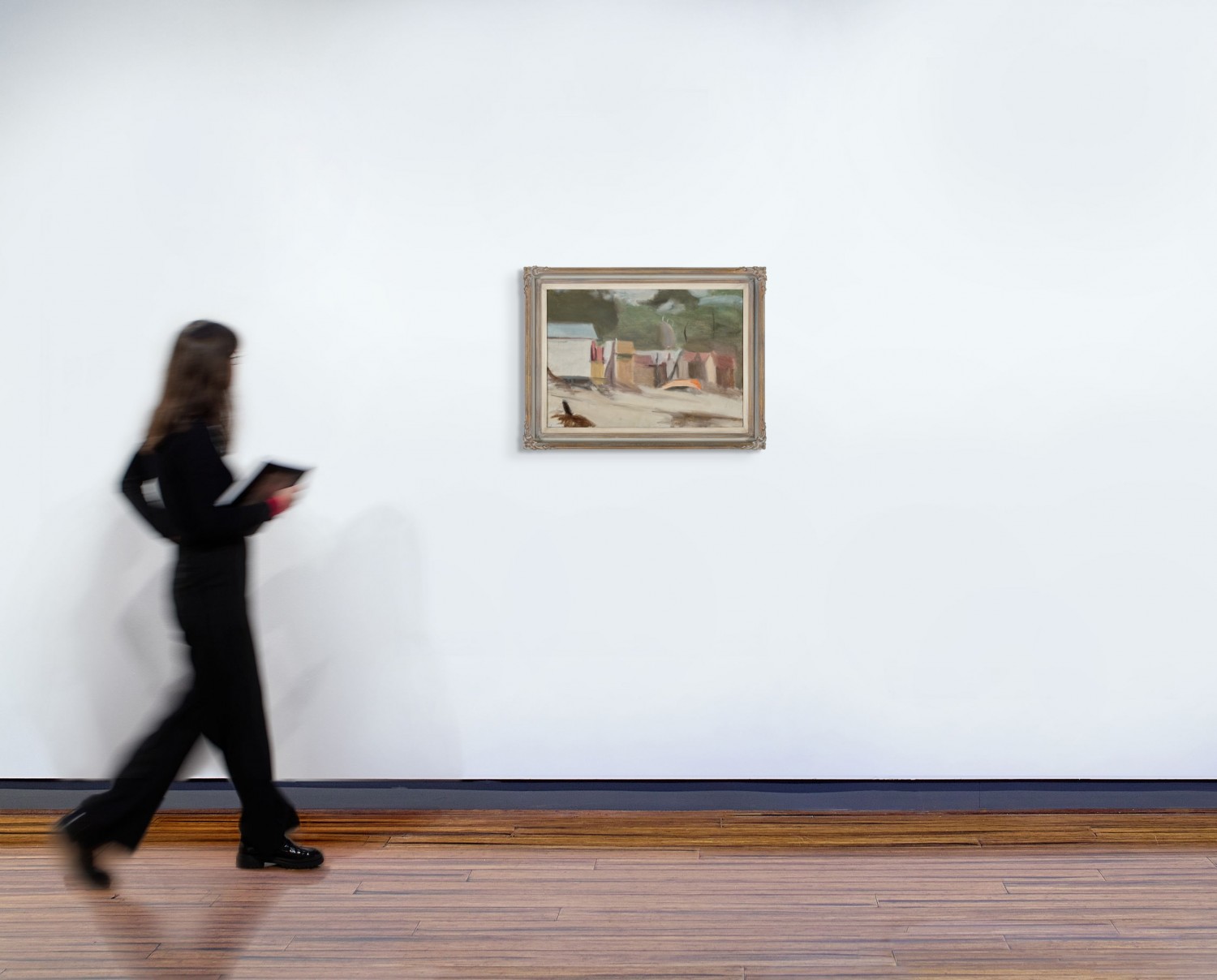
47.0 x 67.0 cm
bears inscription verso: A
bears inscription verso: 60
Rosalind Humphries Gallery, Melbourne
Private collection, Melbourne
Niagara Galleries, Melbourne
Private collection, Sydney, acquired from the above in August 2001
Estate of the above
Homage to Clarice Beckett (1887 – 1935): Idylls of Melbourne and Beaumaris, Rosalind Humphries Gallery, Melbourne, 30 October – 20 November 1971
Clarice Beckett Retrospective Exhibition 1921 – 1935, Realities Gallery, Melbourne, 11 October – 1 November 1979
Clarice Beckett: Politically Incorrect, Ian Potter Museum of Art, University of Melbourne, Victoria, and touring to: S.H. Ervin Gallery, Sydney; Orange Regional Gallery, New South Wales; Art Gallery of South Australia, Adelaide; Bendigo Art Gallery, Victoria; Tasmanian Museum and Art Gallery, Hobart and Burnie Regional Art Gallery, Tasmania, 5 February 1999 – 22 May 2000, cat. 34 (label attached verso)
Blue Chip III: The Collector’s Exhibition, Niagara Galleries, Melbourne, 27 February – 31 March 2001, cat.13 (illus. in exhibition catalogue, p. 14)
Clarice Beckett: The Present Moment, Art Gallery of South Australia, Adelaide, 27 February – 23 May 2021
Hollinrake, R., Clarice Beckett: Politically Incorrect, The Ian Potter Museum, Melbourne, 1999, p. 75
Lock, T., The present moment: The art of Clarice Beckett, Art Gallery of South Australia, Adelaide, 2021, pp. 145 (illus.), 186 (illus.)
Clarice Beckett’s enduring connection to the Bayside region of Port Phillip Bay was forged in early childhood. Although raised in Casterton in regional Victoria, her family often holidayed at Beaumaris, a coastal suburb to the south of the city of Melbourne.1 Beckett’s mother counted the artists Walter Withers and Ola Cohn among her friends and on their advice, she enrolled Clarice (and her sister Hilda) in National Gallery School in 1914, studying under Frederick McCubbin. Upon attending a lecture by the artist-theorist Max Meldrum, Beckett was inspired to change direction and joined his classes for nine months. Meldrum taught his own theory of ‘optical science’ aka Tonalism, which, as its name implies, revolved around building an image based on tonal values alone. Although she remained within the Meldrumite orbit throughout her subsequent career, Beckett’s paintings were truly a combination of the Gallery School’s academic teaching, Tonalism – and herself. As her colleague Elizabeth Colquhoun noted, her paintings were more ‘fragile’ than Meldrum’s. ‘It was a different kind of thing, but it was very truthful.’2
With her handmade painting trolley in tow, Beckett would wander the same areas repetitively, always approaching a scene with a different ambition as to the mood she wished to capture. Indeed, when asked why she never felt the desire to travel more widely, she responded ‘I have only just got the hang of painting Beaumaris after all these years, why should I go somewhere else strange to paint?’3 From the earliest days of colony, this locale attracted pleasure seekers with the first public swimming baths dating from the 1840s. By the turn of the century, clusters of bathing boxes were built within the ti-tree scrub by private individuals, or to service the patrons of nearby guesthouses. In The bathing boxes, Watkins Bay, 1928, Clarice Beckett turns her gaze to one such group located in the curve of Watkins Bay, at the end of the street where the artist lived. Beckett’s distinctive style is immediately recognisable and, when seen collectively, her paintings provide an unsurpassed record of the changing landscape of the Bayside region. By the late 1920s, when The bathing boxes, Watkins Bay was painted, such huts could be found on all beaches in the area, sometimes two or three deep. A related work, Bathing boxes, Beaumaris, 1928 – 30 (Important Australian and International Fine Art, Deutscher and Hackett, Sydney, 14 September 2022, lot 26), is the same location but viewed from the rear, whilst this painting reveals the front of the huts instead with the Beckett family’s own hut included. The artist’s compositional skill and mastery of colour is evident with the looming green of the background foliage bisected by the grey path leading up to Beach Road. The orange upturned boat also provides an alternate directional trigger, and both emphatically anchor the solidity of the horizontal march of the huts themselves.
A second related work, Bathing boxes, Beaumaris, c.1932 (Important Australian and International Fine Art, Deutscher and Hackett, 21 April 2021, lot 24), depicts the same huts from the opposite and seaward southerly aspect. Ultimately, these idyllic views no longer remain as a huge storm in 1934 destroyed huts up and down the coast, most of which were not replaced. The bathing boxes, Watkins Bay, therefore, retains historic as well as aesthetic importance.
1. The family subsequently lived at ‘St Enoch’s’, Dalgetty St, Beaumaris, from 1919. The house burned down in 1945.
2. Elizabeth Colquhoun, cited in Peers, J., More than just gumtrees: a personal, social and artistic history of the Melbourne Society of Women Painters and Sculptors, Dawn Revival Press, Melbourne, 1993, p. 197
3. Clarice Beckett, c. 1928, cited in Hollinrake, R, Clarice Beckett: the artist and her circle, Macmillan, Melbourne, 1979, p. 21
ANDREW GAYNOR