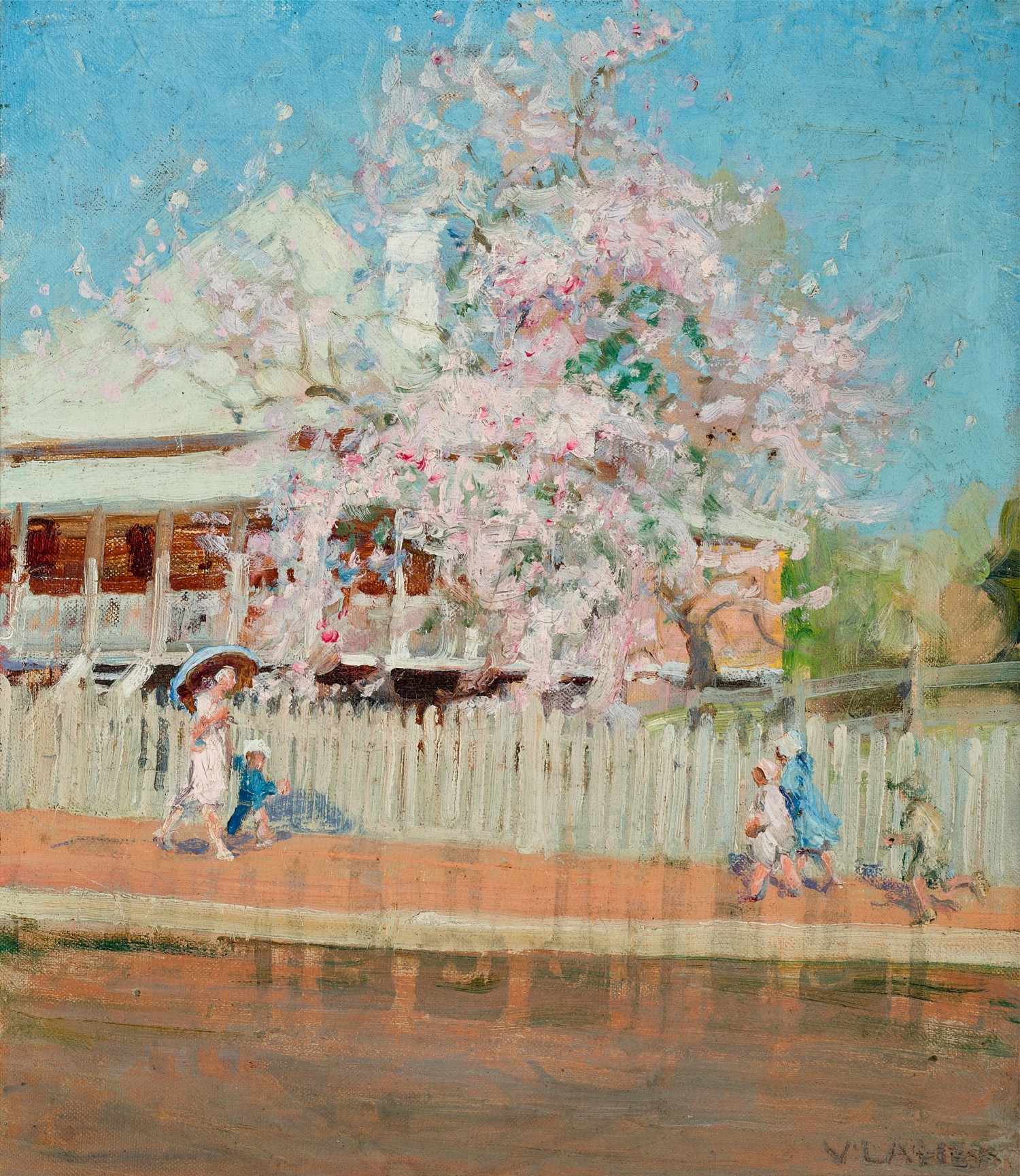
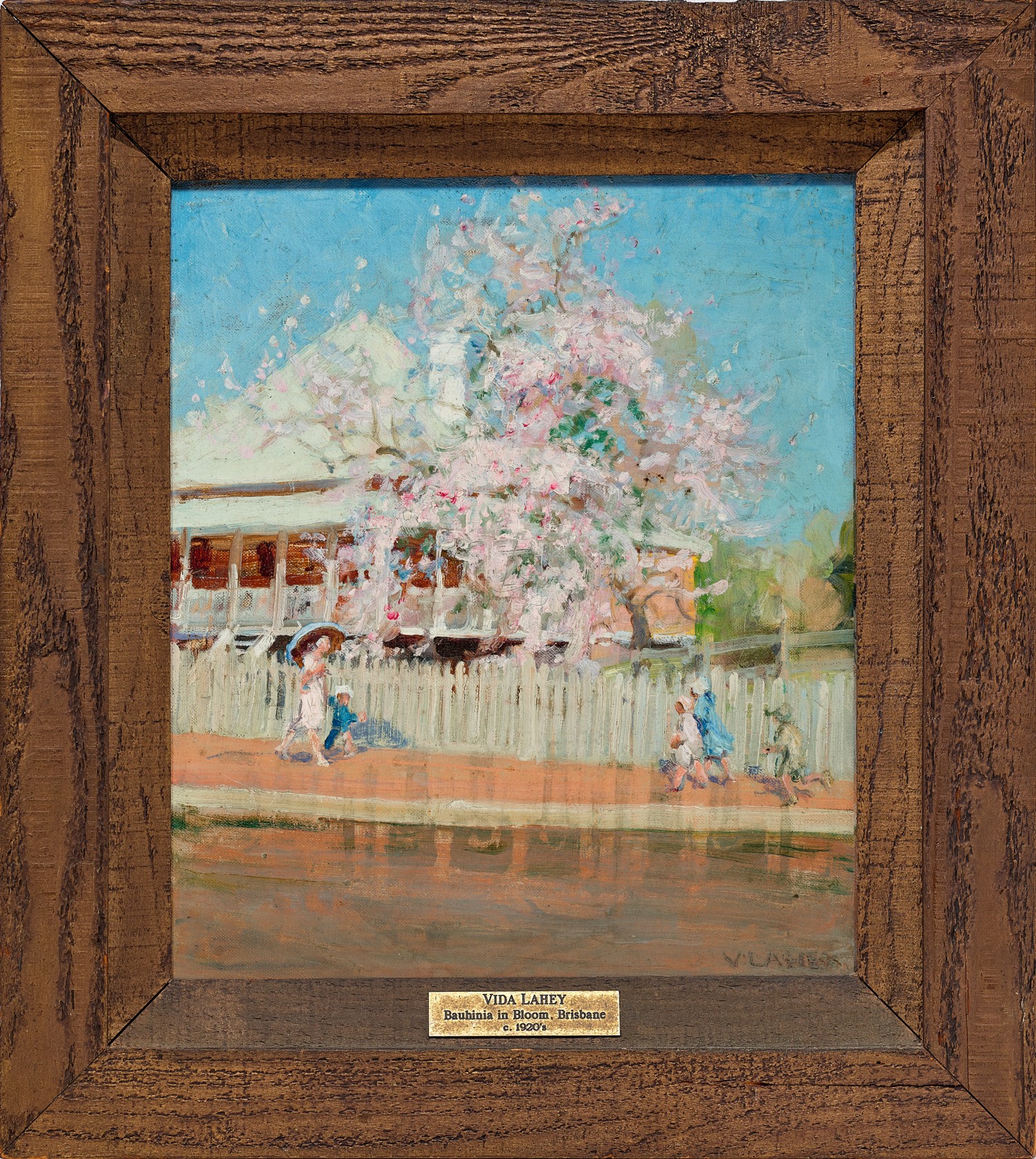
Bauhinia in bloom, Brisbane, 1929
Vida Lahey
oil on canvas on composition board
36.0 x 31.0 cm
signed lower right: V LAHEY
signed and inscribed with title on label verso: ... / Brisbane / Vida Lahey / Corinda Brisbane
Mrs Harry Southwell
Edna O'Sullivan, by 1989
Private collection, Melbourne
Thence by descent
Private collection, Melbourne
Vida Lahey: Oils and watercolours, Gainsborough Gallery, Brisbane, 16 May - 6 June 1929, cat. 1
Paintings by Vida Lahey, The Macquarie Galleries, Sydney, 18 - 28 September 1929, cat. 13
Paintings by Miss Vida Lahey: from seashore and garden, Everyman’s Lending Library, Melbourne, 24 October – 4 November 1933, cat. 5
Exhibition of paintings of Brisbane and of other things, Union Trustee Chambers, Brisbane, 20 May – 6 June 1936, cat. 4
Art of Miss Lahey: Oils and Water Colours [sic]', The Brisbane Courier, Brisbane, 16 May 1929, p. 24
'Art Exhibition. Miss Lahey's Paintings', The Sydney Morning Herald, Sydney, 19 September 1929, p. 10
MacAulay, B., Supplement to Songs of Colour. The Art of Vida Lahey, Works Located to 1989, Queensland Art Gallery, Brisbane, 1989, pp. 6, 30, 31, 37
Vida Lahey’s Bauhinia in bloom, Brisbane, 1929, shows a scene located on Gregory Terrace in Brisbane, a long stretch of road facing parklands.1 In the 1920s and 1930s, the Terrace was home to numbers of the now-iconic raised ‘Queenslander’ houses similar to the one pictured here. The precinct was also home to the Exhibition Building and Concert Hall, built 1891, which housed a modest art gallery to which Lahey was closely connected. Indeed, in 1931, when a new gallery was built within the former Concert Hall, Lahey and her close friend and colleague, the sculptor Daphne Mayo, were honoured by having key examples of their work placed at the entrance, ‘a remarkable testament to the high standing these women had won.’2 In Lahey’s case, it was her powerful and immensely popular painting Monday morning, 1912 (Queensland Art Gallery I Gallery of Modern Art, Brisbane), an honest appraisal of her sister and another woman at work in the family laundry. Lahey was the eldest of twelve children but shared her younger brother Romeo’s ‘interests in planning and environmental issues. In the 1920s and early 1930s, (she) painted as many scenes of industry and civic construction as women in social, work and leisure settings. Both men and women display the dignity of labour and service.’3 Whilst Monday morning illuminated domestic labour, the focus of Bauhinia in bloom, Brisbane is the flipside – a relaxed outdoor stroll with young children.
Bauhinia trees are a feature of the city, blooming typically from October through to December alongside the purple of Jacarandas and the vivid red-orange of Flame trees. Given its location, it is likely this Bauhinia was one she saw regularly as she commuted between the gallery and her studio. Through such details, her paintings have become important matters of record regarding Brisbane’s changing architecture, heritage and flora, with two other key examples being (Carts in Eagle Street), c.1913, and Early morning, Brisbane River, 1932 (Important Women Artists + Selected Important Australian and International Fine Art, Deutscher and Hackett, Melbourne, 10 November 2021, lots 6 and 7 respectively). Whilst this particular Queenslander no longer stands on Gregory Terrace, Lahey’s painting has captured it and its personal Bauhinia for posterity. The season is likely to be early Spring when the fragrant flowers are most profuse, but whose petals have yet to carpet the footpath below. The figures are all bundled in Sunday-best coats and the woman at left holds an umbrella as, despite the brilliance of the blue sky, a recent heavy shower has left the road surface wet and reflective. The bright colour and post-Impressionist brushwork is lively, reminiscent of her friend Ethel Carrick Fox’s paintings, with whom Lahey studied at Colarossi’s atelier in Paris in 1919.
Lahey was often noted for her ‘really beautiful sense of colour’4, and indeed, when Bauhinia in bloom, Brisbane was exhibited in Brisbane, Sydney and Melbourne, a number of critics singled it out for praise. The Sydney Morning Herald’s reviewer, however, went further by highlighting Lahey’s technical virtuosity, noting that the whole scene revolved around ‘the riot of pink blossom, to which the remainder of the picture is artistically keyed, (and) is treated with great delicacy.’5
1. Gregory Terrace is identified as the location in the catalogue for: Exhibition of paintings of Brisbane and of other things, Union Trustee Chambers, Brisbane, 1936
2. McGuire, M. E., All things opposite: essays on Australia art, Champion, Melbourne, 1995, p. 108
3. MacAuley, B., Vida Lahey: paintings and watercolours, Philip Bacon Galleries, Brisbane, 2012
4. Howard Ashton, cited in: ‘Tasmanian pictures. Exhibition in Sydney. Miss Vida Lahey’s work’, The Mercury, Hobart, 4 September 1926, p. 11
5. 'Art Exhibition. Miss Lahey's Paintings', The Sydney Morning Herald, Sydney, 19 September 1929, p. 10
ANDREW GAYNOR