Classical landscape with tower, c.1820
John Glover
oil on canvas
77.0 x 122.5 cm
Thomas Agnew and Sons, London (label attached verso, no. 32719)
Private collection, acquired from the above in October 1970
Leonard Joel, Melbourne, 8 November 1989, lot 261 (as 'Dinas Brann Castle Near Llangollen')
Private collection, Hobart
‘Glover possesses the talent of seizing upon an advantageous feature, or fixing a fleeting beauty. His sphere is locality; but his choice is classic; his eye acute, his mind replete with science and glowing with genial images… He excels, in the representation of particular [atmospheric] effects… without affecting the clearness of the hills in the distance.’1
This praise of John Glover’s art was written in 1809 by art critic William Carey and is one of many such reviews Glover received from London contemporaries and connoisseurs during his long career. Although many of his paintings of British and European landscapes are well known, Glover’s status and reputation as a fashionable painter of watercolours and oils in England over several decades is underappreciated in Australia. Rather, he is widely recognised and appropriately admired as one of the most significant landscape painters in the Australian colonies in the nineteenth century. This antipodean component of his oeuvre occurred only in his later years, having arrived in Van Diemen’s Land (Lutruwita / Tasmania) on 18 February 1831, his sixty-fourth birthday. Yet even in Australia, Glover continued to paint European scenes, their topography prompted by the numerous sketchbooks he had brought with him which were filled with swift annotations of sights seen during his frequent sketching tours through the British Midlands, Lakes District, Wales, Scotland, Switzerland, France, the Rhineland, Italy and elsewhere.
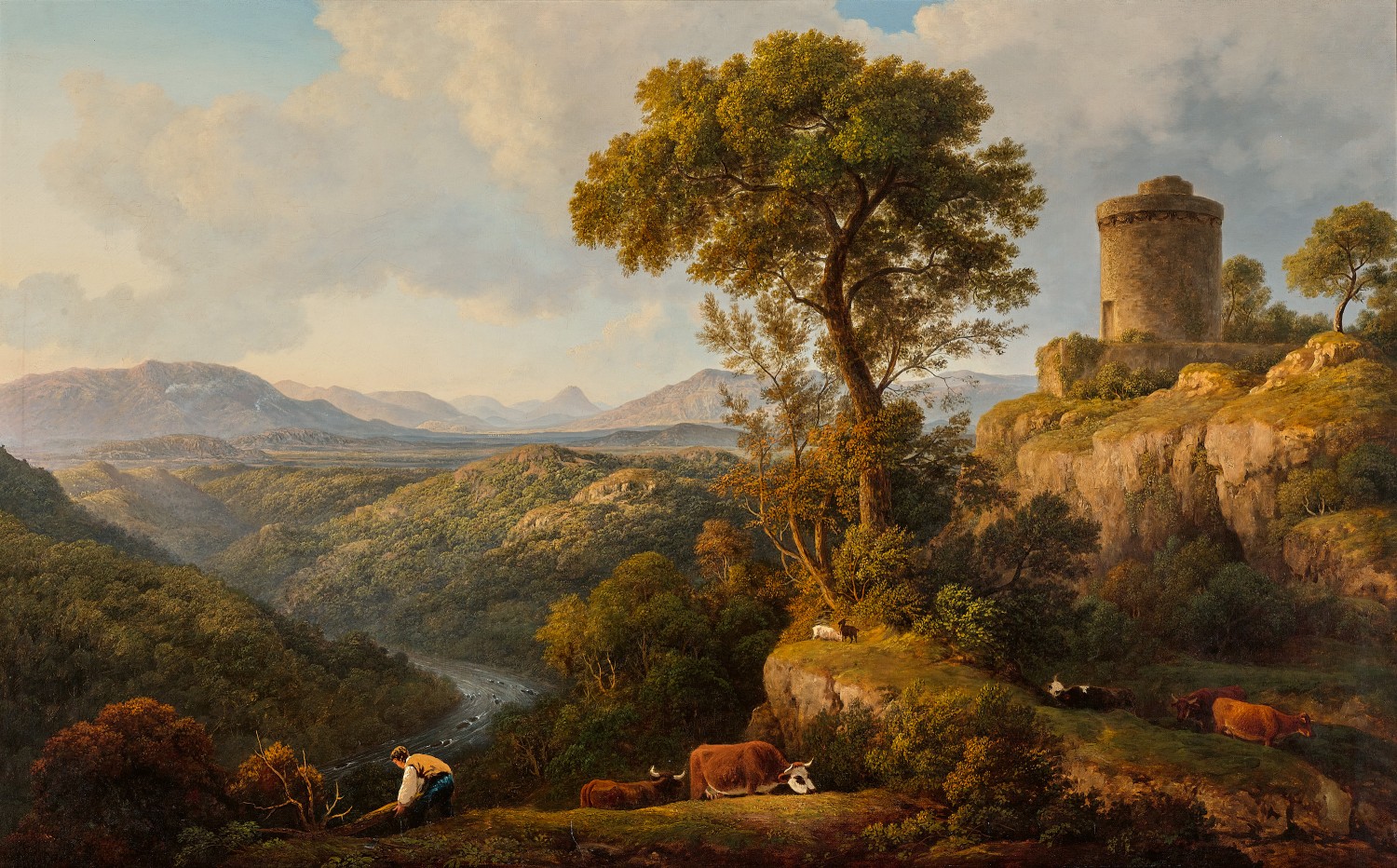
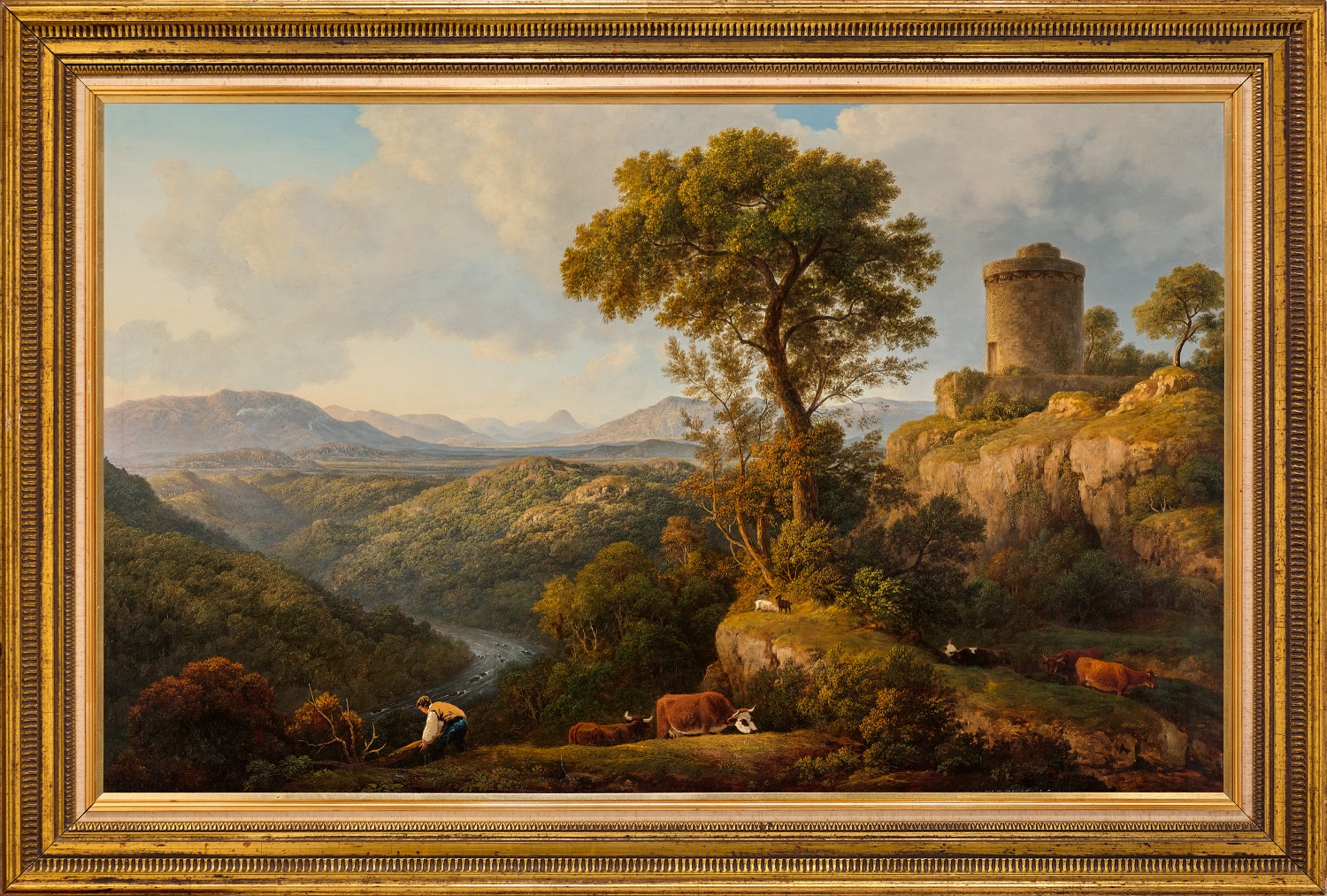
The present expansive scene is typical of Glover’s output, combining the key elements described by Carey. A heavily wooded valley stretches to the distant sun-tipped mountains, our eyes directed to the curving river and beyond by the bending figure’s light clothing. In the foreground, cattle and goats gently animate the scene, grazing contentedly, immersed in the folds of the rocky hilltop. The well-preserved stone fortification that overlooks the valley may be a medieval round tower seen during Glover’s travels, among the innumerable castles, churches, classical buildings and ruins that he sketched. Alternatively, it might be an imaginary feature, a compositional device inspired by classical edifices in the seventeenth-century art of Nicolas Poussin and Claude Lorrain whose luminous arcadian tranquillity Glover sought to emulate. His Classical landscape (Art Gallery of New South Wales), identified by David Hansen as Landscape with a Sybil’s temple: Composition, and painted the year before Glover first visited Italy, has a comparable tower in the mid-distance.
All of these elements – wilderness and pastoral peace, contemporaneity and antiquity – are united by the sinuous curves of the towering tree, arboreal features for which Glover is most widely recognised today, particularly in his depictions of centuries-old gum trees on his northern Tasmanian farm. And across the painting we have the atmospheric effects for which Glover was so often admired: the soft raking light of the low sun to our left, the misty haze in the valley, the cumulus clouds filling much of the sky, and the reddish tints in the foreground foliage that perhaps hint at approaching autumn.
1. William Carey, cited in Hansen, D. (ed.), John Glover and the Colonial Picturesque, Tasmanian Museum and Art Gallery, Hobart, 2003, p. 56
ALISA BUNBURY