The argument, 1959
Jeffrey Smart
oil on board
31.0 x 63.0 cm
signed lower left: Jeffrey Smart
Macquarie Galleries, Sydney
Private collection
Deutscher~Menzies, Sydney, 8 December 2004, lot 46
Private collection, Melbourne
Jeffrey Smart, Macquarie Galleries, Sydney, 15 – 23 September 1959, cat. 6
Quartermaine, P., Jeffrey Smart, Gryphon Books, Melbourne, 1983, cat. 337, p. 106
'Exhibition of Paintings by Jeffrey Smart', Sydney Morning Herald, Sydney, 16 September 1959
'Strange Design in Art by James Gleeson', Sun, Sydney, 16 September 1959
We are grateful to Stephen Rogers, Archivist for the Estate of Jeffrey Smart, for his assistance with this catalogue entry.
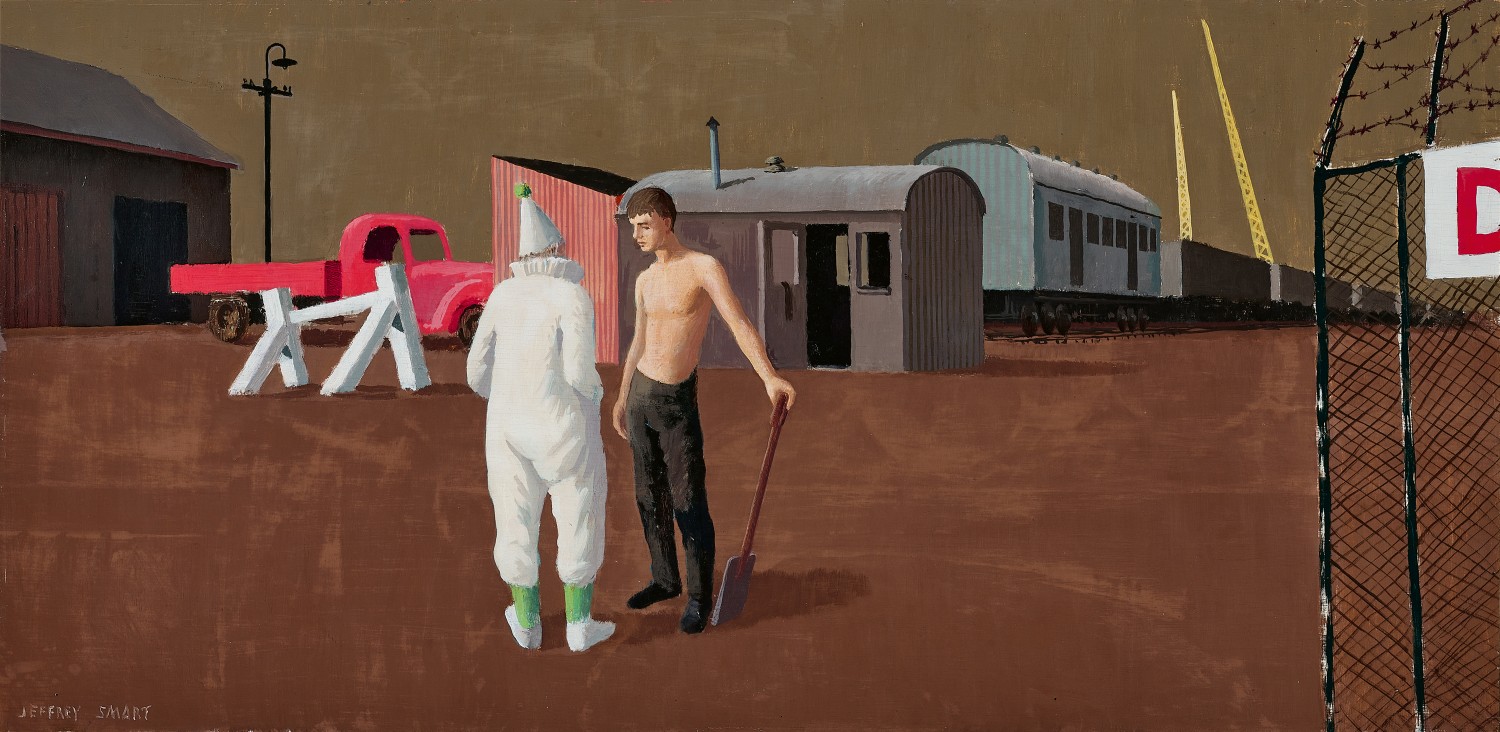
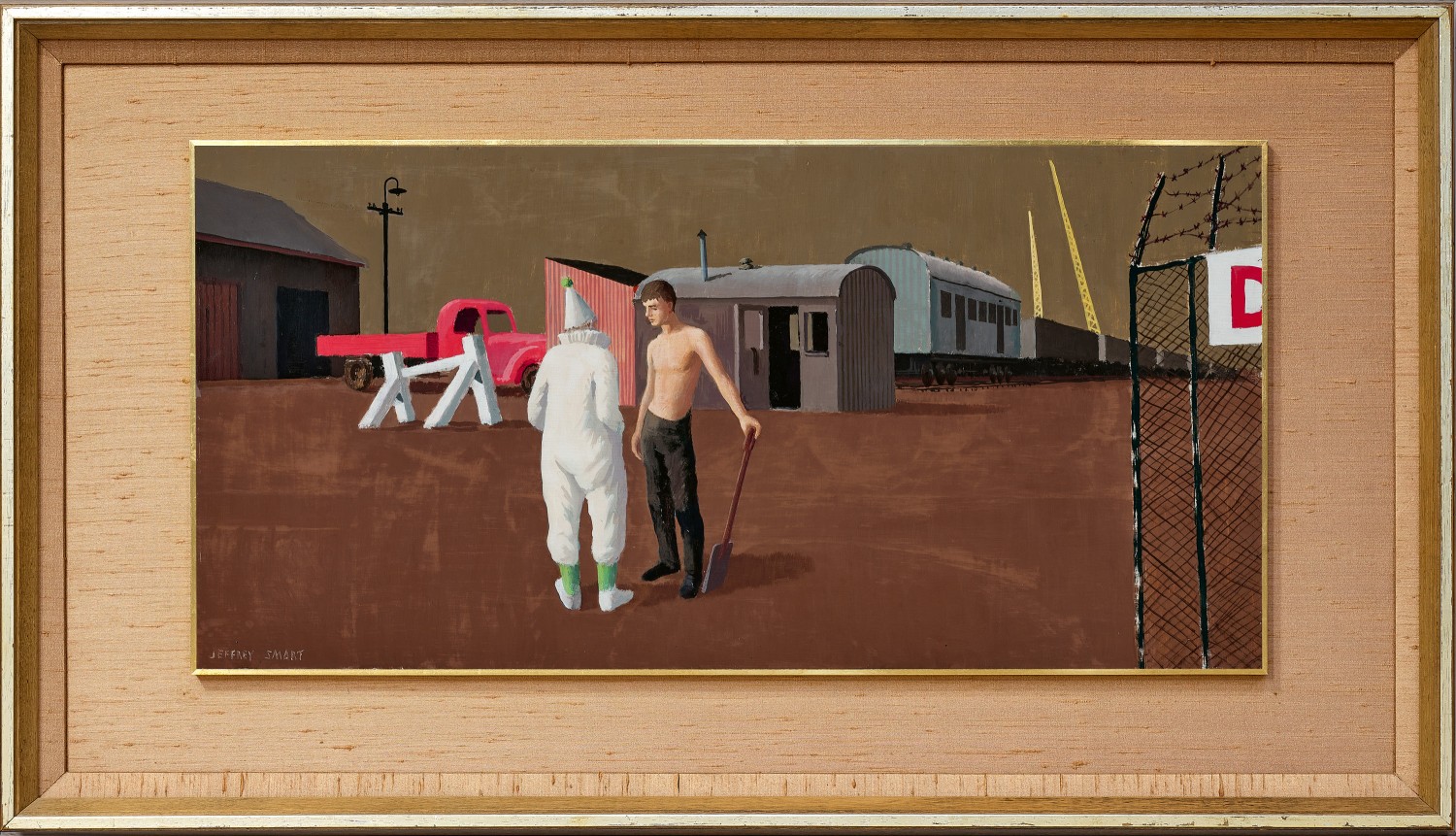
In Jeffrey Smart’s featureless foreground of monochrome brown earth, two men converse intently, the shirtless labourer apparently unfazed by the absurd commedia dell’arte Pierrot costume worn by his partner in dialogue. This enigmatic scene of cinematic stillness presented within The argument, 1959 takes place in a remote outback railyard composed of ‘commonplace things fraught with significance’1 – a couple of empty sheds of corrugated metal, a streetlamp and a cross-hatched fence topped with barbed wire on which is hung a truncated warning sign. Topped by a pair of canary-yellow cranes, a freight train is stationed here, the chain of its wagons receding into the distance. Providing a pop of colour within Smart’s eerily dark scene, a bright red utility vehicle is parked between the buildings, partially obstructed by a lone wooden barricade painted in lustrous white.
‘The Argument’ was a theme Jeffrey Smart addressed in at least three different paintings over various periods in his life – first in Adelaide in 1950 (The Argument, Naples, private collection); then while living in Sydney in 1959 (the present work); and finally, when comfortably settled in Tuscany, in 1982 (The Argument, Prenestina, Art Gallery of South Australia). Each image of this motif featured a group or pair of people in deep conversation against a perspectival backdrop of either towering facades of apartment blocks or an array of stationary vehicles. Undercut with humour by the inclusion of a stock character of pantomime, The argument, 1959 remains taut with what the quality James Gleeson identified as ‘those pauses between moments of action and... the silence that presages a crucial confession, an accusation or a bitter denial.’2
The argument comes from a particularly fertile period for Smart in Sydney prior to his departure for Europe in 1963. Alongside the burgeoning fame of regular solo exhibitions at Macquarie Galleries, Smart strung together stints as an art critic for the Daily Telegraph, as an art teacher at private schools and as a life-drawing teacher at East Sydney Technical college. At the recommendation of Bernard Smith, in 1950 Smart was offered the role as art educator for the ABC Radio program The Argonauts Club for the Children's Hour. He spent the next decade as an influential character in the cultural life of Australia, even appearing on ABC television broadcasts of the show after 1956.
Exhibited amongst seventeen paintings in Smart’s solo exhibition at Macquarie Galleries in September 1959, Wallace Thornton of the Sydney Morning Herald was quick to point out the ‘surrealistic influence of Europe’s Delvaux.’3 Smart’s setting of this staged argument in the deserted terminus of a train station indeed invites comparison with the oneiric works of Belgian modernist Paul Delvaux, with both painters showing a predilection for placing figures frozen in rhetorical gestures in classical, industrial and urban scenes.
Smart’s paintings stood apart from the mainstream of contemporaneous Australian art. Maintaining a staunch resistance to the tide of abstraction, his art tended towards a crisp and detailed magical realism with an imagery exclusively his own. By 1959 the artist had ‘developed his own form of romanticism: which is to isolate and dispose his forms and colours in strange tones and perspectives so that they seem to live in some timeless, faintly desolate tranquillity.’4 The argument was singled out in the Sydney Morning Herald review of the Macquarie Galleries exhibition ‘as one of the more successful paintings, for the artist paradoxically achieves his best effects from his flattest and least textured paintings – paradoxically, that is, because it is these works which come closest to the dangers of theatrical design.’5
1. Gleeson, J., ‘Strange Design in Art', Sun, Sydney, 15 September 1959
2. Gleeson, J., ‘Artist implies his drama’, Sun, Sydney, 24 August 1955,
3. Wallace, T., ‘Exhibition of Paintings by Jeffrey Smart’, Sydney Morning Herald, Sydney, 15 September 1959, p. 2
4. ‘Artbursts’, The Bulletin, Sydney, vol. 80, no. 4154, 23 September 1959, p. 25
5. Wallace, op. cit.
LUCIE REEVES-SMITH