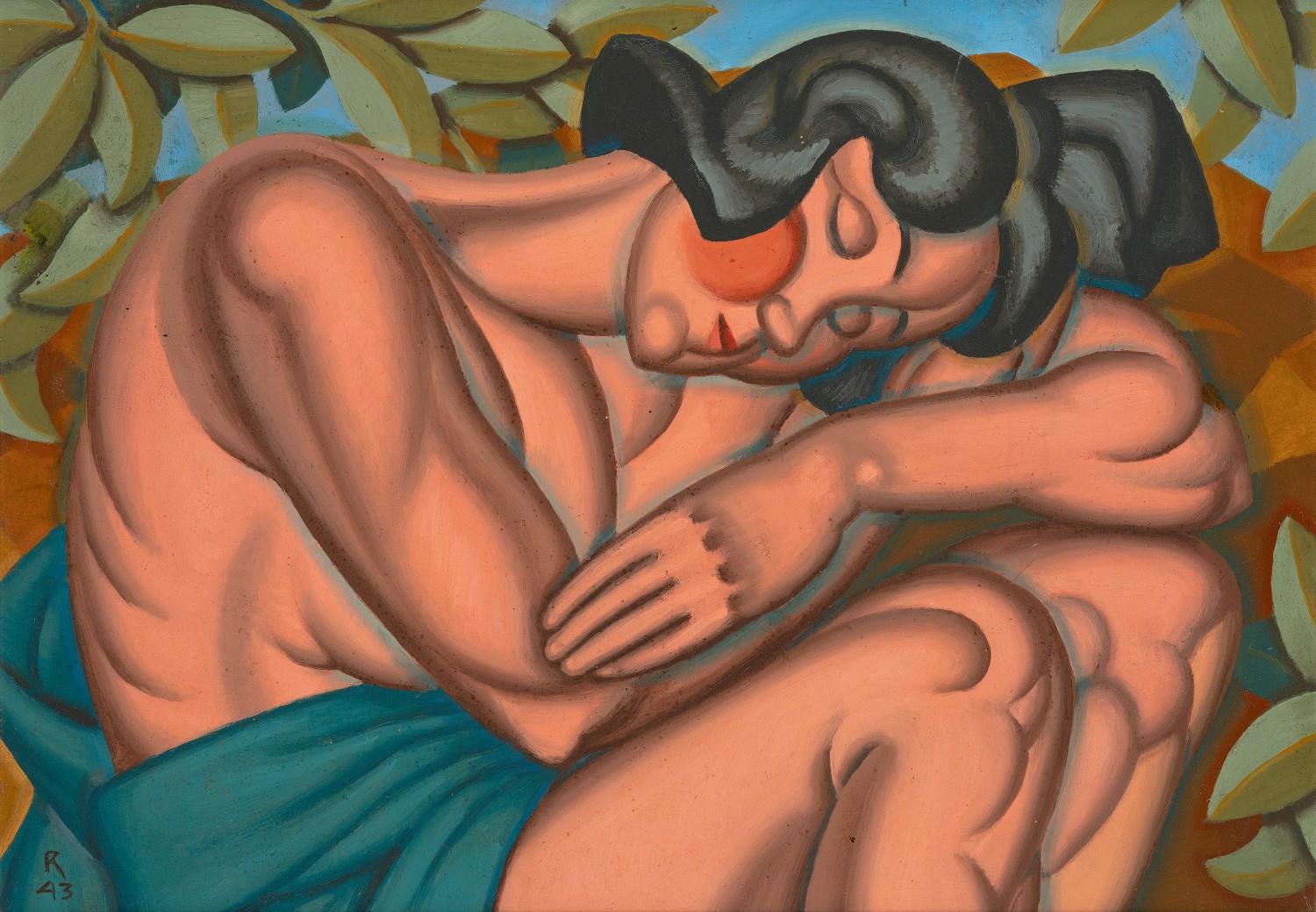
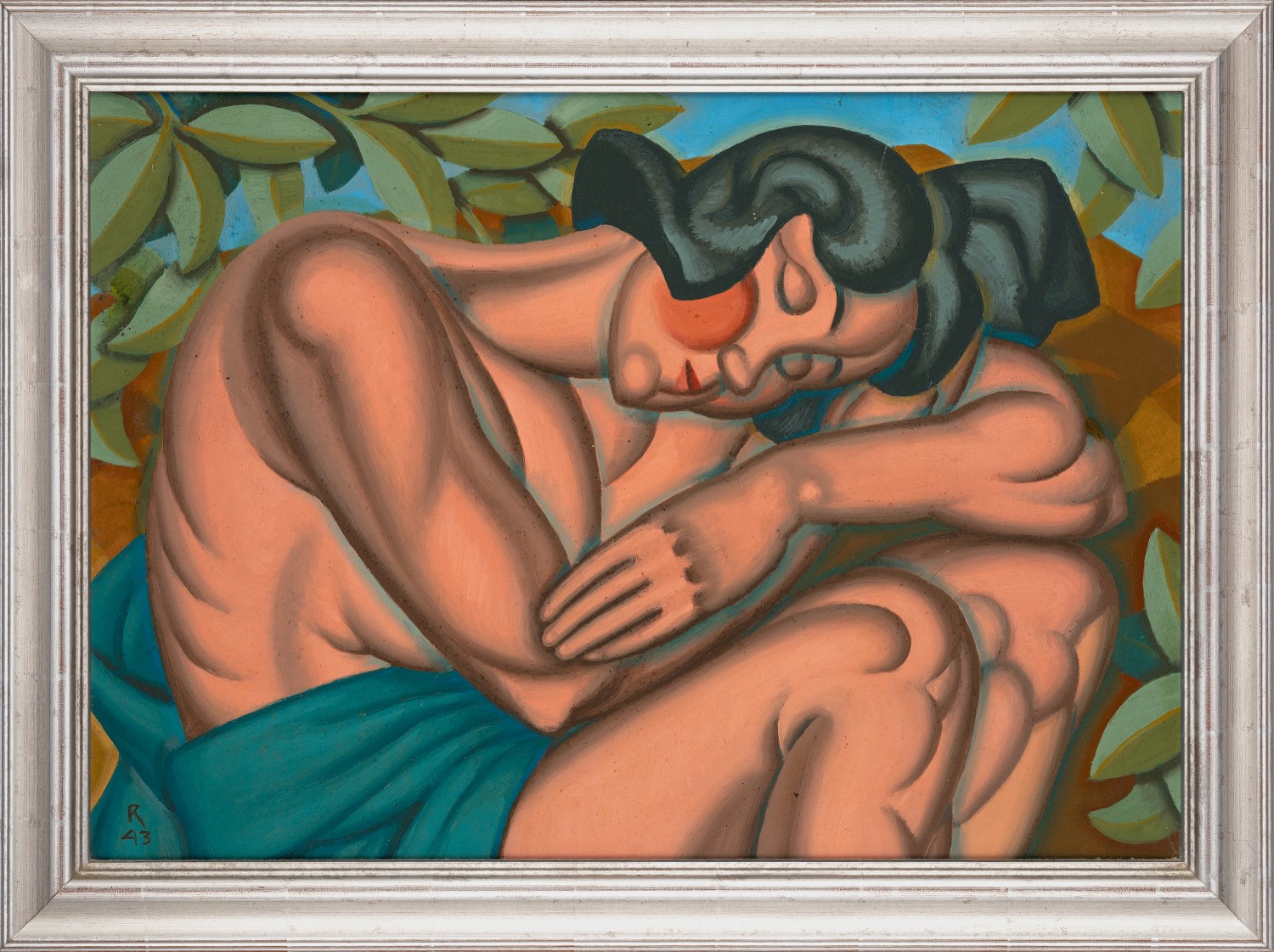
Sleeper, 1943
Weaver Hawkins
oil on composition board
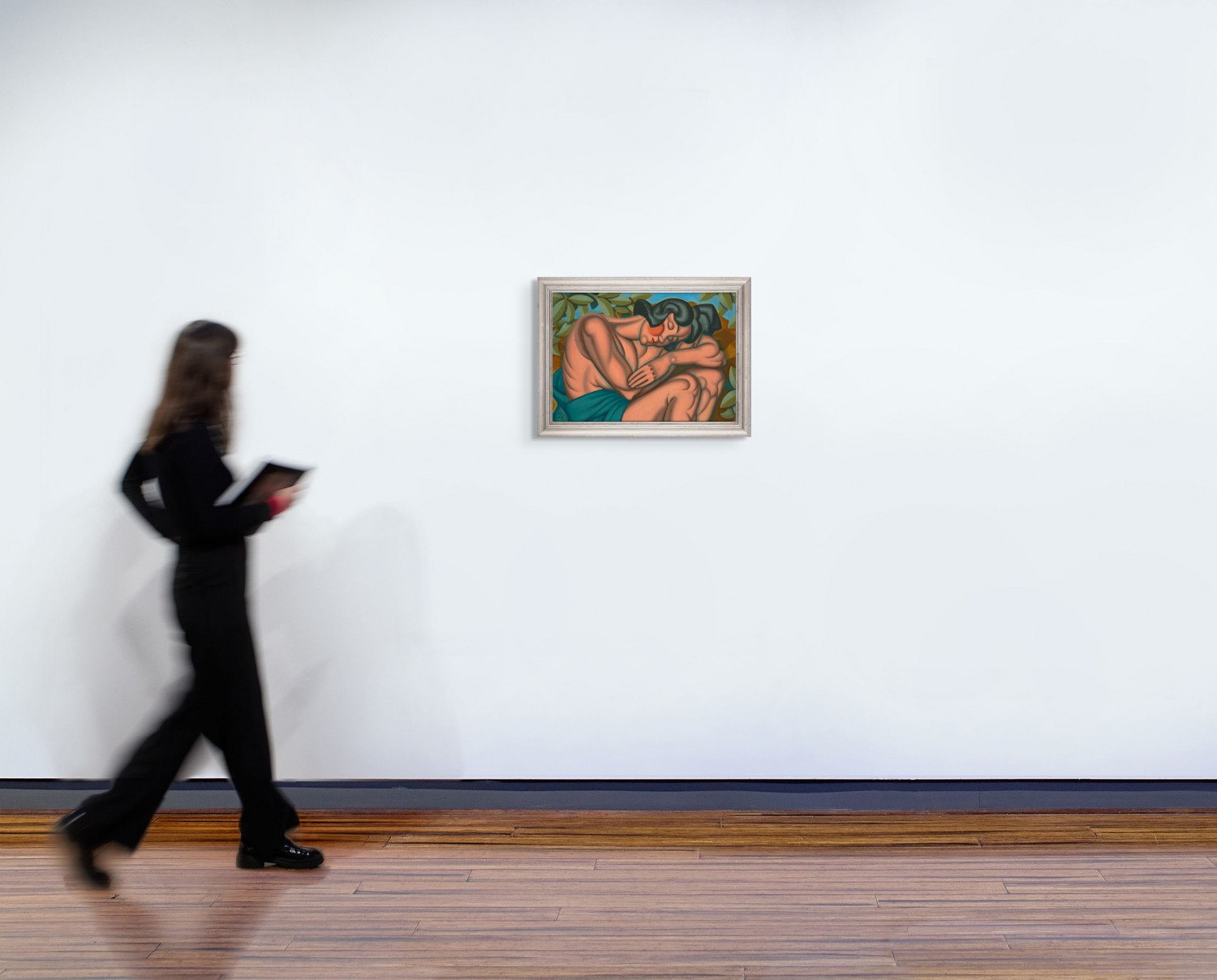
43.0 x 61.0 cm
signed with initial and dated lower left: R / 43
bears inscription verso: Weaver Hawk [sic] / 'SLEEPER'
Private collection, Sydney
Private collection, Sydney, acquired from the above in the 1970s
Widely revered as one of Australia’s most distinctive and immediately recognisable artists, Weaver Hawkins remains best known for his bold palette and rhythmic compositional structures that brilliantly encapsulate the formal innovations of early twentieth-century modernism. Trained in England during a time of profound artistic upheaval, indeed Hawkins was drawn in particular to the Cubist-inspired dynamism of Wyndham Lewis and the Vorticists, while simultaneously cultivating an intellectual framework informed by ‘compositional theories such as Dynamic Symmetry, Platonic Solids, Magic Squares and the Modular’1 – resulting in him becoming ‘one of the finest and most original mid-century painters working in Sydney… for forty years.’2
Born in Sydenham, London in 1893, Hawkins’ early ambitions towards a career in art education were irrevocably disrupted by the outbreak of the First World War. Enlisting in 1914, he was severely wounded on the Somme in 1916 and subsequently endured extensive surgeries that rendered his right hand unusable and his left barely functional. Undeterred, Hawkins set about painstakingly relearning his craft, training himself firstly to draw and then, unbelievably, to etch with remarkable sensitivity using his non-dominant hand – an almost miraculous feat achieved over an eighteenth-month period. In 1923, he held his first solo exhibition, yet critical reception inevitability foregrounded his disability, thus prompting Hawkins to adopt the pseudonym ‘Raokin’ in the late 1920s – an act of quiet defiance intended to redirect attention from biography back to the art itself.
Subsequent sojourns in France and Italy witnessed Hawkins’ style absorb a distinctly modernist inflection, particularly in his depictions of quotidian life. The growing spectre of war in early 1930s Europe, however, eventually led him to seek distance from the continent, embarking upon an extended journey through the South Pacific with his young family where he lived for a time in Tahiti and New Zealand, before ultimately migrating to Australia in 1935. Settling at Mona Vale on Sydney’s northern beaches, Hawkins soon became part of the local creative enclave that included figures such as Rah Fizelle and Arthur Murch, and it was within this vibrant artistic milieu that his mature visual language would crystallise – fusing formal vigour with an expressive, often deeply humanist sensibility.
Although arguably most celebrated for his ambitious allegorical murals that conflate the trauma of the two World Wars with the existential anxieties of the Cold War, Hawkins’ oeuvre was notably diverse – also encompassing depictions of athletes, bush landscapes and scenes of modern life. Closely related to A green room (dancers resting), 1943 (Queensland Art Gallery | Gallery of Modern Art), the present Sleeper, 1943, offers a superb example of Hawkins’ intimate domestic compositions that reveal a quieter, more contemplative dimension of his practice. Beautifully rendered in softly modelled volumes and interlocking curves, here the reclining female figure conveys a profound sense of inwardness, the rhythmic geometry of her depiction underscoring both repose and latent tension, while the stylised foliage and compressed pictorial space attest to the artist’s enduring commitment to formal synthesis.
A leading figure within Sydney’s more progressive artistic circles, Hawkins served as President of the Contemporary Art Society from the mid-1950s until 1963, and continued to champion the principles of rigorous graphic design and abstract values through to his retirement from active painting in 1972. Today his remarkable achievements stand not only as a testament to his personal resilience, but as a compelling articulation of a modernist vision forged in the crucible of twentieth-century conflict – with order and expression, discipline and feeling, existing in perpetual, dynamic equilibrium.
1. Thomas, D., ‘Weaver Hawkins’, Project 11: Weaver Hawkins, Art Gallery of New South Wales, Sydney, 7 February – 14 March 1976
2. Radford, R., ‘Foreword note’, Weaver Hawkins 1893-1977: Memorial retrospective exhibition 1977 – 1979, Ballarat Fine Art Gallery, Victoria, 1977 (n. p.)
VERONICA ANGELATOS