Quaraitnama, MacDonnell Range, c.1945
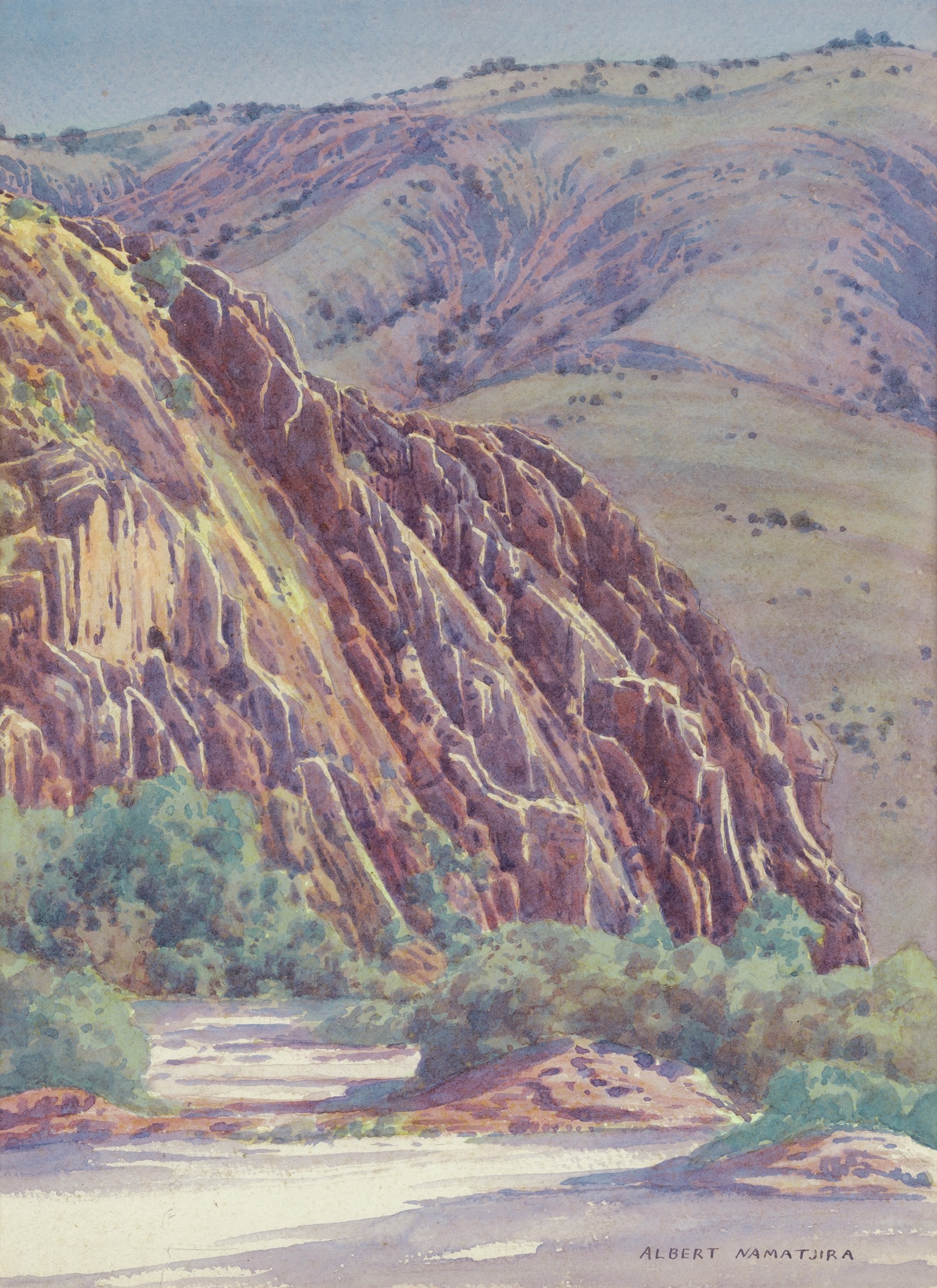
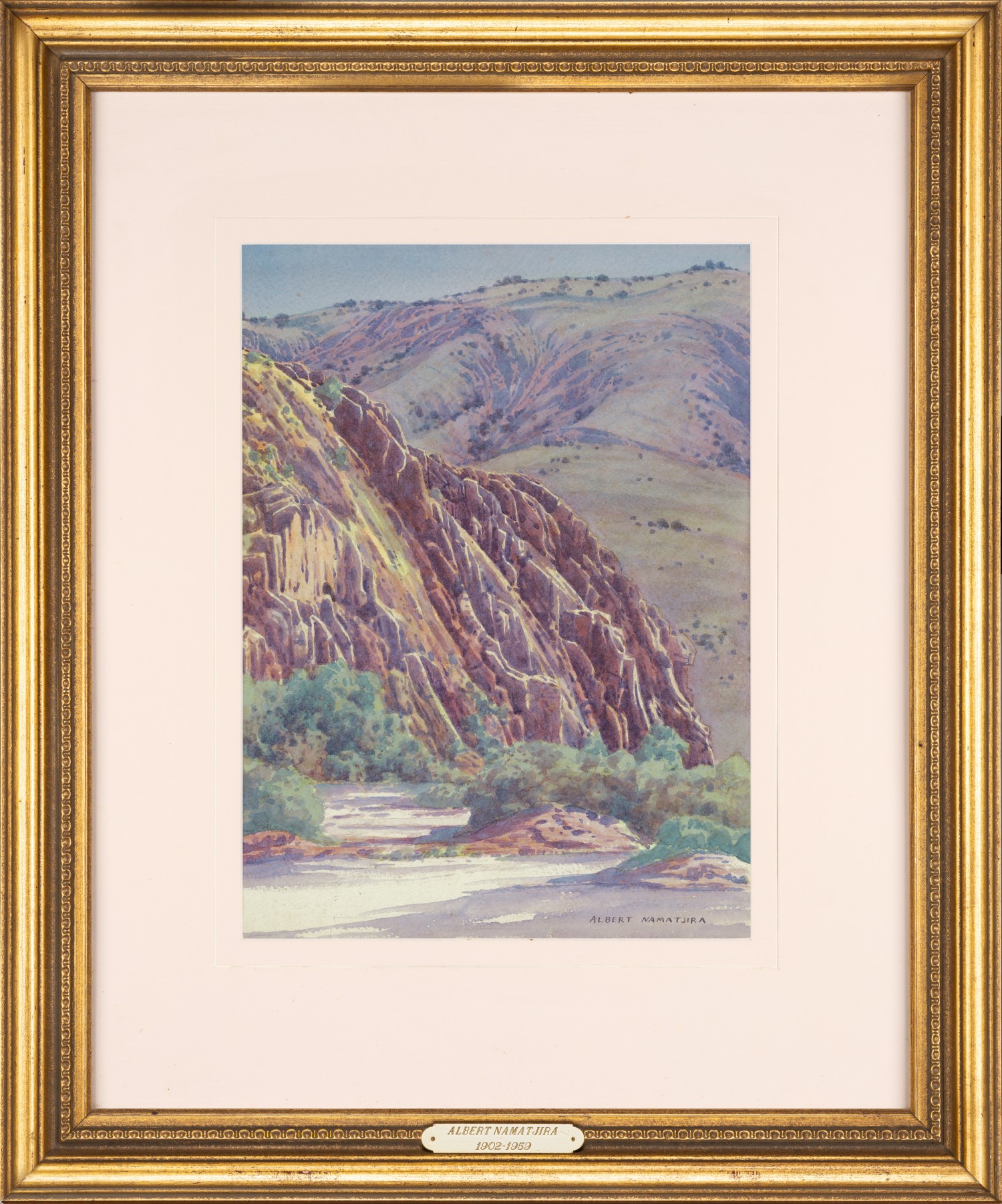
Albert Namatjira
watercolour on paper on card
39.5 x 28.5 cm
signed lower right: ALBERT NAMATJIRA
bears inscription on paper label attached to backing verso: No.33 / “Kwaratnama”/ Quaraitnama / MacDonnell Range / 25 Gns
Private collection
Lawson-Menzies, Sydney, 22 July 2003, lot 131 (as ‘Kwaratnama Quaraitnama (The Organ Pipes) MacDonnell Range’)
Private collection, New South Wales, acquired from the above
WATER COLOURS of Central Australia by Albert Namatjira – Arunta Artist, Royal S. A. Society of Arts Gallery, Adelaide, 12 – 25 March 1946, cat. 33 (25 Gns)
Albert Namatjira’s luminous watercolours of the country surrounding Glen Helen (Yalpalpe) and the Finke River (Lherre pirntea) in central Australia, provided the artist with a continued patrilineal connection to locations of deep significance which formed the bedrock of his art and provided plural meanings for those viewers who could read them. Landforms as discrete entities held a certain fascination for the artist. Whether large mountains or monoliths on a smaller scale, they also hold spiritual meaning for the traditional owners and, as with many locations in central Australian, can be read as both ‘sights’ and ‘sites’.1
Painted in 1945, this beautifully resolved composition of Quaraitnama, MacDonnell Range is a finely detailed view of a geological formation in the West MacDonnell Ranges in the Northern Territory known as the Organ Pipes. Located on the Finke River, just south of Glen Helen Gorge, this is a place and subject Namatjira returned to regularly, but at different times of the year and day, in times of drought and in flood, to capture its ever-changing moods. Here the artist observes the site with lush growth after seasonal rains. Namatjira’s familiarity with his country is evident in these views of particular sites and places that provide a rich range of possibilities and responses that arise from constantly re-engaging with the same subject.’2 They also resonate with important personal symbolism for the artist as statements of belonging – as coded expressions embodying the memory and knowledge of traditional ancestral sites, of his totemic places.3
Transporting his evocative landscapes of Central Australia into the lounge rooms of White Australia in the mid-twentieth century, his depictions of country were fundamental to how Australians viewed their island home. Namatjira’s entry into the Australian art world was both inspired and inspiring. Despite his personal vicissitudes, he inspired his own and subsequent generations of Aboriginal people and artists across Australia and sought to educated non-indigenous Australians about the spiritual link between indigenous people and land. Brenda Croft contends that the artist’s gift to indigenous and non-indigenous people is ‘more than the sum parts of watercolour paints on paper. It is an essence that resides in the strength of Namatjira’s work – his courage, his sorrow, his spirituality… where the enduring influence of this one man upon the entire indigenous arts and culture industry continues to be felt.’4
1. French, A., Seeing the Centre: The Art of Albert Namatjira 1902 – 1959, National Gallery of Australia, Canberra, 2002, p. 93
2. ibid., p. 96
3. ibid., p. 96
4. Croft, B., ‘Albert’s Gift’ in French, A., Seeing the Centre: The Art of Albert Namatjira, 1902 – 1959, National Gallery of Australia, Canberra, 2002, p. 148
CRISPIN GUTTERIDGE