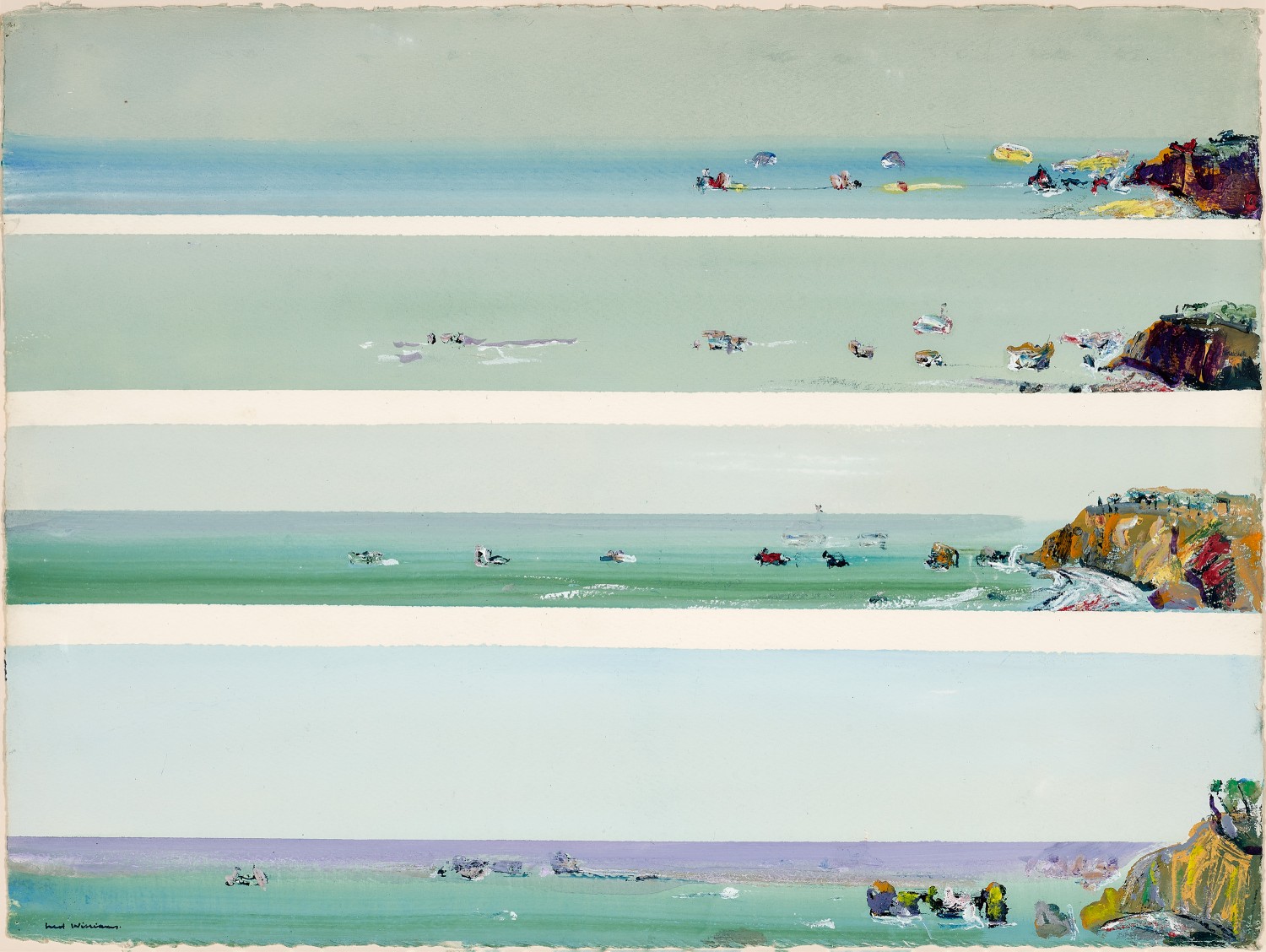
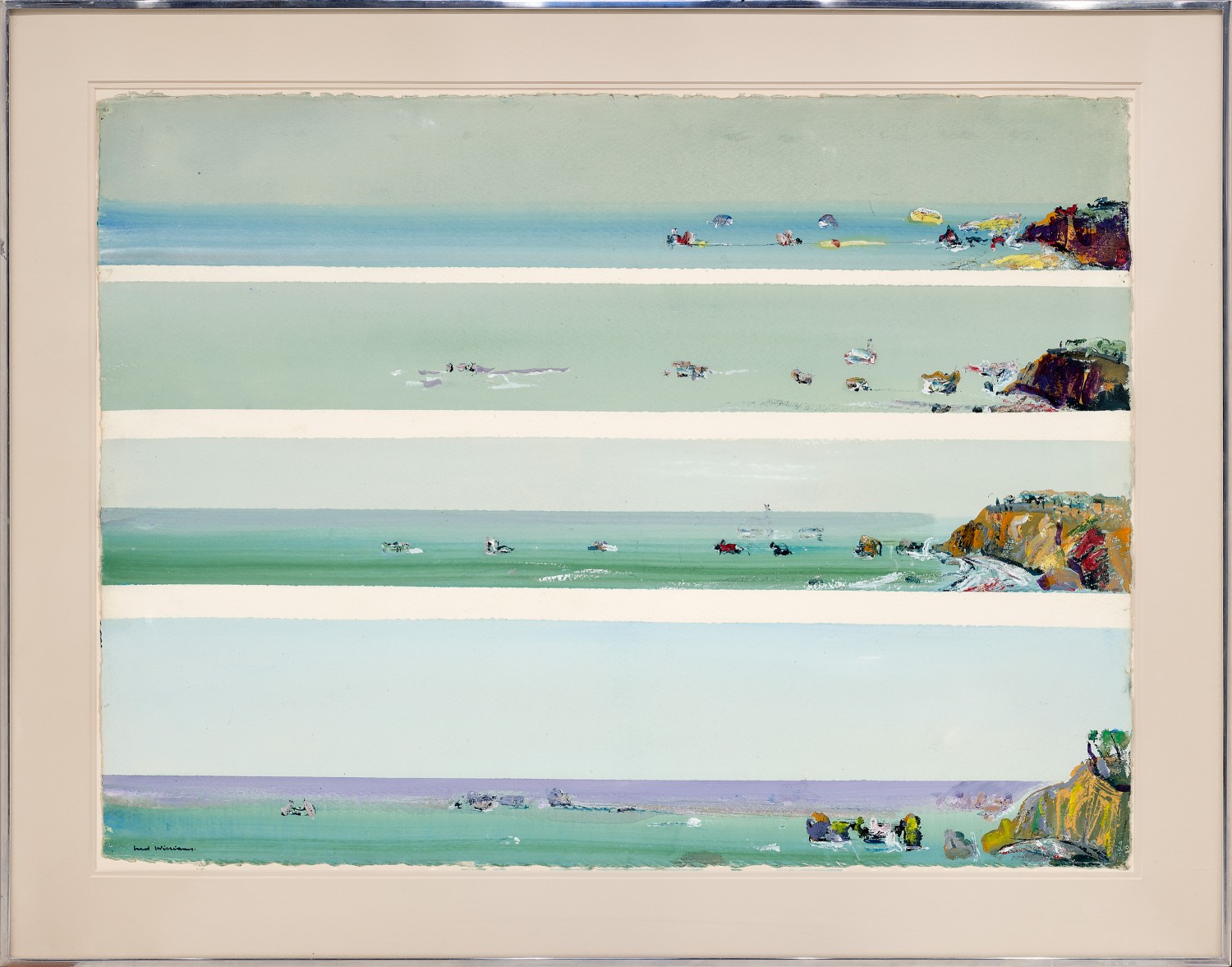
The bay and the bluff, Walkerville, 1970
Fred Williams
gouache on paper
58.5 x 79.0 cm
signed lower left: Fred Williams.
Lewis and Dorothy Cullman, New York, USA, acquired in 1977
Thence by descent
Private collection, New York, USA
Fred Williams: Landscapes of a Continent, The Museum of Modern Art, New York, 11 March – 8 May 1977, cat. 22, and touring to: Norton Gallery, Florida, 1978; Joslyn Art Museum, Nebraska, 1978 and University of Texas Art Museum, Austin, 1 February - 18 March 1979 (label attached verso)
We are grateful to Lyn Williams for her assistance with this catalogue entry.
At the age of 43, Fred Williams’ radical reimagining of the dry, rural Australian landscape, honed over fifteen years of continuous practice, was significantly recognised as a defining and unique national view. In his first museum exhibition in October 1970, Heroic Landscape at the National Gallery of Victoria, he was paired with the father of Australian impressionism, Arthur Streeton – a recognition of both artists’ personal and emblematic engagement with the inland natural environment. Continually refining his painterly interpretation of the landscape, throughout 1969 Williams had pushed his practice to the point of strikingly minimal abstraction. Traversing a series simply titled Australian Landscape, with its painterly gestures lightly dancing across a monochrome ground, the artist found himself at a creative impasse. In need of a ‘sea change’, a return to nature itself, Williams and his young family booked a holiday house over the summer of 1970 – 71 in Walkerville, in Gippsland’s picturesque Waratah Bay, 190km south-east of Melbourne, on the lands of the Gunai nation.1
Painted during this restorative and inspiring sojourn, The bay and the bluff, Walkerville, 1970 presents a layered sequence of four horizontal, panoramic views of the steep cliff face at South Walkerville Beach. Each depicting the same view at different times of day, tidal and atmospheric conditions, Williams contrasts the dramatic focal point of the impasto limestone headland and its constellations of jagged, submerged rocks (known locally as ‘Bird Rock’) with the smooth, graduated sweeps of blue, teal and lilac denoting the waters of Waratah Bay. Experimenting with a new format of gouache painting en plein air – known as ‘strip gouaches’ – Williams’ use of cropped narrow bands to isolate the motif within a larger landscape, eliminating a muddying and superfluous foreground or sky, was a ‘revelation in conception.’2 This format, devised earlier in 1970, while Williams had been painting views of the mouth of the Yarra river from the 24th floor of the AMP tower in Bourke St, was particularly well adapted to painting riverscapes and seascapes. Within a systematic and unvarying grid, Williams’ intense observation of the subject resulted in the recording of nuanced chromatic changes between each strip. Painted with diversified, luminous colour hitherto unseen within his oeuvre, over the summer Williams’ delicate and swift notations had ‘almost got to handwriting.’3
Of the new seascapes painted in gouache in Walkerville and other short holidays around the Mornington Peninsula that summer (Western Port Bay, Queenscliff and Sorrento), those in Walkerville were the most comprehensive, painted over a sustained period of ten days. In contrast to Williams’ paintings of rural Australia, where uniformity causes a disorienting lack of scale, the artist felt free in these gouaches to paint the naturally picturesque views of this southernmost point of the Australian mainland. Within his diaries, Williams recorded his admiration of the ‘natural state’ of the scrubland along the tops of the cliffs; while ‘beautiful’, he qualified Walkerville as a ‘curious kind of landscape.’4 Furthermore, like Claude Monet’s series of Rouen Cathedral, the repeated depiction of a motif allowed for the reintroduction of the effects of light and atmospheric conditions within his works, moving from a generalised Australian landscape to specific locations and times of day.
The bay and the bluff, Walkerville was included in Landscapes of a Continent, a showcase of Williams’ gouaches held in New York’s Museum of Modern Art in 1977 – the first solo exhibition of any Australian artist to take place at this prestigious location.
1. Hart, D., Fred Williams. Infinite Horizons, National Gallery of Australia, Canberra, 2011, p. 109
2. ibid.
3. Fred Williams, cited in Mollison, J., A Singular Vision: The Art of Fred Williams, Australian National Gallery and Oxford University Press, Canberra, 1989, p. 145
4. Fred Williams, cited in McCaughey, P. and Timlin, J., The Diaries of Fred Williams. 1963 – 1970, The Miegunyah Press, Melbourne, 2024, pp. 487, 611
LUCIE REEVES-SMITH