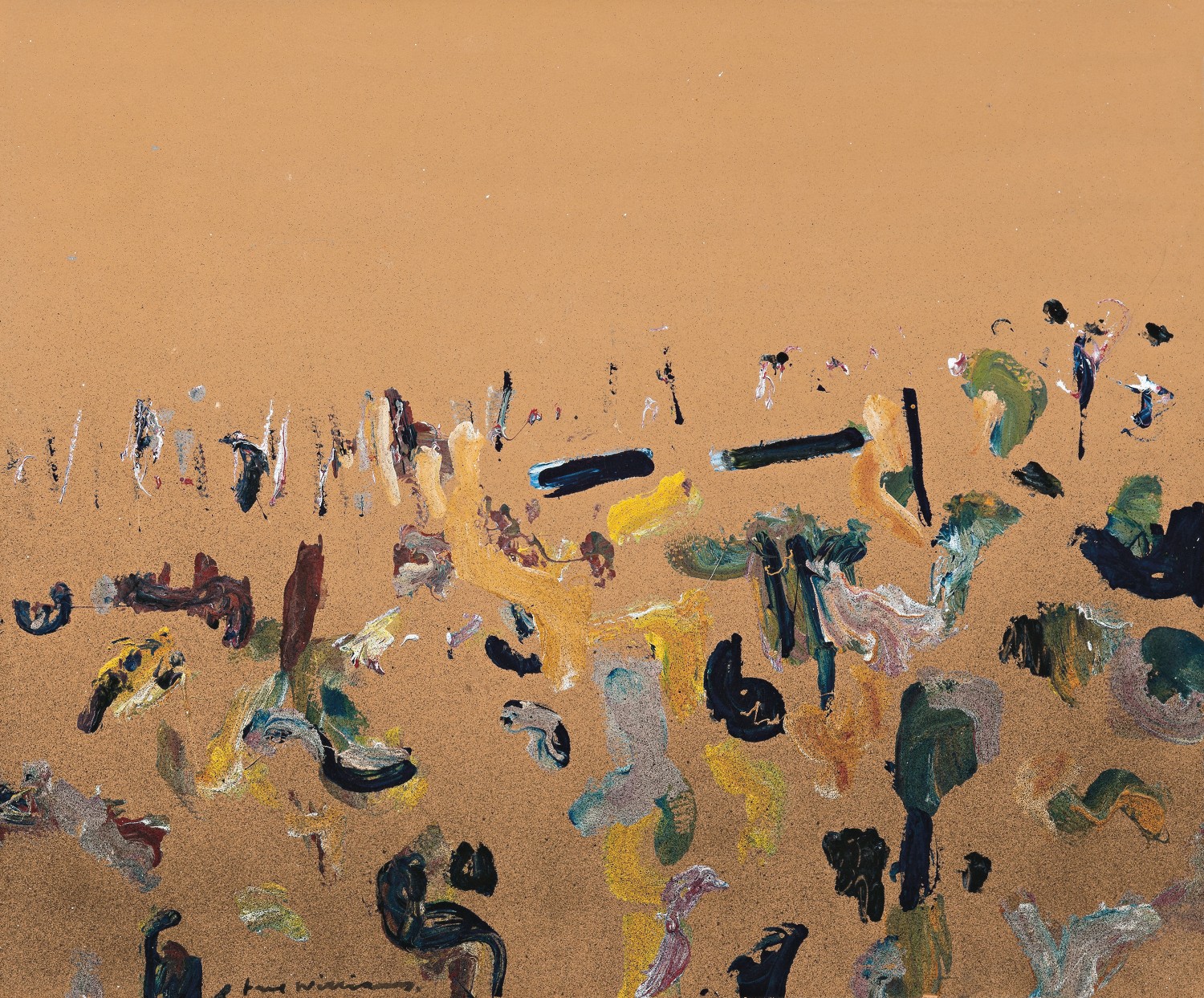
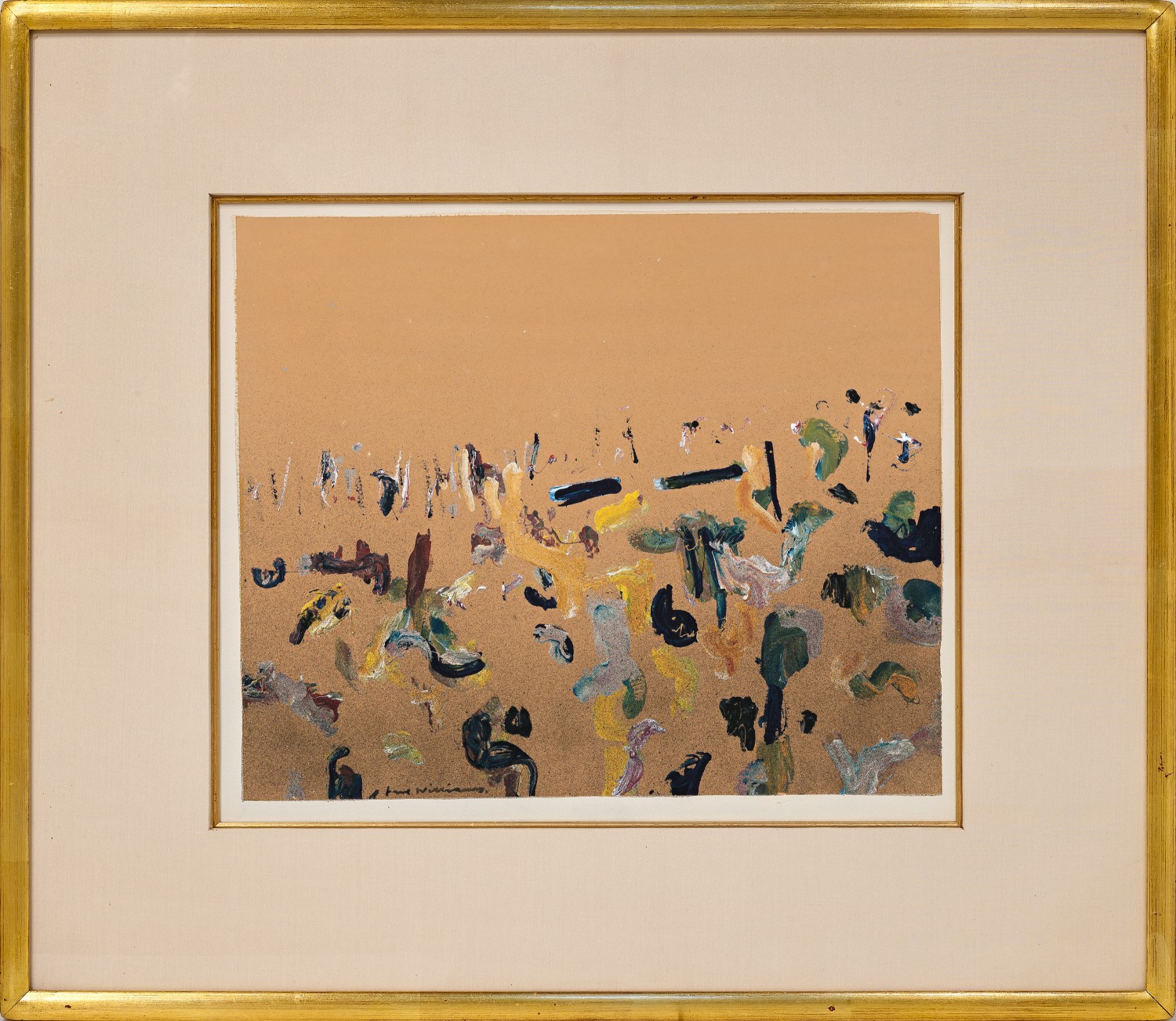
Lysterfield landscape, c.1966 – 67
Fred Williams
gouache on paper
39.0 x 47.0 cm
signed lower left: Fred Williams
Private collection
Christie’s, Sydney, 23 September 1985, lot 601 (as 'Landscape')
Private collection
Savill Galleries, Sydney, May 2000 (label attached verso)
Private collection
Leonard Joel, Melbourne, 2 December 2014, lot 23 (as ‘Untitled (Lysterfield Landscape)’)
Company collection, Melbourne
Deutscher and Hackett, Melbourne, 4 May 2016, lot 80
Private collection, Melbourne
We are grateful to Lyn Williams for her assistance with this catalogue entry
By the mid-1960s, Fred Williams was reaching maturity as a painter, confidently entering a period of outstanding creativity. His ability to ‘find form in a seemingly featureless landscape’ transformed the familiar rural landscape of the Australian impressionists into a new, gestural, and decidedly contemporary aesthetic experience.1 Lysterfield landscape, c.1966 – 67 is painted with an expressive and sensual touch, with Williams’ discrete brushstrokes laid plainly on a velvety flat ground ranging from full-bodied and laden with pigment in the foreground, to delicate dry apostrophes along the crest of the Lysterfield hillside.
Inching towards a more reductive expression of the landscape, Fred Williams’ Lysterfield landscape, painted in gouache on paper, presents an airy and balanced minimalism, a quality in his works of the period that appeared to critics at the time ‘almost Chinese in [the] mixture of immediate gesture, spontaneous notation, with contemplation and serenity.’2 Here, Williams continues to rework the motif of the hillside which had already captivated his attention for many years, explored in various proportions, degrees of precipitous incline and elaborations of brushstrokes. Against a flat and monochrome golden ochre ground, Williams has removed all tonal variation between land and sky, together with the clear horizon line that had previously characterised his Hillside compositions. Williams’ gently sloping incline, its distant edges implied through a differentiation of painted touches, unevenly bisects the sheet of paper, providing animation to his simple composition.
Today a suburb in Melbourne’s southeast, Lysterfield was then sparsely settled countryside of rolling hills and scrubby plains. Lying a short drive from the Williams’ Upwey home, the area became a regular destination for weekday plein-air painting trips. The quick-drying and fluid medium of watercolour mixed with opaque white pigment provided Williams with an effective and immediate way of recording colouristic impressions of the landscape, creating valuable visual records for larger painted works in the studio while also remaining resolved artworks in their own right. Williams often exhibited the gouaches alongside his oil paintings. In 1971, he devoted an entire exhibition to ‘watercolours’, with fifty works selected by the artist from his own collection from the years 1957 to 1971 shown in Newcastle Art Gallery. The importance of gouaches to his oeuvre continued to be recognised within subsequent exhibitions, including the National Gallery of Australia’s 2011 retrospective, Fred Williams: Infinite Horizons.
Looking to the Barbizon School of landscape painters, in particular the work of Gustave Courbet, Williams had begun to use diagonal structuring lines to compose his landscapes, placing objects of focal importance in the intersection of these invisible vectors. In Lysterfield landscape, amongst the white, yellow and lilac accents lie two black fallen trunks, close to the horizon line. Providing an elegiac quality reminiscent of Arthur Streeton’s environmentally conscious paintings of Olinda in the late 1920s – 30s (see lot XX), the ‘chopped tree’ became a recurring motif within Fred Williams’ Lysterfield landscapes, reflecting the artist’s alarm at the number of trees being felled in the district around Upwey. He wrote in his diaries of the ‘continual swing of the axe and chainsaw... its prettiness cannot last much longer, and this makes me very sad – it is the reason we came to live here.’3
1. McCaughey, P., Fred Williams, Bay Books, Sydney, 1980, p. 154
2. Lynn, E., ‘Poetic Bushland’, The Bulletin, Sydney, vol. 88, no. 4520, 22 October 1966, p. 54
3. Fred Williams, cited in Mollison, J., A Singular Vision: The Art of Fred Williams, Australian National Gallery and Oxford University Press, Canberra, 1989, p. 97
LUCIE REEVES-SMITH