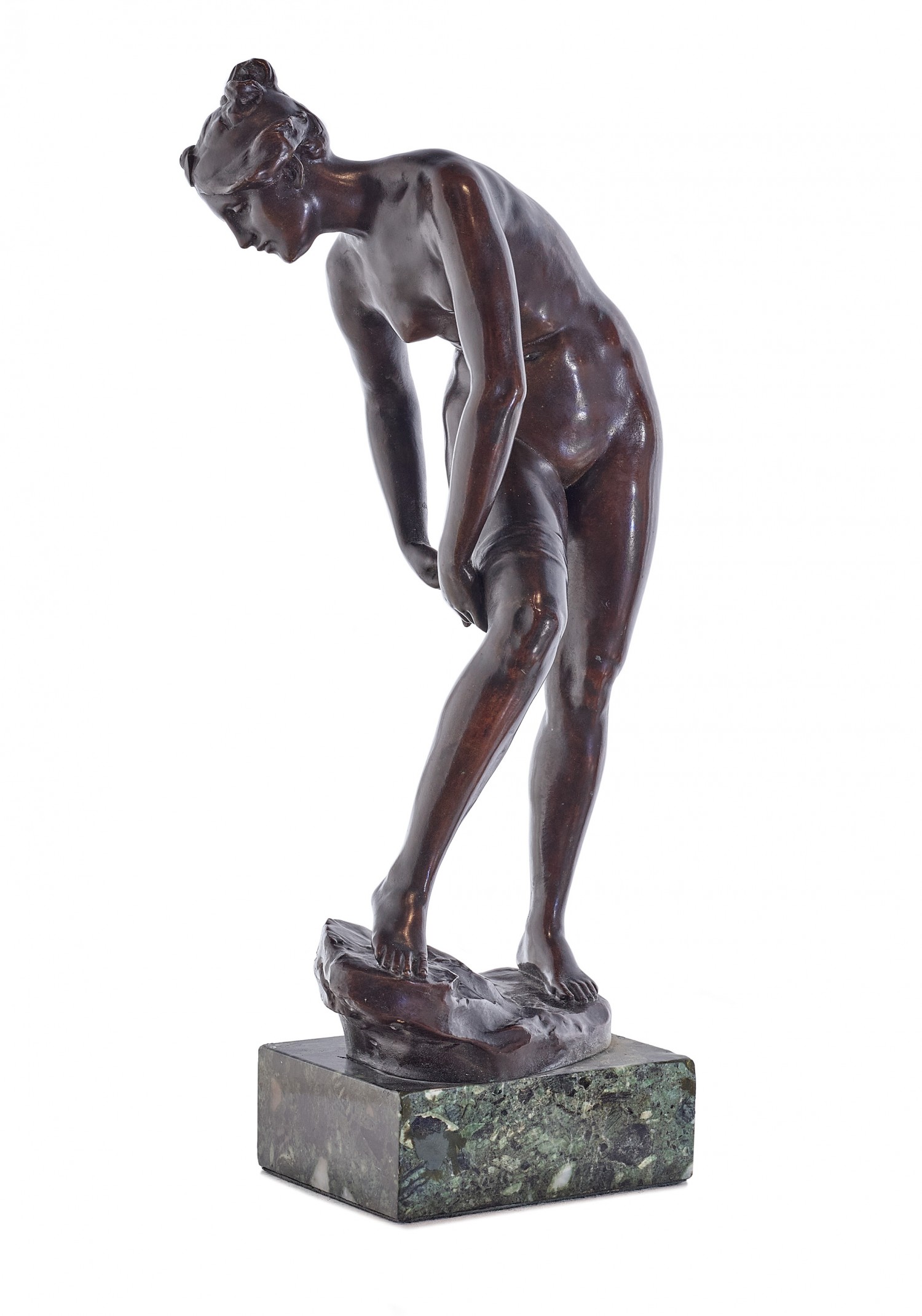
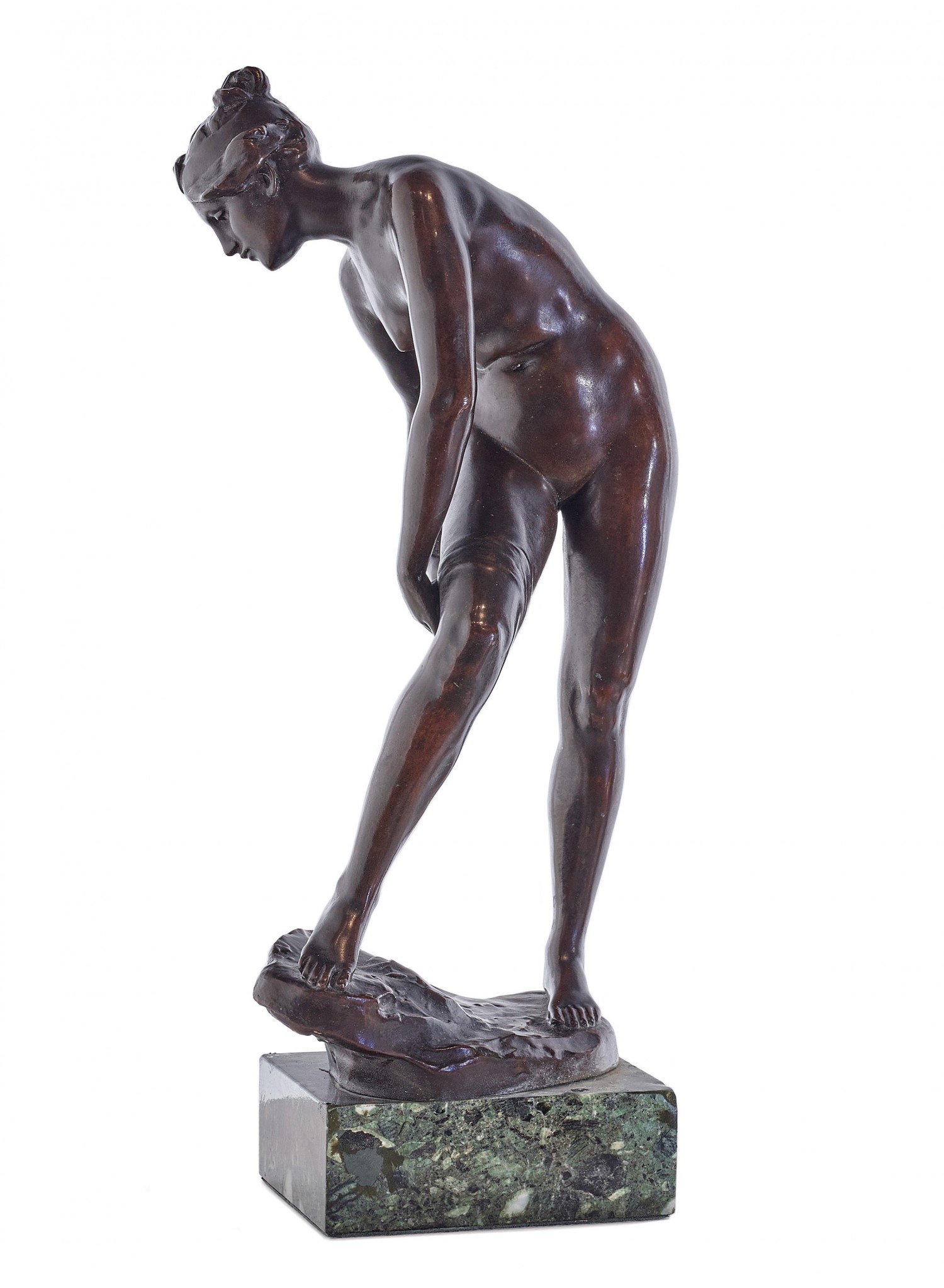
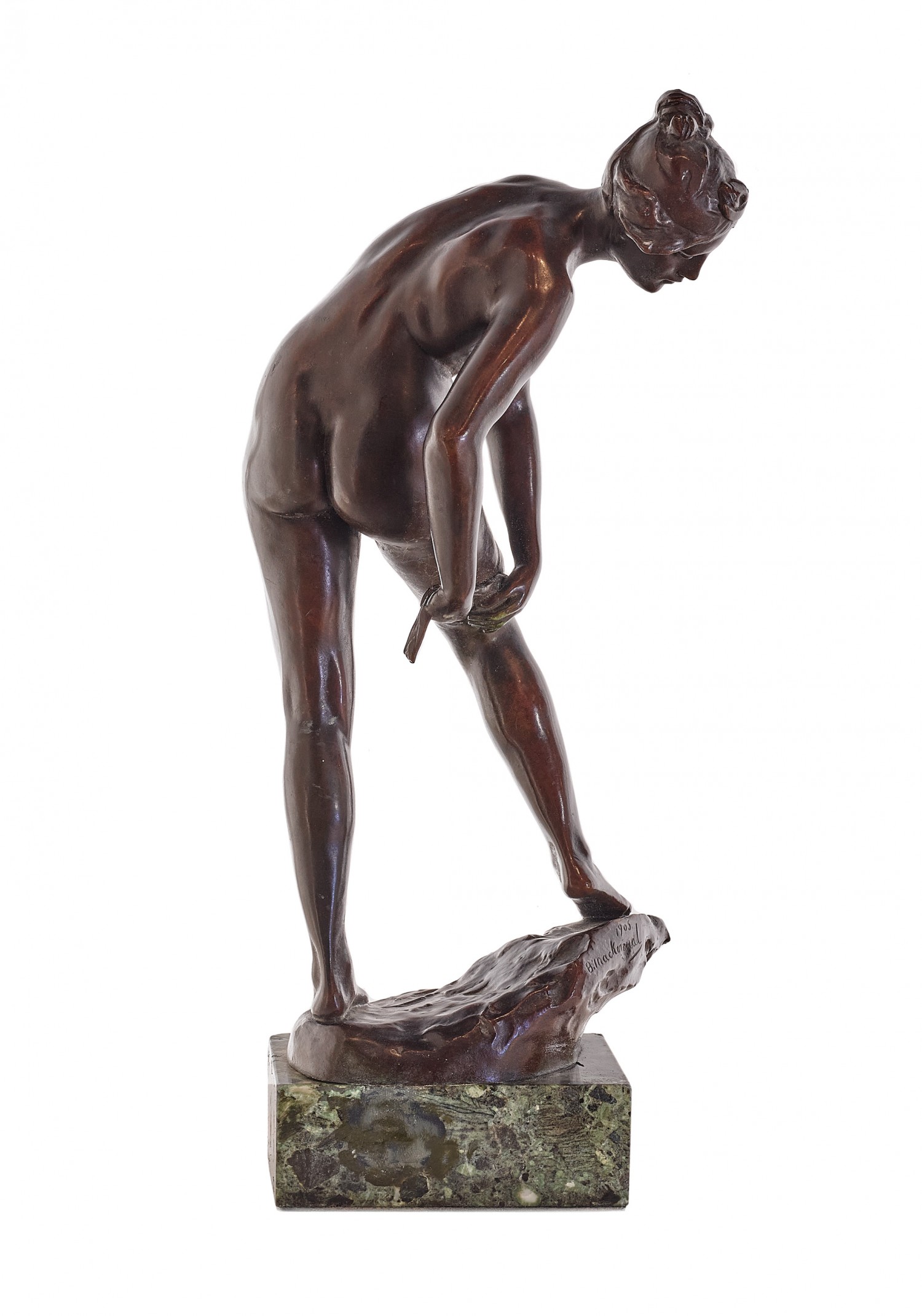
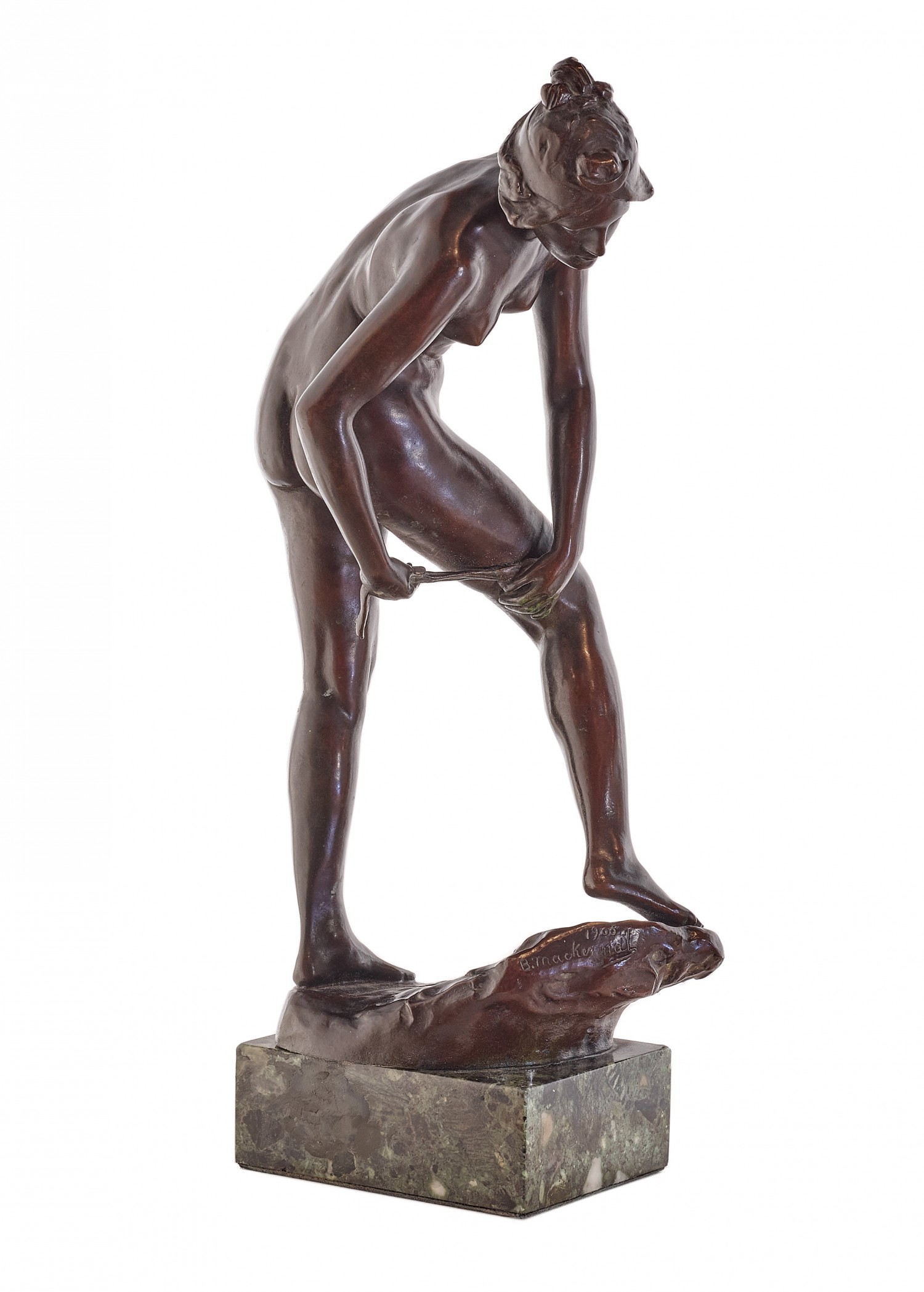
Diana wounded, 1905
Bertram Mackennal
bronze
36.5 cm (height)
41.0 cm (including base)
signed and dated at base: 1905 / B. Mackennal
Private collection, France
Senequier-Crozet, Grenoble, 30 September 2025, lot 251 (as 'Diane blessée')
Private collection, France
The Exhibition of the Royal Academy of Arts, Royal Academy of Arts, London, 1906, cat. 1648 (another example)
Summer Exhibition, Second Portion, New Gallery, London, 1909, cat. 195 (another example)
Exhibition of Bronzes by Sir Bertram Mackennal K.C.V.O., R.A., Macquarie Galleries, Sydney, 7 - 20 October 1926, cat. 11 (another example)
Exhibition of Bronzes by Sir Bertram Mackennal, Fine Art Society's Gallery, Melbourne, 16 - 29 May 1928, cat. 5 (another example)
Memorial Exhibition of Statuettes by the Late Sir Bertram Mackennal, K.C.V.O, Fine Art Society, London, May 1932, cat. 27 (another example)
Commemorative Exhibition of Works by Late Members, Royal Academy of Arts, London, 7 January – 11 March 1933, cat. 19 (another example)
150 years of Australian Art, Art Gallery of New South Wales, Sydney, 27 January – 25 April 1938, cat. 169 (another example, illus. in exhibition catalogue, n.p.)
“The New Sculpture in Australia”: Australian Art Nouveau Sculpture 1880 – 1920, McClelland Gallery, Victoria, 3 May – 5 June 1987, cat. 11 (another example)
Bertram Mackennal: The Fifth Balnaves Sculpture Project, Art Gallery of New South Wales, Sydney, 17 August – 4 November 2007, and touring to National Gallery of Victoria, Melbourne, 30 November 2007 – 24 February 2008 (another example)
‘Royal Academy Exhibition, Australian Pictures’, The Register, Adelaide, 20 June 1906, p. 6 (another example, as ‘Diana’)
‘London Exhibitions’, The Art Journal, London, December 1909, pp. 252, 255 (illus., another example, as ‘Diana’)
The Sun, Sydney, 8 September 1926, p. 9 (illus., another example)
‘Exclusive Pictorial Features’, The Daily Standard, Brisbane, 15 September 1926, p. 10 (illus., another example)
‘Mackennal's Art. Exhibition of sculpture’, The Sydney Morning Herald, Sydney, 6 October 1926, p. 14 (another example)
‘Fine Bronzes at Bertram Mackennal's Exhibition’, The Sunday Times, Sydney, 10 October 1926, p. 2 (illus., another example)
‘Sir Bertram Mackennal's Art’, The Australasian, Melbourne, 16 October 1926, p. 44 (another example)
‘Bronzes by Mackennal’, The Argus, Melbourne, 16 May 1928, p. 8 (another example)
‘Exhibition of Bronzes’, The Australasian, Melbourne, 19 May 1928, p. 21 (another example)
‘Memorial Exhibition Statuettes by Mackennal’, The Examiner, Launceston, 5 May 1932, p. 10 (another example)
‘Personal’, The Argus, Melbourne, 5 May 1932, p. 6 (another example)
MacDonald, J. S., ‘Mr. J. R. McGregor's Collection’, Art in Australia, Sydney, 3rd Series, no. 57, 15 November 1934, p. 45 (illus., another example)
Tranter, R. R., Bertram Mackennal: A Career, Parker Pattinson Publishing, New South Wales, 2004, cat. 58, p. 137 (another example)
Edwards, D., Bertram Mackennal: The Fifth Balnaves Sculpture Project, Art Gallery of New South Wales, Sydney, 2007, pp. 66 (illus., another example), 67, 68, 116 – 118
The mythological tales of the huntress Diana inspired many artists over the centuries – with Diana and Actaeon, 1556 – 59 (National Gallery, London) by Venetian Renaissance master Titian being one of the most celebrated examples. By contrast, Bertram Mackennal’s bronze Diana wounded, 1905 is a far cry from Actaeon being torn to pieces by his own hounds. Stripped of her godly attributes, ‘her bow and hounds’, here Diana is presented, rather, as a blithe nude in all her virgin splendour, with her contemporary appearance as a nubile Edwardian beauty the subject of much commentary by writers.1 During the 1890s, Mackennal’s mind was very much occupied, like many of the best fin de siècle artists and writers, with the femmes fatales of both his time and of past ages – smart, alluring women capable of persuasion and emasculation. Witness for example, his various portrayals of the world’s greatest contemporary actress at the time, Sarah Bernhardt – the living image of that mesmerisingly seductive woman – in her in the role of Cleopatra and a bold bronze relief (c.1892 – 93) in the collection of the Art Gallery of New South Wales, alongside bronzes immortalising prominent female figures of antiquity, including his infamous Circe, 1893 (National Gallery of Victoria) and Salome, c.1895 (Art Gallery of New South Wales). Although Mackennal’s approach changed in the first decade of the new century with his women becoming outwardly more genteel, refinement did not reduce their considerable appeal.
Diana, in Roman mythology, was the moon goddess of the hunt and birthing – the equivalent of the Greek goddess Artemis, daughter of Zeus and twin sister of the sun god Apollo. According to mythology, Jupiter gave Diana permission ‘to live in perpetual celibacy’ and, as ‘the patroness of chastity’, ‘to shun the society of men’2; notably however such mythological references are avoided in Mackennal’s interpretation which is purposely more tongue-in-cheek. Indeed, here the vicious Roman moon goddess in Ovid’s Metamorphoses is inverted; it is she, not the quarry Damasichthon, son of Amphion and Niobe, who is injured in the leg.3 Considering the association of Diana with ‘heavenly’ and ‘divine’, Mackennal carried this further. Divine in looks rather than status, she is a sight perilously tantalising to the mortal male – with the action of bandaging her thigh, inspired by the more explicit sight of ‘a model doing up her stocking’, effectively enabling the artist to show off her bodily attributes without loss of modesty.4 This teasing play between the appealing and the unobtainable epitomised that beguiling blend of poise and pleasure so typical of la belle époque and its English Edwardian counterpart. Although calling freely upon ancient Greek and Roman sculptures of the goddess of love, Aphrodite and Venus, she is a thoroughly modern Edwardian maiden. Effectively using the contrapposto pose, Mackennal created an ideal image endowed with grace, but sensuous of modelling. When Mackennal made a marble life-sized version in 1907 – 08, he crowned Diana with her crescent moon. It was smartly acquired by the Chantrey Bequest for the Tate Gallery in London in 1908 and subsequently hailed by The Times as ‘one of the most beautiful nudes that any sculptor of the British school has produced.’5
1. Edwards, D., Bertram Mackennal: The Fifth Balnaves Sculpture Project, Art Gallery of New South Wales, Sydney, 2007, pp. 67 – 68
2. Lemprière, J., Lemprière’s Classical Dictionary of Proper Names mentioned in Ancient Authors, Routledge and Kegan Paul Ltd, London, revised edition, 1972, p. 204
3. Hutchison, N., ‘Here I am!’: sexual imagery and its role in the sculpture of Bertram Mackennal’, in Edwards, op. cit., p. 116
4. ibid.
5. ‘The Royal Academy: second notice’, The Times, London, 8 May 1908, p. 6, cited in Edwards, op. cit., p. 67