INVESTMENT BANKER'S ART SALE INCLUDES ONE THAT GOT AWAY FROM AGNSW
Among 14 paintings to be auctioned from the estate of the widely admired Sydney businessman Michael Gleeson-White is the one that got away.
Got away, that is, from the Art Gallery of New South Wales while then director Edmund Capon was playing his famous (and successful) media popularity card.
Mount Tambourine on fire by William Robinson was hanging at the gallery in 1987 after being selected as a finalist in the Wynne Prize.
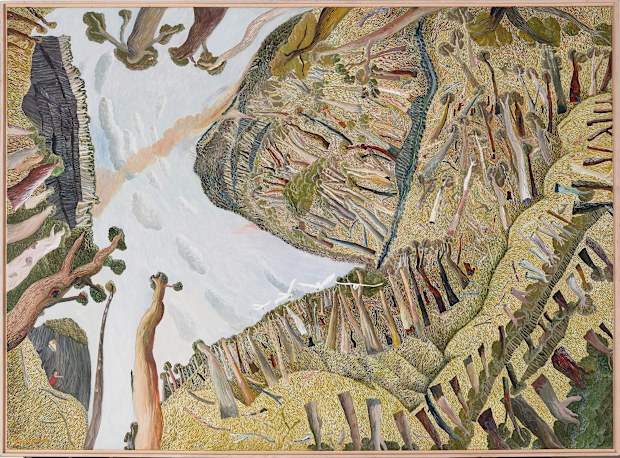
William Robinson’s Mount Tambourine on fire, 1987, estimated at $180,000 to $250,000 in Deutscher + Hackett’s auction of Important Australian and International Art, on August 26 in Melbourne.
Gleeson-White, a leader at Ord Minnett, Schroders and the Bank of Singapore Australia, was president of the gallery’s trustees and hence a judge of the Wynne Prize and its sister the Archibald Prize for portraiture. He had been immediately captivated by the beauty and innovation of Robinson’s landscape.
All too aware that private collectors would be circling – particularly because Robinson had also won that year’s Archibald – Gleeson-White rushed to reserve Mount Tambourine on fire for the AGNSW.
He rang Ray Hughes whose eponymous gallery in Sydney’s Surry Hills represented Robinson at that time, asking him to put it on hold as a matter of urgency.
Capon, meanwhile, had other ideas. Ever the media darling, he was playing up a line about Robinson being a hokey goat farmer. The bit about goat farming was actually true. But Robinson, who died aged 89 in August last year, was a sophisticated and erudite man who played his grand piano every day before entering the studio.
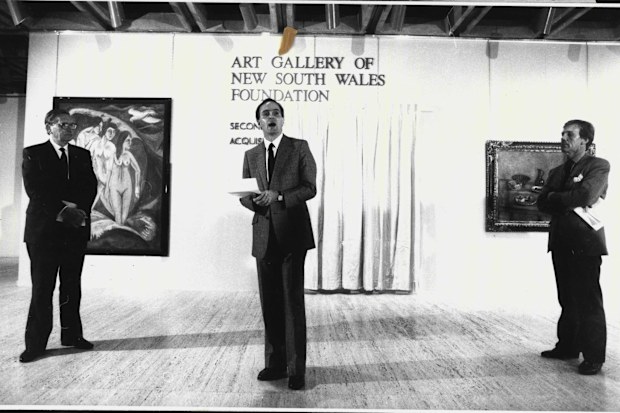
Left to right Michael Gleeson-White, then NSW minister Bob Debus, and Art Gallery of NSW direcor Edmund Capon. Ian Charles Cugley/Fairfax Media
Unable to get the AGNSW interested in buying Mount Tambourine on fire for the permanent collection, Gleeson-White did what any true art lover would do: he bought it for himself.
The painting is now part of the Gleeson-White estate’s consignment of 14 mainly Australian artworks – with estimates totalling between $1.455 million to $2.122 million – to Deutscher + Hackett’s Important Australian and International Art auction, to be held in Melbourne on August 26.
Gleeson-White died aged 100 in January after a remarkable career as an economist and business advisor, holding senior executive roles in firms including Ord Minnett and Schroders Australia. He was deputy chairman of the Bank of Singapore, and an adviser to the Government of Singapore Investment Corporation. He was on the board of MLC Ltd and Equitilink.
Gleeson-White was actually very close to Capon and collaborated with him to launch the AGNSW Foundation in 1983. The Foundation raised money for the gallery to buy important works of art.
Gleeson-White, who lived in Sydney, stayed abreast of art world machinations right until the end of his life. The Capon story is one he told with affectionate glee on more than one of the lunches he shared with Henry Mulholland.
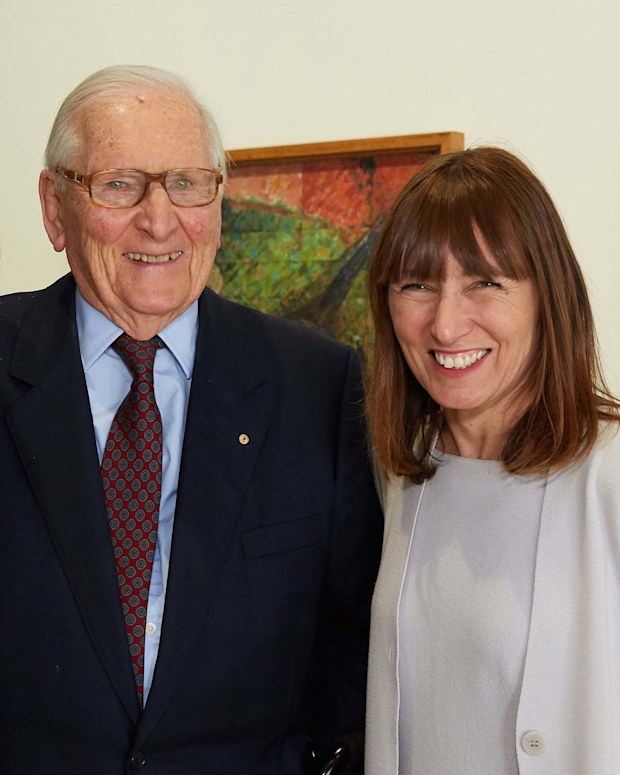
Michael Gleeson-White and Maud Page at the Art Gallery of New South Wales Board of Trustees reception in 2018. Gleeson-White died in January 2026.
Mulholland is today a specialist at Deutscher + Hackett. But in 1989 he was part of the Ray Hughes Gallery stable of artists when he met Gleeson-White. Just as he had been at Rudy Komon’s famous Sydney gallery before it closed in 1984, Gleeson-White was a Saturday morning regular for conversations about art and culture with Hughes and his vibrant circle of inquiring minds.
Now Mount Tambourine on fire is up for auction, carrying an estimate of $180,000 to $250,000. Looking at the painting feels like lying on your back and gazing at the sky through a fringe of forest trees. Robinson would spend decades developing this device, and it was one of the things that stamped his work with robust originality.
Mount Tambourine on fire is not the only Robinson artwork in the Gleeson-White consignment. There’s also a pastel on paper, Pumpkin Scones with Fruit, 2014, which echoes the still life drawings of Paul Cézanne, an artist Robinson greatly admired.
The works with the highest estimates in the Gleeson-White consignment are Fred Williams′ Paraburdoo landscape, 1981 and Jeffrey Smart’s Municipal Car Park, 1983. Each is estimated at $300,000 to $400,000.
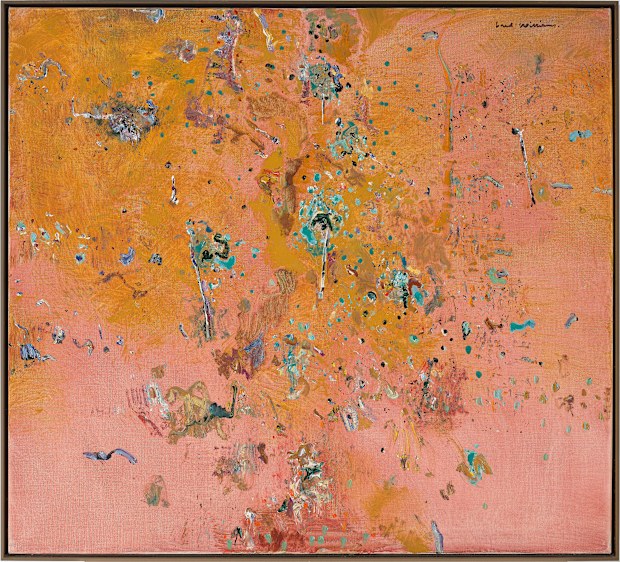
AFR, Saleroom Paraburdoo landscape, 1981, by Fred Williams is estimated at $300,000 to $400,000 at Deutscher + Hackett.
Williams probably painted Paraburdoo landscape in his Melbourne studio, working from drawings in gouache on paper, Mulholland says. Paraburdoo is in the Pilbara region of Western Australia, and it’s unlikely the artist would have travelled there the year before he passed away.
Smart’s Municipal Car Park is architecturally underpinned by a coffered ceiling, strong vertical walls and blue diagonals. A red circular roadsign at the centre secures the composition.
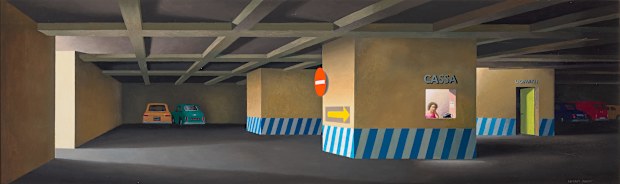
Jeffrey Smart’s Municipal Car Park, 1983, estimated at $300,000 to $400,000 at Deutscher + Hackett.
Gleeson-White bought both Paraburdoo landscape and Municipal Car Park from Rex Irwin Art Dealer in Sydney.
The other Smart in the consignment, Adrian’s View, was bought from Rudy Komon Art Gallery in 1980, the year it was painted. Its estimate is $100,000 to $140,000.
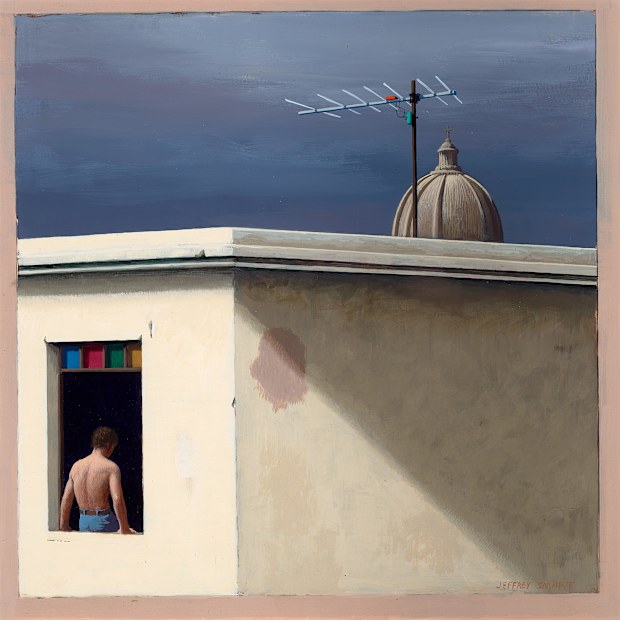
Adrian’s View, 1980, by Jeffrey Smart, estimated at $100,000 to $140,000 at Deutscher + Hackett.
There’s a pastel drawing of a nude woman by Avigdor Arikha, the French-Israeli artist who died in 2010. Gleeson-White bought the drawing, titled Nu à plat, 1984, from Marlborough Fine Art Gallery in London. Its estimate in the Deutscher + Hackett auction is $12,000 to $18,000.
Another Fred Williams painting in the consignment is Saplings, 1961 (estimate $180,000 to $240,000). Mulholland says it was painted in the Southern Highlands.
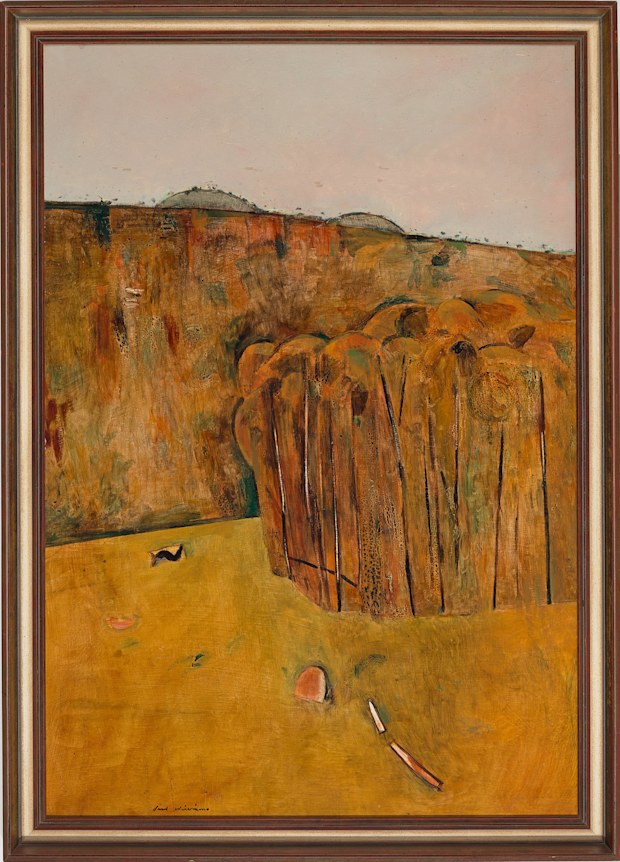
Saplings, 1961, by Fred Williams, is estimated at $180,000 to $240,000 at Deutscher + Hackett.
In all, there are four paintings by Fred Williams in the Gleeson-White consignment, three by William Robinson, two by Jeffrey Smart, and one each by Avigdor Arikha, Arthur Boyd, Ivon Hitchens, Sidney Nolan and Lloyd Rees.
Gleeson-White fell in love with art when he was overwhelmed by the beauty of Renaissance art while attending a friend’s wedding in Rome in 1960. He didn’t collect art so much as become “captivated” by certain pieces that he had to have, and that he lived with for many years, daughter Jane Gleeson-White says.
He maintained long and close friendships with many artists, including Williams and Smart. He was virtually the same age as Williams, who would die of cancer in 1982.
Gleeson-White loved Williams “as a painter and as a man”, Jane Gleeson-White told Saleroom.
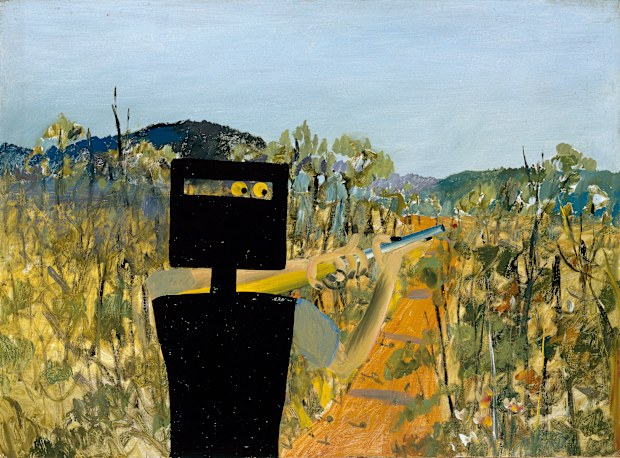
First-class marksman, 1946 by Sidney Nolan, was bought for the AGNSW with help from the Gleeson/O’Keefe Foundation. Bridgeman Images
Smart was a little older, and died in 2013. Jane Gleeson-White remembers a family trip to have lunch with the convivial Smart at his Tuscan home in the 1980s.
Two boxes of correspondence between Smart and Gleeson-White now reside in the collections of the National Library of Australia, in Canberra, and would surely make a fascinating read.
Gleeson-White’s contribution to the Australian art world was also profound. He was president of trustees at the AGNSW between 1982 and 1988. He was a trustee of the Gleeson O’Keefe Foundation, which enabled the gallery to acquire major works including Sidney Nolan’s masterpiece, First-class Marksman.
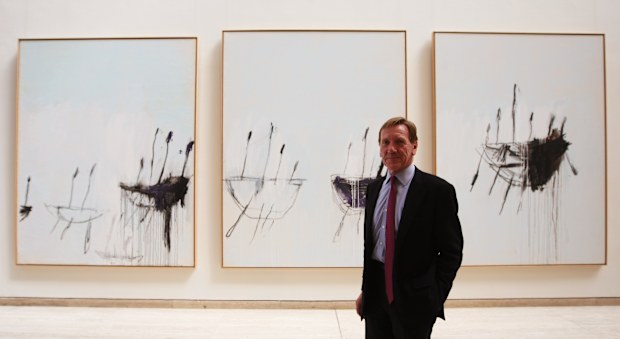
Edmund Capon in front of Cy Twombly’s Three Studies from the Temeraire in 2008. Jon Reid
He was instrumental in establishing the AGNSW Foundation, which enabled the gallery to buy works including Three Bathers by German Expressionist artist Ernst Ludwig Kirchner and Three studies from the Temeraire by American artist Cy Twombly.
Elsewhere in the auction world, Noble Numismatics’s current catalogue includes a sliver of wood from the keel of Captain Cook’s ship, Endeavour, which the auctioneer has estimated at $250,000.
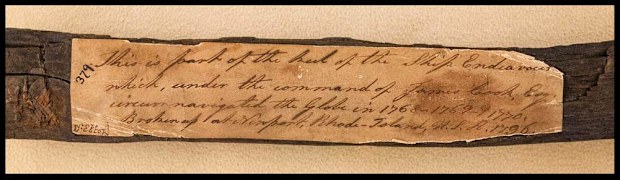
A piece of the wooden keel from Captain Cook’s ship Endeavour will be offered in Noble Numismatics’ auction to be held from 28 July to 30 July in Sydney. The catalogue states that the estimate is $250,000.
Managing director Jim Noble indicated to Saleroom that the reserve would be around $150,000 and the item would be “on the market” from that point.
The piece of wood, 22 x 2 cm, was retrieved from the wreck of the Endeavour at Newport, Rhode Island, US, in 1796, and includes a note believed to be written by Sir Joseph Banks’ sister, Sarah.
It will be offered in Noble’s Important Coins, Medals and Banknotes auction from 28-30 July in Sydney.