Under the pergola, 1951
Dorrit Black
oil on canvas on board
79.0 x 58.5 cm
signed with initials lower right: DB
Estate of the artist, Adelaide
Thence by descent
Helen Finlayson (née Black), Adelaide, 1951 [the artist's sister]
Margaret Michelmore (née Finlayson), Adelaide, a gift from the above
Estate of the above, Adelaide
Dorrit Black Memorial Exhibition, Royal South Australian Society of Arts, Adelaide, 22 April – 2 May 1952, cat. 23
on long term loan to the Art Gallery of South Australia, May 1976 (copy of original label attached verso)
Dorrit Black: Unseen Forces, Art Gallery of South Australia, Adelaide, 14 June – 7 September 2014
North, I., The Art of Dorrit Black, Art Gallery of South Australia, Adelaide, and Macmillan, South Melbourne, 1979, cat. 0.115, pl. 53, pp. 113 (illus., dated 1951), 106, 125
Lock, T., Dorrit Black, Unseen Forces, Art Gallery of South Australia, Adelaide, 2014, pp. 140, 141 (illus.), 195 (illus.)
In July 1939, Dorrit Black purchased a block of land in Romalo Avenue, Magill, a suburb on the eastern edge of Adelaide, and a few months later construction of her home studio began. The building was complete by the end of the year, and Black wrote to her friend, ‘I’m very thrilled with the little house and I haven’t felt at all nervous or lonely so far. The studio looks awfully nice. At least I think so, and other people appear to also. I wish you could see it.’1
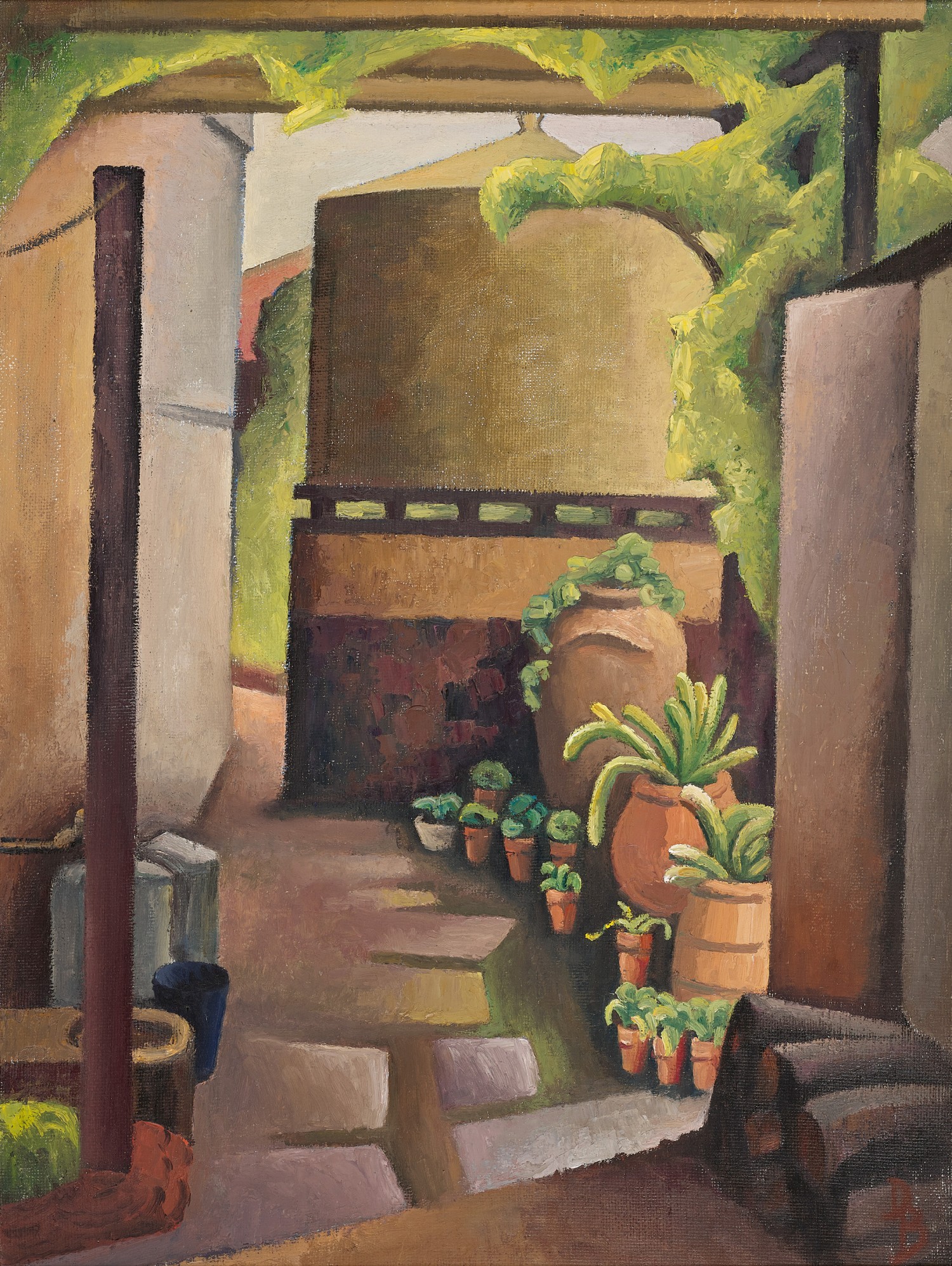
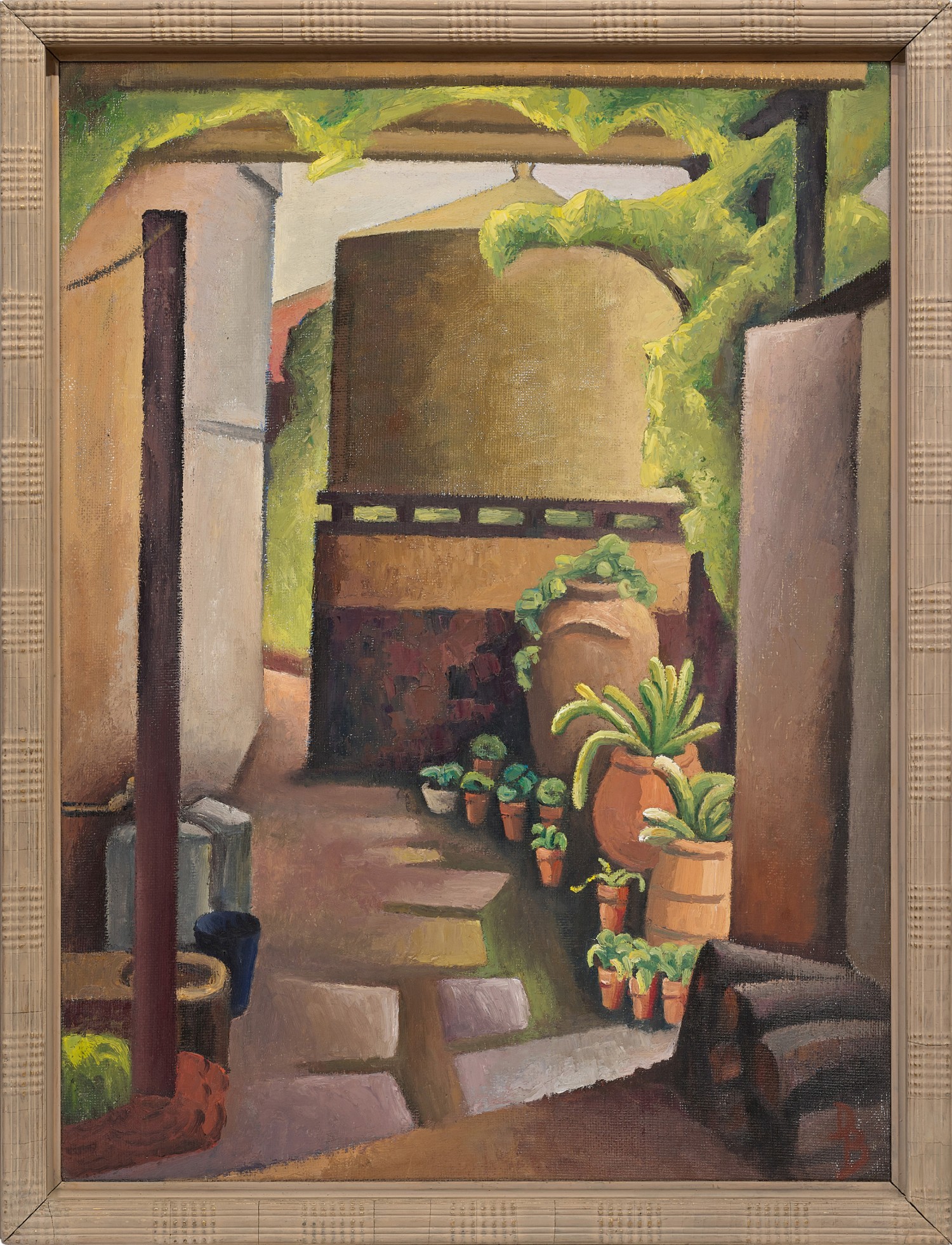
The purpose-built studio had a large south-facing window that looked out to the foothills of the Mount Lofty Ranges, a landscape that ‘had formed the backdrop to her childhood home at the entrance to Stonyfell Road, which led to the mid-nineteenth-century Stonyfell vineyard established by her great-uncle Henry Clark.’2 The 1940s was a productive decade for Black and views of this familiar country featured in her paintings, as did subjects that were found even closer to home. She painted a series of still-lifes and interiors depicting aspects of her domestic environment, and Under the pergola, c.1950 describes an exterior view of her home. From the pile of logs stacked in readiness for a warming fire, to the row of plants in terracotta pots lining the path, it is intimate and personal in the way that it reveals aspects of the artist’s everyday life.
There is an emphasis on light and shade in this picture – the spaces under the pergola are in shadow but sunlight creeps in, drawing us through the image towards the narrow opening between the raised water tank and building on the left. Tracey Lock interprets this painting as a poetic expression of ‘marking time and the contemplation of a spiritual dimension’, suggesting that in it, ‘The artist seems to be encouraging the viewer to contemplate the unknowable land beyond; it is a work of unexpected spiritual gravitas.’3 The fact that it is possibly the last work that Black made before her premature death in 1951 certainly gives this painting added poignancy.
1. Dorrit Black to Marjorie Caw, 10 December 1939, cited in Lock, T., Dorrit Black: unseen forces, Art Gallery of South Australia, Adelaide, 2014, p. 183
2. ibid., p. 112
3. ibid., p. 140
KIRSTY GRANT