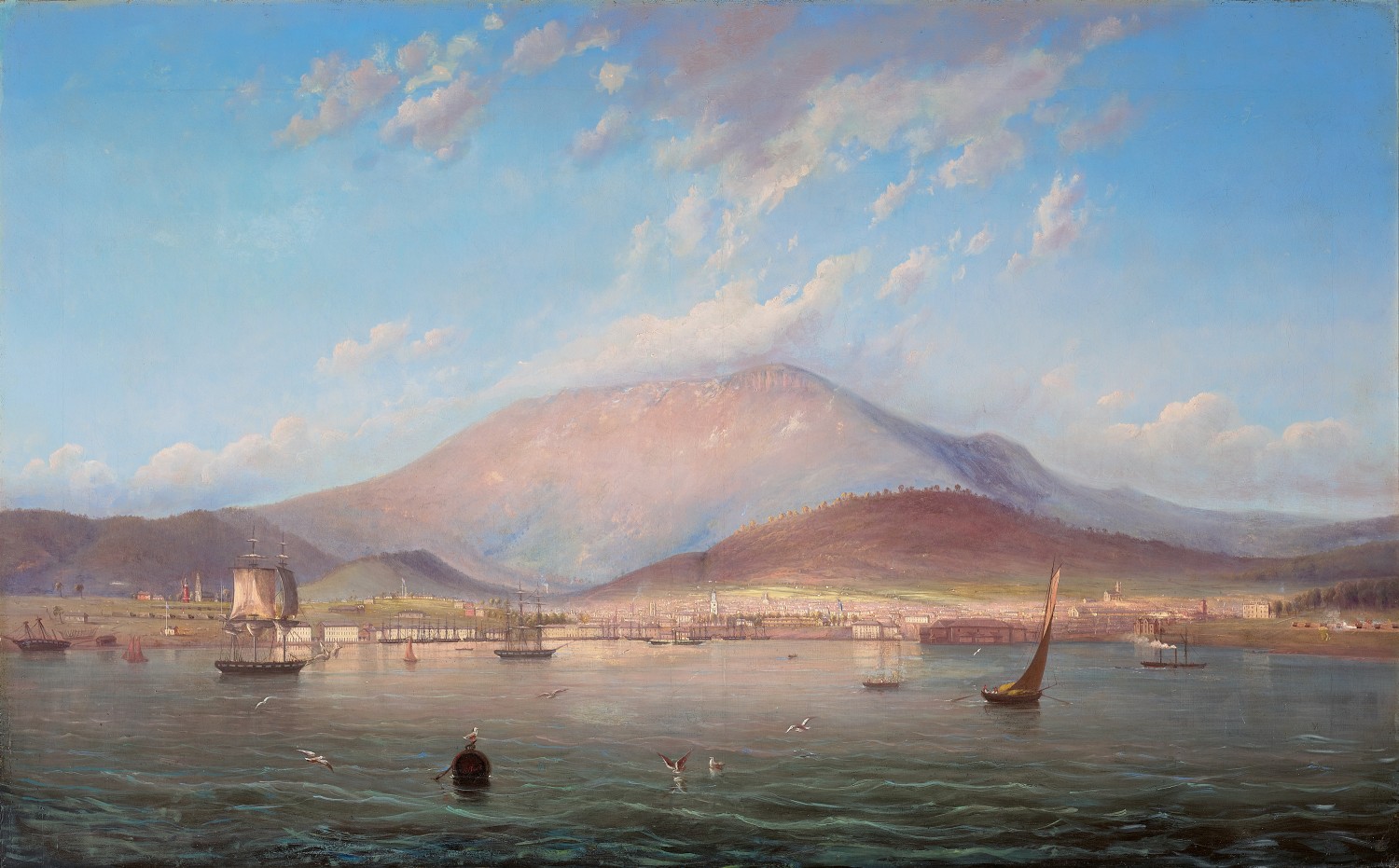
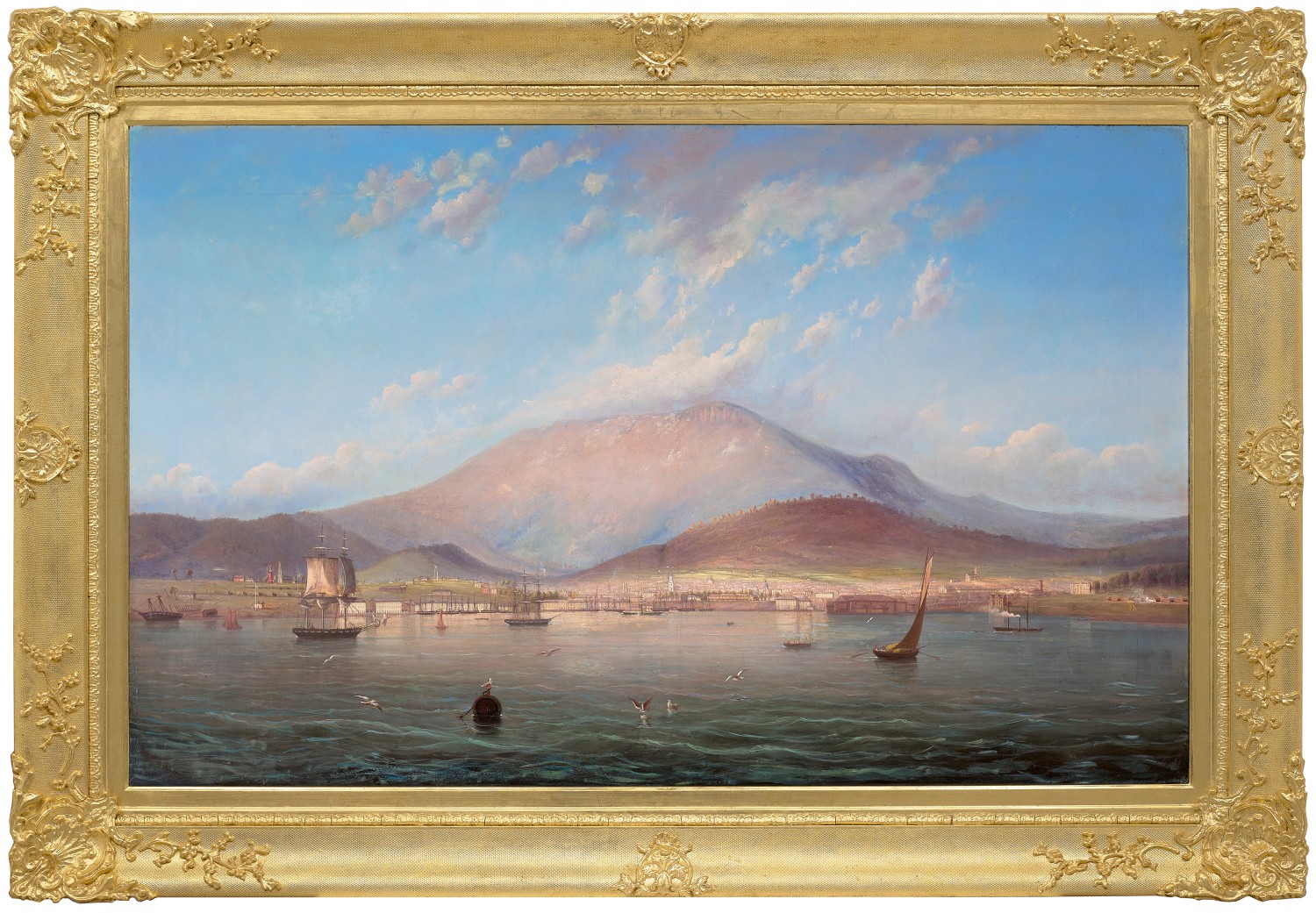
The city of Hobart Town with Mount Wellington beyond, 1855
Knud Bull
oil on canvas
78.0 x 127.0 cm
signed lower centre: K Bull
bears inscription on typed label verso: The City of Hobart Town with Mount Wellington / Knut Bull
Private collection, by descent through the artist's family
Phillips Auctioneers, London, 3 October 1989, lot 12
Private collection, Hobart
on long term loan to Tasmanian Museum and Art Gallery, Hobart, October 1989 – July 2015 (label attached verso)
on long term loan to Government House, Hobart, July 2015 – June 2026
260130 Knut Bull HR (web).jpg
Although he only painted in Tasmania for a few years – principally 1852 to 1856 – the Norwegian artist Knud Bull has a significant presence in the history of painting in the colony. The only professional landscape artist practising in Hobart at the time, Bull depicted the flourishing port city from a variety of locations, as well as nearby properties and surrounding environs. This superb painting depicts his best-known view, looking across the Derwent Estuary to Hobart (then named Hobart Town). Morning sun illuminates the slopes of Kunanyi / Mount Wellington and is reflected in the pellucid waters, casting a soothing glow over the bustling city established some fifty years prior. The sublime presence of the towering mountain is counterbalanced by the gentle ripple of the water which offers safe haven to passenger, cargo and whaling ships from the turbulent Southern Ocean.
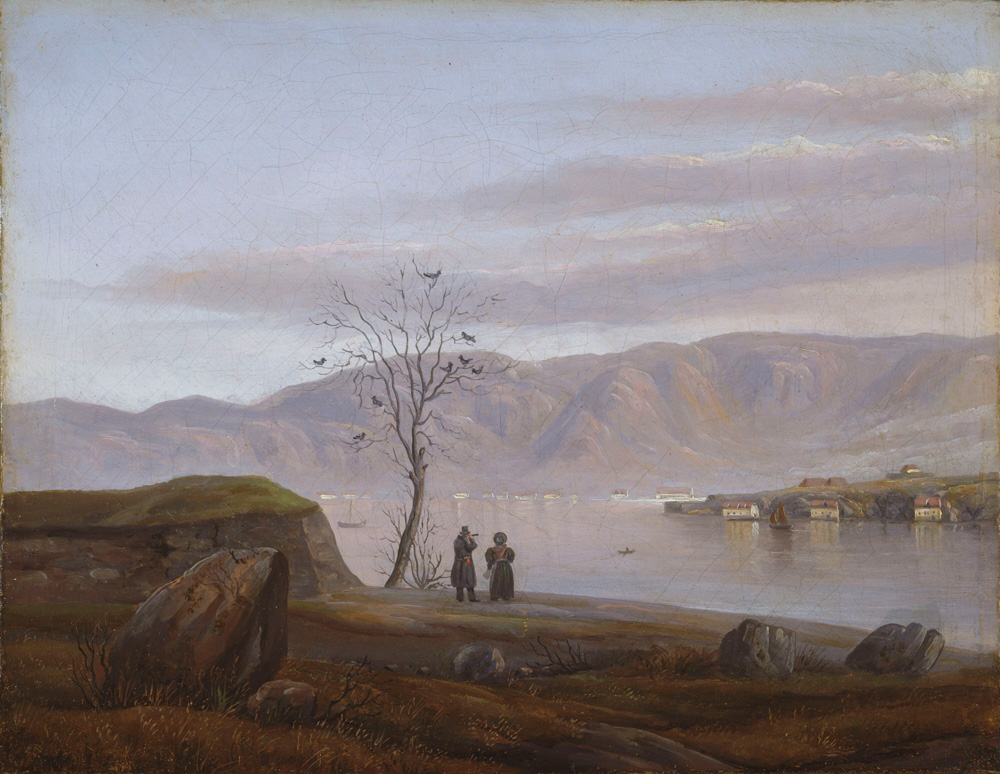
Knud Geemuyden Bull was born in 1811 in Bergen, Norway, a country then under Danish control.1 He and his nine siblings grew up in comfortable and cultivated circumstances: his eldest brother Ole became an internationally renowned violinist and composer, while his youngest, Georg Andreas, became an influential architect. Knud Bull’s artistic interests developed at an early age; although his preliminary teaching is unknown, it possibly included study in Copenhagen, as he later claimed. In 1833, aged 22, he attended the Dresden Art Academy for six months, studying with Norwegian-born Johan Christian Dahl, an influential participant in the German Romantic landscape movement, and a close friend of Caspar David Friedrich. Following his return to Bergen, Bull exhibited numerous landscapes and portraits in 1836, although only a small number are now known. One of his most accomplished, View of parts of Bergen, Nordnes, and Sandviken from Laksevåg (Parti fra Bergen, Nordnes og Sandviken sett fra Laksevåg) undated, (National Museum, Oslo), shows both his observational training and a close aesthetic relationship to the painting offered here.
260130 Knut Bull HR_1 (web).jpg
Despite the establishment of the Norwegian National Gallery in 1837, and Bull’s participation in the formation of art societies in Christiania (now Oslo) and Bergen, he left Norway, visiting Dresden and spending time in Stockholm. While painting, he also turned his artistic knowledge to less legal ventures. In December 1845, only weeks after arriving in London, Bull and an accomplice were charged that they ‘did feloniously make on block of brass for printing… a promissory note of a foreign state, to wit, of the Kingdom of Norway.’ Their trial was extensively reported, with the two sentenced to 14 years transportation. During the subsequent four-month voyage on the convict transport John Calvin, Bull’s behaviour was recorded as exemplary, and he formed a friendship with ship surgeon Henry Kelsall, for whom he produced at least one painting and a number of sketches. After nine months’ imprisonment under the brutal regime of Commandant John Price at Norfolk Island’s remote penal settlement, Bull arrived in Van Diemen’s Land on 15 June 1847, aged 35.
Over the next few years, Bull progressed swiftly through the required stages of his sentence, from labouring at a probationary station near Port Arthur, to probationary pass-holder to Hobart itself (including serving as a drawing master north of Hobart). In 1850, he disrupted this progress by absconding to Melbourne with a forged certificate of freedom under the pseudonym Thomas Evans and was apprehended three weeks later. Yet Bull was fortunate, being returned to Hobart to work for J. G. Medland, a reverend and amateur artist who lived in the opulent Italianate mansion ‘Boa Vista’ (now destroyed). Bull’s ticket-of-leave was granted in March 1852, with his conditional pardon approved in September 1854, having served fewer than nine of his required fourteen years.
As early as 1848, Bull had been enabled to continue with his art, producing a number of somewhat doll-like portraits of his patrons and a sombre shipwreck scene, The wreck of the ‘George the Third’, 1850 (National Gallery of Australia), showing the aftermath of a tragedy in which many convicts drowned. In 1852, only months after receiving his ticket-of-leave, Bull (recorded as ‘Mr Buhl, a German artist’) exhibited ‘a large oil painting of Mt Nelson… which… possess[es] considerable merit in colouring and in the management of the deep foreground, and [realises] with remarkable fidelity the characteristic features of the trees and the general condition of the forest ground of Tasmania.’2 Over the next few years, Bull received considerable praise and attention for similarly scenic paintings.
260130 Knut Bull (web).jpg
In 1854, a substantial exhibition was held in Hobart displaying items selected to represent the colony at the 1855 Paris Exposition Universelle. Among the samples of wool, wheat, timber, coal, seaweeds, bird skins and botanical specimens – as well as Palawa woven baskets, carved spears and shell necklaces – was ‘a splendid oil painting, being a view of the port and city of Hobart Town, with Mount Wellington in the distance, from the pencil of Mr. K. Bull, of this city.’ As additional promotion for Tasmania ‘it is framed in colonial wood, richly gilt with native gold.’3
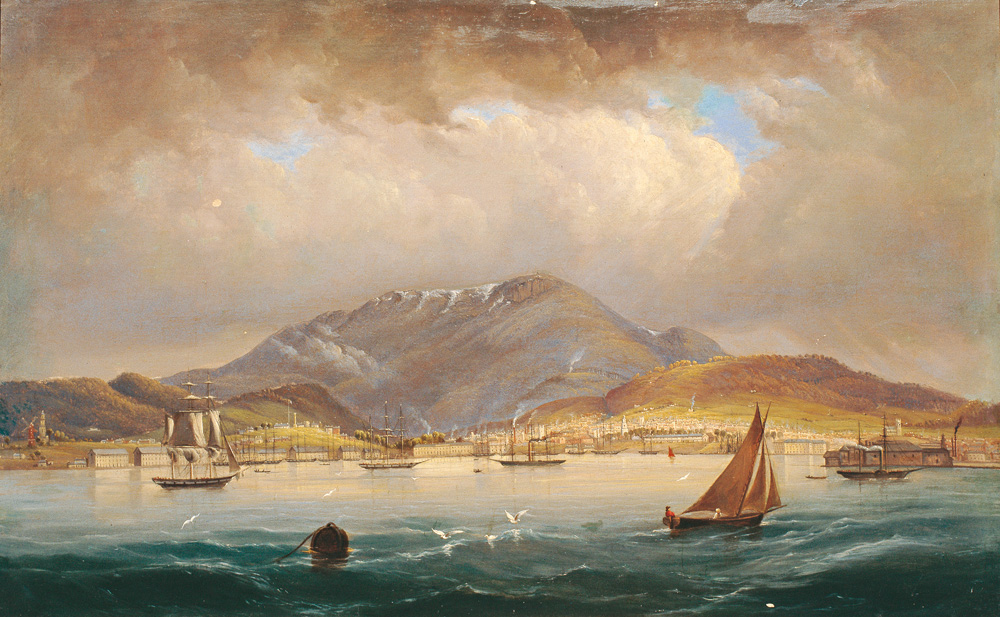
This painting (probably View of Hobart Town, 1854, Tasmanian Museum and Art Gallery) was received with sufficiently glowing admiration for Bull to repeat it for further sales, now having a growing family to support. In September 1855 (while the months-long Paris Exposition was underway), Bull offered two versions of the same scene by lottery. The Hobart Courier urged:
‘The list of subscribers to the lottery for the admirably delineated views of Hobart Town, by Mr. Knud Bull, the intelligent artist… is fast filling up, and we advise those of our citizens who are desirous to possess two art-gems of such surpassing local interest, to make their intentions known before it is too late.’4
It is likely that the impressively scaled view presented here is the larger of these two lottery paintings, valued then at £150. A fourth version is also known – each meticulously painted yet varying in scale, expressive atmosphere, watercraft, buoys and seagulls.
260130 Knut Bull EvG (web).jpg
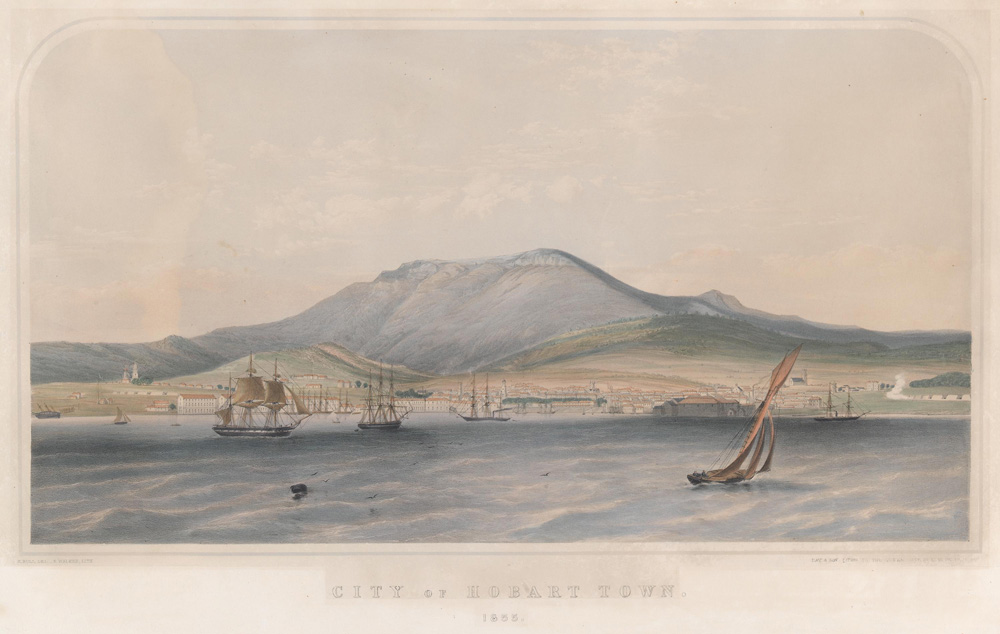
In addition to the paintings, available only to wealthier collectors, a print was also commissioned. This was undertaken for publishers Day & Son in London by artist Elizabeth Walker, who translated the glowing colours of the oil to the soft tonalities of lithography, with additional hand-colouring ‘in the most natural and delicate manner.’5 The resulting prints were received with delight by the Hobart press, which advocated them as ideal means of attracting ‘the attention of intending emigrants to our fertile island… The price is moderate, within the reach of everyone.’6
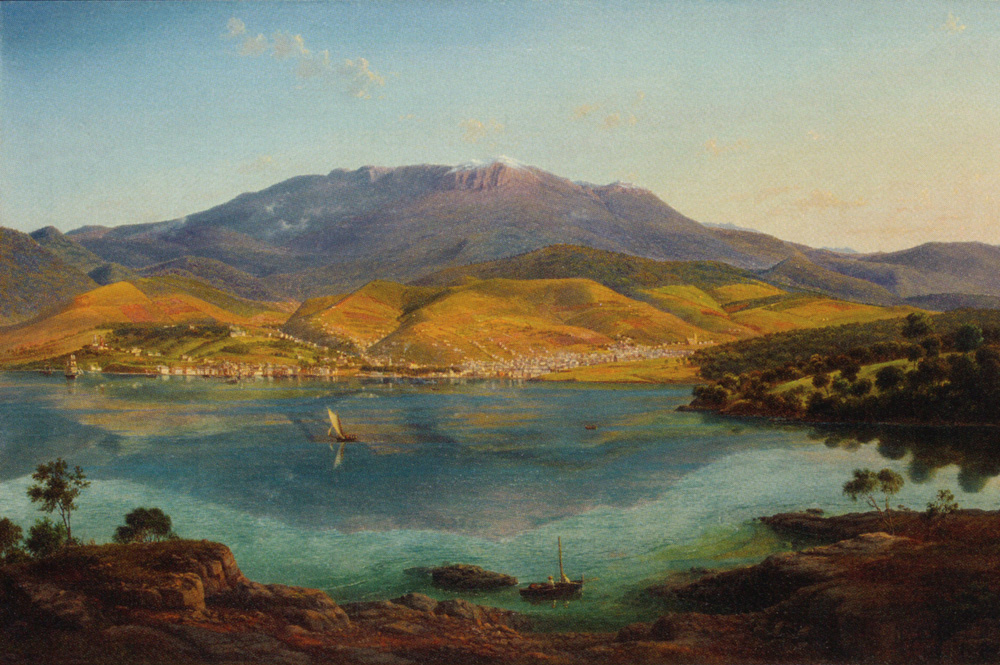
Bull was by no means the only, or the first, artist to take advantage of such an impressive vista from or near Bellerive on the estuary’s eastern shore. In addition to John Glover’s earlier Mount Wellington and Hobart Town from Kangaroo Point, 1834 (owned jointly by the Tasmanian Museum and Art Gallery and National Gallery of Australia), during Bull’s residence in Hobart Eugene von Guérard produced a high-keyed rendition following a short visit in mid-1855. In 1856, Henry Gritten moved from the mainland to Hobart and – like Bull – saw the commercial potential of multiple versions of this view (as he had previously done in Melbourne with views from the Botanic Gardens). The arrival of a competing landscape artist might have been one factor in Bull’s decision to relocate from Tasmania to the mainland colonies. He subsequently worked between Melbourne, Sydney and Adelaide, in a variety of professions, artistic and otherwise (with additional run-ins with the law) until his death in Sydney in 1889.
1. Complicating research, his first name appears spelled Knut, Knude, Kenud, Kanute and Canute while his surname also appears as Buhl – in addition to pseudonyms used in his illegal activities.
2. The Courier, Hobart, 20 October 1852, p. 3
3. The Courier, Hobart, 9 November 1855, p. 2
4. The Courier, Hobart, 4 October 1855, p. 2
5. The Courier, Hobart, 1 July 1856, p. 3
6. The Courier, Hobart, 28 April 1856, p. 3
ALISA BUNBURY