Labourers after dinner, 1884
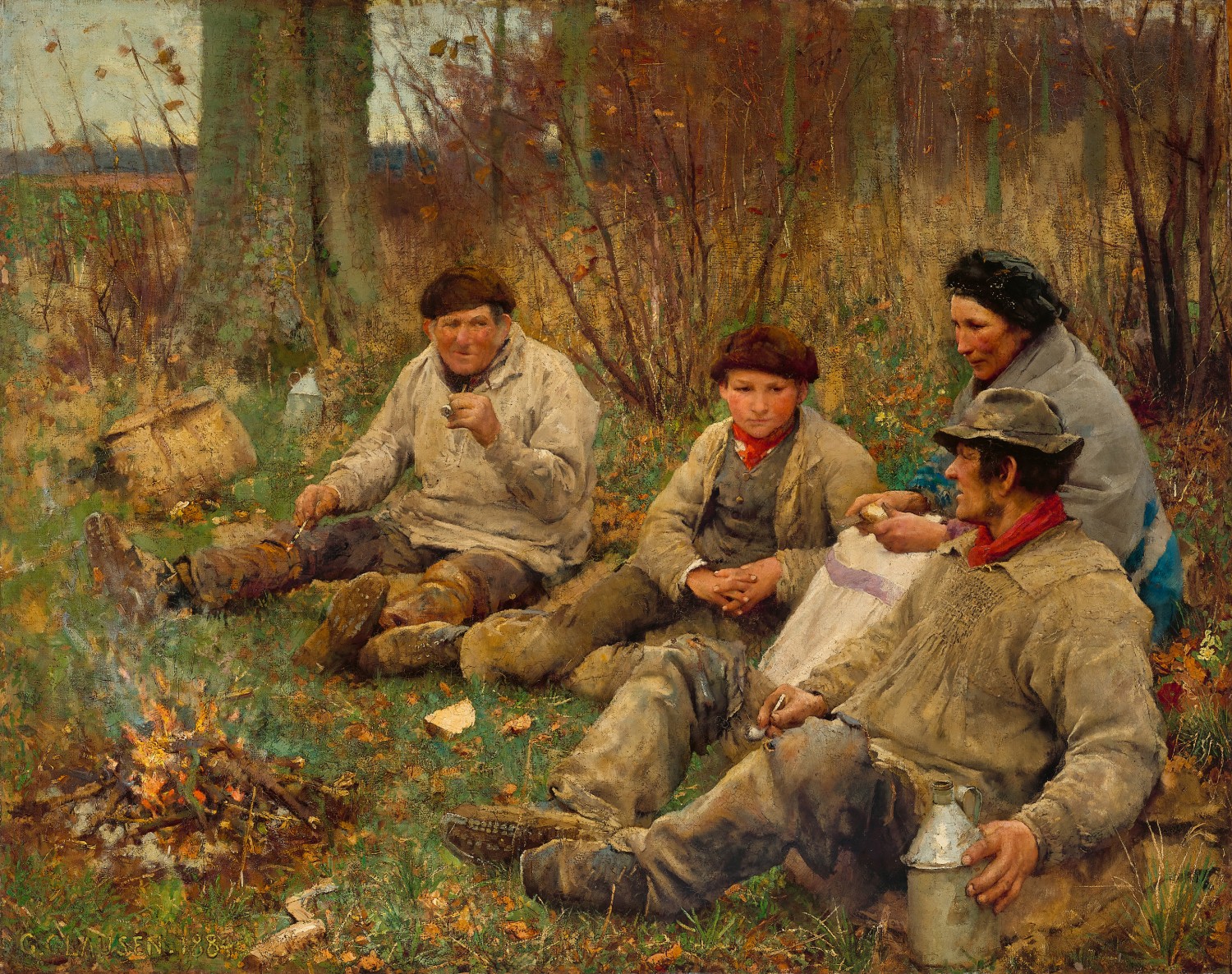

George Clausen
oil on canvas on plywood
122.0 x 152.0 cm
signed and dated lower left: G. CLAUSEN. 1884
Sharpley Bainbridge, Esq., J.P., by 1895
Christie's, London, 10 February 1922, lot 105
Private collection, purchased from the above by a buyer recorded as 'Major'
William Berstein, Sydney
Artlovers Gallery, Sydney
John Brackenreg, Sydney, acquired from the above in June 1975
Private collection
The Exhibition of the Royal Academy of Arts, The 116th, Royal Academy of Arts, London, 5 May – 4 August 1884, cat. 1630
Fourteenth Autumn Exhibition of Pictures in Oil and Water–Colours, Walker Art Gallery, Liverpool, 1 September – December 1884, cat. 1690
Autumn Exhibition, New Gallery, London, September – November 1892
Blackburn, H. (ed.), Academy Notes, Chatto & Windus, London, 1884, p. 75
‘Current Art III’, The Magazine of Art, London, 1884, p. 397
‘Current Art IV’, The Magazine of Art, London, 1884, p. 446
‘The Royal Academy, Gallery XI’, The Art Journal, London, 1884, p. 244
Monkhouse, C., ‘The Royal Academy’, The Academy, no. 628, London, 17 May 1884, p. 356
‘Burlington House’, The Tablet, London, 24 May 1884, p. 805
‘The Royal Academy IV’, St James's Gazette, London, 26 May 1884, p. 6
‘The Royal Academy IV’, St James's Budget, London, 31 May 1884, p. 12
‘The Royal Academy – Third Notice’, Daily News, London, 4 June 1884, p. 7
‘Royal Academy, Fourth Notice’, Illustrated London News, London, 7 June 1884, p. 562
‘Art in October’, The Magazine of Art, London, 1893, p. i
Moore, G., Modern Painting, W. Scott Publishing, London, 1893, pp. 115–122
Moore, G., ‘The New Gallery’, The Speaker, London, 8 October 1893, pp. 436–437
Moore, G., ‘Exteriority’, The Speaker, London, 22 June 1895, p. 685
The Magazine of Art, Cassell and Company Limited, London, 1895, pp. 406, 417
Frank Leslie's Popular Monthly, Frank Leslie, New York, June 1896, p. 645 (illus.)
Hussey, D., George Clausen, Ernest Benn Ltd., London, 1923, pp. 15, 17 (as 'Labourers: After Dinner')
Laver, J., Portraits in Oil and Vinegar, John Castle, London, 1925, p. 88
McConkey, K., George Clausen RA, RWS, 1852–1944, exhibition catalogue, Bradford and Tyne and Wear Museums, Bradford, 1980, pp. 29–30 (illus.)
McConkey, K., ‘Figures in a Field – Winter work by Sir George Clausen RA’, Art at Auction 1982–83, Sotheby's, London, 1982, p. 77 (illus.)
McConkey, K., ‘Rustic Naturalism in Britain’, in Weisberg, G. P. (ed.), The European Realist Tradition, Indiana University Press, Bloomington, 1982, p. 222 (illus.)
McConkey, K., British Impressionism, Phaidon Press, London, 1989, p. 33
McConkey, K., Impressionism in Britain, Barbican Art Gallery / Yale University Press, London and New Haven, 1995, p. 108
Holden, K., ‘George Clausen and Henry Herbert La Thangue: Rural Painting and Urban Patronage’, Apollo, London, February 1999, p. 11 (illus.)
McConkey, K., Memory and Desire: Painting in Britain and Ireland at the Turn of the Twentieth Century, Ashgate Publishing, Aldershot, 2002, fig. 67, pp. 132 (illus.), 133
Gruetzner Robins, A., ‘Living the Simple Life: George Clausen at Childwick Green, St Albans’, in Corbett, D. P. et al. (eds), The Geographies of Englishness, Studies in British Art 10, Yale University Press, New Haven, 2002, p. 12
McConkey, K., ‘Un petit cercle de thuriféraires – Bastien–Lepage et la Grande Bretagne’, 48/14: La revue du Musée d'Orsay, no. 24, Paris, Spring 2007, p. 28
McConkey, K., George Clausen and the Picture of English Rural Life, Atelier, Edinburgh, 2012, pp. 63 (illus.), 64, 71, 107, 112, 116, 186, 216, 222
260229 Clausen (Jules Bastien-Lepage)-topaz-upscale-2x (web).jpg
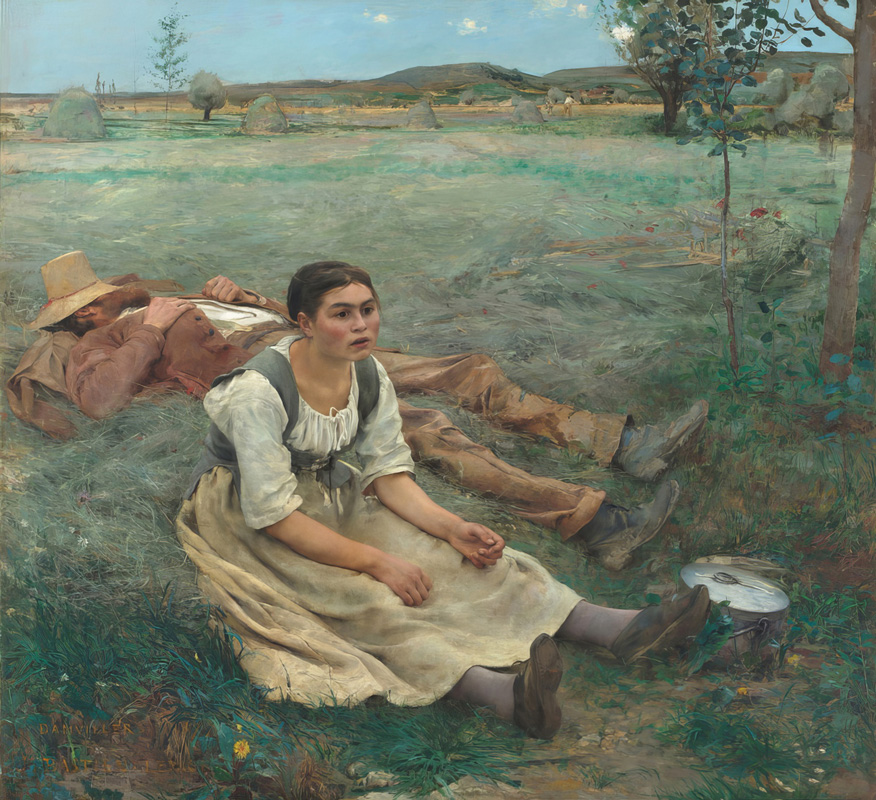
In May 1880, the special feature within the Grosvenor Gallery Spring exhibition was a small retrospective of works by Jules Bastien-Lepage (1848 –1884). The gallery’s managers, who had displayed paintings by Whistler three years before and incurred Ruskin’s wrath, were living up to their reputation for controversy. Lepage’s portraits were admired, but beside the ‘ugly’ Annunciation to the shepherds, 1875 (National Gallery of Victoria), hung the painting that had made his reputation, Les foins (The hay harvest), 1877 – 78.1
While Lepage’s skill could not be denied, this picture’s ‘primeval Eve, as first evolved from the gorilla’, offended critics attuned to the anodyne lotus lands of Burne-Jones and Albert Moore.2 There was, nevertheless, a ‘little knot of worshippers’ in front of Lepage’s resting field workers, ‘admiring or condemning in the most vehement manner.’3
It is sometimes difficult to appreciate the attraction felt by young aspiring artists for the work of older peers who seem to have all the answers, but in the case of George Clausen, a fellow Grosvenor Gallery exhibitor in 1880, there had been experiments in rural genre painting before Lepage’s work presented itself.4 Having left the Government Art Training School, he was aware of the trend towards plein air Naturalism in the work of the Barbizon and Hague School artists, had toured Holland, Belgium and northern France, and had started to collect prints of the work of Jean-Francois Millet. But it was only with Les Foins that he found the rigorous objectivity he was looking for – the ‘verité strictement scientifique’ that Emile Zola had applauded in Lepage’s work.5 Lepage painted in the fields, so must he. The following year, having shown his final London-based canvas at the Royal Academy, he married Agnes Mary Webster, the talented sister of a fellow student, and decamped to Childwick Green near St Albans in Hertfordshire for a new start. It was, he later declared, ‘a liberation… one saw people doing simple things under good conditions of lighting... nothing was made easy for you, you had to dig out what you wanted.’6
260229 Clausen December (web).jpg
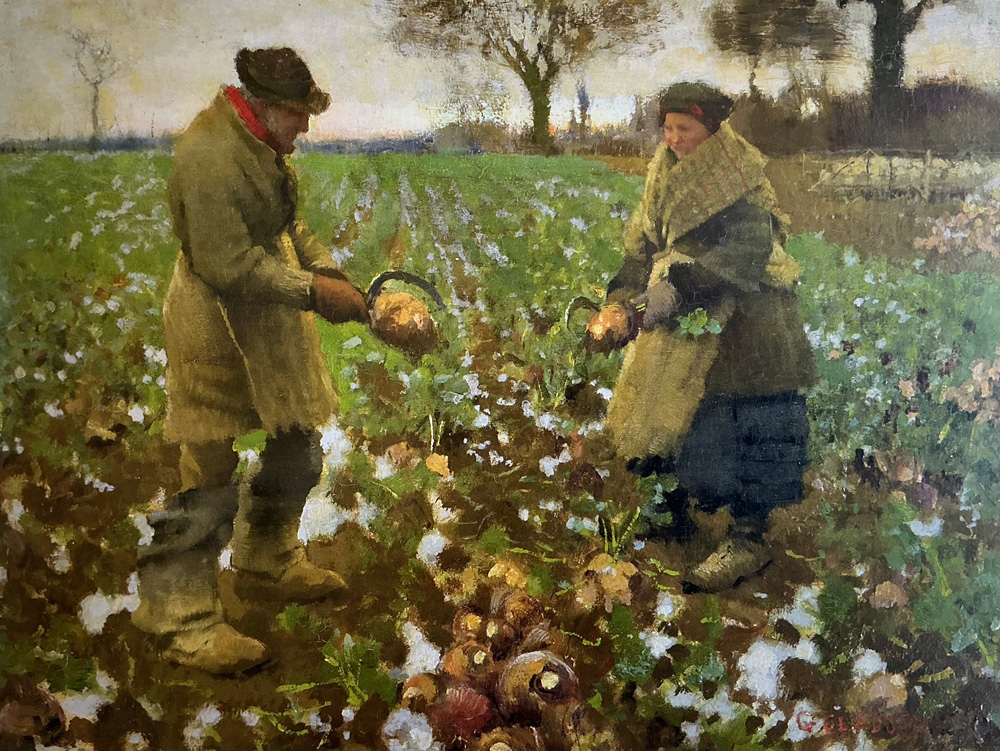
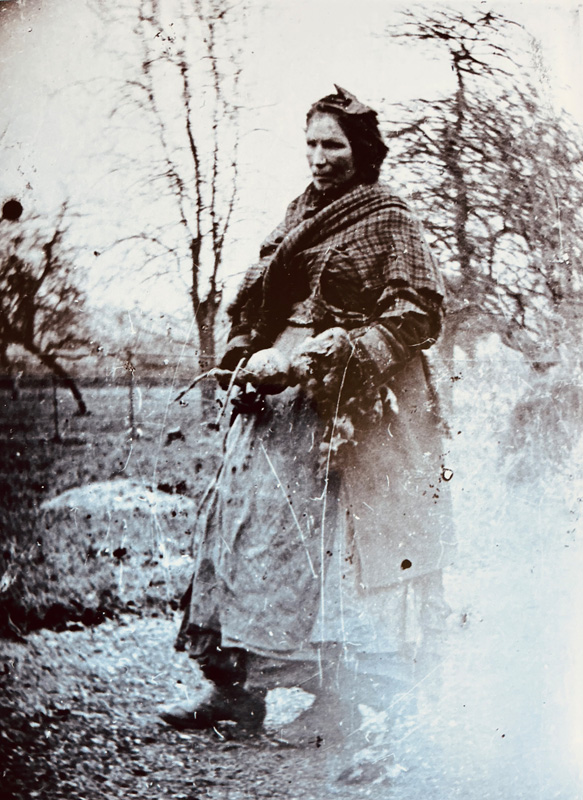
Clausen was now a tenant on the Toulmin estate, spending his days with a portable easel and sketchbook in the company of hired hands.7 The impact on his work was immediate. The yearly cycle of ploughing, hoeing, harvesting, hedging, of thinning the woodlands and preparing winter feed for sheep filled his sketchbooks and expanded into small works such as December.8 The faces of the present Labourers after dinner, 1884 now become recognisable and to assure himself of their documentary accuracy he acquired a small, hand-held 1.5 inch glass plate camera to record their activities.9
Before visual facts, there were no concessions, and in this respect, he allied himself with contemporary writers and social recorders of the English ‘Hodge’, such as Thomas Hardy and Richard Jefferies.10 This lowest stratum of society, according to Jefferies, had ‘no myths, no heroes … no Achilles, no Agamemnon, and no Homer.’11 It was Clausen’s task to give them visual presence. A brief sojourn in Brittany one year and a few weeks in the Paris ateliers the next confirmed his Naturalism, and during 1883 he was busily engaged on larger canvases, the first two of which were Winter work, and Daydreams.12
260229 Clausen Untitled 1983 (web).jpg
Without a broad sense of the current diversity of British painting, it is hard to appreciate why these images appeared so extreme. It was not simply that rustics were represented, so much as that their grimy work-clothes, gnarled and swollen fingers, and weather-beaten faces had not been prettified. They may not be named, but they were no less real. The most carefully studied and largest of the sequence was Labourers after dinner, where the recording of specific identities was at its most profound.
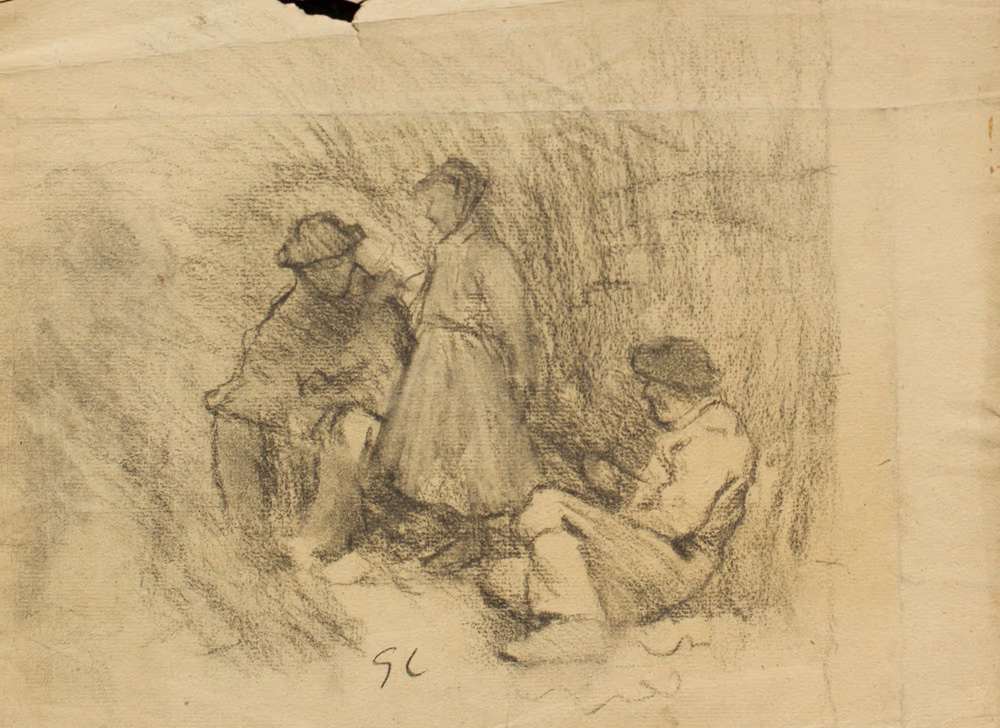
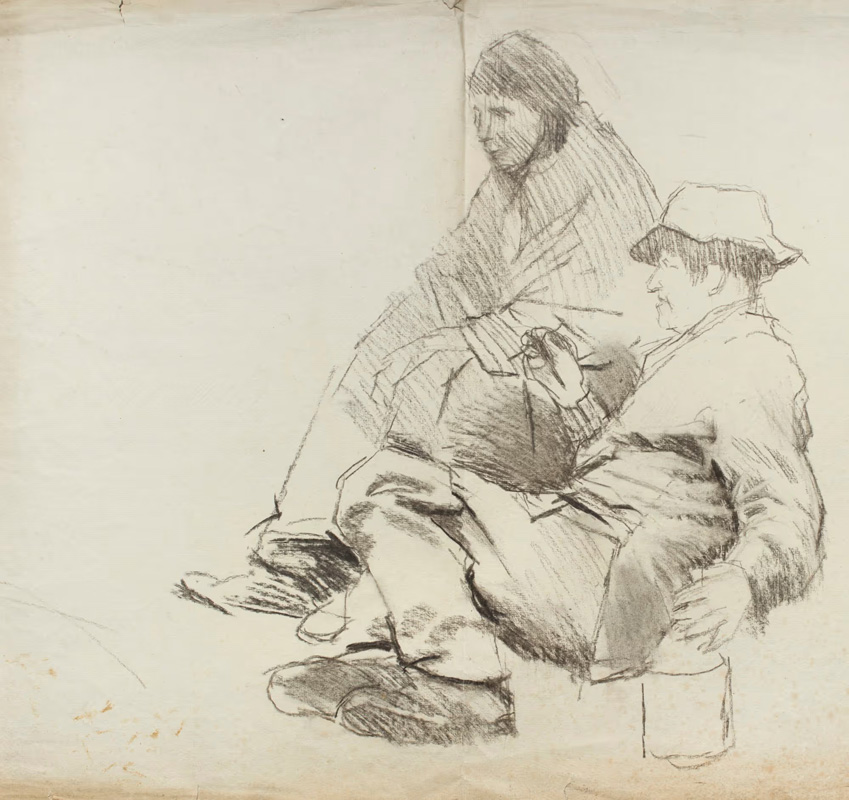
The idea for Labourers after dinner began with a simple drawing of two seated field workers and a girl to be followed by three large, folded sheets detailing the possible positions of one, two and then three figures, to which a fourth, the man in the background, was added.
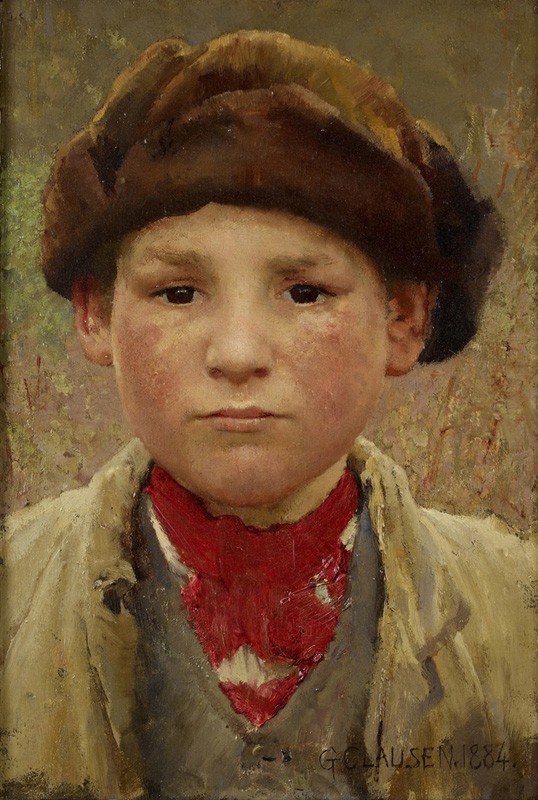
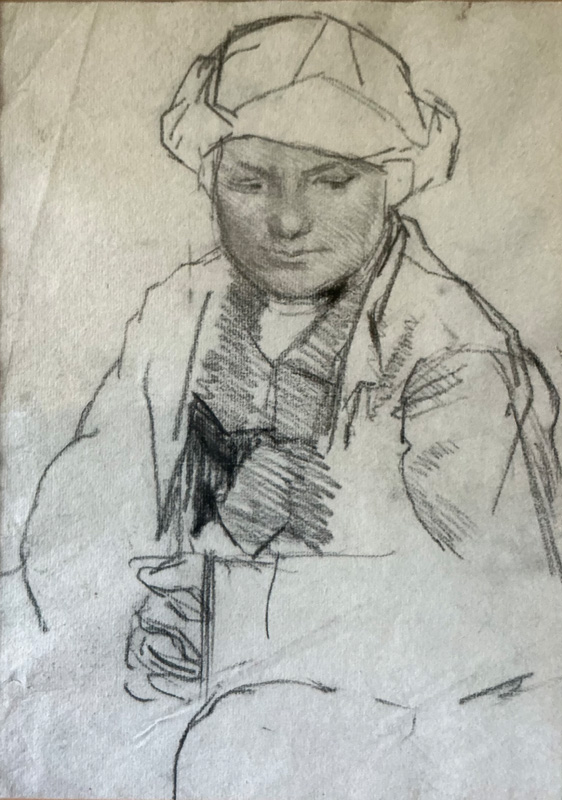
Margin notes on the top right-hand corner of one of these tell us that the man in the foreground is William Smith, a labourer whose son, John, sits behind the woman. She is thought, on the basis of other drawings, to be Susan Chapman, a straw plaiter, while the older man about to draw on his clay pipe is likely to be ‘old Lawrence’.13 This core group was augmented by several other drawings and supplementary oil studies, specifically in the woman’s and boy’s cases.14
All lived close to the painter and his wife. That these individuals have names and addresses was clearly of significance, but they went undeclared; they might typify their class, but not in a generalised or heroic sense à la Millet, and therein was the basis of the offence they caused to conservative critics.
260229 Clausen Winter work option 2-topaz-upscale-2x (web).jpg
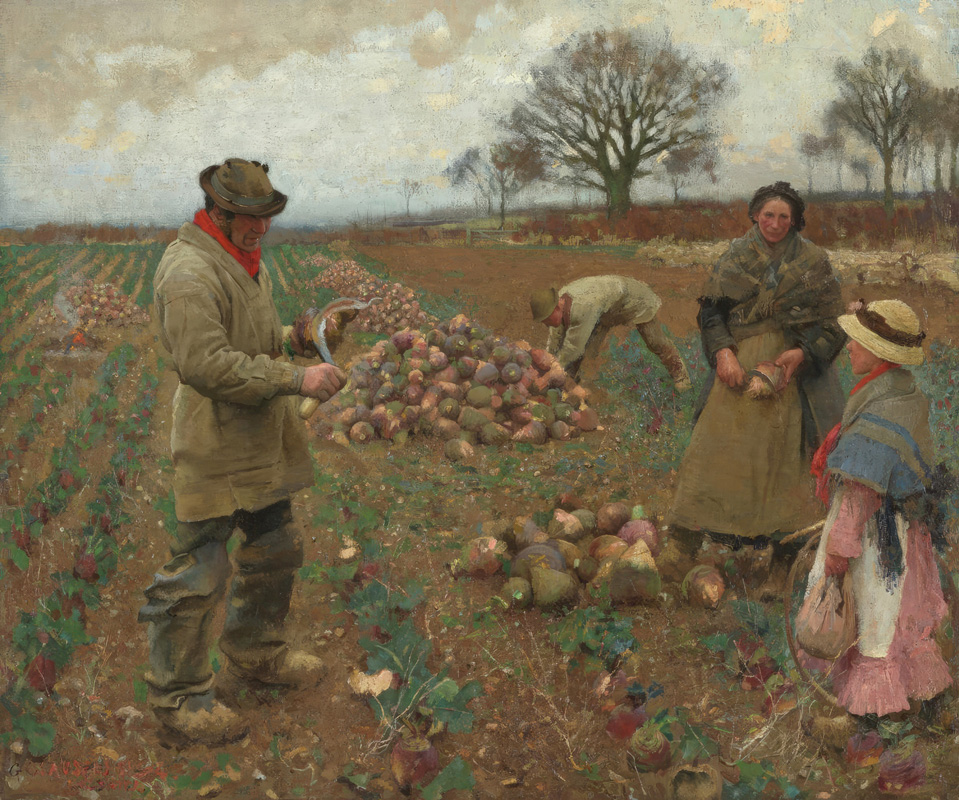
Clausen later expressed his admiration for Lepage’s figures in terms of their mentalities and interactions with the viewer. ‘He paints a man, and the man stands before you and you ask yourself, “What is he going to say?”’ was how he put it.15 The same might be said of this little field gang. Thus, the gap between lived confrontation in real time and space, and its realisation was to be bridged – in this case in a setting that included a closely observed campfire, brushwood and a glimpse of landscape – all to be ready in time for delivery to the Royal Academy in March 1884.
The exhibition opened to a critical chorus – aged members, each with eight allocated places ‘on the line’, were crowding out younger artists. Fatigue set in by Gallery XI, where Clausen’s work was placed, and he had to wait until the beginning of June to be told that his work was ‘fully equal to [Bastien-Lepage] in veracity if not in ugliness.’16 He even lacked the French painter’s ‘sentiment’, according to The Art Journal.17 Among his defenders, The Magazine of Art pointed out that glib references to Lepage did not do justice to a ‘thoroughly English work’ in which ‘day-Labourers after dinner denied the light of working-men’s clubs and socialism’ are represented with ‘such power and amplitude.’18 However, Clausen’s dismay with the Burlington House cartel was such that, after Labourers after dinner was exhibited, he took to the ‘Letters’ pages of The Times in 1886 to call for Academy reform and threw his weight behind the expansion of the newly-formed New English Art Club. He would not return to its Summer exhibition for a further five years.
260229 Clausen Day Dreams (web).jpg
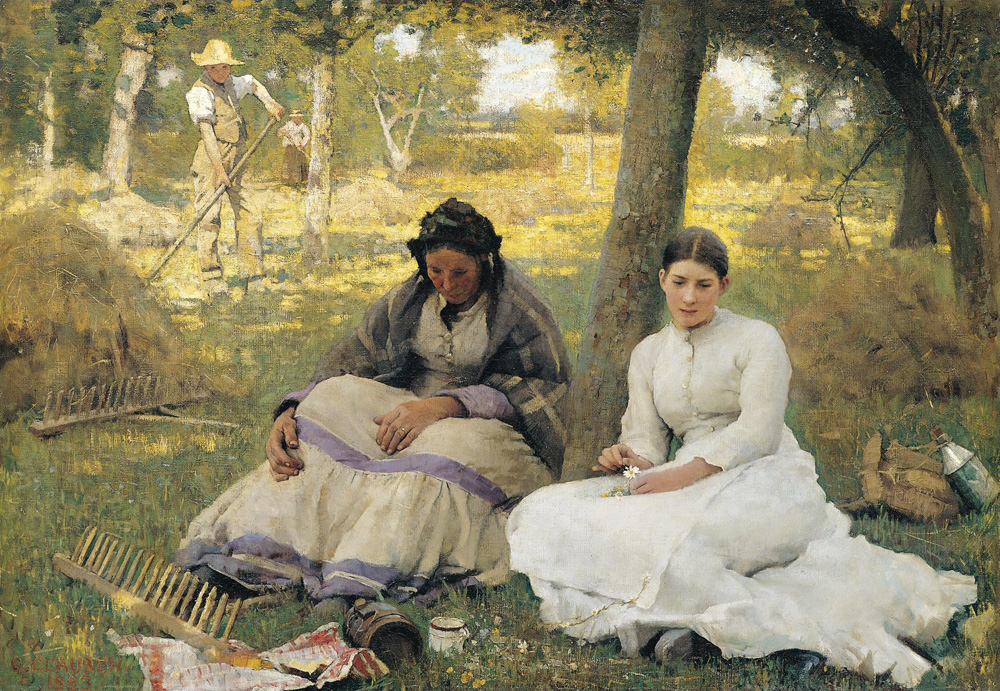
260229 Clausen Labourers Resting option 2 (web).jpg
In 1883, the Toulmin estate passed to John Blundell Maple, the celebrated London furniture retailer who immediately started to convert its mixed arable and grazing fields into paddocks for his stud farm, and Clausen’s tenancy was not renewed. He spent a year in St Albans and a further six years in Cookham Dean in Berkshire before moving to Widdington in Essex where he remained until 1905. By 1892 when Labourers after dinner was first requested for the following year’s New Gallery Autumn exhibition and listed for possible inclusion in the Chicago World’s Fair, the painting had been in the collection of Sharpley Bainbridge (1849 – 1910) of Lincoln for some time.19 Bainbridge, a clothier, who expanded the business into a chain of successful department stores in cities of north-east England, was an avid early collector of Clausen’s work.20 He was probably advised by the artist’s brother-in-law Alfred George Webster (1852 – 1916), then a teacher, and later Principal of Lincoln School of Art.21
260229 Clausen Studies of an iold man relating to .... (web).jpg
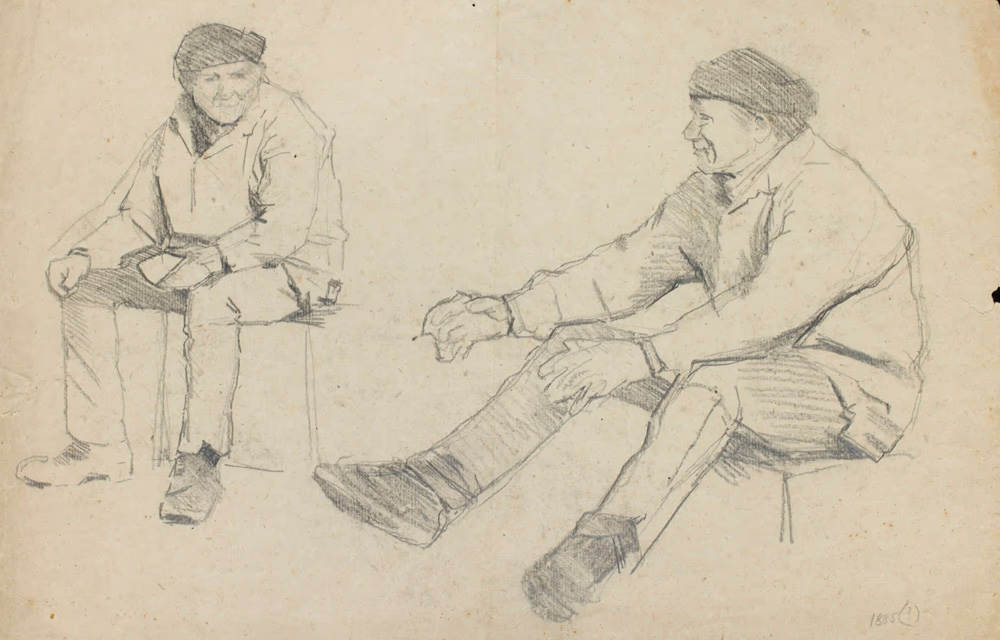
260229 Clausen Study for Labourers After Dinner (web).jpg
The move to Essex coincided with fundamental changes in Clausen’s work when the static, grey day subjects such as The girl at the gate, 1889 (Tate Gallery, London) were abandoned in favour of the vivid colour and more impressionistic handling of The mowers (Usher Gallery, Lincoln) and Evening song (private collection), exhibited in 1892 and 1893. The development was approved by ‘new critics’ spearheaded by the Irish novelist, George Moore. In order to convey the significance of the change in Clausen’s recent work, Moore amplified opinions expressed in his recent columns in The Speaker in his book Modern Painting (1893) by contrasting Labourers after dinner with these more recent paintings. The picture that had, for very different reasons, offended the popular press in 1884, was now castigated by those who espoused the avant-garde! ‘Were we ever as mad as that?’ Moore exclaimed when he referred to it.22
The artist responded, passing a message to the critic through a mutual friend. But it was only in May 1895 that he caught up with Moore in the crowd of visitors at that year’s Royal Academy exhibition. In a friendly exchange, he reminded Moore of his early sub-Zola école naturaliste novels in which surface detail – the equivalent of the ‘blank brutality’ of the Labourers after dinner – had been sacrificed to spiritual essence.23 They agreed that artist and writer had come to similar conclusions at around the same time and both were expressions of artistic integrity.
260229 George Clausen, Farmer's Boy (web).jpg
260229 Clausen Study for 'Labourers After Dinner' (web).jpg
The aesthetic argument, the central preoccupation of the ‘new critics’, had much to do with the nature of beauty, both popular and refined. There was a tightrope to cross. Back in the day, The Illustrated London News had contrasted the anodyne Anglo-Greek maidens of Albert Moore’s Reading aloud (Glasgow Museum) and the brutality of Clausen’s Labourers after dinner. It had been proof that no other work quite so essentially pierced the contemporary debate. These were not romantic swains and milkmaids, but real people with real lives. Only in their company, in that brief moment in the winter of 1883 – 84, did the vital spark ignite. It even outshone Clausen’s own earlier works. It was, in short, a manifesto.
1. ‘The Grosvenor Gallery – First Notice’, The Standard, London, 3 May 1880, p. 2
2. ‘The Grosvenor Gallery’, The Illustrated London News, London, 8 May 1880, p. 451
3. ‘The Grosvenor Gallery’, The Spectator, London, 12 June 1880, p. 751
4. McConkey, K., George Clausen and the picture of English rural life, Atelier Books, Edinburgh, 2012, pp. 29 – 41
5. Zola, E., Le Bon Combat, De Courbet aux Impressonistes, Collection Savoir, Éditions Hermann, Paris, 1975, p. 207
6. Clausen RA, G., ‘Autobiographical Notes’, Artwork, no 25, Spring 1931, p. 19
7. For Henry H Toulmin (1807 – 1871) and the improvements to the estate, see Aitken, C., Childwickbury, published privately, 2011, pp. 13 – 24
8. McConkey, K., ‘Rustic Naturalism at the Grosvenor Gallery’, in Casteras, S. P., and Denney, C., eds., The Grosvenor Gallery, A Palace of Art in Victorian England, Yale University Press, New Haven, 1996, pp. 156 – 57
9. McConkey 2012, op. cit., pp. 54 – 55
10. ibid, pp. 14 – 16, 26, 62
11. Jefferies, R., Hodge and his Masters, Sketches of Rural Life, Smith, Elder & Co, London, 1880, vol. II, p. 204
12. Winter work was first shown at the Grosvenor Gallery in 1883, but when unsold, was later modified, while Day dreams, was sent to the first Royal Institute of Painters in Oil Colours exhibition in November 1883, see Sotheby’s, London, 11 December 2007, lot 54 (essay by Kenneth McConkey)
13. See Robins, A. G., ‘Living the Simple Life, George Clausen at Childwick Green, St Albans’, in Peters Corbett, D., et al, The Geographies of Englishness, Studies in British Art, Yale University Press, New Haven, 2002, no. 10, pp. 17 – 19, and Aitken, op. cit., p. 170 (transcribes addresses from the 1881 census).
14. McConkey, 2012, op. cit., p. 62, fig 87 for the woman’s head study. See also A Moment’s Rest, 1882, 45.7 x 33.0 cm, sold Christie’s, London, 15 December 2011, showing the woman seated in a field setting.
15. Clausen, G., ‘Jules Bastien-Lepage as Artist’, in Theuriet, A., Jules Bastien-Lepage and his Art, T. Fisher Unwin, London, 1892, p. 115
16. The Illustrated London News, London, 7 June 1884, p. 562
17. The Art Journal, London, 1884, p. 280
18. ‘Current Art III’, The Magazine of Art, London, 1887, p. 397. The point was reiterated when, a few weeks later, he showed members of the same group hoeing turnips, see ‘Current Art III’, The Magazine of Art, London, 1887, p. 446
19. On 16 June 1885 Clausen notes in his account book that Labourers [sic.] along with Over the hill (unlocated), had been sent to Aberdeen – the entry being crossed out with the word ‘returned’ (this was possibly to the opening exhibition of Aberdeen Art Gallery). The painter’s mother, Elizabeth Fillan, hailed from Aberdeen; his father was Danish. Since no other reference is made until 1892, we may assume that Bainbridge owned the work before the painter began to keep accounts in 1885. Dates for the New Gallery show and the Chicago exhibition clashed.
20. Anon., ‘The Collection of Sharpley Bainbridge JP, Lincoln’, The Art Journal, 1898, pp. 225 – 229, 272 – 275. The last Bainbridge store in Newcastle-upon-Tyne was sold to the John Lewis chain in the 1970s.
21. McConkey, 2012, op. cit., pp. 41, 81 – 82
22. Moore, G., Modern Painting, Walter Scott Publishing, England, 1893, p. 117
23. Moore, G., ‘Exteriority’, The Speaker, 22 June 1895, p. 685
KENNETH McCONKEY