Wendy on cushions, 1976
Brett Whiteley
also known as The Studio: Wendy Asleep
charcoal on paper
76.0 x 101.5 cm
stamped with artist’s monogram lower left: BW
signed verso: Brett Whiteley
Australian Galleries, Melbourne
Private collection, Melbourne, acquired from the above in September 1976
Private collection, Melbourne, acquired from the above in March 2010
Recent Interiors, Still lifes, Windowscapes, Sculpture and Ceramics, Australian Galleries, Melbourne, 21 September – 5 October 1976, cat. 4
Brett Whiteley: Recent Nudes, the artist’s studio, Sydney, 3 – 31 October 1981 (illus. in exhibition catalogue, p. 15)
Lloyd Rees: Brett Whiteley: On the Road to Berry, Museum of Modern Art at Heide, Melbourne, 13 July – 5 September 1993 and touring to Art Gallery of New South Wales, Sydney, 17 September – 14 November 1993, cat. 63 (as ‘Figure and Lavender Bay (Wendy Sleeping)’)
Brett Whiteley: Art and Life, Art Gallery of New South Wales, Sydney, 16 September – 19 November 1995, cat. 84 and touring to Museum and Art Galleries of the Northern Territory, Darwin, 13 December 1995 – 28 January 1996; Art Gallery of Western Australia, Perth, 22 February – 8 April 1996; Art Gallery of South Australia, Adelaide, 9 May – 16 June 1996; National Gallery of Victoria, Melbourne, 2 July – 26 August 1996 and Tasmanian Museum and Art Gallery, Hobart, 18 September – 17 November 1996, cat. 69
50 Years: Australian Galleries 1956–2006, Australian Galleries, Melbourne, 2006 (label attached verso, as ‘Interior Lavender Bay, 1977’ [sic])
Brett Whiteley: Connections, TarraWarra Museum of Art, Victoria, 6 November 2010 – 19 March 2011
McGrath, S., Brett Whiteley, Bay Books, Sydney, 1979, cat. 81, pp. 47 (illus. as 'Wendy Asleep, 1973' [sic]), 226 (illus. as 'Figure and Lavender Bay')
McCulloch, A., Encyclopedia of Australian Art, Hutchinson of Australia, Melbourne, 1984, pl. 76, n.p. (illus. as 'The Studio')
Klepac, L., Lloyd Rees: Brett Whiteley: On the Road to Berry, Beagle Press, Sydney, 1993, p. 19 (as ‘Figure and Lavender Bay (Wendy Sleeping)’)
Pearce, B., Brett Whiteley: Art & Life, Art Gallery of New South Wales, Sydney, 1995, fig. 18, pp. 26 (illus.), 224
Hallett, B., The Australian Magazine, Sydney, 26 – 27 August 1995, p. 16 (illus.)
Klepac, L., Brett Whiteley Drawings, The Beagle Press, Sydney, 2014, p. 137 (illus.)
Sutherland, K., Brett Whiteley: Catalogue Raisonné 1955 – 1992, Schwartz Publishing, Melbourne, 2020, cat. 8.76, vol. 3 p. 328 (illus.), vol. 7, p. 350
‘Drawing is a completely unrehearsable and unrepeatable visual truth. The purpose of drawing is to make freshness permanent – to trigger astonishment. Out of the billions of moments of futility a few seconds of rightness are immutably held together.’1
‘He was quick, eloquent and charged with energy. Drawing for him was almost like big game hunting. He would put on a record and play it as loud as possible, and the stage was set.’2
260277 Whiteley, Interior with Time Past (web).jpg
After being busted for drugs in Fiji in November 1969, Brett Whiteley, his wife Wendy and young daughter Arkie returned to Sydney, initially unsure about whether they would stay. However, a major deciding factor in their eventual ‘settling down’ was the house they found in Lavender Bay through their friend, architect Roland Schlicht, who had been in London at the same time as the Whiteleys and was living with his family on the house’s upper floor.3 With its sprawling spaces and stellar view of Sydney Harbour, the Lavender Bay house was to provide both refuge and creative inspiration for Whiteley throughout the next decade, serving as a constant and clearly recognisable presence in the harbour views, interiors and still lifes that he created during this highly productive time. Indeed, curator Barry Pearce writes of this period as ‘a real rebonding with Australia; a centring, as it were, of [Whiteley’s] universe.’4 As Wendy Whiteley later recalled: ‘In a sense Lavender Bay was Brett’s return to paradise, having come from a very anxious situation – and it is paradise. He said some quite tender things about it at the time, like ‘I’m home again at last’. And yet that was a really dark period because we started destroying it by being locked into a chemical paradise which had its moment in hell.’5
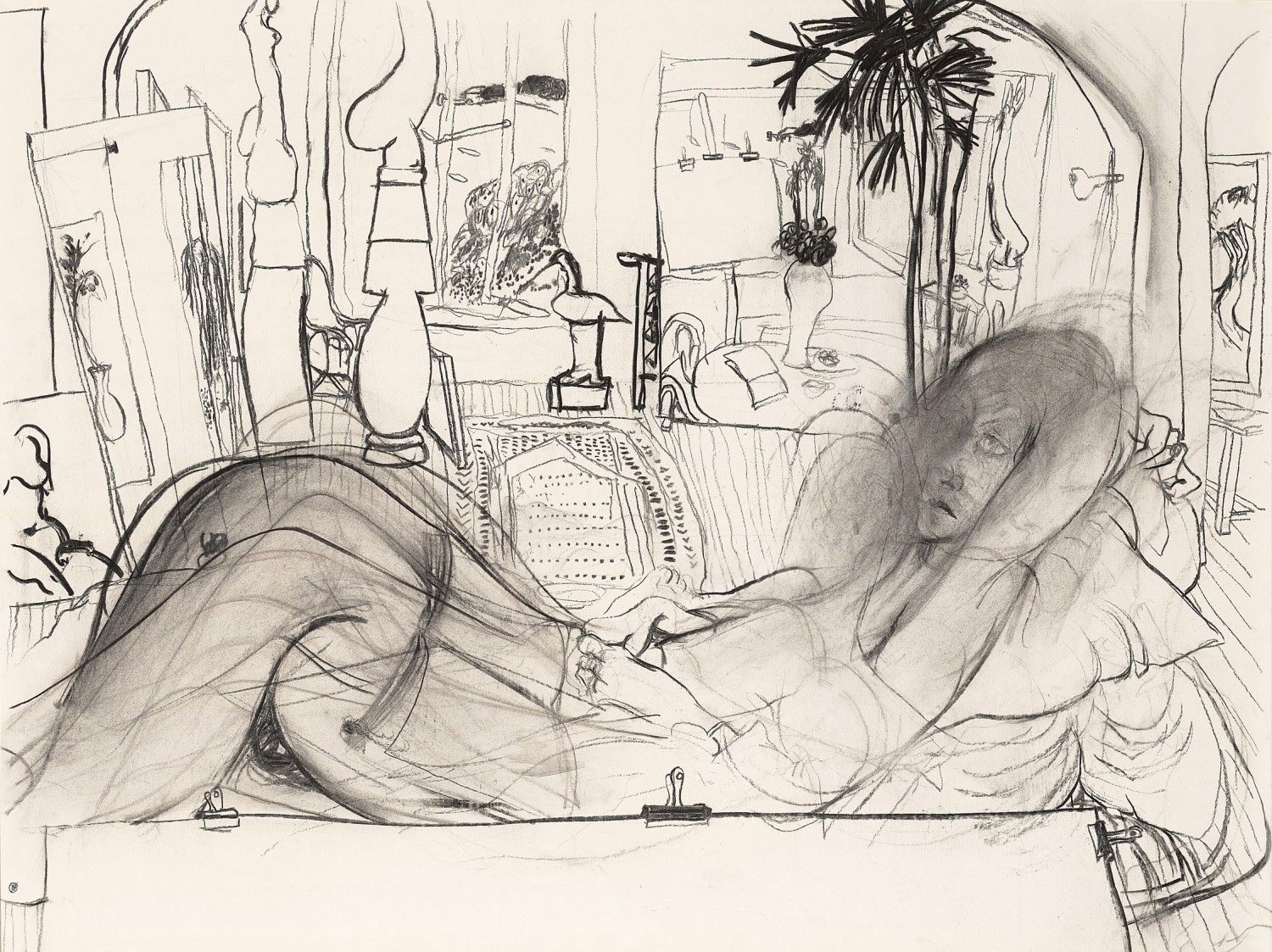
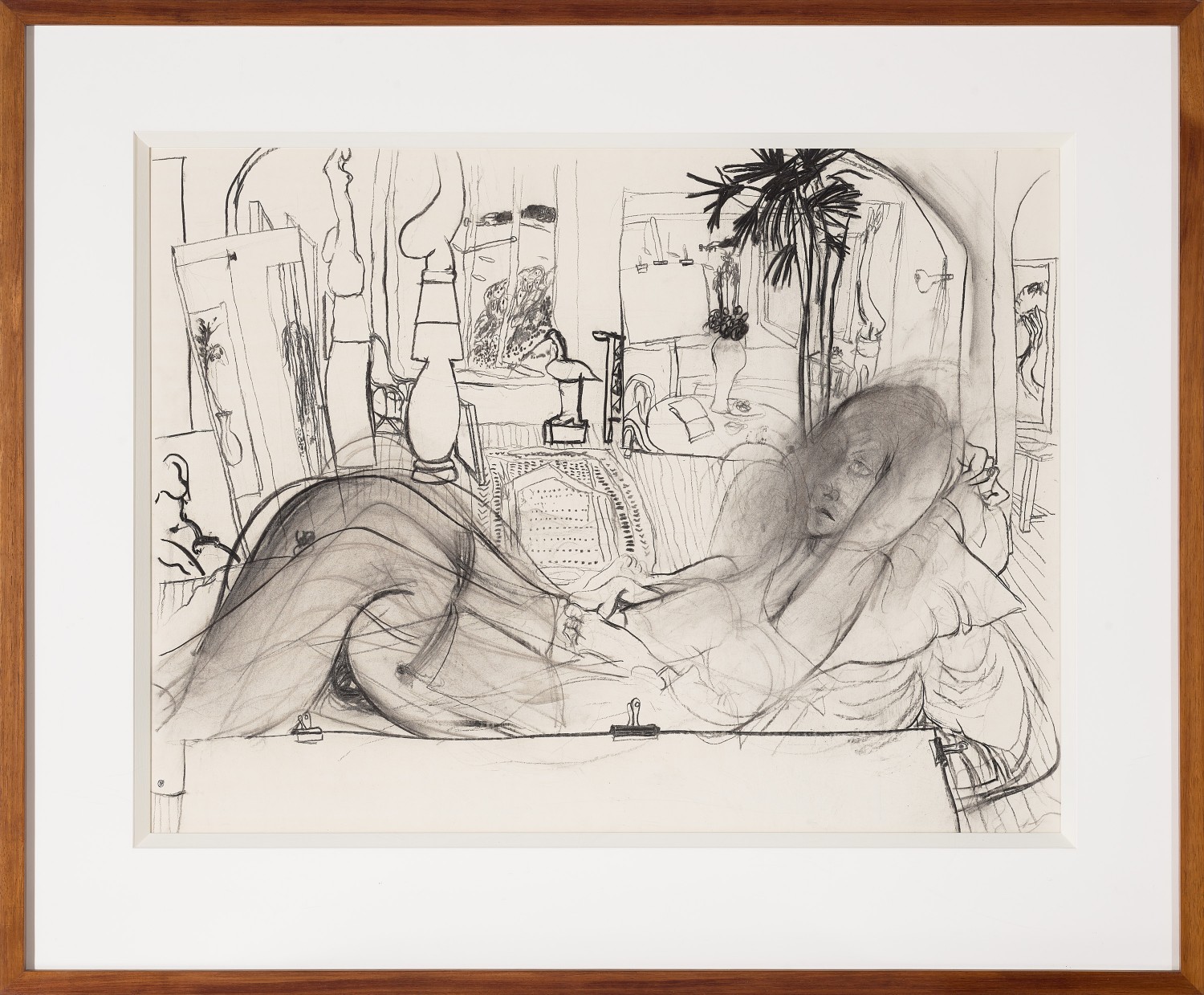
The smudged outlines of Wendy’s head and face, and her relaxed pose in Wendy on cushions, 1976, depict the kind of drug-infused state that the pair increasingly found themselves in during their early experimentation with heroin.6 Yet Whiteley’s mastery of the medium enables him to capture the relaxed intimacy of this moment with both warmth and tenderness, as Wendy, his muse, reclines odalisque-like; the movement of her body echoed by the series of lines and curved arches that appear like ghosts across her form. ‘Whiteley said it was possible to draw with the hand, the wrist, the elbow, the arm and shoulder’, states Lou Klepac7, and we can feel this sense of pace and vitality – almost an urgency – in the work’s assured linework and complex picturing of space. Whiteley builds the domestic and creative environment he knows so well with marks of breathtaking economy and fluidity, filling the room’s expansive whitewashed spaces with his paintings and sculptures, the family’s rugs, and the objects that he and Wendy collected on their travels. For Whiteley, drawing was as important as painting. It served as an immediate route from looking to making for him, and similarly enabled the most direct expression of his thoughts and perceptions: ‘Some drawings are made in order for me to see something, some are made in order for me to show off. The best of my drawing, I feel, has been made either in acute self-consciousness or in complete unconsciousness – with no middle-ground.’8
260277 Whiteley option 2 (web).jpg
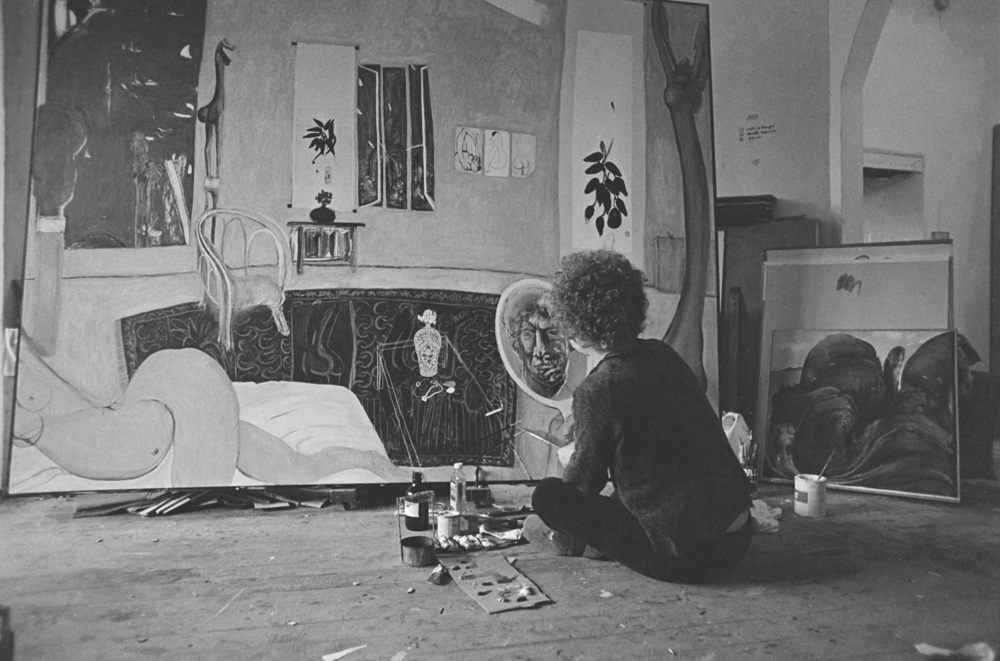
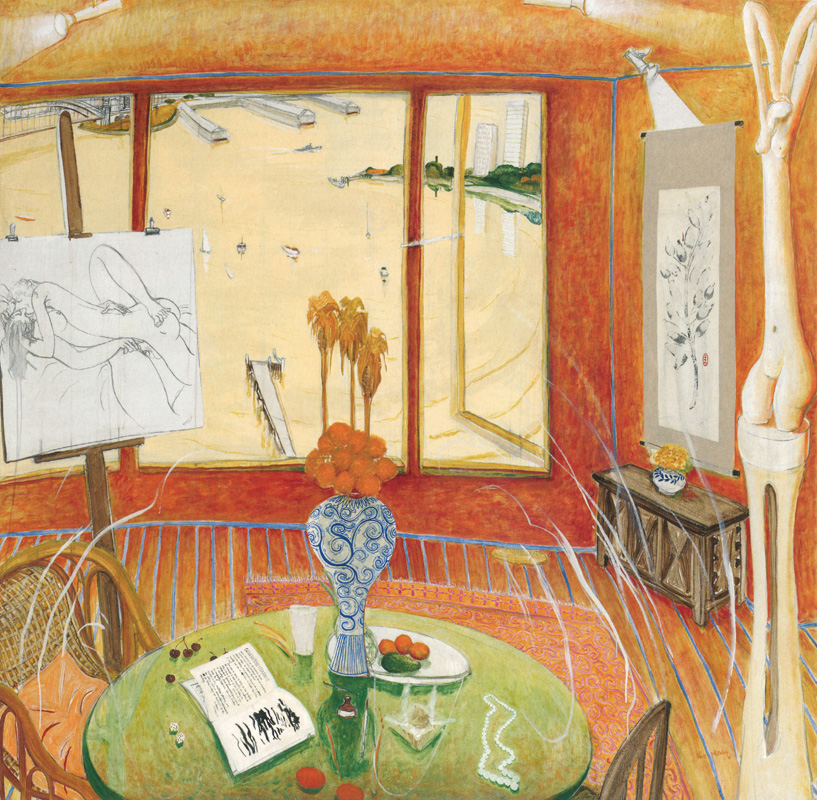
While the Lavender Bay interiors serve on one level as an ode to Matisse, and particularly the artist’s The Red Studio, 1911, which Whiteley loved9, in Wendy on cushions Whiteley is present in the tableau in a way that Matisse never is – making it clear, as he enters the composition (via the blank sheet of paper bulldog-clipped to his drawing surface), that he is both observer and subject. This sense that Whiteley saw the work, in its exploration of his identity and the creative process, as a form of self-portraiture, is further emphasised by the presence of the artist’s painting Interior with Time Past, 1976 (National Gallery of Australia), which won the Art Gallery of NSW’s coveted Sir John Sulman Prize in the year this drawing was made. During this period of extraordinary good fortune – Whiteley was also awarded the 1976 Archibald Prize for his painting Self Portrait in the Studio, 1976 – the artist seems to be questioning the nature of success, characteristically creating a small note of tension, or foreboding, in this sumptuous, languid scene.
1. Whiteley, B., 162 Drawings, Brett Whiteley 1960 – 85, Robin Gibson Gallery, Sydney, 19 October – 6 November 1985, cited in Klepac, L., Brett Whiteley Drawings, The Beagle Press, Sydney, 2014, p. 22
2. Klepac, ibid., p. 12
3. Grishin, S. et al., Baldessin / Whiteley: Parallel Visions, National Gallery of Victoria, Melbourne, 2018, p. 142. The Whiteleys bought the house in 1974.
4. Pearce, B., ‘Persona and the Painter’ in Brett Whiteley: Art & Life, Thames & Hudson in association with The Art Gallery of New South Wales, new edition, 2004, p. 35
5. ‘Recollections: Wendy Whiteley Interviewed by Barry Pearce’ in Pearce, ibid., p. 48
6. The pair began to use heroin in Lavender Bay in 1974. Wendy travelled to England for treatment in 1985, returning to Australia in 1986. Sadly, Whiteley continued to use and died of a heroin overdose on 15 June 1992 at the age of 53.
7. Klepac, op. cit., p. 15
8. Whiteley, B., 162 Drawings, Brett Whiteley 1960 – 85, Robin Gibson Gallery, Sydney, 19 October – 6 November 1985, cited in Klepac, L., op. cit., p. 179
9. Pearce, op. cit., p. 35
KELLY GELLATLY