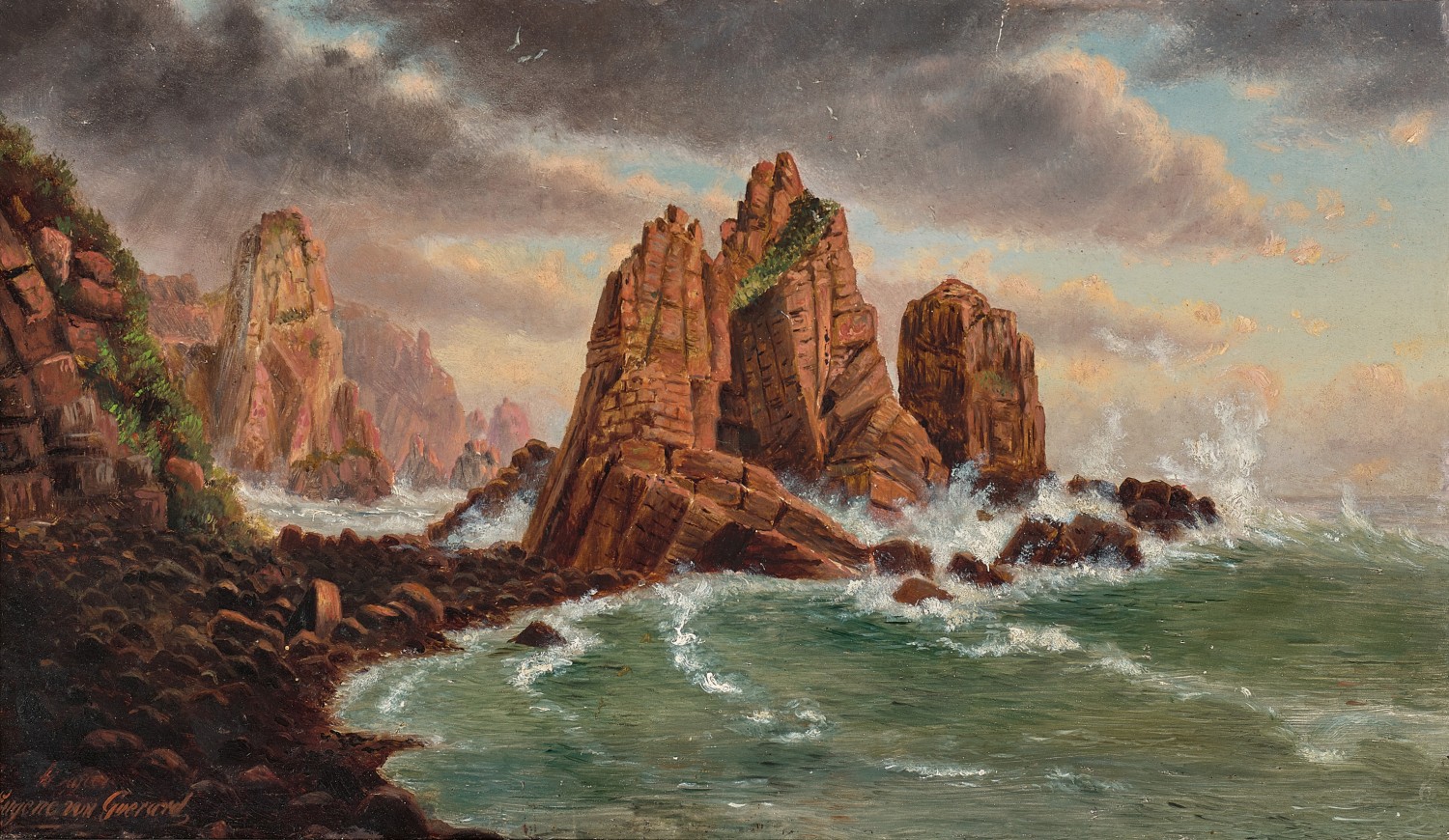
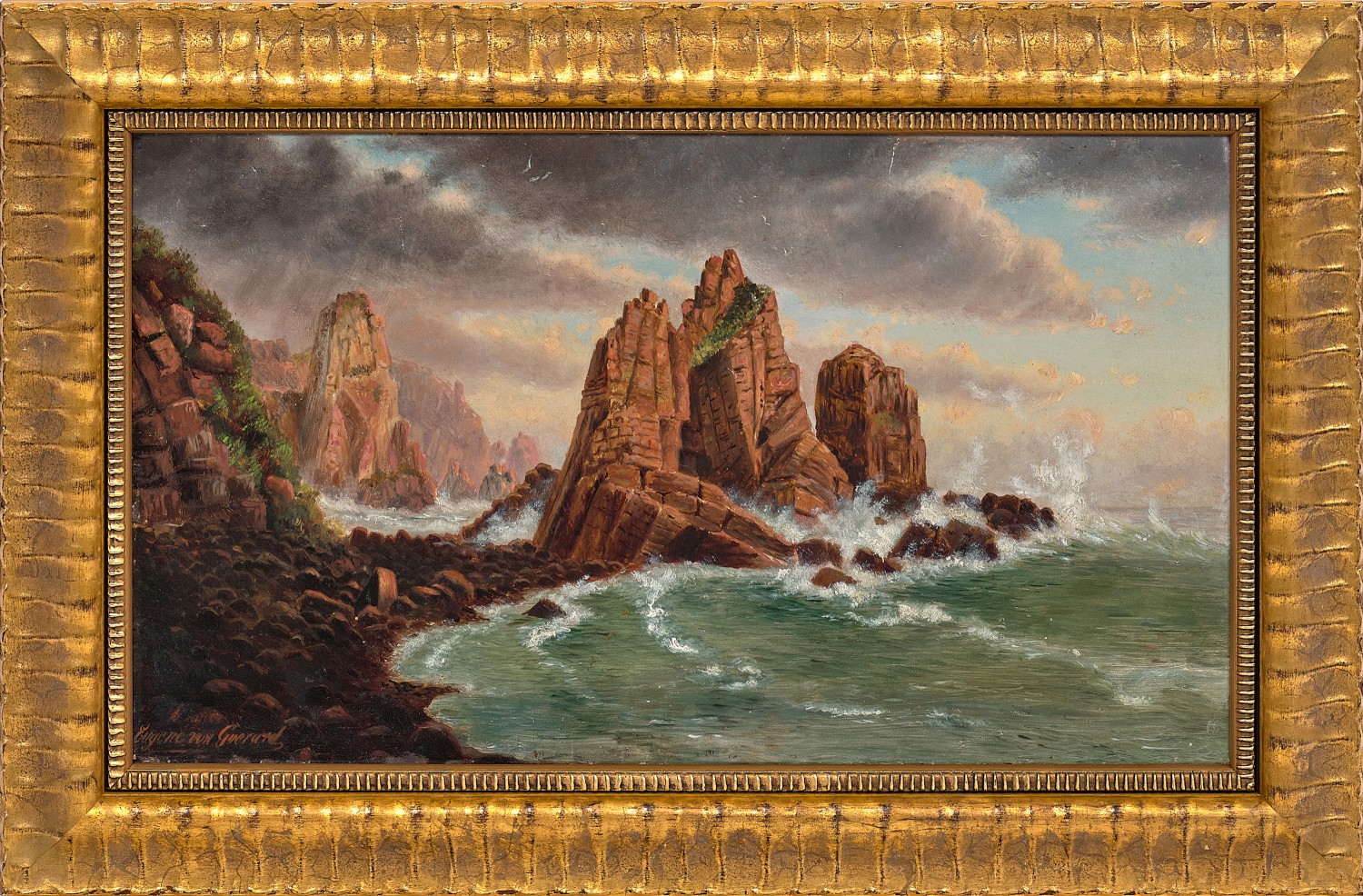
The Pinnacles, Cape Woolamai, c.1872
Eugene Von Guérard
oil on academy board
22.0 x 37.5 cm
signed lower left: … / Eugene von Guerard
Private collection
Leonard Joel, Melbourne, 11 April 1984, lot 150 (as 'Victorian Coast Line')
Private collection
Thence by descent
Albert Manning, Melbourne and Perth
GFL Fine Art, Perth, 29 November 2022, lot 50
Private collection, Perth
In December 1869, von Guérard spent eight days sketching at Phillip Island. His hosts were John and Georgianna McHaffie who, along with two of John’s brothers, had secured the pastoral licence for the entire island in 1842 – though that changed with the government’s 1868 – 69 subdivisions of the land. During his stay, von Guérard produced a series of large and sketchbook drawings, in which the island’s rocky coastline is portrayed with crystalline clarity and extraordinary geological precision. Among them was the sketch upon which The Pinnacles, Cape Woolamai, c.1872 was based.
On 18 December 1869, von Guérard and Georgianna’s brother, J.B. Henderson, a surveyor and watercolourist, set out on horseback for the ten-mile ride from McHaffie’s homestead at Ventnor to Cape Woolamai. The artist’s impressions of the site are recorded in three double-page sketchbook drawings: the first from the cliff top, the second of the Pinnacles with the Nobbies in the distance, and the third, the drawing for the present work, looking to the south-east.1 As they explored the site, he and Henderson came across ‘thousands of nests of mutton birds’, and lots of ‘shells and bird bones’ – perhaps the remains of middens built up over years by Bunurong people, whose country this is.
In 1855 – 56, von Guérard’s associate, the geologist, zoologist and artist, Wilhelm von Blandowski, reported that ‘The granite of Cape Woolamai is quite peculiar to that locality and forms picturesque pyramidal peaks, on and around which are seen numbers of sea hawks (ospreys) and gulls. This fine-coloured granite is characteristic, on account of the intense green colour of the mica, and the livid flesh colour of the feldspar.’2 Von Guérard’s response was both scientific and Romantic: the forms of the spectacular red granite stacks and their cracks and fissures, created as the hot magma cooled and shrank, are articulated with geological accuracy. Here he also felt the awe-inspiring power of nature at its most elemental: sea, wind, rain and rocks that spoke of an unimaginably ancient geological history.
Von Guérard painted four versions of this subject. Of the largest, View of the Granite Rocks at Cape Woolamai, 1872, he wrote, ‘Lately I have painted a marine peace [sic.] of very fine red Granit [sic.] rocks from Philip Island [sic.] at Cape Wooloomai [sic.] with fine green waves dashing against those rocks. I hope it will be of some effect.’3 The work, exhibited at Melbourne’s Victorian Academy of Fine Arts in 1872 and at the Vienna World Exposition in 1873, received mixed reviews, but the fact that another three versions were painted testifies to the interest it generated. One version is now in the collection of the National Gallery of Australia, another in a private collection.
The work presented here, which shares almost the same dimensions as the National Gallery of Australia’s painting, has the freshness and energy of a study. The brushwork is confident, free and painterly. With sea birds wheeling above the Pinnacles, sea spray suspended in mid-motion and a sense of rapidly shifting light and weather conditions, this work has an airy, atmospheric immediacy. It seems that von Guérard enjoyed painting this picture.
1. Eugene von Guérard, Sketchbook XXXVI, 1866 – 1870, Dixson Galleries, State Library of NSW, DGB 16, vol. 14a, ff. [62], [63], [64], [65]
2. William Blandowski, ‘Report no. III to the Surveyor General of an excursion from King’s Station to Bass River, Phillip and French Islands’, in Transactions of the Philosophical Institute of Victoria from August 1855 to December 1856 inclusive, Melbourne, 1857, p. 54
3. Eugene von Guérard, Letter to William Strutt, 29 January 1872, William Strutt papers, ML MSS 167/5, Mitchell Library, State Library of NSW, Sydney.
DR RUTH PULLIN