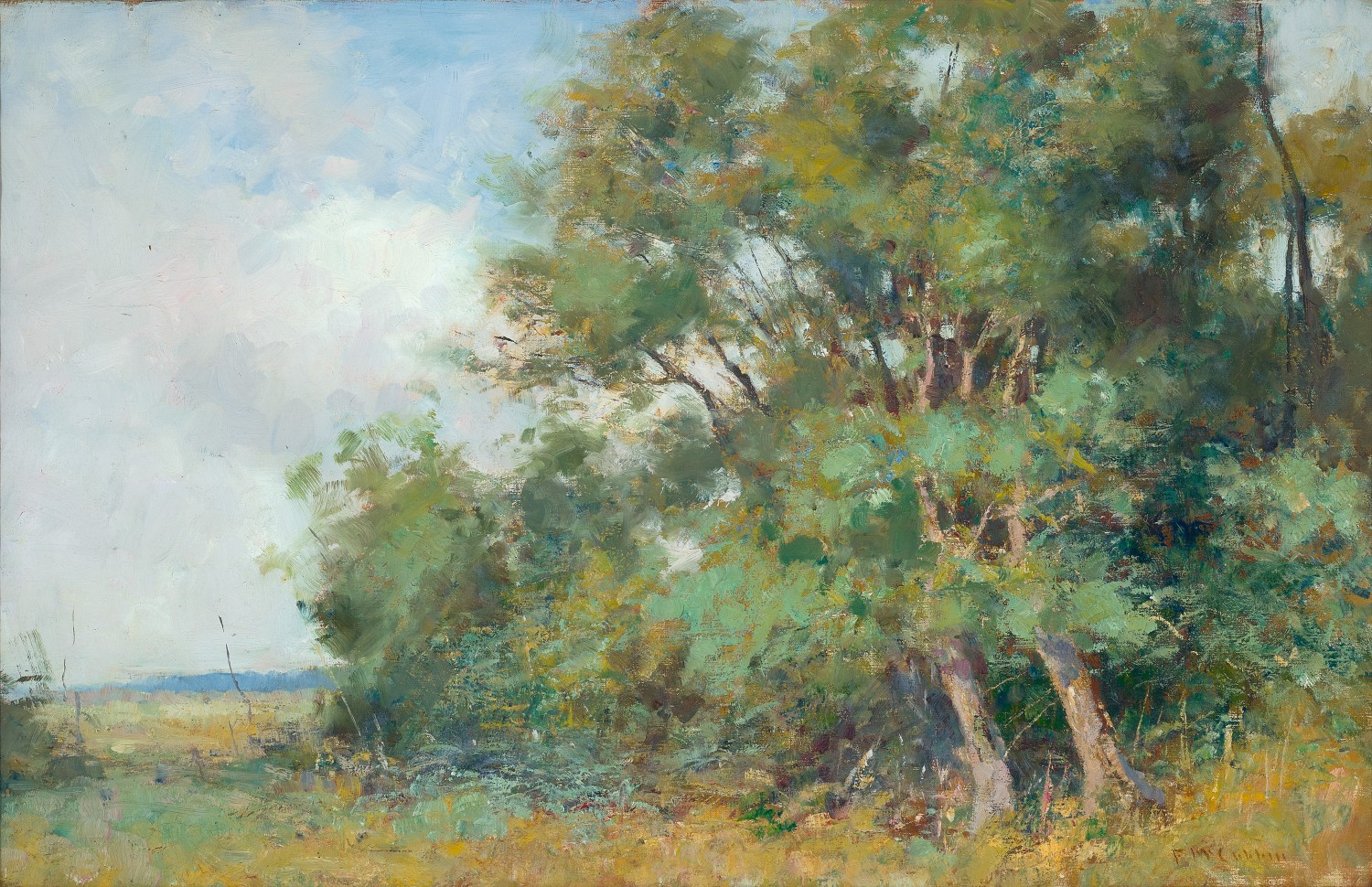
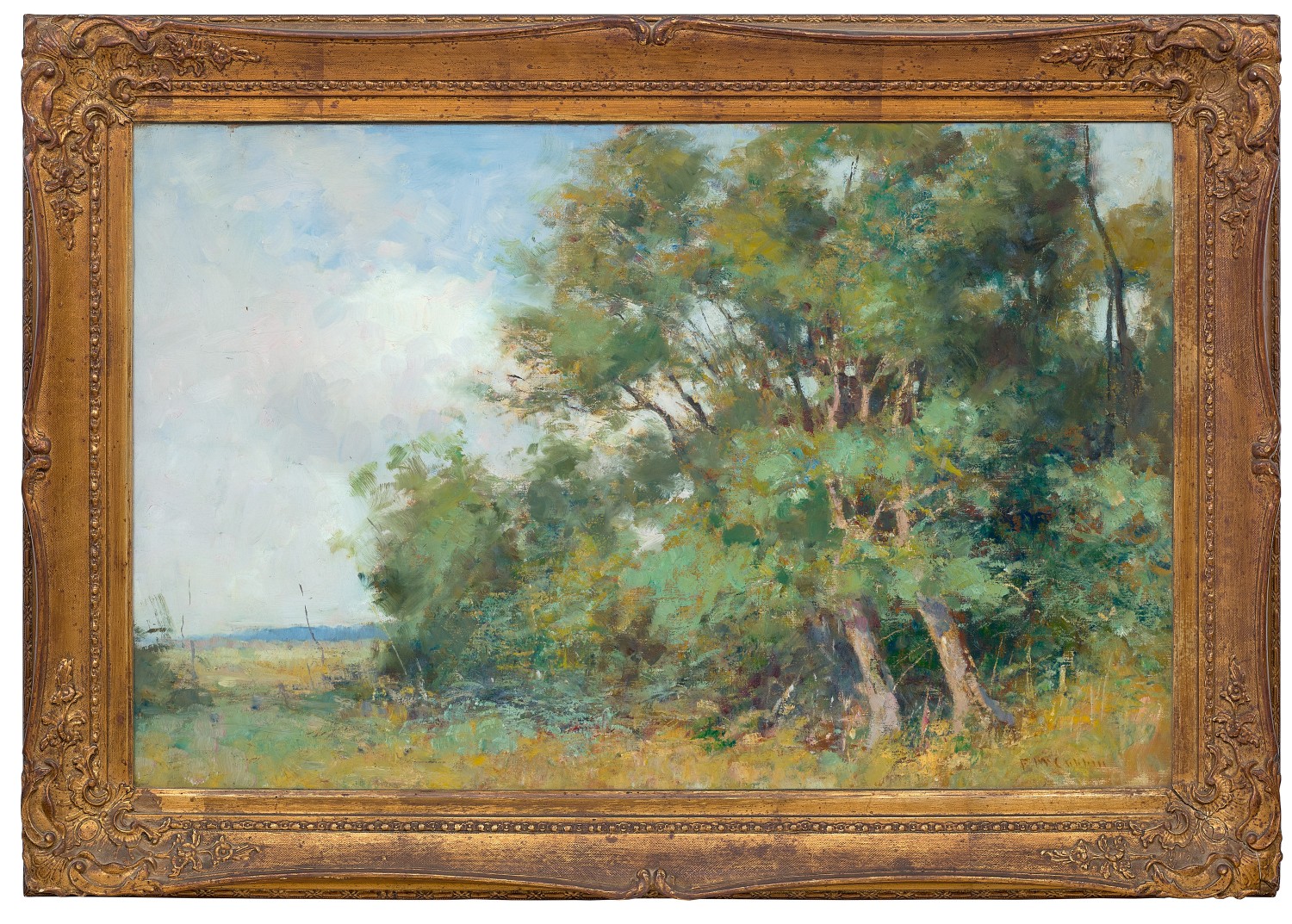
Macedon landscape (View from Hesket), c.1910 – 1912
Frederick Mccubbin
oil on canvas
58.0 x 78.0 cm
signed lower right: F. McCubbin
original John Thallon Frame, Melbourne
Mr Charles Mills, ‘Uardry’, Hay, New South Wales
Thence by descent
Private collection, New South Wales
Thence by descent
Private collection, New South Wales
A major influence in Frederick McCubbin’s long career was the imagery and philosophy of the Barbizon school of artists who painted within the Forests of Fontainebleau, fifty kilometres south of Paris, between the 1820s and 1880s. These artists, including Jean-François Millet and Jean-Baptiste-Camille Corot, were not only distinctive in their dedication to plein air painting; they were also driven by the challenge of how to integrate the figure within the landscape. A number of McCubbin’s major works – particularly Lost, 1886 (National Gallery of Victoria); Down on his luck, 1889 (Art Gallery of Western Australia), and The pioneer, 1904 (National Gallery of Victoria) – explore this same challenge. However, on his only overseas visit to England and France between July and October 1907, McCubbin encountered for the first time actual examples of the paintings of his many painting heroes, writing to Tom Roberts that ‘I actually thought I was somebody over in England, right up against Rembrandt, Turner, Velasquez, Gainsborough, Reynolds. I felt quite in good company.’1 He also saw works by Claude Monet and ‘seeing the materiality of so many light-drenched late Turners and French Impressionist pictures bolted McCubbin fully into the new late style towards which he was already tending.’2 After his return, his paintings became less populated and lighter in mood, utilising a new palette filled with pinks and soft greens applied with brush and palette knife.
Some years before this, in 1901, McCubbin purchased a two-storey house in Glover Road, Mt Macedon, which he named, not so surprisingly, ‘Fontainbleau’, and the scrubby hills behind it provided the setting for a number of major works including The pioneer. It appears that Macedon landscape (View from Hesket), c.1910 – 12, was painted a kilometre away at the north-eastern foot of Mt Macedon near the village of Hesket which had been the centre of a timber industry that began in 1837. By the turn of the century, however, the majority of the local white gum, stringy-bark, messmate and peppermint trees had been felled though sufficient remained to support a small industry. In Macedon landscape (View from Hesket), a reflective McCubbin looks over the now-cleared fields from a position within the surviving scrub. At bottom left may be seen the blue-violet run of low ranges incorporating the Cobaw State Forest, also seen in Hauling rails for a fence, Mt Macedon, 1910 (National Gallery of Australia), with the scene described by McCubbin as being ‘a regular Millet.’3 He likely stood where Gallery School students would camp when visiting McCubbin, a site known as the ‘Old Garden’. ‘My father loved the spot,’ said daughter Kathleen Mangan. ‘It was about a mile from our cottage and it had a swampy area there full of that long grass that grows in swamps and also numerous bullfrogs.’4 By having a permanent base at Mt Macedon, McCubbin was able to immerse himself in the local environment as the Barbizon artists had done at Fontainbleau, charting Mt Macedon’s seasons and the variable light of each day. Critics too noted the quality of these radiant works, lauding the artist’s ‘remarkable skill in dealing with and realising the intricacies, colour and atmosphere of the Australian bush; especially… the artistic tangle of the undergrowth, and the charm of solitude and silence.’5
Notably, the painting’s original owner, Charles Mills, was the founder of the internationally renowned ‘Uardry’ sheep station in Western New South Wales. The continuing quality of their wool was of such importance to the Australian economy that one of Uardry’s prize merinos was the model for the image on the one-shilling coin in 1938.6 When in Melbourne, Mills lived in Toorak, not far from McCubbin’s home in Kensington Avenue, South Yarra.
1. Frederick McCubbin, Letter to Tom Roberts, late December 1907, cited in McKenzie, A., Frederick McCubbin 1855 – 1917: ‘The Proff’ and his art, Mannagum Press, Melbourne, 1990, p. 269
2. Gray, A. (ed.), McCubbin: last impressions 1907 – 17, National Gallery of Australia, Canberra, 2009, p. 17
3. Frederick McCubbin, Letter to Tom Roberts, 19 January 1910, cited in McKenzie, op. cit., p. 280
4. Kathleen Mangan, cited in McKenzie, ibid., p. 188
5. ‘Mr F. McCubbin. A distinguished artist’, The Argus, Melbourne, 21 December 1917, p. 11
6. Laurissa Smith, ‘Former jackeroo uncovers story behind shilling ram’, ABC News, 19 March 2014 at: https://www.abc.net.au/news/rural/2014-03-19/shilling-ram-book/5330800 (accessed 5 June 2026)
ANDREW GAYNOR