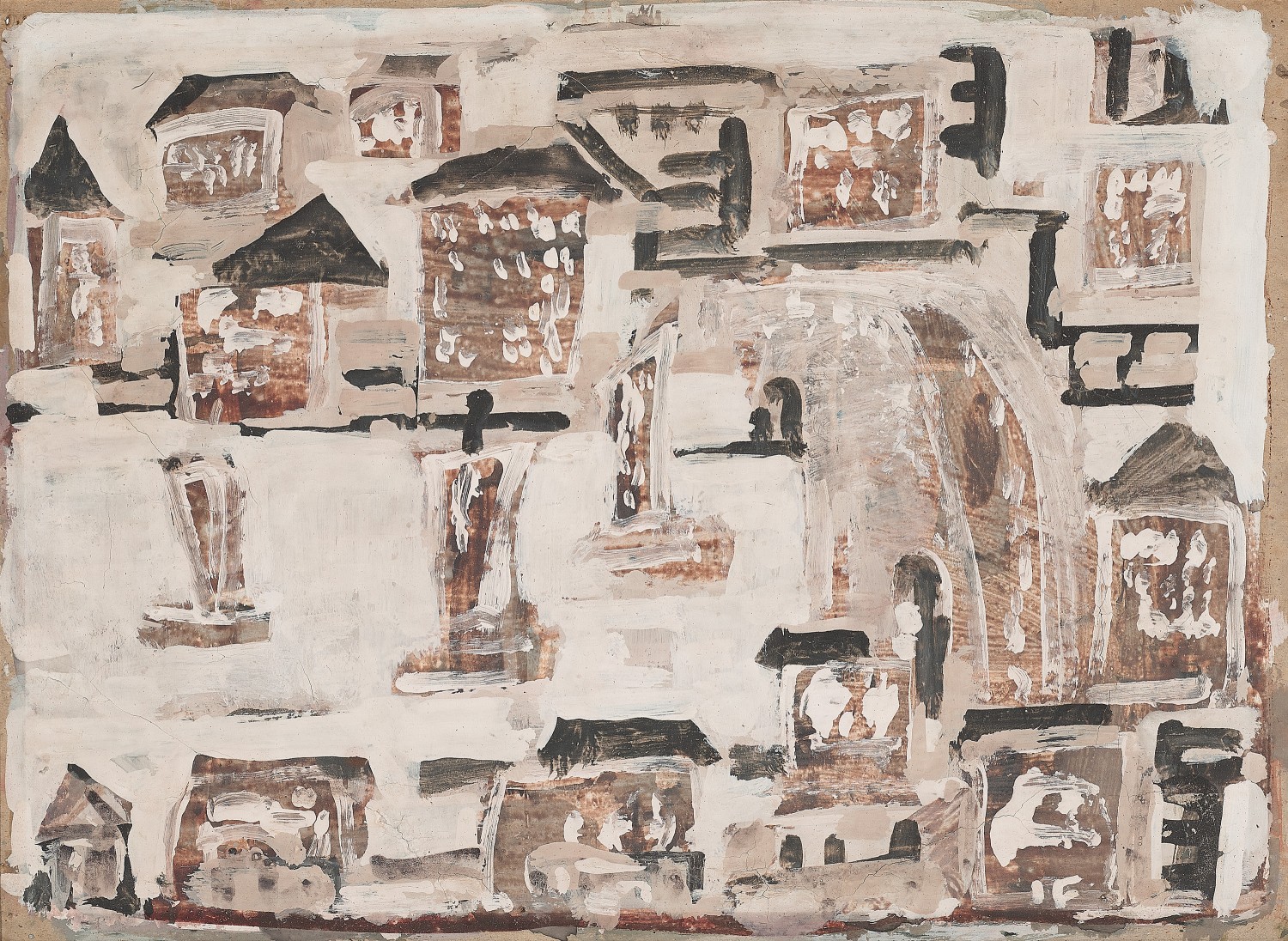
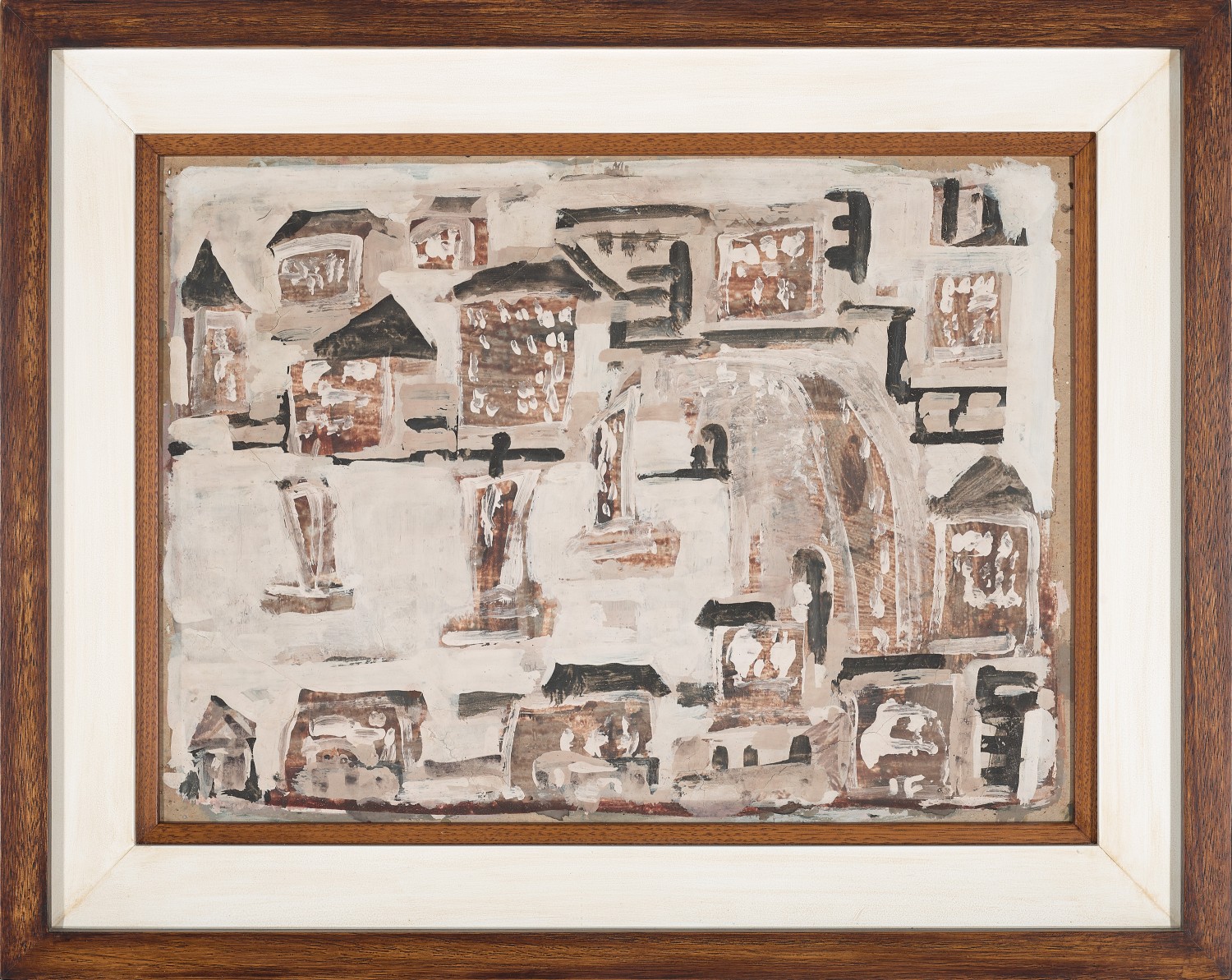
Canal scene, China, 1954
Ian Fairweather
gouache on cardboard
37.0 x 51.0 cm
signed with initials lower right: IF
Macquarie Galleries, Sydney
Mrs J. E. A. Walkley, Melbourne, 1954
Rob Ferguson
Niagara Galleries, Melbourne
The Reg Grundy AC OBE and Joy Chambers–Grundy Collection, acquired in 1998 (label attached verso)
The Grundy Collection, Bonhams, Sydney, 26 June 2013, lot 22
Private collection, Adelaide
Ian Fairweather, Macquarie Galleries, Sydney, 2 – 14 June 1954, cat. 8 (as ‘Harbour’)
Spring Exhibition, Joseph Brown Gallery, Melbourne, 15 September – 8 October 1969, cat. 31 (illus. in exhibition catalogue)
Fairweather, Queensland Art Gallery, Brisbane, 1 October – 27 November 1994, and touring to: National Gallery of Victoria, Melbourne, 17 December 1994 – 19 February 1995; Art Gallery of New South Wales, Sydney, 22 March – 7 May 1995, cat. 18
Australia Today, October 1963, p. 72 (as ‘Aboriginal')
Bail, M., Fairweather, Art and Australia Books in association with the Queensland Art Gallery, Brisbane, 1995, pl. 18, p. 90 (illus.)
Bail, M., Fairweather, Murdoch Books, Sydney, revised edition 2009, cat. 109, pl. 102, pp. 123 (illus.), 252
In a letter to his old friend H. S. (Jim) Ede in early 1954, Fairweather detailed all the disasters that had happened to him over the past two years – the raft voyage and subsequent media circus, the strange experience of returning to England after twenty-five years, and the bushfire that had recently swept through his land at Bribie Island, destroying his tent and its contents. Notwithstanding these setbacks, he had built a hut – a frame of poles thatched with grass, with a bed padded with ferns and tables made from reeds. Around him, he wrote, ‘there is only the forest, burnt black with the fire and not a sound, not even the wind. Every new year I always listen for the first sound. It has so often a message, a sign of things to come. This year there was a stillness, a blank. Don't know what to make of it.’1
It was with this frame of mind that Fairweather returned to depicting scenes from the past, such as this gouache, Canal scene, China, 1954 which features a narrow creek and several Chinese junks with their distinctive geometric sails. ‘The symbolic junks, the crowded buildings, the twisted bridge and line of pedestrians are composed as a kind of serene haphazardness like memory itself.’2 Although the actual place was never identified by Fairweather, it is possibly Suchow Creek where it meets the Huangpu River, and where the Bund – known for its massive Art Deco buildings – begins. Here, the Waibaidu Bridge arches across the river on the right, with masses of sturdy buildings all around. Fairweather's studio was at 235 Szechuan Road (now 235 Si Chuan Bei Lu), opposite the Shanghai Post Office (the tall building with the clock tower).3 It was on ‘the top floor, spacious and quiet’ and gave him a bird’s eye view of the bustling city which he has recreated here decades later.
1. Abbott-Smith, N., Ian Fairweather: Profile of an Artist, University of Queensland Press, Brisbane, 1978, p. 126
2. Bail, M., Ian Fairweather, Bay Books, Sydney, 1981, p. 118
3. ibid., p. 19
DR CANDICE BRUCE