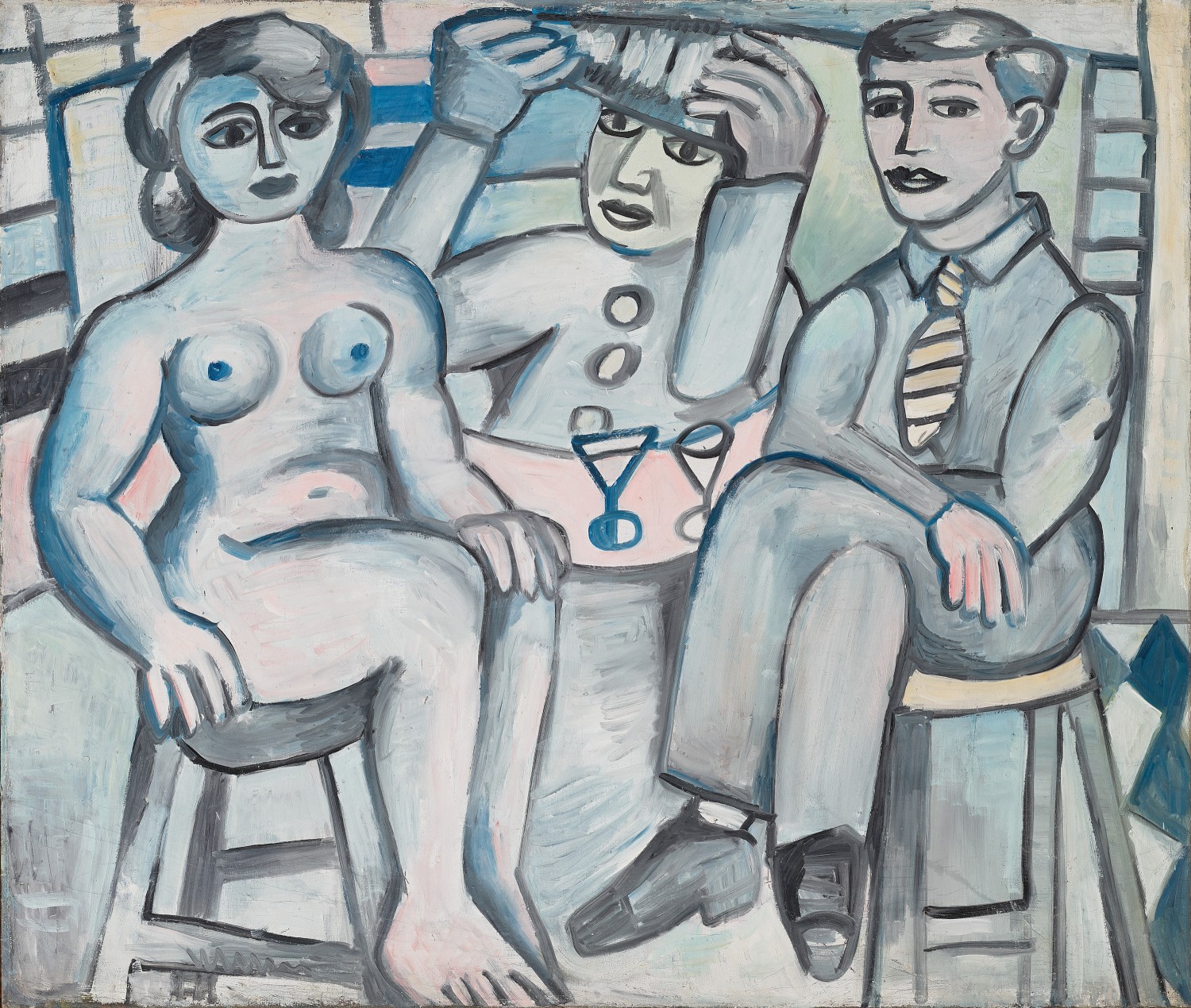
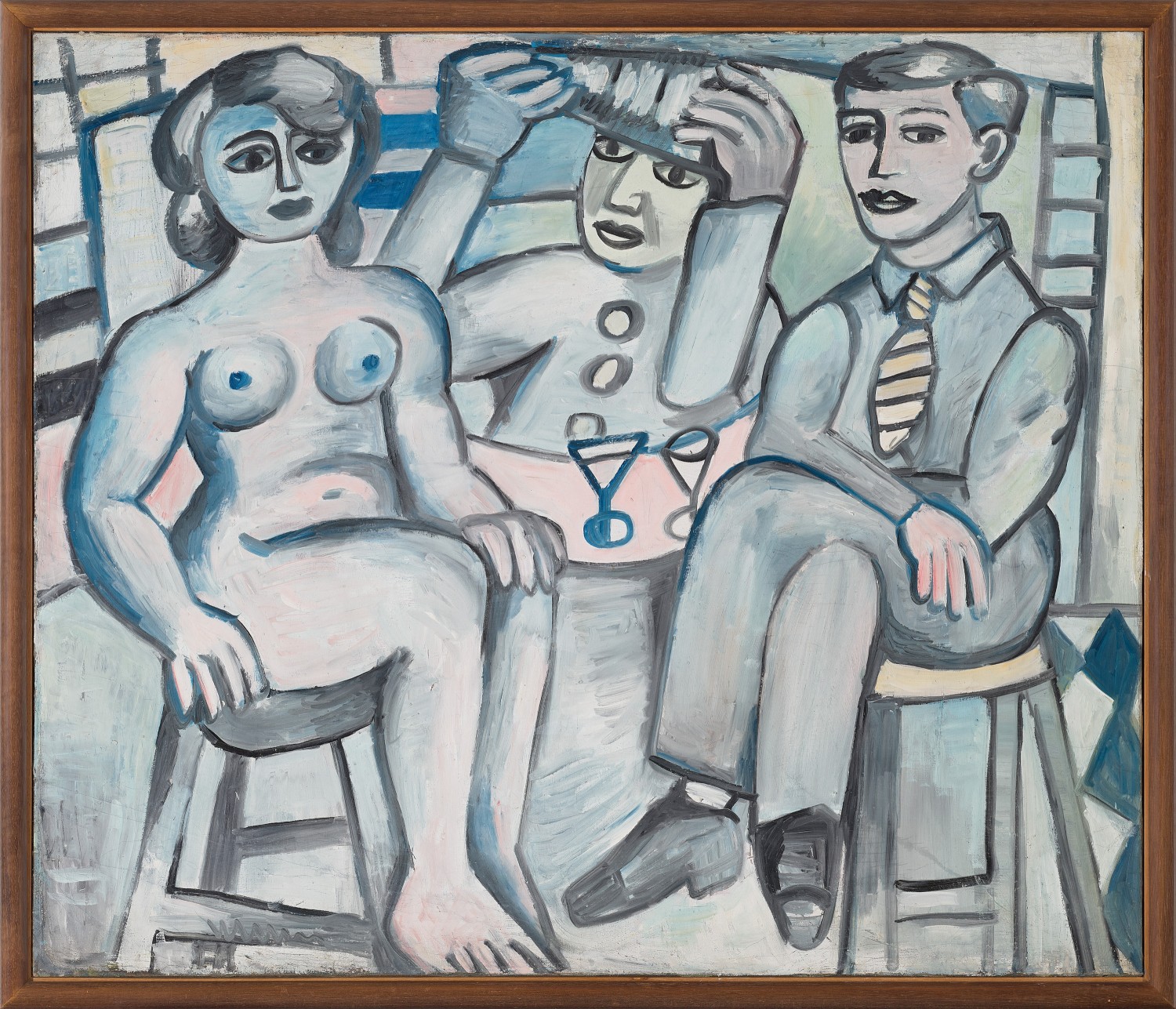
Cocktails for two no. 2 (TP 161), 1947 – 50
Tony Tuckson
oil on canvas
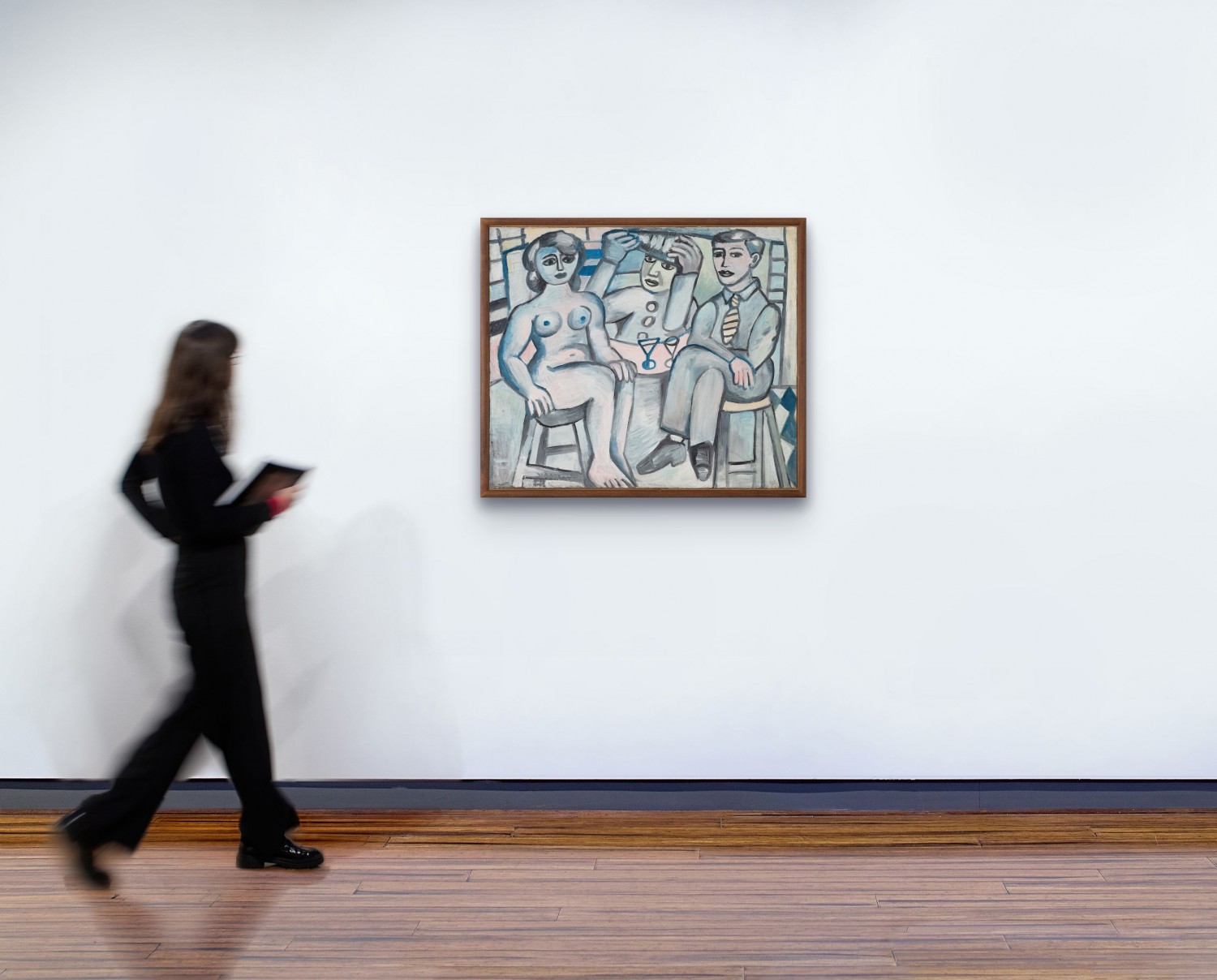
85.0 x 100.5 cm
Estate of the artist
Watters Gallery, Sydney
Private collection
Deutscher~Menzies, Melbourne, 28 August 2002, lot 32
Private collection, Melbourne
Tony Tuckson: Twenty Paintings on Canvas 1947? – 1957?, Watters Gallery, Sydney, 1 – 18 October 1986, cat. 8
Thomas, D., Free, R., Legge, G., Tony Tuckson, Craftsman House, Sydney, 1989, pl. 14, pp. 48 (illus.), 179
Egyptian-born Englishman Tony Tuckson emigrated to Australia after the end of the Second World War, having served in the Royal Air Force as a Spitfire pilot. Taking advantage of the Commonwealth Reconstruction Training Scheme that was available to ex-servicemen, Tuckson enrolled at East Sydney Technical College in 1946, picking up on his earlier study at the Hornsey School of Art in London from 1937 to 1938, and the Kingston School of Art in 1939. Described by his teachers, abstract artists Ralph Balson and Grace Crowley as their most ‘sincere’ pupil1, Tuckson had a distinct advantage over his fellow students, as he had already seen the work of modern artists such as Cézanne, Picasso, Matisse, Soutine, and Klee ‘in the flesh.’2 These experiences – along with his voracious study of modern art and absorption of art magazines – were to sustain his creative imagination for years to come. Excluding a trip for the Art Gallery of New South Wales to New Guinea in 1965, Tuckson did not leave Australia again until 1967, 20 years after his arrival. At the time that Cocktails for two No. 2 (TP161), 1947 – 50 was painted, the influential 1953 travelling exhibition French Painting Today, which introduced Australian audiences to Europe’s modern masters for the first time, was not yet a reality, and even Tuckson’s teacher, Balson, had never travelled abroad.
Driven by the need to support his young family, Tuckson was appointed as an attendant and cleaner at the Art Gallery of New South Wales in 1950, before swiftly rising to the position of Assistant Director (from 1950 – 57) under Director Hal Missingham, and later, becoming Deputy Director (1957 – 73). It is here that his life as an artist went underground.3 Tuckson spent the next two decades working in isolation from a home studio surrounded by bush on Sydney’s North Shore; his head filled with creative possibilities and the exciting exemplars provided by the artists he admired – Picasso, Matisse, Modigliani, Dubuffet, Pollock, Motherwell, and Twombly, amongst others – and by his increasing knowledge of and deep admiration for Aboriginal and Melanesian art.
In the late 1940s and early 1950s Tuckson’s imagery included figures dancing at parties, nightclub scenes, musicians, and variations on the subject of ‘Cocktails for two’ – a couple sitting at a bar behind which a bartender animatedly shakes a cocktail shaker. The stylised blocky forms of the figures clearly reveal the influence of Picasso, just as the deft exploration of the work’s restricted palette echoes the French artist’s Blue Period (1901 – 04), without the sombre subject matter. Tuckson’s scene is at once cool and appealing – one can almost hear the jazz soundtrack playing in the background. The assured nude and her companion (Tuckson and his wife Margaret) sit on a different plane to the bar and its patterned background, which slope, Cézanne-like, towards the viewer, inviting us into the scene. Rather than simply emulating the respective styles of his masters here, Tuckson explores the formal principles and dynamism of their work as a way in which to feed and expand his own creative practice. As Joanna Mendelssohn has noted: ‘By painting in private, Tuckson was freed from the opinion of others. He was able to experiment, to succeed or fail, taking only his own judgement into account.’4
1. Thomas, D., ‘An Introduction to Tony Tuckson, 1921 – 1973’, Thomas, D., Free, D. & G. Legge, Tony Tuckson, Craftsman House, Roseville, 1989, p. 27
2. Terence Maloon states that Tuckson had opportunities to see the Hugh Walpole collection at the Leicester Galleries in London (16 May – 9 June 1945), comprising 176 works by Cézanne, Picasso, Matisse, Soutine, Klee and others, as well as the Matisse and Picasso exhibition at the Victoria and Albert Museum in December 1945 while on leave from his air force base in Cornwall. The catalogues for both exhibitions were among Tuckson’s papers. See Maloon, T., Painting Forever: Tony Tuckson, National Gallery of Australia, Canberra, 2000, at: https://nga.gov.au/exhibitions/painting-forever-tony-tuckson/ (accessed July 2026)
3. From his time as a student until 1962, Tuckson occasionally submitted paintings to the annual exhibitions of the New South Wales Society of Artists and the Contemporary Art Society.
4. Mendelssohn, J., ‘Passion and Beauty: The Paintings of Tony Tuckson’, The Conversation, 28 November 2018, at: https://theconversation.com/passion-and-beauty-the-paintings-of-tony-tuc... (accessed July 2026)
KELLY GELLATLY