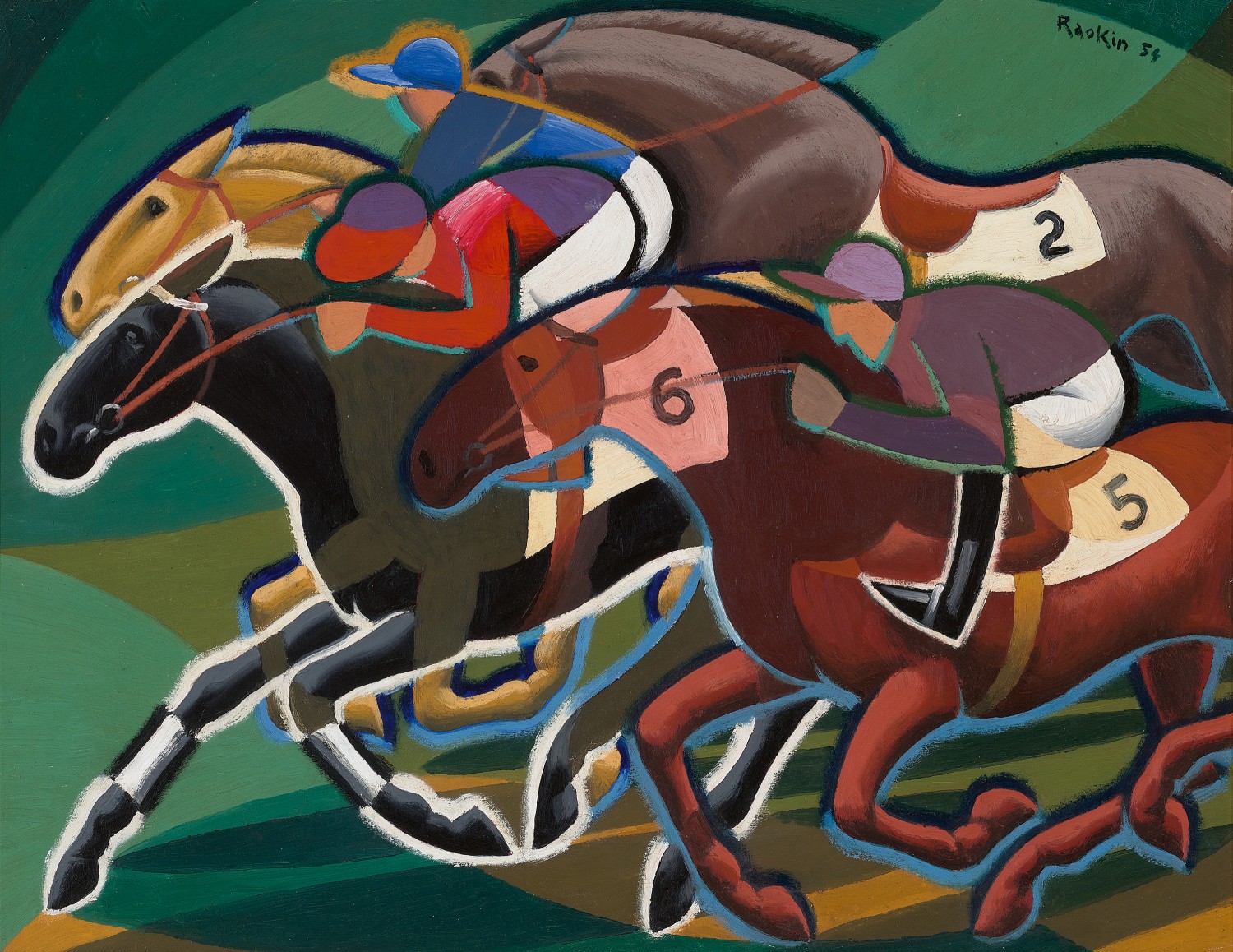
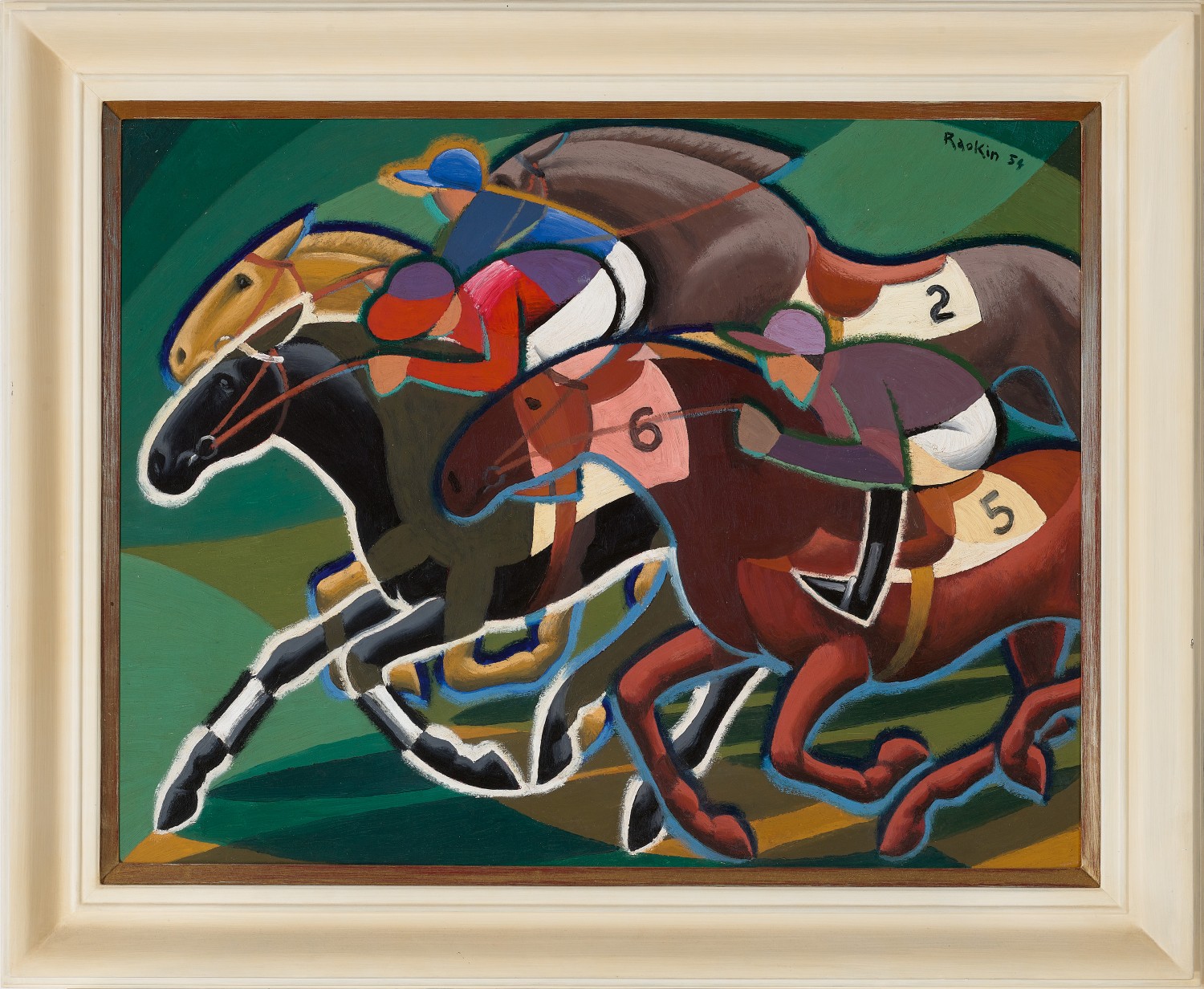
Full tilt, 1954
Weaver Hawkins
oil on composition board
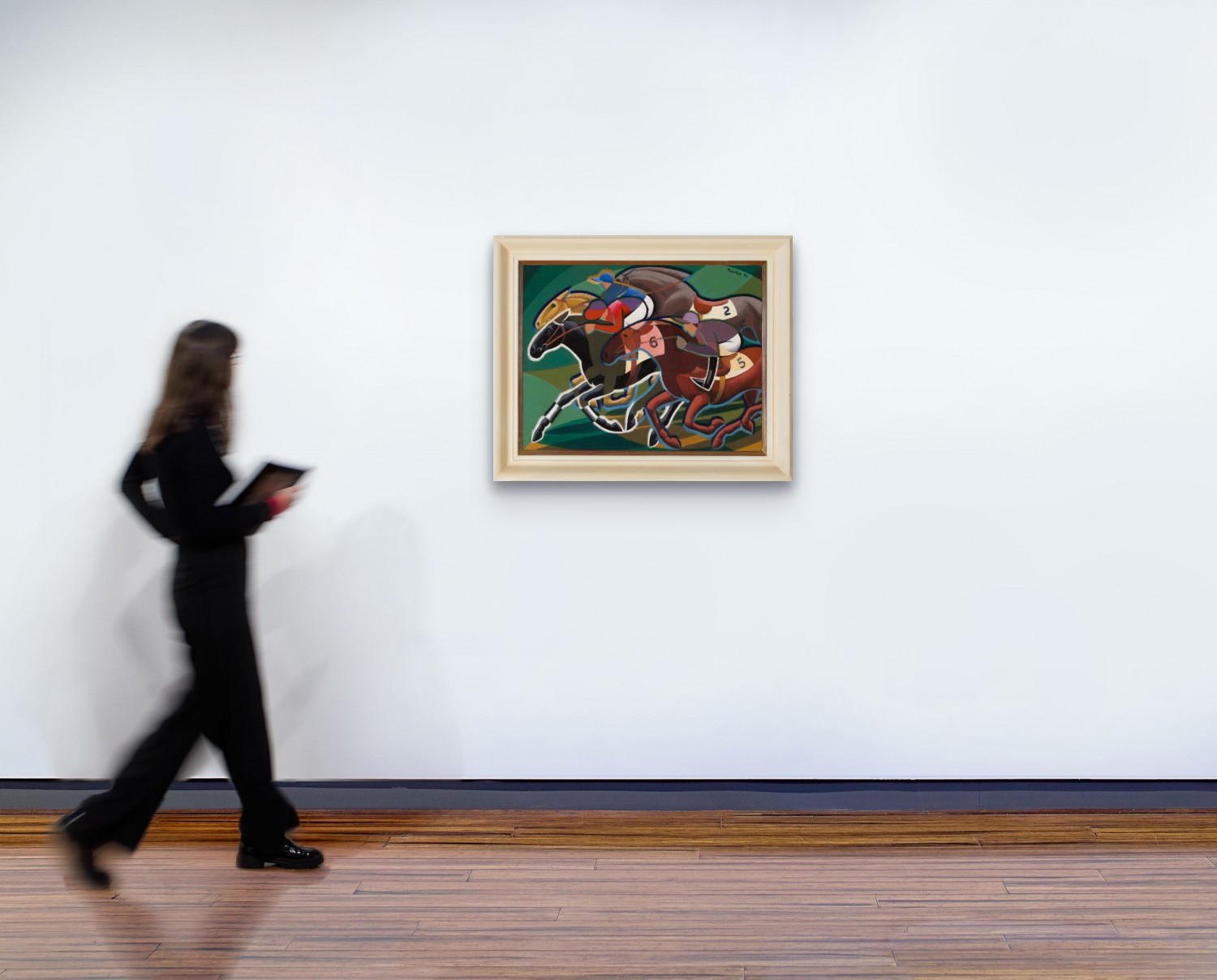
61.0 x 78.5 cm
signed and dated upper right: Raokin 54
signed and inscribed with title verso: WEAVER HAWKINS (RAOKIN) / FULL TILT
The artist’s family
Leonard Joel, Melbourne, 23 August 1995, lot 116
Private collection
Sotheby's, Melbourne, 26 April 1999, lot 92
Private collection
Deutscher~Menzies, Sydney, 4 March 2004, lot 94
Private collection, Sydney
Contemporary Art Society State Exhibition 1955 Madach Prizes, David Jones' Art Gallery, Sydney, 13 – 21 April 1955, Section 1, cat. 44
Weaver Hawkins: Raokin, David Jones Art Gallery, Sydney, 4 – 17 June 1958, cat. 5
Weaver Hawkins 1893 – 1977: Memorial Retrospective Exhibition, Ballarat Fine Art Gallery, Victoria (illus. on exhibition invitation) and touring to Melbourne University Art Gallery, Melbourne, Hamilton Art Gallery, Victoria; Castlemaine Art Gallery, Victoria; Geelong Art Gallery, Victoria; Horsham Art Gallery, Victoria, Ararat Art Gallery, Victoria; Mildura Arts Centre, Victoria; Sale Regional Art Gallery, Victoria; Warrnambool Art Gallery, Victoria; McClelland Art Gallery, Victoria; Newcastle Region Art Gallery, New South Wales and University Art Museum, University of Queensland, Brisbane, October 1977 – March 1979, cat. 19
Art and Australia, Fine Arts Press Pty Limited, Sydney, vol. 34, no. 2, Summer 1996, p. 249 (illus.)
‘Life is movement, change, growth. Art moves, changes, grows in unison with life. For creatures with a soul, one cannot be without the other.’1
The energetic rhythms and crisp delineation of Weaver Hawkins’ Full tilt, 1954, have their roots in a wide variety of sources including the artists of English Vorticism, alongside whom Hawkins exhibited in London, as well as a deep understanding of ‘such compositional theories as Dynamic Symmetry, Platonic Solids, Magic Squares and the Modular.’2 When he began exhibiting his paintings in Sydney in 1946, local audiences were confused as they were at the time happily distracted by the popular work by Neo-Romantic ‘Charm School.’ This dislocation became magnified in subsequent years as figurative expressionism, followed by international abstraction, found favour to such degree that it was not until the 1970s that Hawkins’ complex, stylised paintings were re-evaluated and celebrated. Permanently disabled under horrifying experiences in World War One, Hawkins nonetheless fought to retrain himself as an artist before exhibiting widely. In Australia, he later also became actively involved as teacher, lecturer and member of the Contemporary Art Society for whom he served as Vice-President, then President, between 1948 and 1963. It is not surprising therefore that historian Frank Campbell described him as being ‘dauntless. (D)isablement, public indifference and rejection did not crush or embitter him.’3
Hawkins was already a skilled artist when he was left for days grievously wounded in no-man’s land on the Western Front. After numerous operations – including removal of both elbows – he was left with two withered arms, the left marginally stronger than his right, meaning he had to relearn how to paint la gauche. Such was his ‘dauntless’ personality that he was soon making intricate etchings, and his paintings began to appear in exhibitions. A ‘free thinker’, he married the like-minded artist Renée Villiers and with the growing family, travelled extensively by yacht in the 1920s, living for a year near Siena in Italy. Annoyed that English exhibition reviewers constantly referred him as a ‘wounded artist’, he began signing his name as ‘Raokin’, based on a phonetic attempt by a local Sienese at spelling Hawkins: ‘Signor Hawkins’ became ‘Signor Raokin’. The family arrived in Sydney in March 1935 and settled at beachside Mona Vale where, with a permanent base, Hawkins’ paintings became increasingly radiant and dynamic.
The companion to Full tilt is Going round, 1954 (Art Gallery of New South Wales), which shows a scene from earlier in the race and, as the artist once explained, both paintings were built up ‘step by step, like the architect building a building brick by brick.’4 Working through a series of sketches and watercolours, Full tilt exploits a Futurist technique known as ‘Lines of Force’ whereby ‘objects were outlined, highlighting their two-dimensional character but they were outlined in complementary colours so the image jumps out dramatically.’5 In Full tilt, this is strikingly apparent in the cerulean-blue outlines of the front two horses and pulses out from the curved lines that otherwise direct the eye to the riderless horse at the top, a regular scene in horse races near the finish line. Going round also has these blue ‘Lines of Force’ but lacks Full tilt’s overall sense of excitement and anticipation – ‘virile with movement and surging, changing patterns.’6
1. Weaver Hawkins, cited in Contemporary Art Society State Exhibition 1955 Madach Prizes, David Jones’ Art Gallery, Sydney, 1955, n. p.
2. Thomas, D., ‘Weaver Hawkins’ in Project 11: Weaver Hawkins, Art Gallery of New South Wales, Sydney, 7 February – 14 March 1976
3. Campbell, F., Raokin, Gallery Irascible, Melbourne, 1996
4. ‘Weaver Hawkins interviewed by Hazel de Berg in the Hazel de Berg collection’ [transcript], 31 December 1965, National Library of Australia, Canberra, ID: 457156, p. 13
5. McIntyre, A., ‘Weaver Hawkins – a tribute to a pioneer’, The Weekend Australian Magazine, Sydney, 15 – 16 April 1978, p. 7
6. Canberra Times, 30 September 1971, cited in Chanin, E. and Miller, S., The art and life of Weaver Hawkins, Craftsman House, Sydney, 1995, p. 85, fn. 33
ANDREW GAYNOR