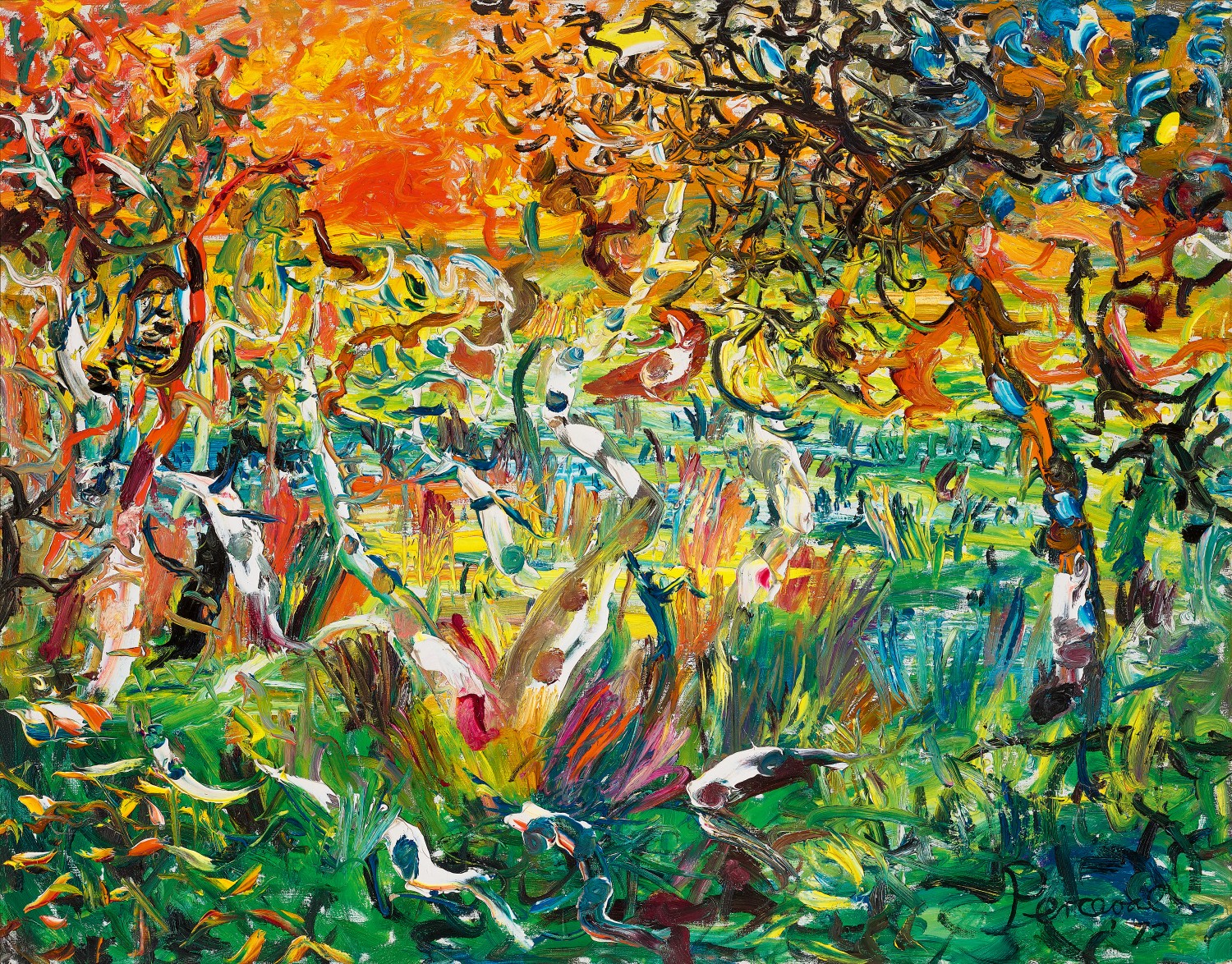
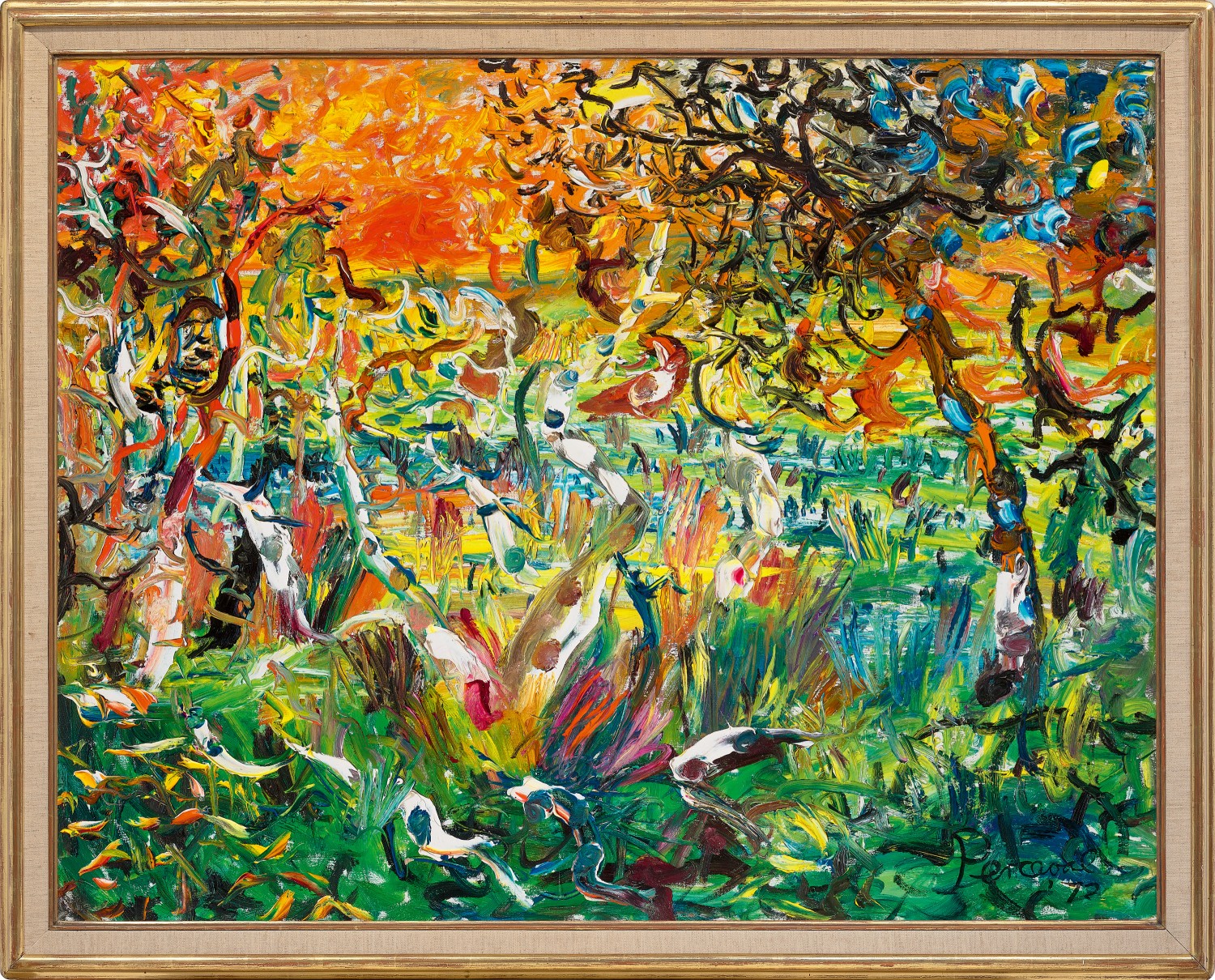
Sun setting over the marsh, 1972
John Perceval
oil on canvas
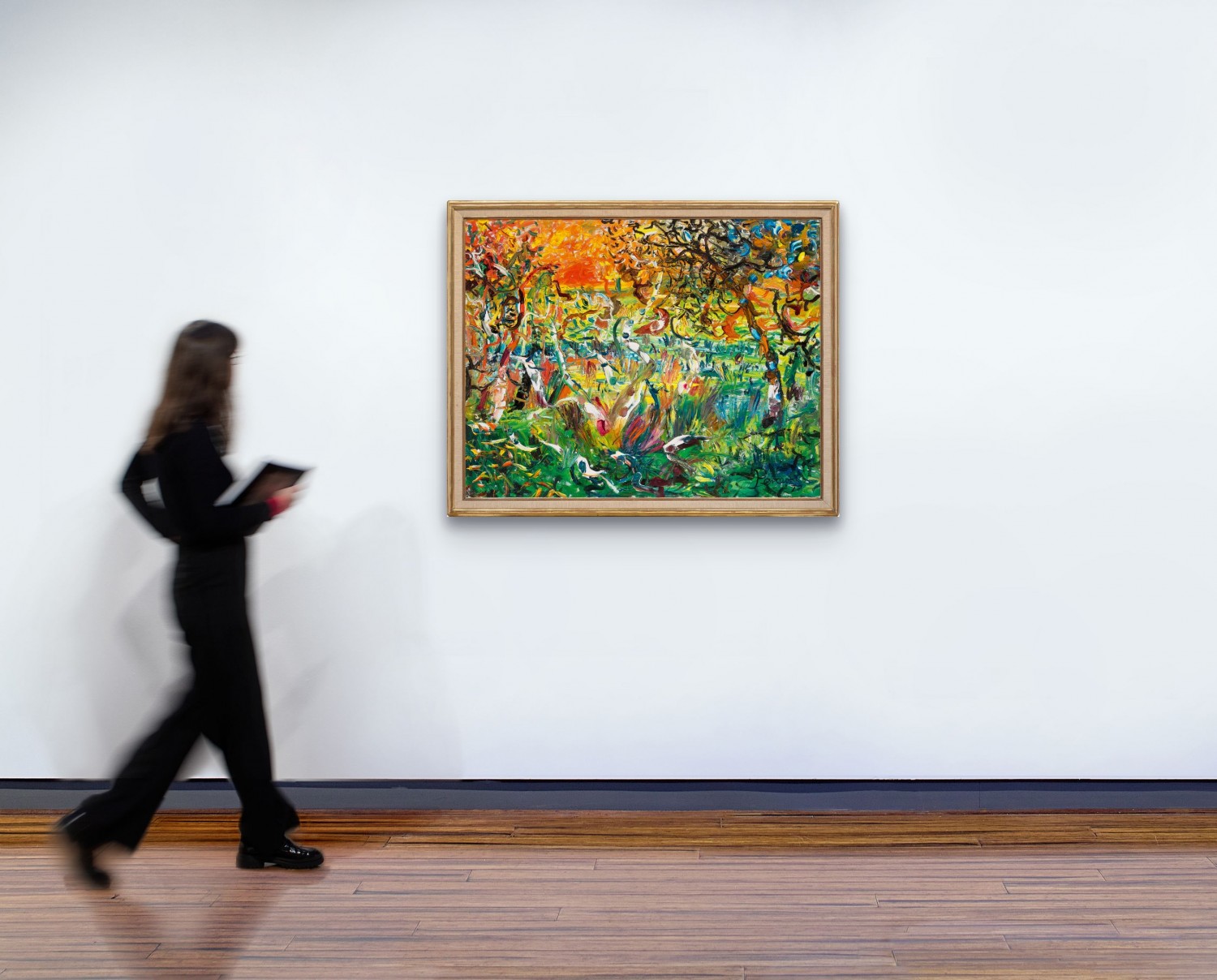
91.0 x 116.5 cm
signed and dated lower right: Perceval / '72
South Yarra Galleries, Melbourne (partial label attached verso)
Bruce Wenzel, Melbourne
Thence by descent
David Wenzel, Melbourne
Gould Galleries, Melbourne
Private collection, Melbourne, acquired from the above in 2000
Recent works by John Perceval, South Yarra Gallery, Melbourne, opening 17 October 1972, cat. 7
Paintings by John Perceval, David Jones Art Gallery, Sydney, 28 May – 9 June 1973, cat. 3
The Australian landscape, Gould Galleries, Melbourne, 7 October – 7 November 1999
Allen, T., John Perceval, Melbourne University Press, Melbourne, 1992, p. 171
We are grateful to Robert Gould for his assistance with this catalogue entry.
In the early 1970s, John Perceval owned two cars: an apple-green Porsche and a battered Volkswagen station wagon. Whilst ironically representing two sides of the artist’s personality and dynamic, they were also entirely practical when Perceval was seeking inspiration, driving the Porsche all over Victoria ‘investigating landscapes’ and ‘looking for poetry.’1 On his return to the family base in Canterbury, he would then load up the station wagon with ‘nearly a hundredweight’ of gear.2 To enable this, he had an assistant who also travelled to the painting locations as Perceval walked with a limp due to childhood polio and required help loading and unloading his painting equipment. The sites were often patches of humble scrub, usually overlooked, but for Perceval, they were rich in possibility and as a result, many of these sites remain unidentified as the resultant paintings did not always include a location within their title. One such sequence is the small group known as the ‘Red Marsh’ series, of which Sun setting over the marsh, 1972, is a key example.
Perceval’s landscapes had been building in strength from the mid-1950s with the evocative paintings done at Gaffney’s Creek, first shown alongside those from the Williamstown foreshore. By the early 1960s, the scenes became tangled masses, close-up encounters with ti-tree and spiky saplings done in somewhat melancholic deep blues and black. By the end of the decade, however, he reached a new understanding of the landscape and how to paint its moods, and as artist-critic James Gleeson memorably observed, Perceval now made ‘no distinction between flesh and flower – they are all paint to him… (He) sees this fact as a cause for celebration.’3 Perceval was annoyed by other critics such as Robert Hughes who described his work as ‘roly poly’4, countering that ‘I do not hold any particular attitude to my work or to art in general. I chose early not to work from an aesthetic theory or concept but prefer the results to be governed by developments that occur while the work is in progress.’5 Technically, the initial layers in his paintings were worked tonally with background, middle ground and foreground spaces, after which the impasto brushstrokes were then applied. Whilst Perceval viewed the process as ‘exhausting… it’s like a ballet dancer’s first night, but every painting is a first night’6, the ever perceptive Gleeson also believed that through this effort the artist was able to effectively convey his love for ‘the warmth or crispness of the air and evokes its quality with the exactness of an Impressionist and the feeling of an Expressionist.’7
Sun setting over the marsh was exhibited in Melbourne and Sydney in shows that pulsated with colour and optimistic energy. Depicted over the course of five related ‘Red Marsh’ paintings, the anonymous location is revealed at various stages of the day, alive to the artistic challenges presented by an ever-changing light, a sun not of the Impressionists but ‘of the Symbolists, the sun as the source of light and energy, the symbol of all that is positive and affirmative in nature.’8 With rich passages of orange, yellow and red blazing above the greens and blues of the sheltered ground, Sun setting over the marsh further reveals the strength of Perceval’s artistic sensibility.
1. Sykes, J., ‘The artist who won fame at home’, The Sydney Morning Herald, 15 February 1973, p. 7
2. ibid.
3. James Gleeson, ‘Flesh or flower: they’re all paint to Perceval’, The Sun-Herald, Sydney, 28 November 1971, p. 140
4. Hughes, R., The art of Australia, Penguin, Melbourne, 1966 (revised edition 1970), p. 235
5. John Perceval, cited in Reed, J., New Painting 1952 – 1962, Longmans, Melbourne, 1963, p. 24
6. Aldridge, R., ‘Picture of the artist in the wheatfield’, The Age, 18 November 1972, p. 14
7. Gleeson, J., Modern painters: 1931 – 1970, Lansdowne Press, Sydney, 1971, p. 95
8. Gleeson, J., ‘Painter in the making’, Sun Herald, 10 June 1973
ANDREW GAYNOR