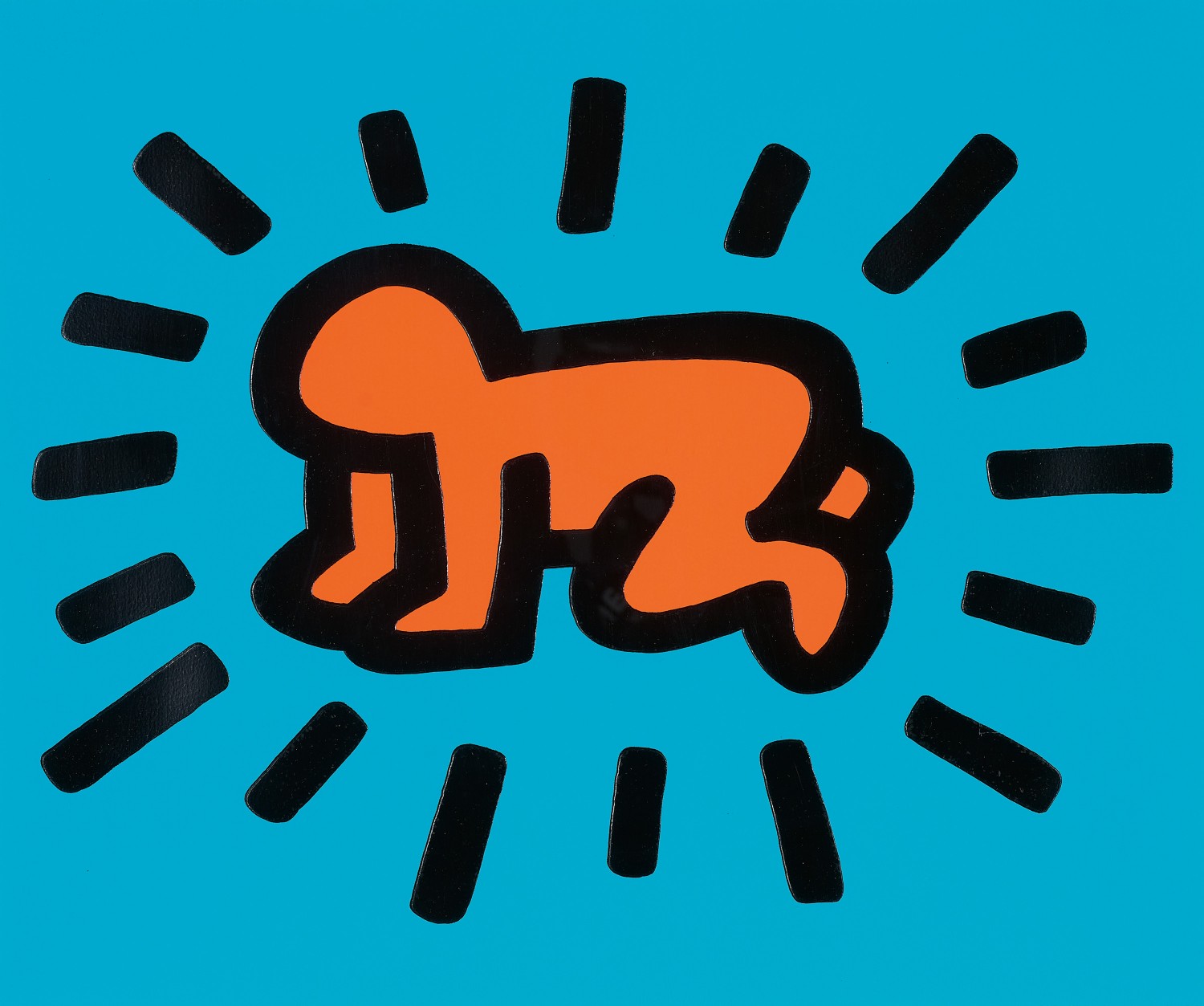
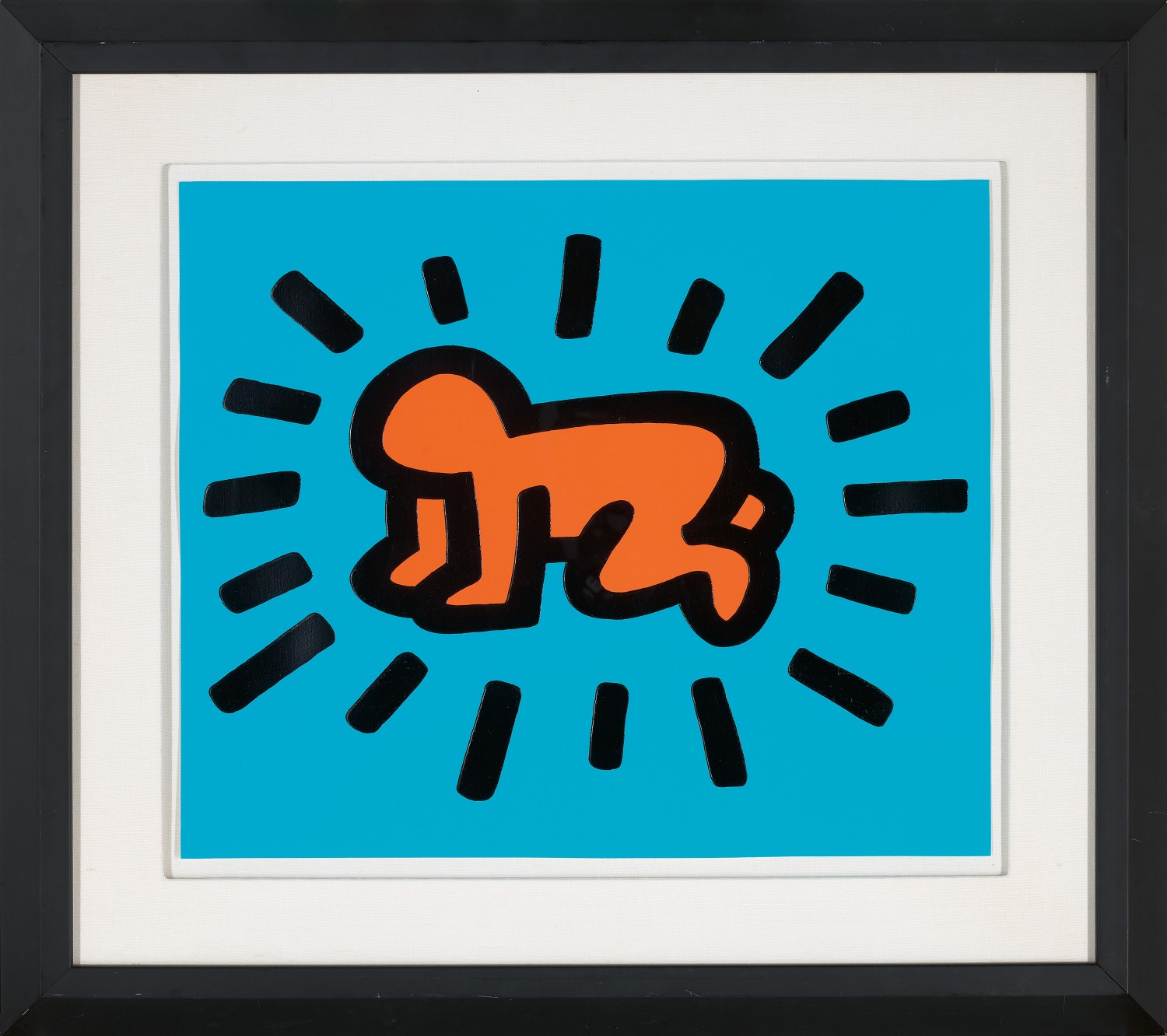
Radiant baby, 1990
Keith Haring
from Icons
colour screenprint with embossing on Arches cover paper
53.5 x 63.5 cm
signed, dated and numbered on estate stamp verso by the Executor for the Keith Haring Estate: 91/250 / Julia Gruen 6/28/90
Published by Tony Shafrazi Editions, New York
Pop International Galleries, Inc., New York (label attached verso)
Private collection, Sydney & London, acquired from the above
Littmann, K., Keith Haring: Editions on Paper 1982-1990, The complete printed works, Hatje Cantz, Stuttgart, Germany, 1993, p.170 (illus., another example)
Phillips, N. E., 'The Radiant (Christ) Child: Keith Haring and the Jesus Movement', American Art, The University of Chicago Press, Chicago, on behalf of the Smithsonian American Art Museum, Washington, vol. 21, no. 3, Fall 2007, p. 55 (illus., another example)
Few artists have so successfully dissolved the boundaries between street culture and the establishment as Keith Haring, whose exuberant pictorial vocabulary transformed the walls of New York’s subway stations into one of the defining artistic stages of the 1980s. Executed in a bold, graphic style distinguished by fluid black contours, simplified forms and pulsating lines of energy, indeed Haring’s instantly recognisable imagery defied the conventions of contemporary art, communicating directly with audiences regardless of age, language or cultural background. At the heart of this unique iconography was the Radiant baby – arguably the artist’s most enduring and universally recognised symbol, embodying what Haring himself described as ‘the purest and most positive experience of human existence.’1
Notably, the Radiant baby motif first appeared in the early 1980s amongst the hundreds of chalk drawings Haring produced on vacant advertising panels throughout the New York subway system. Conceived as an artistic intervention within the everyday rhythms of urban life, these ephemeral works bypassed the exclusivity of galleries and museums, bringing art directly to the public. Amidst barking dogs, flying saucers and dancing figures, the crawling infant encircled by radiant lines rapidly emerged as Haring’s personal ‘tag’ – a succinct visual shorthand through which he expressed optimism, innocence and the limitless creative potential of humanity.
Although deceptively simple in appearance, Radiant baby is imbued with rich symbolic resonance. The child, rendered in dynamic motion and enveloped by an aura of radiating energy, evokes themes of birth, renewal and universal connectivity, while simultaneously echoing the haloed Christ Child of traditional Christian iconography. Raised within a religious household, Haring frequently acknowledged the abiding influence of spiritual imagery upon his artistic imagination – yet his intention was never doctrinal. Rather, by reducing the human figure to its most elemental form, he sought to create an image capable of transcending cultural, political and linguistic boundaries – a symbol of hope and shared humanity immediately accessible to all.
Created in 1990, the year of Haring’s untimely death at just thirty-one, the present Radiant baby belongs to the celebrated Icons portfolio – a poignant culmination of the artist’s extraordinary career. Revisiting five of his most iconic motifs, the series encapsulated the visual language he had refined over the previous decade into images of remarkable clarity and immediacy. Embossed upon luxurious Arches paper, the brilliant colour and emphatic line preserve all the vitality and spontaneity of Haring’s signature subway drawings, while transforming an ephemeral street intervention into an enduring work of art. More than four decades after first appearing beneath the streets of Manhattan, today Radiant baby remains one of the defining images of contemporary art – a timeless expression of optimism whose joyful simplicity continues to resonate with audiences around the world.
1. Keith Haring, cited in Gruen, J., Keith Haring: The Authorised Biography, New York, 1991, p. 78
VERONICA ANGELATOS