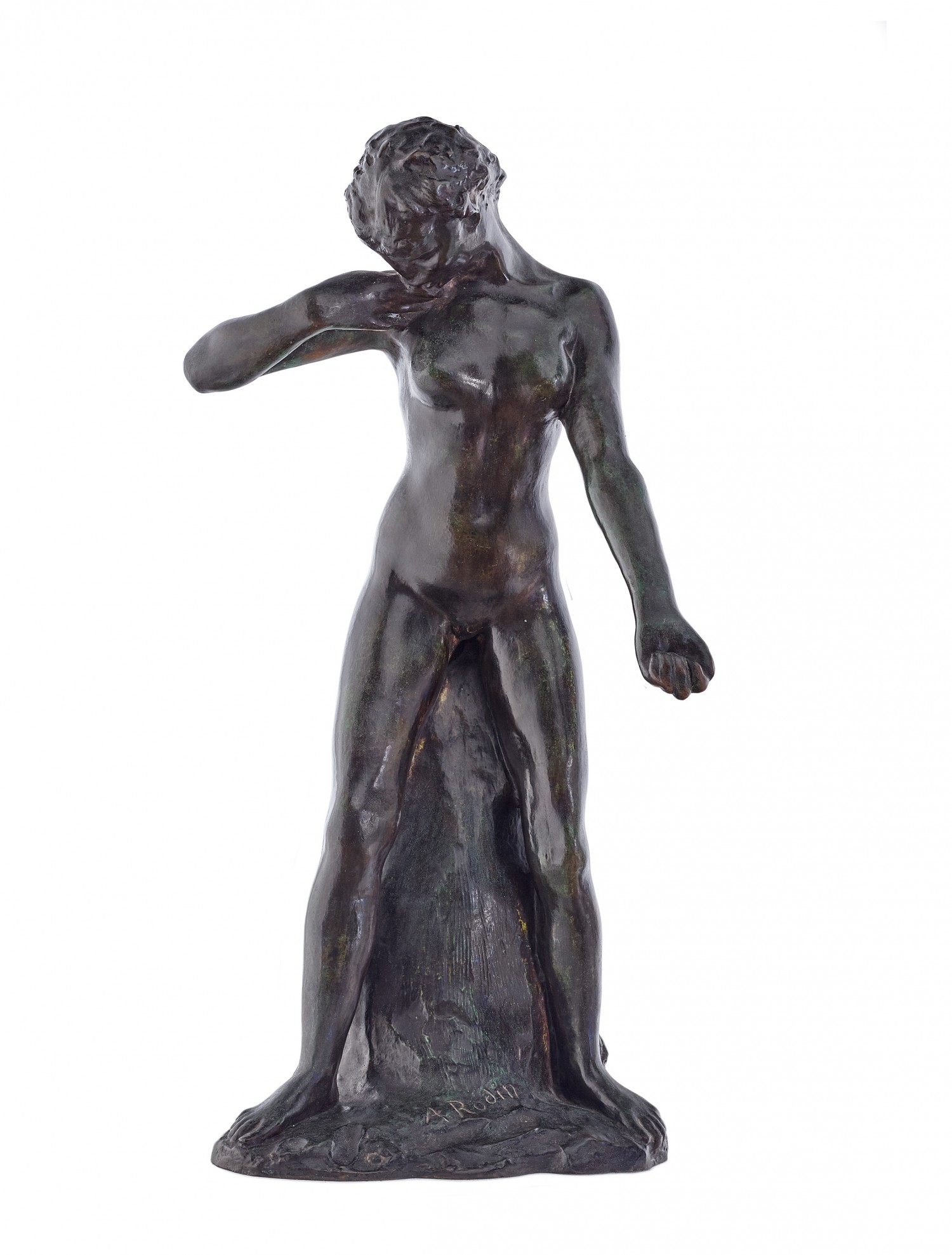
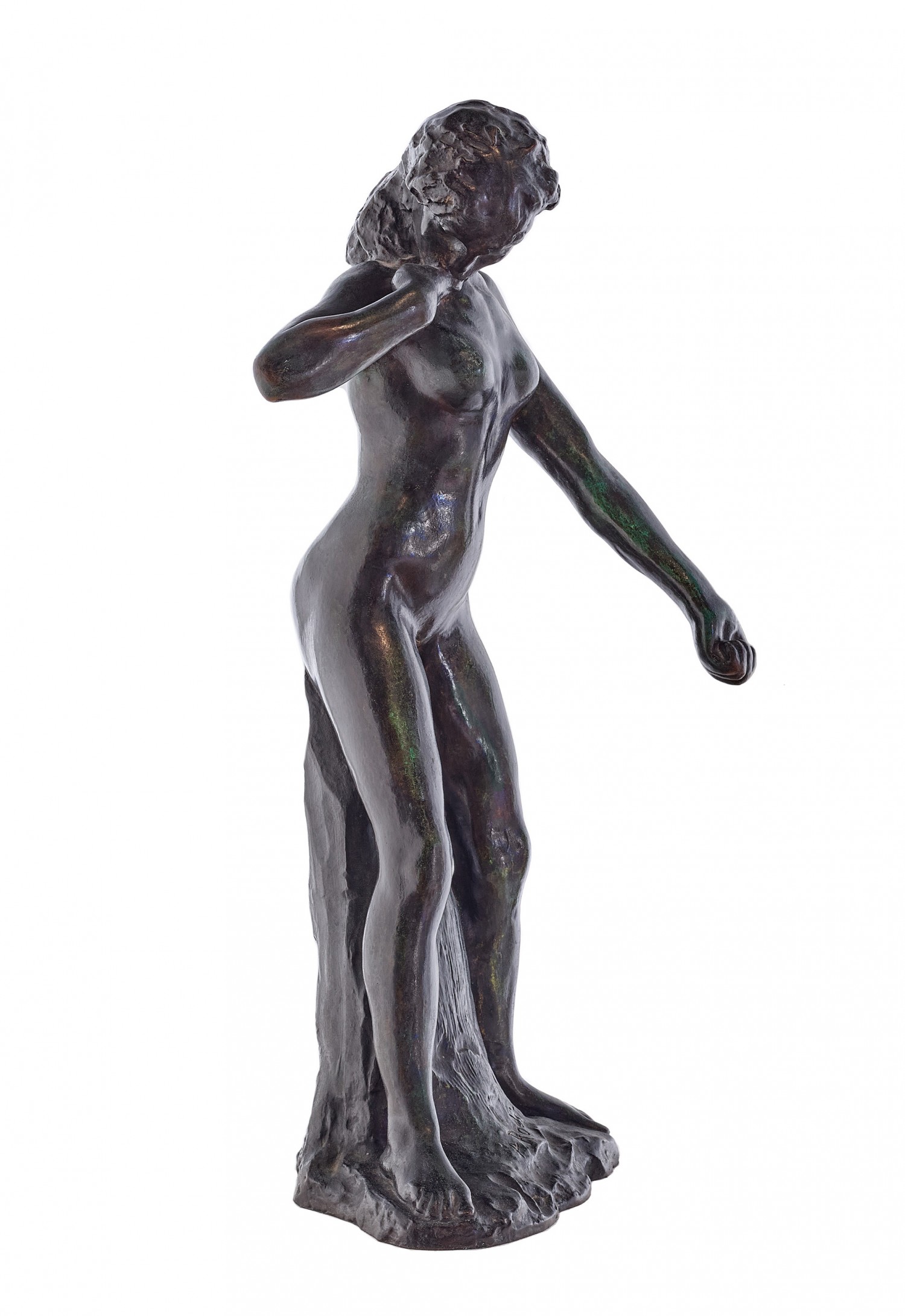
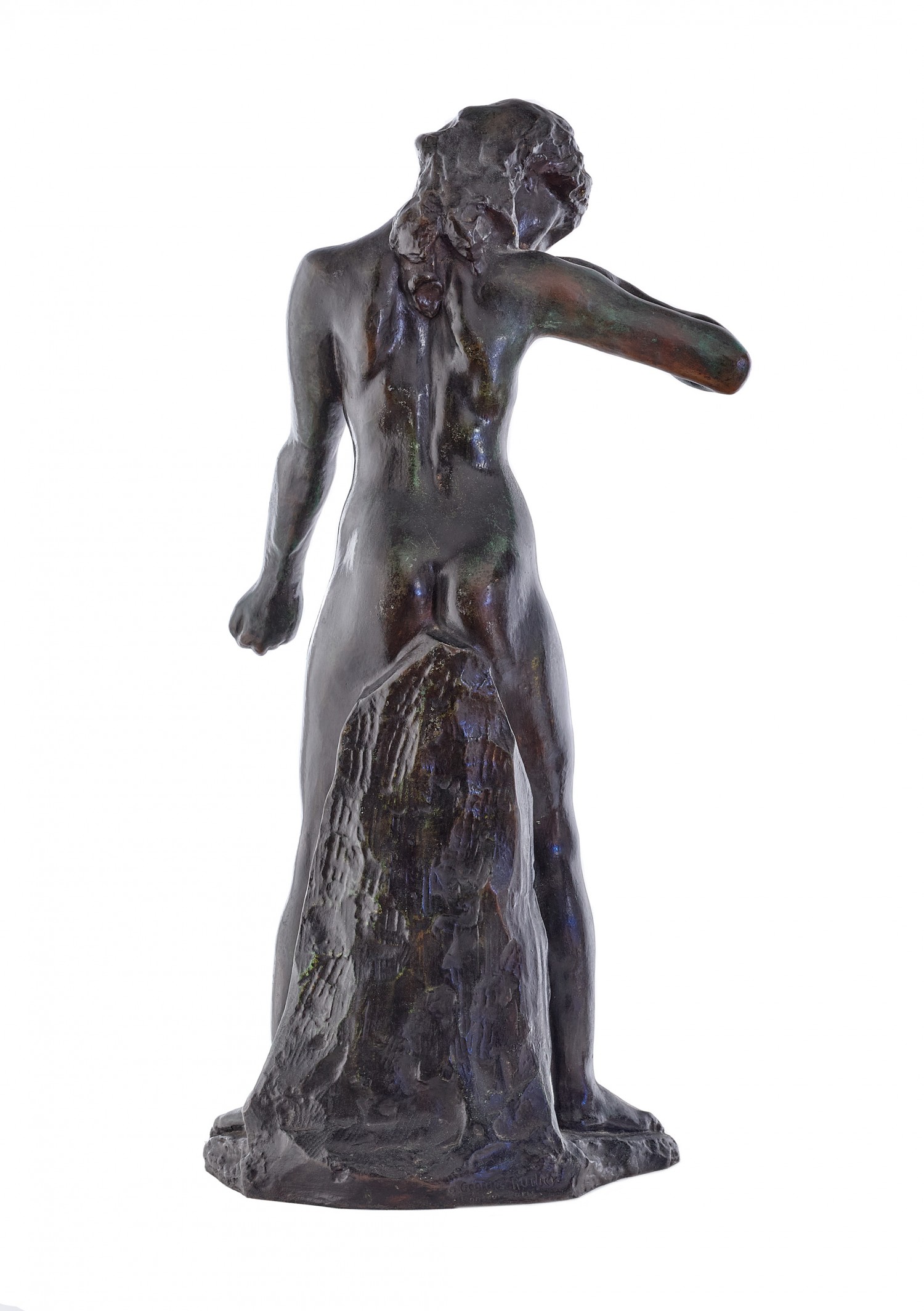
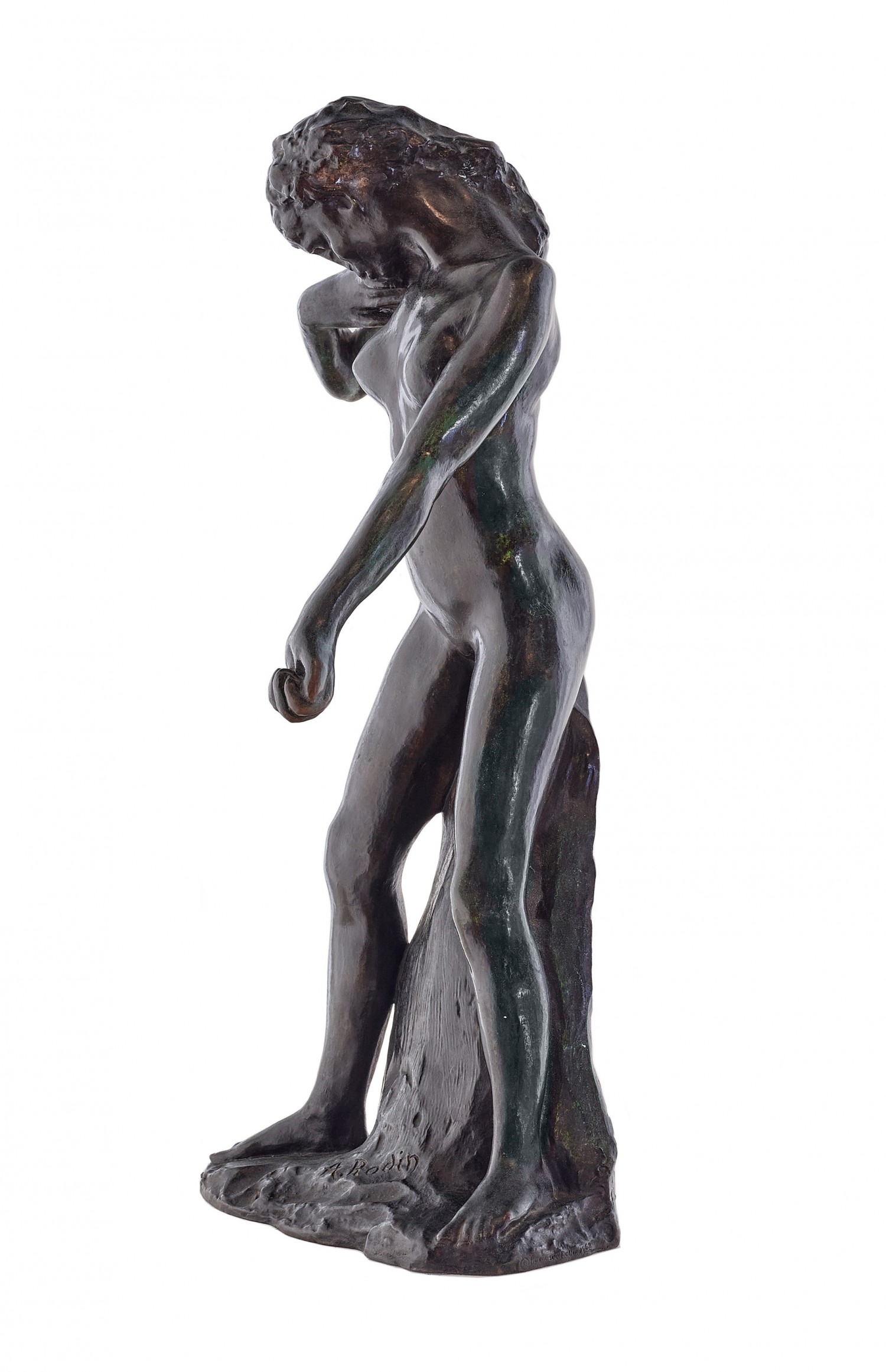
La faunesse debout (Standing faunesse), 1884, cast 1963
Auguste Rodin
(conceived in 1884, this bronze version was cast in an edition of 12 by the Musée Rodin, Paris, completed in 1963)
bronze
62.0 x 29.8 x 25.0 cm
signed at base: A. Rodin
bears foundry inscription at base: Georges Rudier / Fondeur. Paris.
bears inscription at base: © by Musée Rodin 1963
Musée Rodin, Paris
David Jones Art Gallery, Sydney
Private collection, acquired from the above in November 1965
David Jones Art Gallery, Sydney
Michael and Suzanne Kent, Adelaide, acquired from the above in March 1986
Private collection, Adelaide and Melbourne, acquired from the above in June 2003
Thence by descent
Private collection, Melbourne
Rodin - sculpture and drawings, David Jones Art Gallery, Sydney, 2 – 26 June 1965
Rodin, National Museum of Western Art, Tokyo, 23 July – 11 September 1966, cat. 24 (another example)
French & English: Sculpture, Paintings, Drawings, Browse and Darby, London in association with David Jones Art Gallery, Sydney, 6 February – 1 March 1986, cat. 8
Rodin et la Porte de l’Enfer (Rodin and the Gates of Hell), National Museum of Western Art, Tokyo, 21 October – 17 December 1989, cat. 39 (another example)
Auguste Rodin, Das Höllentor: Zeichnungen und Plastik, Städtische Kunsthalle Mannheim, Mannheim, Germany, 28 September 1991 – 6 January 1992, cat. 56 (another example)
Rodin. L'exposition du centenaire, Musée Rodin and Réunion des Musées Nationaux - Grand Palais, Paris, 22 March - 31 July 2017, cat. 278 (another example)
National Touring Exhibition of Western Art from the NMWA: When Here and Afar Meet: Western Art in Yamagata / Western Art in Takaoka, Yamagata Museum of Art, Yamagata, 17 July – 27 August 2021; Takaoka Art Museum, Toyama, 10 September – 24 October 2021, cat. Y1_6 | T3_39 (another example)
Renoir, Monet, Gauguin: Images of a Floating World: the Collections of Kōjirō Matsukata and Karl Ernst Osthaus, Museum Folkwang, Essen, Germany, 6 February – 15 May 2022 (illus. in exhibition catalogue, another example, p. 237)
Grappe, G., Catalogue du Musée Rodin, Paris, 1938, cat. 97 (illustration of the plaster)
Hubacher, H., Rodin, Editions Muckleman, Zurich, 1949, pl. 37 (illus., another example)
Charbonneau, J., Les Sculptures de Rodin, Fernand Hazan, Paris, 1949, cat. 38, pl. 38 (illus., another example)
Jianou, I. & Goldscheider, C., Rodin, Arted Editions d'Art, Paris, 1967, p. 90 (other examples)
Le Normand-Romain, A., The Bronzes of Rodin, Catalogue of the Works in the Musée Rodin, Éditions de la Réunion des Musées Nationaux, Paris, 2007, vol. 2, p. 628 (illus., another example)
260018 Rodin (2).jpg
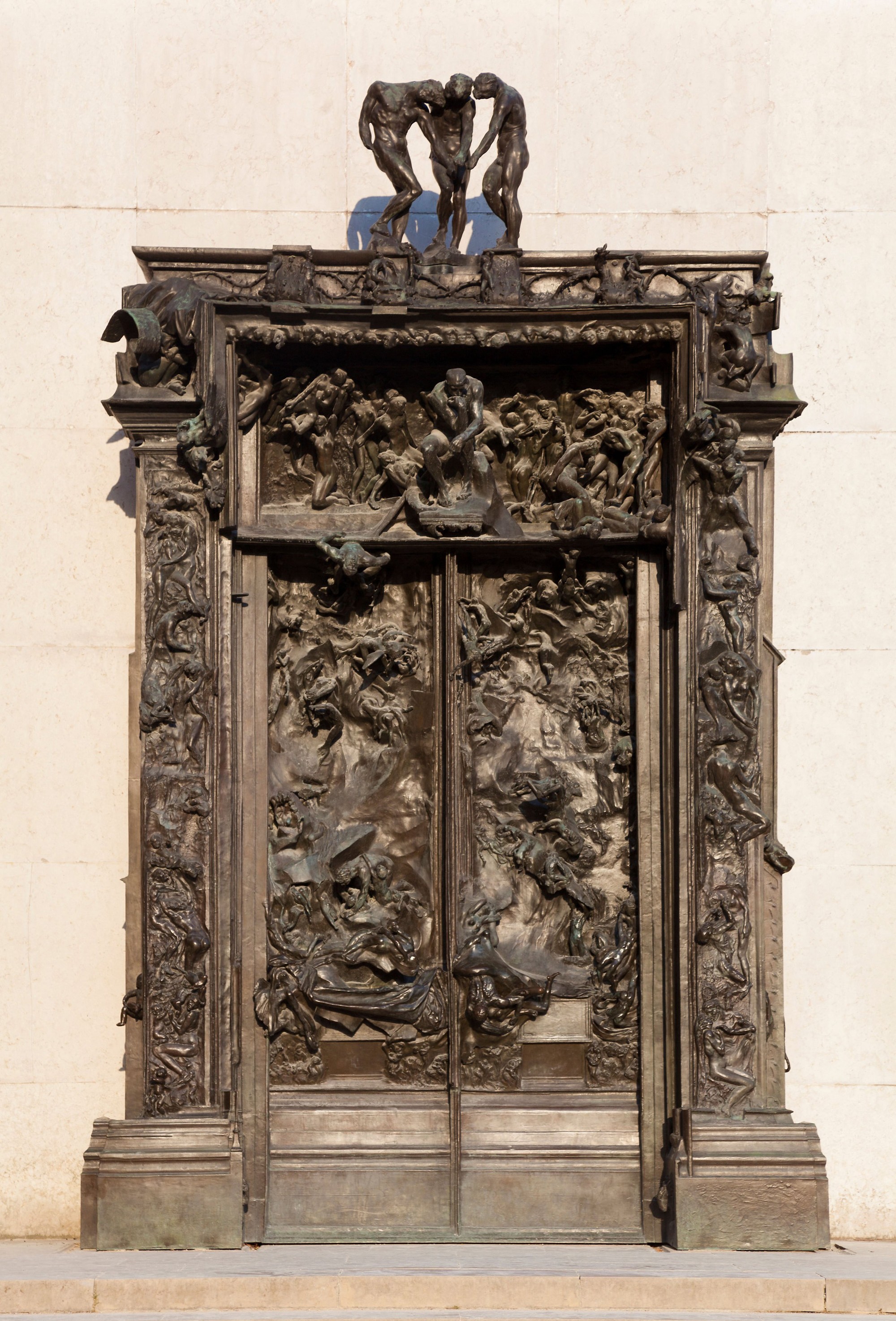
Auguste Rodin
La porte de l’Enfer (The Gates of Hell),
1880 – 90, cast 1928
bronze
635.0 x 400.0 x 85.0 cm
Musée Rodin, Paris
In 1880, Auguste Rodin, growing in fame as a figurative sculptor within the Parisian salons, was awarded a commission from the French Government for a monumental entranceway for a planned, democratic Musée des Art Décoratifs in the place of the old Cour des Comptes, which had burnt to the ground during the 1871 Paris Commune. Although never fully realised during his lifetime, the resulting huge gate, La Porte d’Enfer (Gates of Hell), conceived with a slow and cumulative genesis over several decades, became the ultimate masterpiece of Rodin’s illustrious career. Although Rodin had completed by the mid-1880s a life-size plaster maquette, the construction of the intended museum had stalled.1 An incomplete version of the plaster maquette (devoid of its high-relief figures) was exhibited only once during Rodin’s lifetime, at the Exposition Universelle, in Paris in 1900, and full bronze casts of the gates were only fabricated posthumously from 1917.
Towering over six metres high and containing a great compendium of Rodin’s figurative oeuvre with over two hundred distinct forms, the Gates of Hell was a daringly modern Symbolist composition. Gestural and metamorphic, the writhing, anonymous spectres in bas and high relief throughout the Gate were the product of an extraordinary creative endeavour, the intensity of which ‘had no precedent in the history of art.’2 While informed by Charles Baudelaire’s controversial modernist poetry in Les fleurs du mal (1857), Rodin’s tormented vision of modern life portrayed within the gates was also inspired by two iconic medieval works. Thematically based in the conception of hell presented in Dante Alighieri’s fourteenth century epic poem The divine comedy – with Rodin including a handful of named characters – the format of the Gates’ panelled double doors was intended to be an infernal, disordered counterpoint to Lorenzo Ghiberti’s gilded bronze doors, Gates of Paradise, 1425 – 52, at Florence’s Baptistery of San Giovanni.
The plaster life-size maquette of the gate remained within Rodin’s studio throughout the remainder of his career, becoming a cumulative receptacle for all his ideas and fantasies, and in turn feeding his oeuvre. By the mid-1880s, it became the source of his most famous, standalone works – including The thinker, 1904 and The kiss, 1882 and a myriad of smaller individual figurines, including the present La faunesse debout, 1884 which Rodin began to isolate and exhibit independently.
260018 Rodin-topaz-upscale-2x.jpg
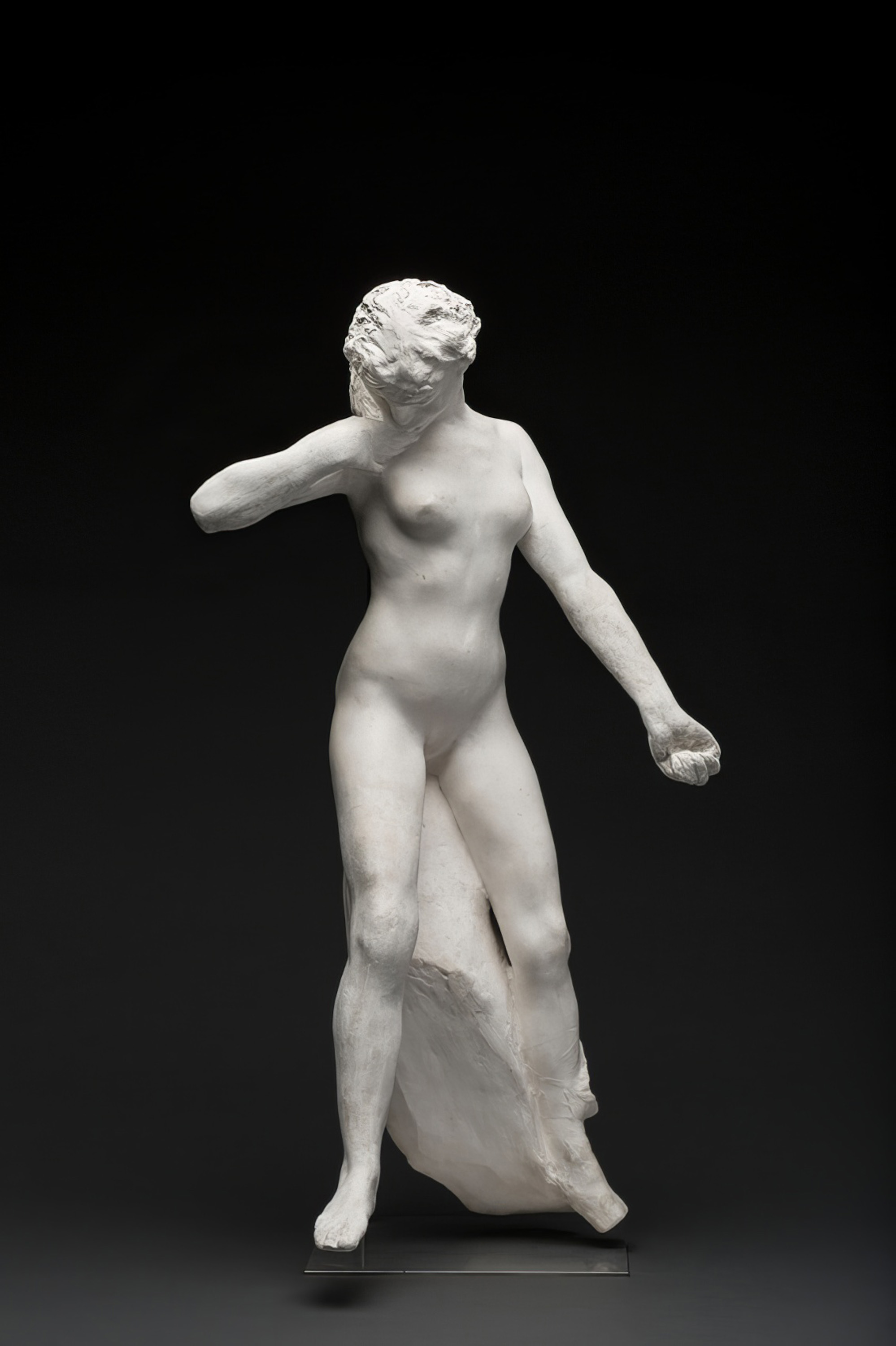
Auguste Rodin
Faunesse standing, before 1887
plaster statuette
61.5 x 24.7 x 16.0 cm
Musée d’Orsay, Paris
© Rodin Museum Photographic Agency/
Pauline Hisbacq
La faunesse debout, a female mythological creature, had been a semi freestanding projection in high relief in the far right of the gate’s tympanum. Rodin generated a series of faunesses in various poses from this same section, in plaster (posthumously editioned in bronze), and later also carving larger marble sculptures of the motif. A fragment of the monumental whole, here the fauness is transferred into an independent context, as an intimate figure study based in a non-Christian past.3 Although some of these figures were truncated as a result of their extraction, La faunesse debout remained intact and formally complete. Rodin kept many of these figures in small sizes, to dispel rumours that his expressive and lifelike forms had been moulded from nature.4
Brazenly showing her naked body in the uninterrupted light at the front of the tympanum, and even more so later as an individual figurine, La faunesse debout is an expression of Rodin’s unorthodox iconography based on a self-taught understanding of mythology and literature. In classical Greece and Rome, the faun was the spirit of the woods, the ‘selva oscura’ at the beginning of Dante’s canto. During the 19th century, however, the male faun took on erotic connotations for writers, artists and choreographers, becoming the embodiment of natural desire. While Victor Hugo spoke of the faun being a ‘god of ill repute’ with a ‘lustful eye’, the sensual figure was taken to extremes in Stéphane Mallarmé’s 1876 symbolist poem L'après-midi d'un faune, infamously performed by the Ballets Russes in 1912.5
Presenting the extricated figurines in various forms of formal completion, Rodin invited the viewer into a privileged creative position. Here he emphasises the faunesse’s smooth, sinewy and sensual figure, while leaving her head and hair roughly hewn from the plaster mass, suggesting a oneness with nature. Looking to the sculptors of antiquity, Rodin sought to create a lively and expressive physicality, the tension of the faunesse’s arm and body contrasting with the solidity of her supports. Her weight is physically and metaphorically counterbalanced on the rock behind her, while she stretches languorously. While some critics deplored that individual figures became ‘indecent’ when removed from the literary and thematic contexts of the larger Gates, Belgian critic Raymond Nyst wrote of the La faunesse debout in 1899, declaring her a ‘little wonder’, radiating with freshness and sensuality.6
1. Masson, R. and Mattiussi, V., Rodin, Flammarion and Musée Rodin, 2015, p. 29
2. Blanchetière, F., ‘La Porte d’Enfer’, Rodin. Livre du Centenaire, Réunion des Musées Nationaux, Grand Palais, Paris, 2017, p. 60
3. Elsen, A., ‘The Gates of Hell: What They Are About and Something of Their History’ in Rodin Rediscovered, National Gallery of Art, Washington, 1981, p. 63
4. Auguste Rodin cited in Masson and Mattiussi, op. cit., p. 25
5. Bonafoux, P., Rodin and Eros, Thames and Hudson, London, 2012, p. 89
6. Nyst, R., ‘Rodin’, La Gerbe, Brussels, no. 1, Juillet 1889, p. 7
LUCIE REEVES-SMITH