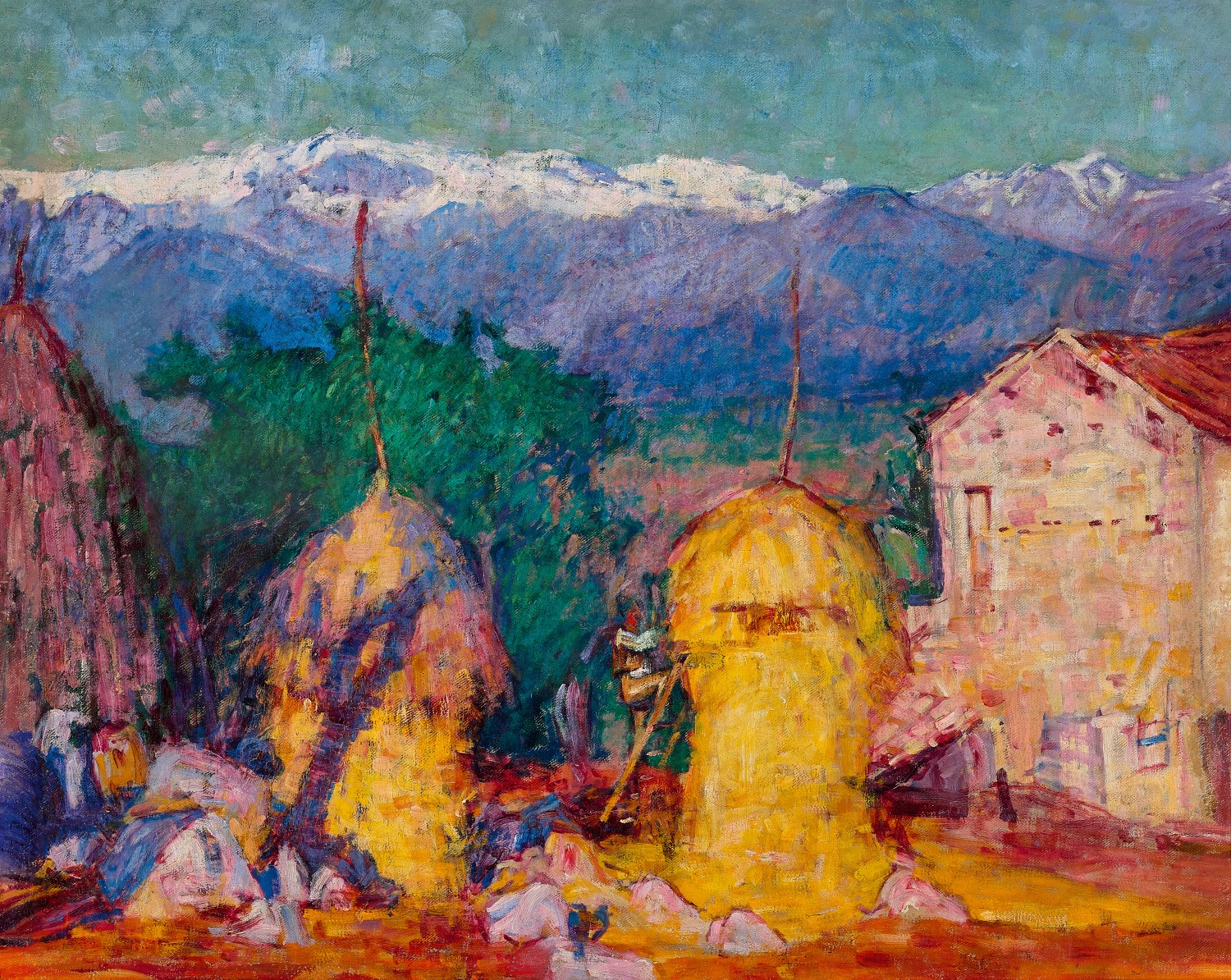
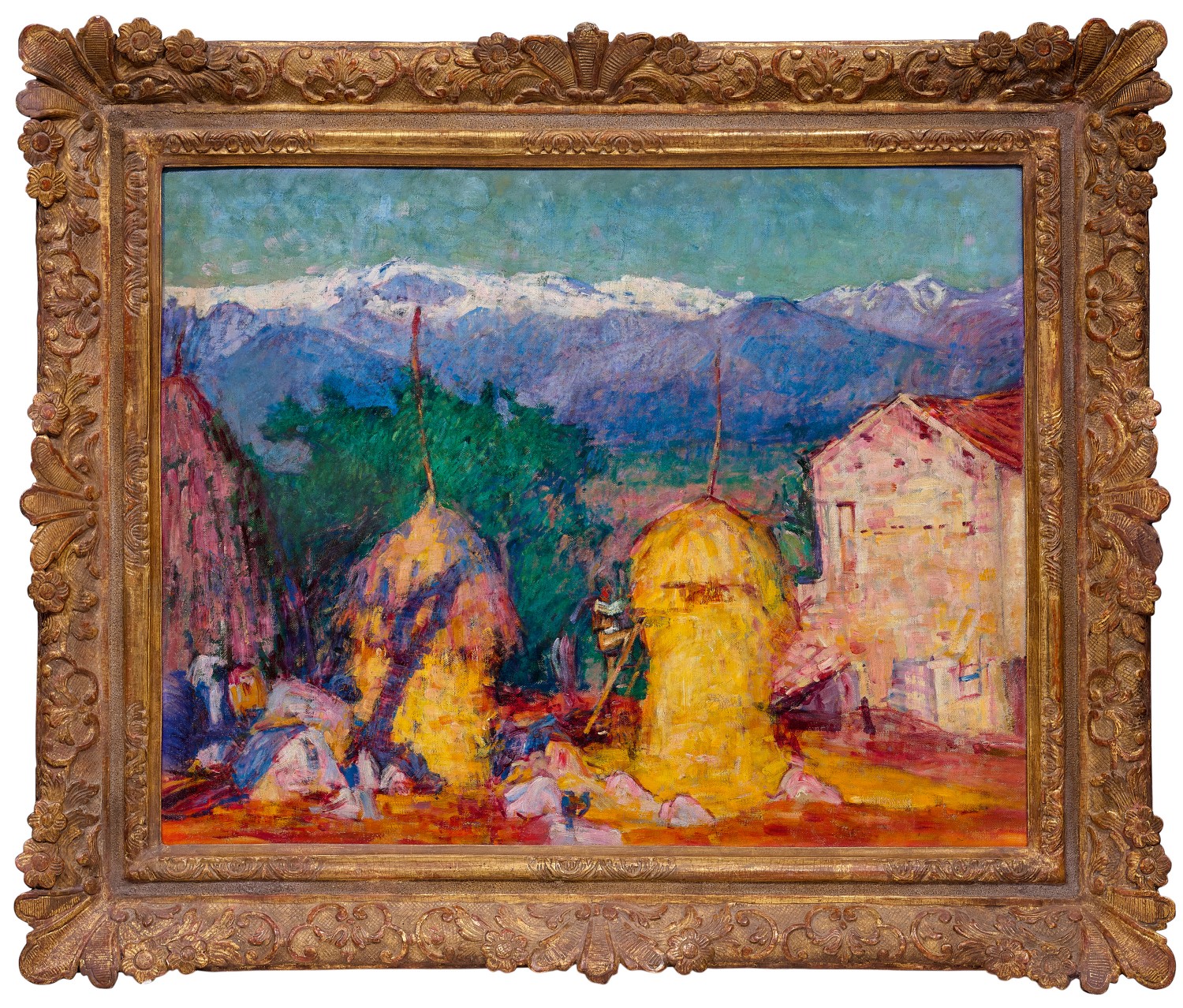
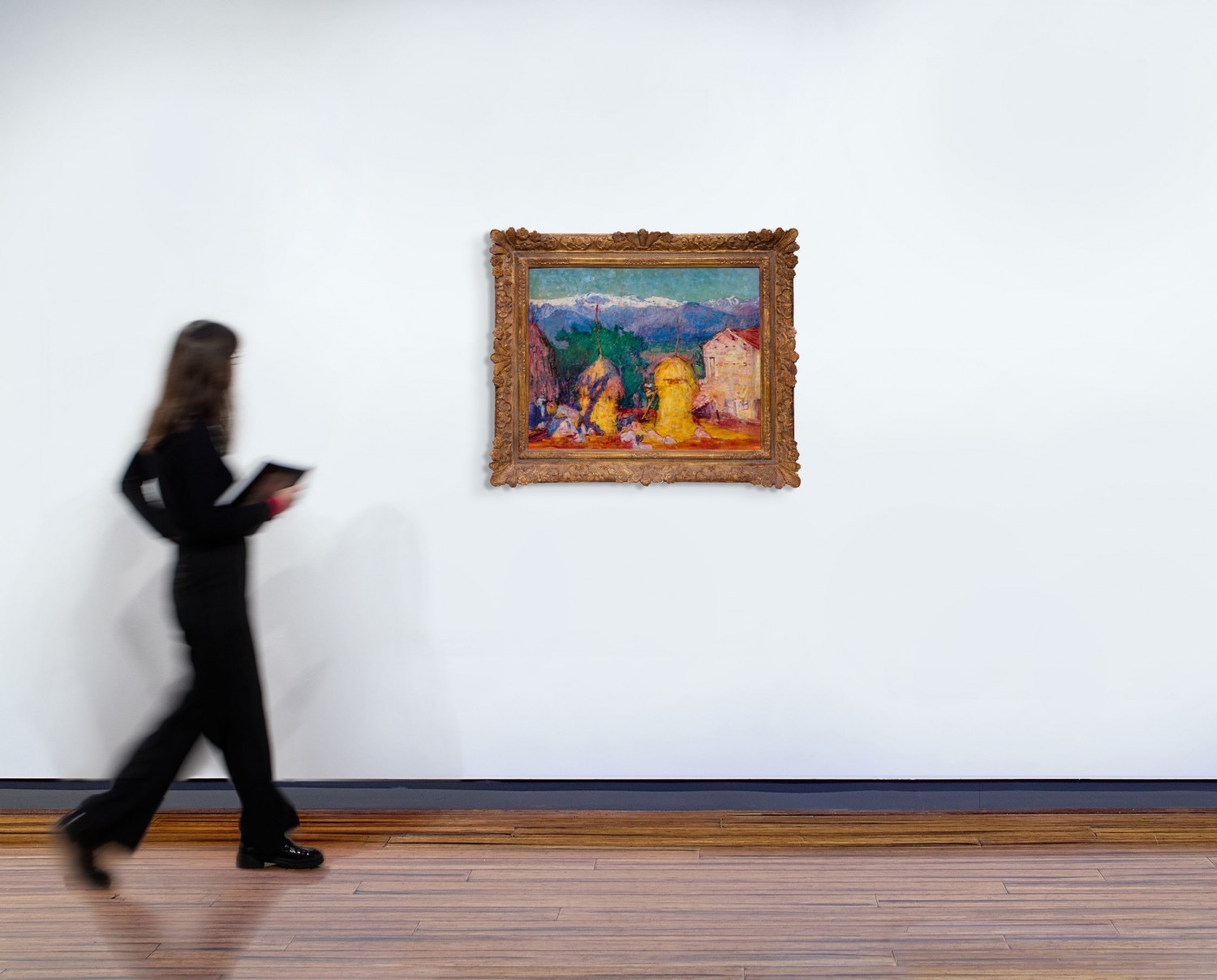
Meules de Blé à Monte Cassino, c.1889
John Peter Russell
oil on canvas
65.0 x 81.0 cm
label attached verso: 6
Madam Lecoin, Brittany, France
Thierry-Lannon & Associés S.A.R.L., Brest, France, 10 December 2011
Private collection, Melbourne
Private collection, Perth
John Peter Russell, Galerie G. Denis, Paris, 1941 / 1943 (?), cat. 50 (label previously recorded by Galbally verso, as ‘Les Meules a Monte Cassino’)
John Peter Russell 1858-1931: Australian Impressionist, Wildenstein & Co. Ltd, London, July – August 1965, cat. 12
Galbally, A., The Art of John Peter Russell, Sun Books, Melbourne, 1977, cat. 75, pl. 18 (illus.), p. 101
Unknown-topaz-upscale-2x cmyk.jpg
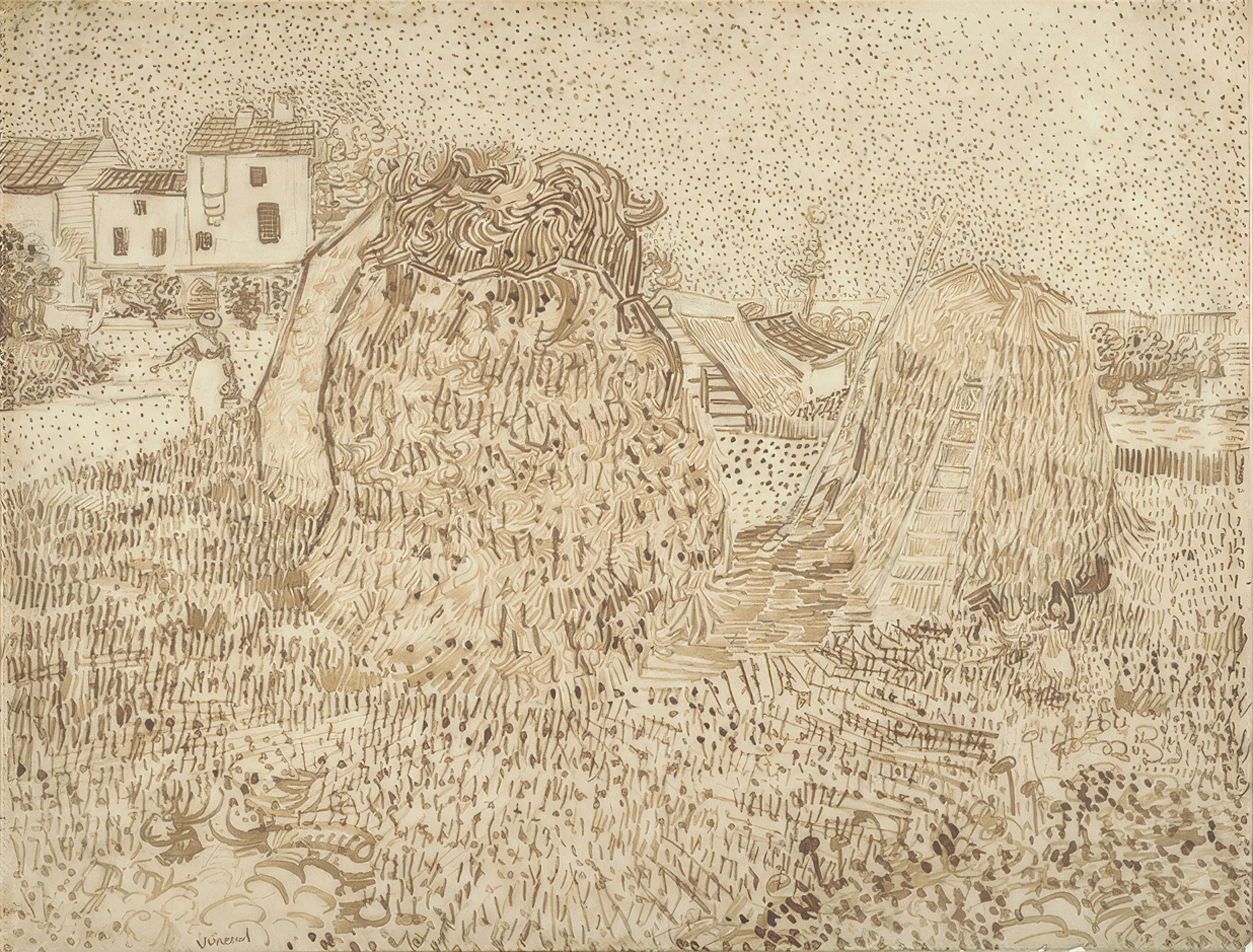
Vincent Van Gogh
Haystacks, 1888
Gifted to John Peter Russell by Vincent van Gogh in 1888
reed and quill pens and brown ink over graphite
24.0 x 31.0 cm
Philadelphia Museum of Art, Philadelphia
John Russell’s inherited wealth afforded many freedoms, setting him on a unique path unlike that of any other Australian artist of the time and bringing him into direct contact with some of the masters of European Impressionism and Post-Impressionism. No longer expected to join the family business following the premature death of his father and now in possession of a substantial fortune, he sailed to England in 1880, enrolling at London’s Slade School the following year. Continuing his studies at Fernand Cormon’s atelier in Paris in the mid-1880s, he worked alongside Émile Bernard, Henri de Toulouse-Lautrec and later, Vincent Van Gogh. The two artists established an enduring friendship which is documented in their personal correspondence.1 Russell was also one of the few artists to paint Van Gogh and the 1886 portrait, now in the collection of the Van Gogh Museum in Amsterdam, was treasured by the Dutchman who asked his brother Theo to ‘take good care of my portrait… which means a lot to me.’2
260143 JPR (5).jpg
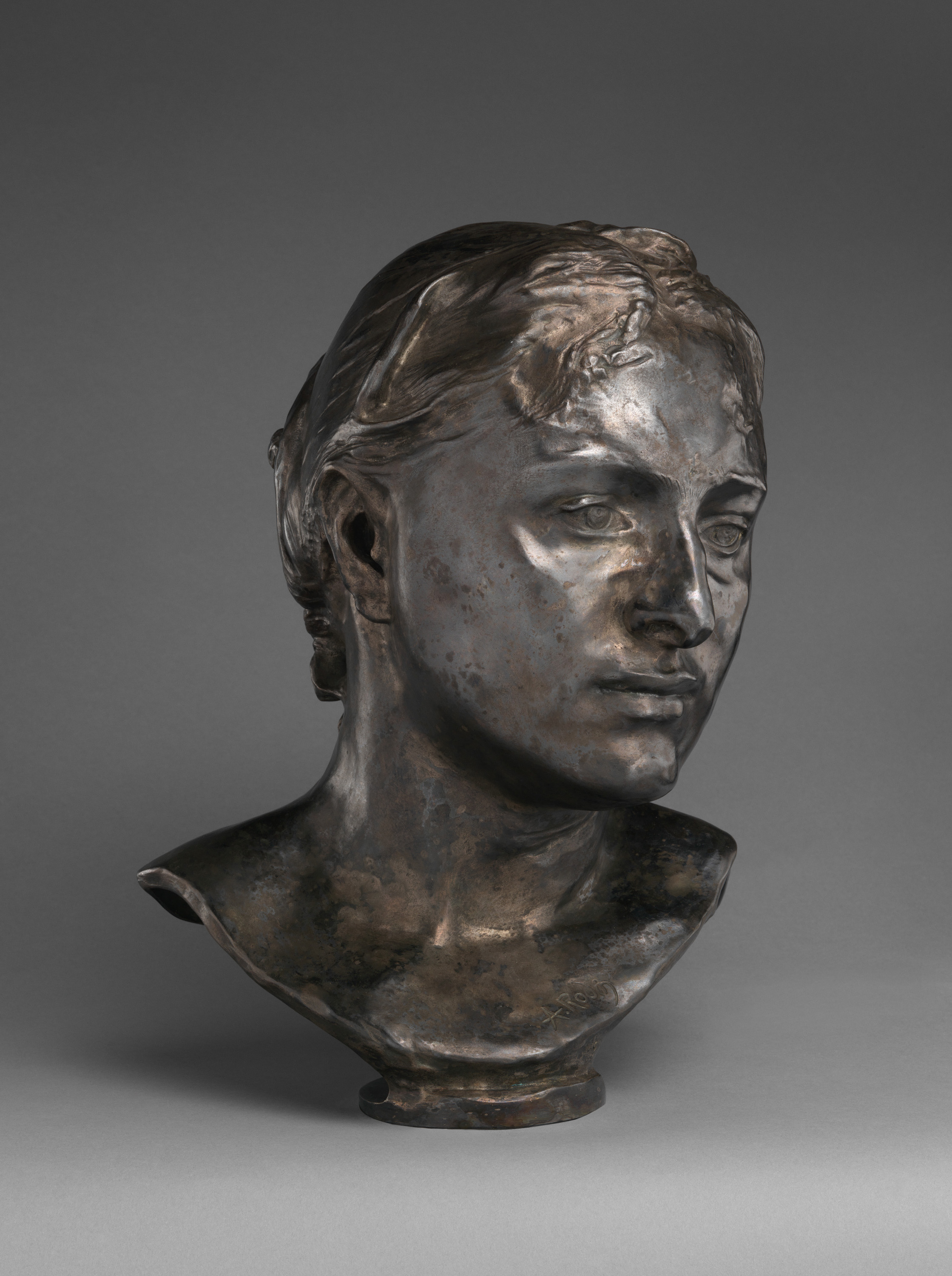
Auguste Rodin
Mrs. Russell (Mariana Mattioco della
Torre), 1888, cast 1979
Cast by Georges Rudier
(active 1954 – 1969, French)
silvered bronze, 35.2 cm (height)
The Metropolitan Museum of Art,
New York
Around 1884 Russell met Marianna Mattiocco, probably in the studio of his friend, the British artist Harry Bates. Born into a farming family at Cassino, Italy, in 1865, Marianna and two of her brothers had moved to Paris, initially working as roving street performers and later, as artists’ models. Widely regarded as a classical beauty, Marianna was probably the model for Bates’ bas-relief sculpture, Dido, Queen of Carthage, 1885 (National Museum of Wales, Cardiff).3 Russell’s first dated drawings of Marianna are from 1886 and as Russell scholar Ann Galbally has noted, their inscriptions, which refer to her as Marianna Antonietta Russell (or M.A.A.R.), indicate the strength and seriousness of their relationship at the time even though they didn’t marry until early 1888.4 In the lead up to their marriage, Russell commissioned Auguste Rodin to sculpt a portrait of Marianna which he requested to be cast in silver so that it would have ‘all the delicacy of [the master’s] touch.’5 This commission initiated a longstanding friendship between the two artists and the silver bust, now in the collection of the Musée d’Orsay in Paris, was followed by a unique variation in bronze which is held by the National Gallery of Victoria.6
260143 JRP photo.jpg
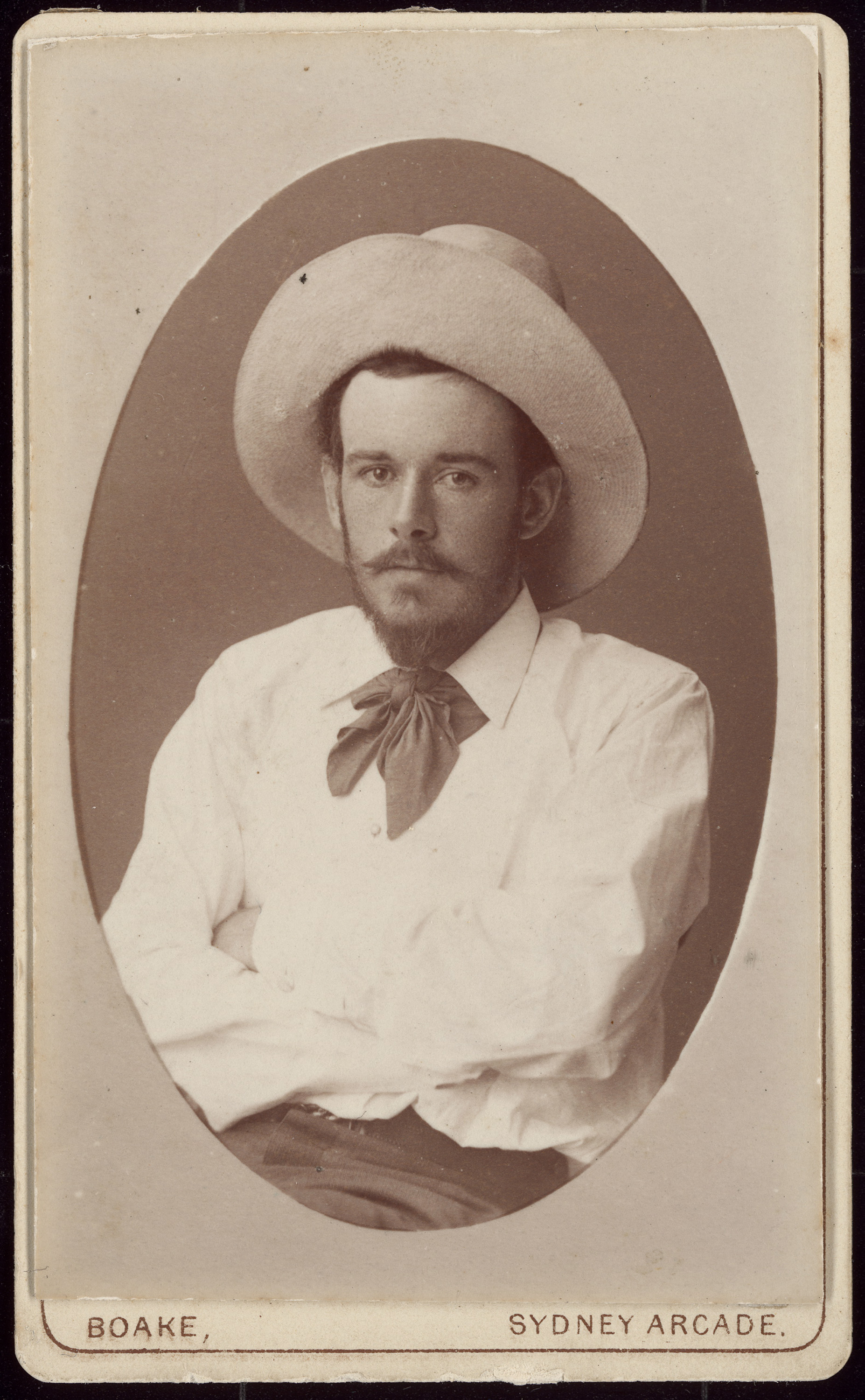
John Russell, c.1883
photographer: Barcroft Capel Boake
National Art Archive
Art Gallery of New South Wales Archive
260143 JPR v1.jpg
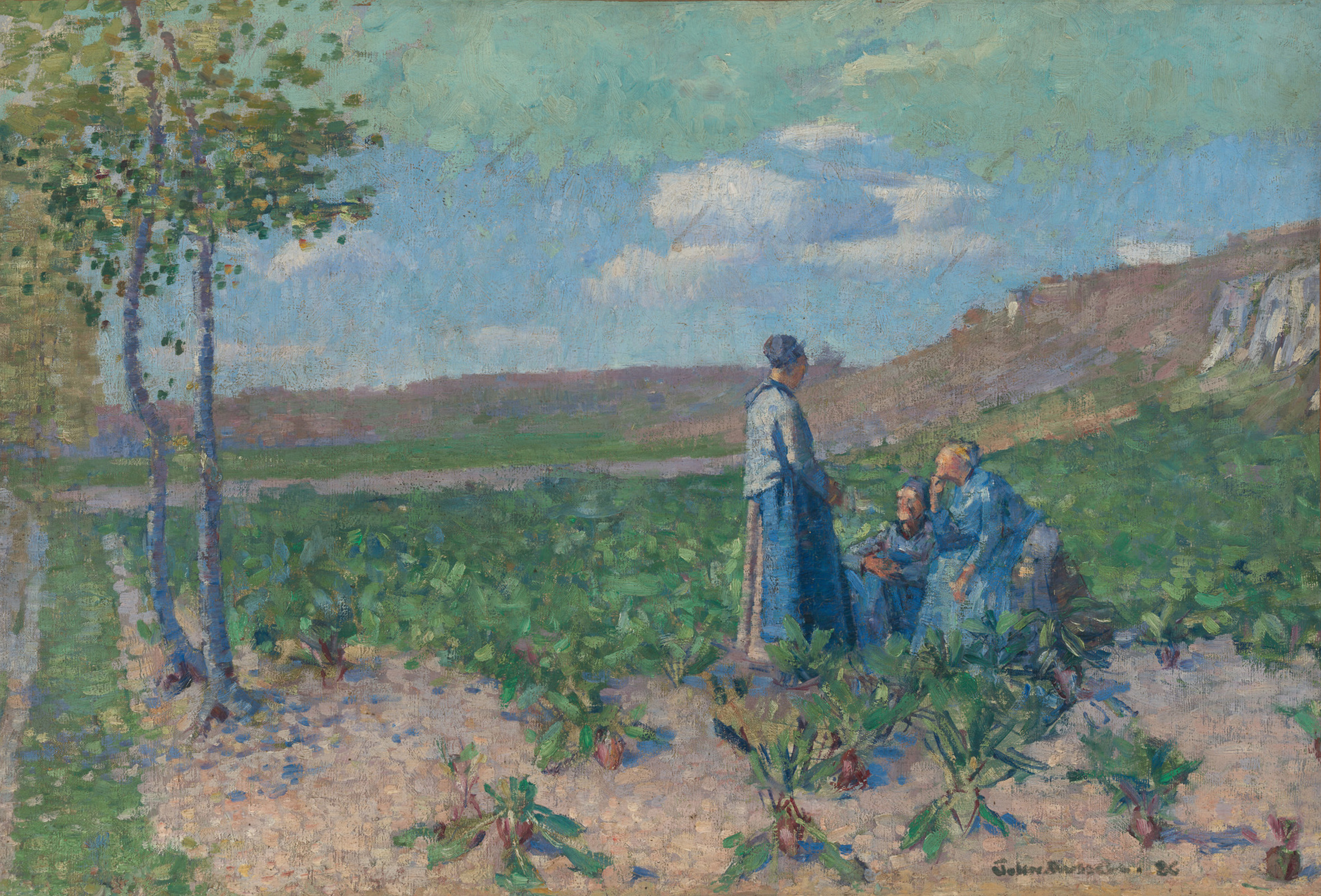
John Peter Russell
Peasant Women at Monte Cassino, 1886
oil on canvas
50.2 x 73.2 cm
National Gallery of Australia, Canberra
Soon after, Russell and Marianna went to Italy, visiting her family in Cassino and in spring of the following year, travelling to Sicily where they established a base in the hilltop town of Taormina. The influence of the encounter with Monet on Belle-Île was significant and, stimulated by the clarity of the Mediterranean light, almost immediately Russell began working in a new way, creating compositions made up of pure strokes of high-keyed colour and removing black from his palette altogether.8 The clean, bright colours of Peasant women at Monte Cassino, 1886 (National Gallery of Australia) reflect these changes in approach, but it is in later paintings made around the time of a second visit to Cassino in 1889, such as The terraces of Monte Cassino, c.1889 (private collection) and the current work, Meules de Blé à Monte Cassino, c.1889, which show increasingly bold colour choices. Monet’s brilliantly coloured paintings of Antibes, which Russell saw in Paris in 1888, also influenced his chromatic experimentation during these years, feeding into his development as a brilliant and often daring colourist. Writing to Tom Roberts, Russell’s excitement about the possibilities of colour (and specifically the subject-matter of Belle-Île) is palpable, ‘But when we get to color. The gorse & heather. Yellow & purple, orange boat sails, blue sea, red rocks, green sea. All a matter of feeling. Tis in the man with brush & paint pot or it is not.’9 John Peter Russell
260143 JPR (4).jpg
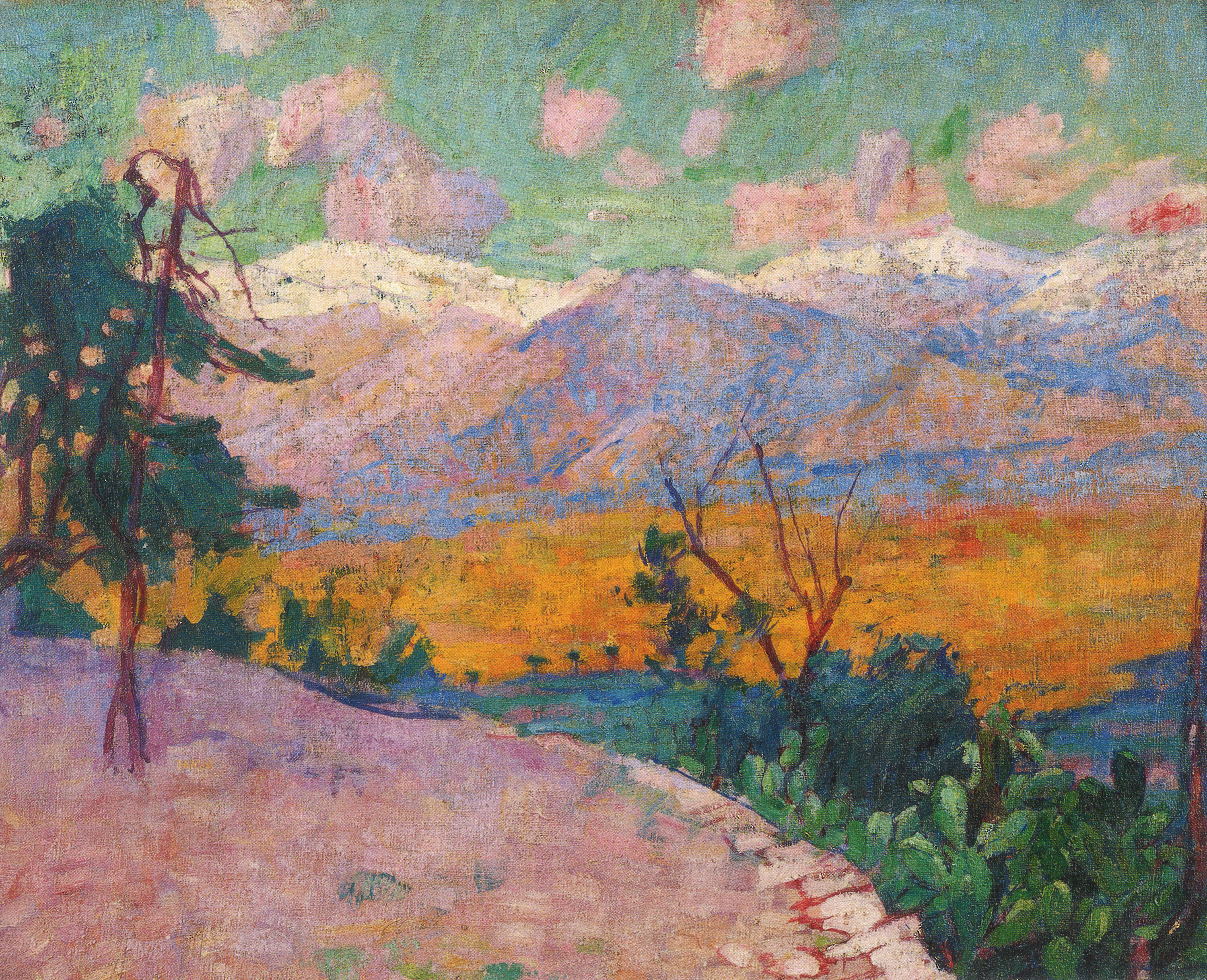
Les Terrasses de Monte Cassino, c.1889
oil on canvas
65.0 x 81.0 cm
Private collection, on loan to The National Gallery, London
Meules de Blé à Monte Cassino takes in a view of the distant mountains, purple and white beneath a band of blue sky, with green fields in the middle distance and in the foreground, a vernacular stone building and trio of dome-shaped haystacks that glow in dazzling shades of orange, yellow and red. Deep purple shadows contrast with the shimmering golden hues of the central haystack, suggesting late afternoon and adding emphasis to the labouring lone figure. Such subject matter reflects the prevailing influence of Barbizon School painter Jean-François Millet (1814 – 75), whose paintings celebrated the nobility of peasant workers and a growing recognition at the end of the nineteenth century that this way of life was disappearing. This romantic notion of rural life was popular among contemporary artists and in addition to featuring in their imagery, was reflected in the choice that some made to live outside of the city centres.10 With the aim of establishing ‘a studio of the south’, Van Gogh moved to Arles in the south of France in early 1888, where harvest scenes became a familiar part of his subject matter. Indeed, one of the twelve ink drawings that he gave to Russell in 1888 – and one which Russell later gave to Matisse when he visited Belle-Île11 – describes a pair of haystacks similar to those depicted in Meules de Blé à Monte Cassino. Writing to Russell in the summer of 1888, Van Gogh said, ‘For ever so long I have been wanting to write to you – but then the work has so taken me up. We have harvest time here at present and I am always in the fields… Am working at a Sower. The great field all violet, the sky and sun very yellow.’12
260143 JPR (2).jpg
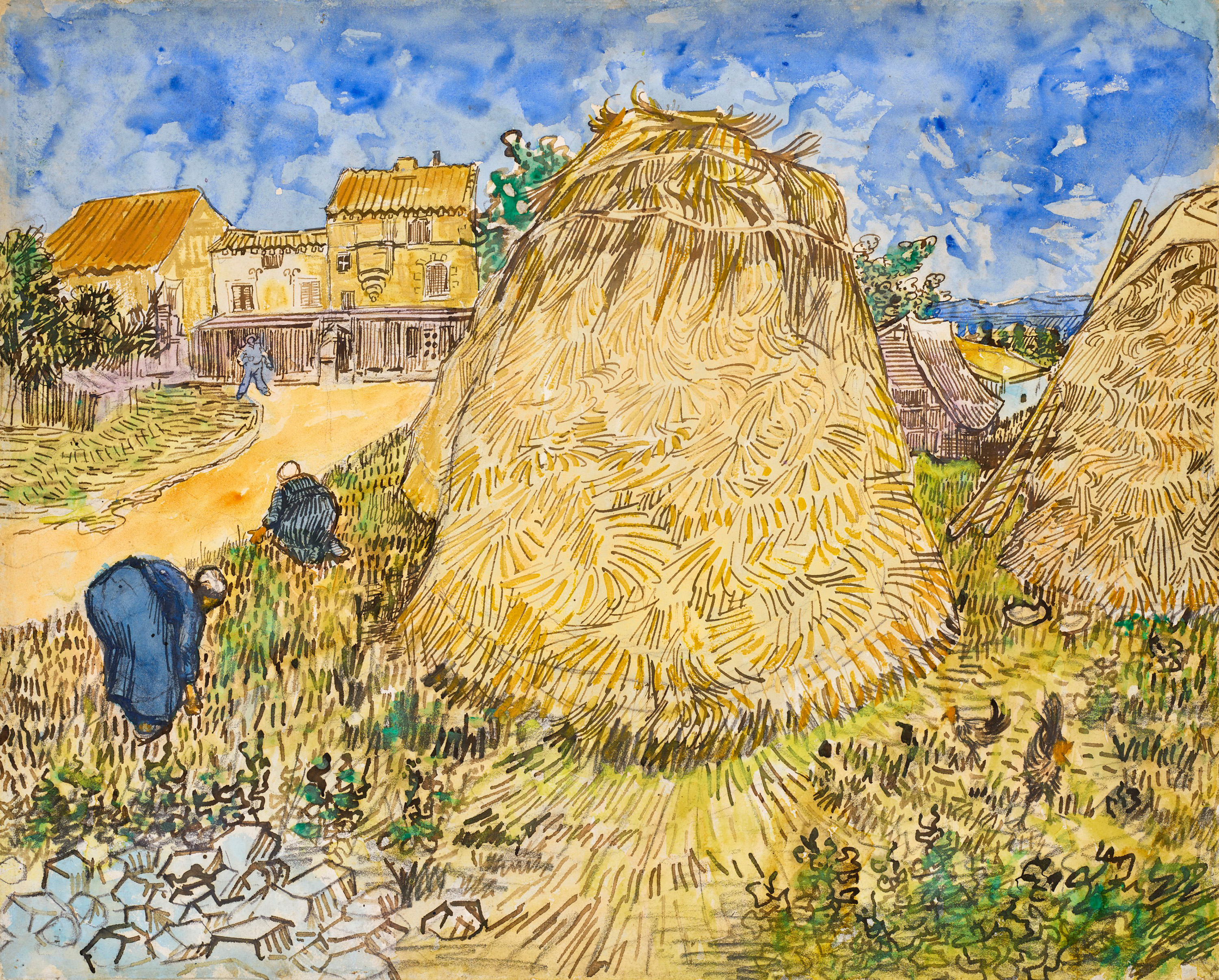
Vincent Van Gogh
Meules de blé, 1888
gouache, watercolor, pen and brush and
black ink over pencil on paper, 48.5 x 60.4 cm
Private collection
Sold Christie’s, New York, 11 November 2021,
for USD 35,855,000 (inc. BP)
260143 JPR-topaz-upscale-2x.jpg
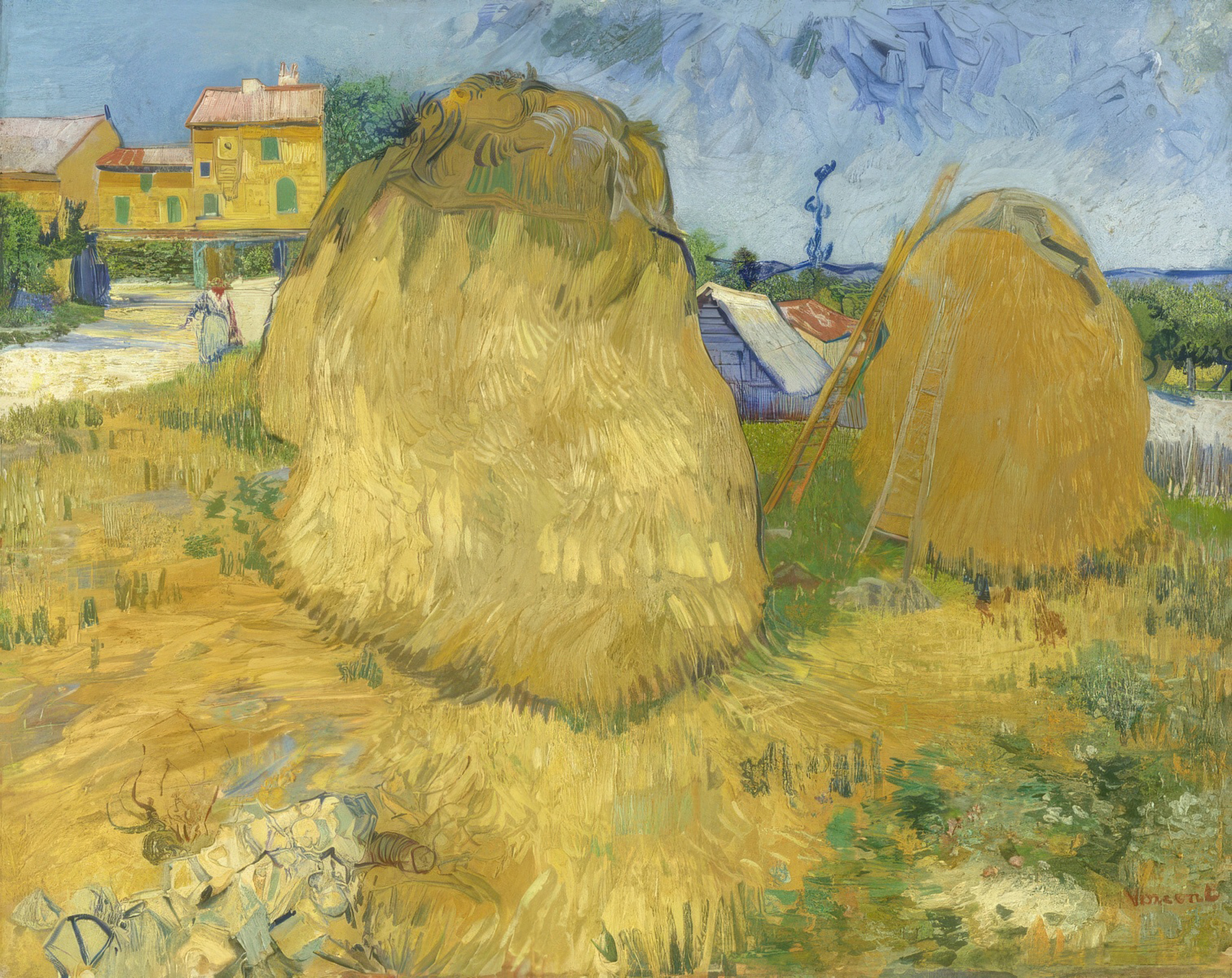
Vincent Van Gogh
Haystacks in Provence, 1888
oil on canvas
73.5 x 93 cm
Kröller-Müller Museum, Otterlo, Netherlands
The work of Paul Gauguin, who joined Van Gogh in Arles for two months in late 1888, also featured similar subjects and his painting, Yellow Haystacks (Golden Harvest), 1889 (Musée d’Orsay, Paris) celebrates local agricultural workers in a vibrant and bucolic rural scene. It was, however, Monet who made the subject most famous in his renowned series of haystack paintings created between 1890 – 91. Towering stacks of hay in the field adjacent to his house at Giverny inspired the series of thirty or so canvases which he developed en plein air, moving between several easels at a time, as well as in the studio. It was the first series in which Monet focussed on a single subject, revisiting it at different times of the day and in different seasons, under varied weather and light conditions, his primary motivation being to record the full scope of chromatic and atmospheric effects. ‘For me a landscape hardly exists at all as a landscape, because its appearance is constantly changing; but it lives by virtue of its surroundings, the air and the light which vary continually.’13
260143 JPR 1985.1103 - Stacks of Wheat (End of Summer).jpg
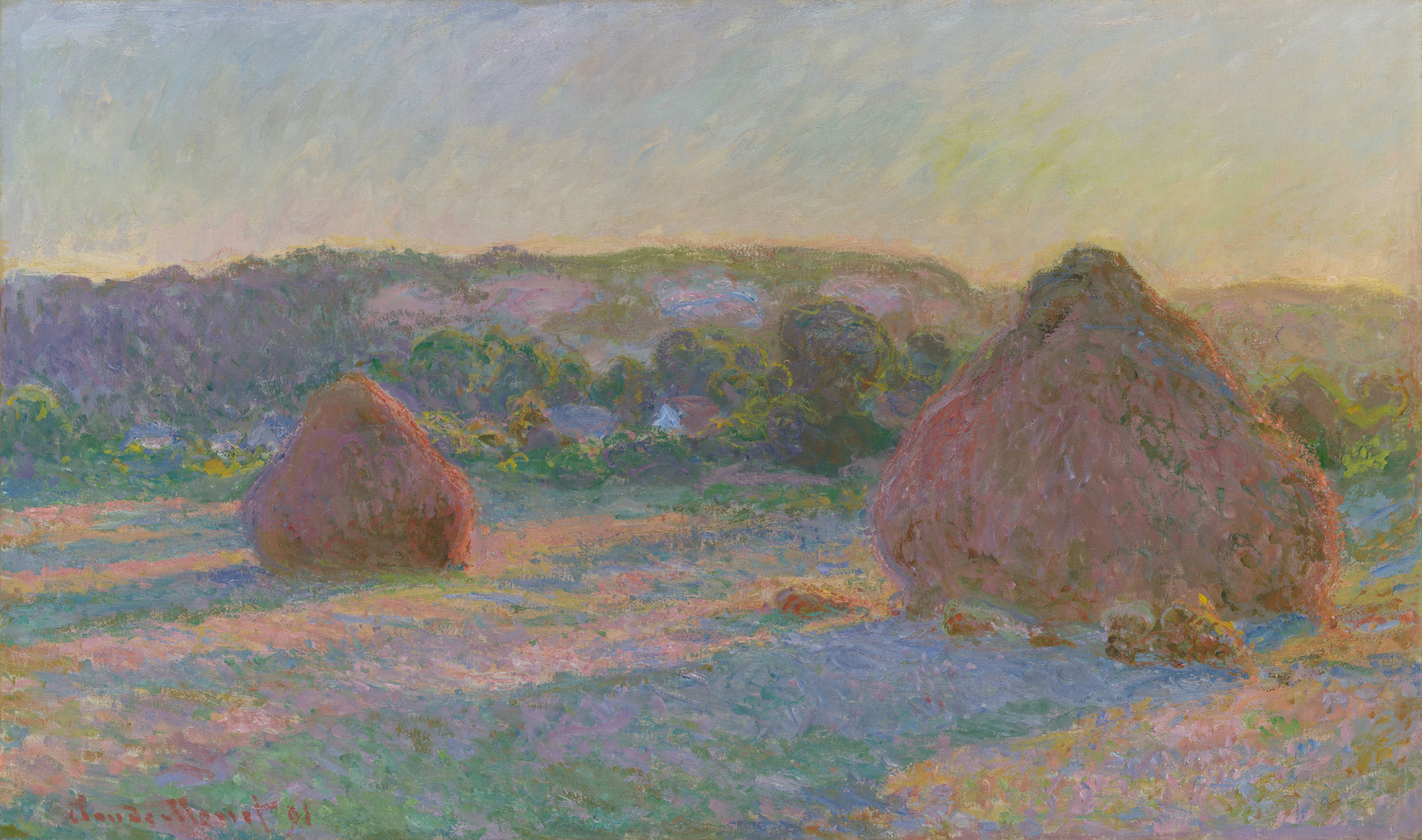
Claude Monet
Stacks of Wheat (End of Summer), 1890 – 91
oil on canvas
60.0 x 100.5 cm
Art Institute of Chicago, Chicago
260143 JPR (3)-topaz-upscale-4x.jpg
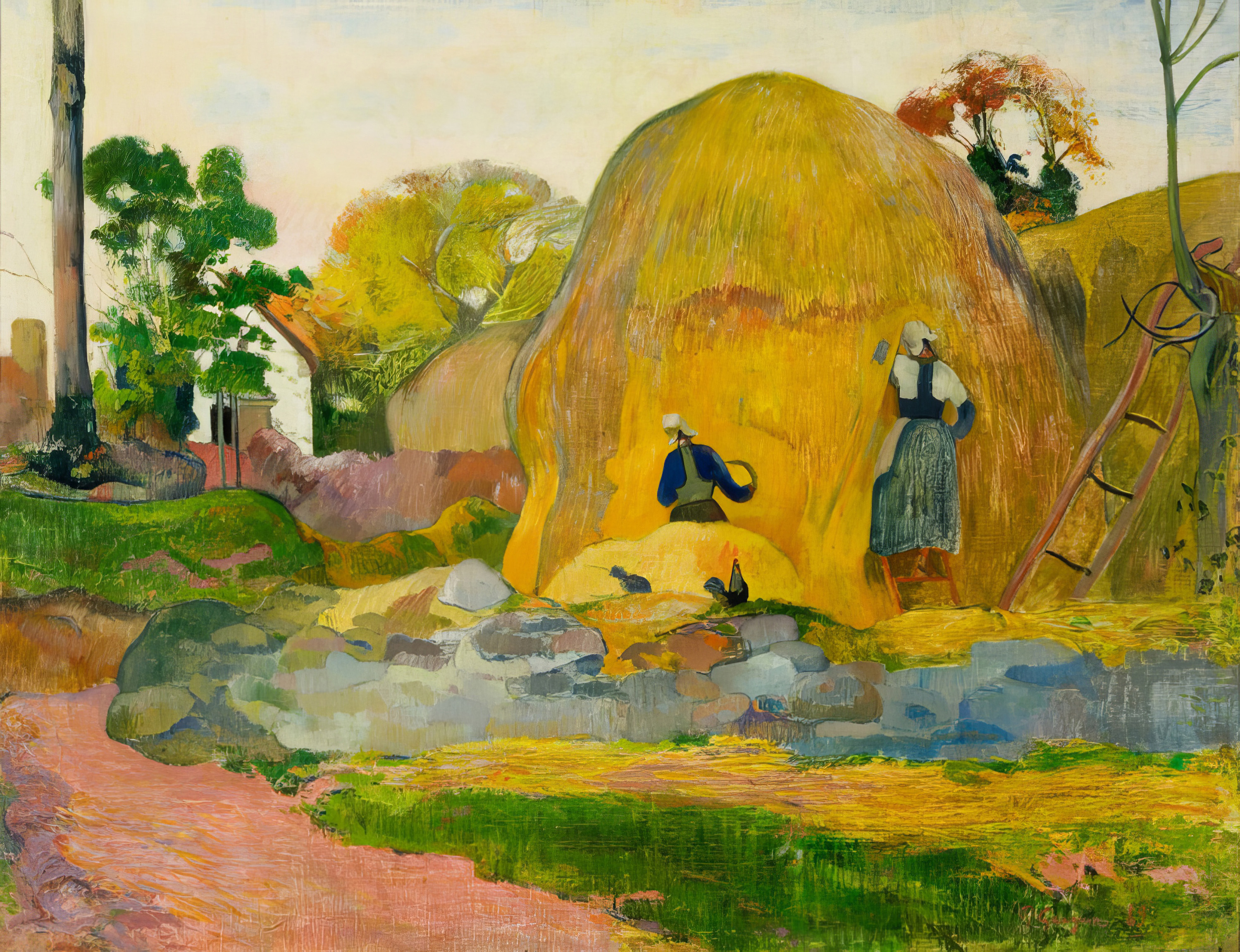
Paul Gauguin
Les Meules jaunes, 1889
oil on canvas
73.0 x 92.5 cm
Musée d’Orsay, Paris
1. Although Russell did not see van Gogh again after he departed for Arles in the south of France in early 1888, their friendship continued via correspondence. See Galbally, A., A remarkable Friendship: Vincent van Gogh and John Peter Russell, The Miegunyah Press, Carlton, 2008.
2. Taylor, E., ‘John Russell and friends: Roberts, Monet, van Gogh, Matisse, Rodin’, Australian Impressionists in France, National Gallery of Victoria, Melbourne, 2013, p. 56
3. See Onfray, G., translated by Lucie Reeves-Smith, ‘The most Breton of foreign painters of the era’, John-Peter Russell, Un impressionniste australien, Musée des Jacobins, Morlaix, 1997, pp. 8 – 9; Galbally, A., The Art of John Peter Russell, Sun Books, Melbourne, 1977, p. 28; and Tunnicliffe, W., (ed.), John Russell: Australia’s French Impressionist, Art Gallery of New South Wales, Sydney, 2018, p. 26
4. Galbally, ibid., pp. 28-29
5. John Peter Russell to Auguste Rodin, 17 October 1888, cited in Dunn, J., ‘An enduring regard: Russell and Auguste Rodin’ in Tunnicliffe, op. cit., p. 123
6. See Dunn, ibid., pp. 122 – 125
7. John Peter Russell to Tom Roberts, 5 October 1887, cited in Tunnicliffe, op. cit., p. 193
8. See Taylor, op. cit., p. 60
9. ibid., p. 195
10. See Galbally, 1977, op. cit., p. 45 – 49
11. See Spurling, H., ‘Henri Matisse on Belle-Île’ in Tunnicliffe, op. cit., pp. 130 – 137
12. Vincent Van Gogh to John Peter Russell, cited in Tunnicliffe, ibid., pp. 204 – 205
13. Claude Monet, cited in Getty Museum Collection database, entry for Wheatstacks, Snow Effect, Morning (Meules, Effet de Neige, Le Matin), 1891 at: https://www.getty.edu/art/collection/object/103RK8 (accessed 30 March 2026)
KIRSTY GRANT