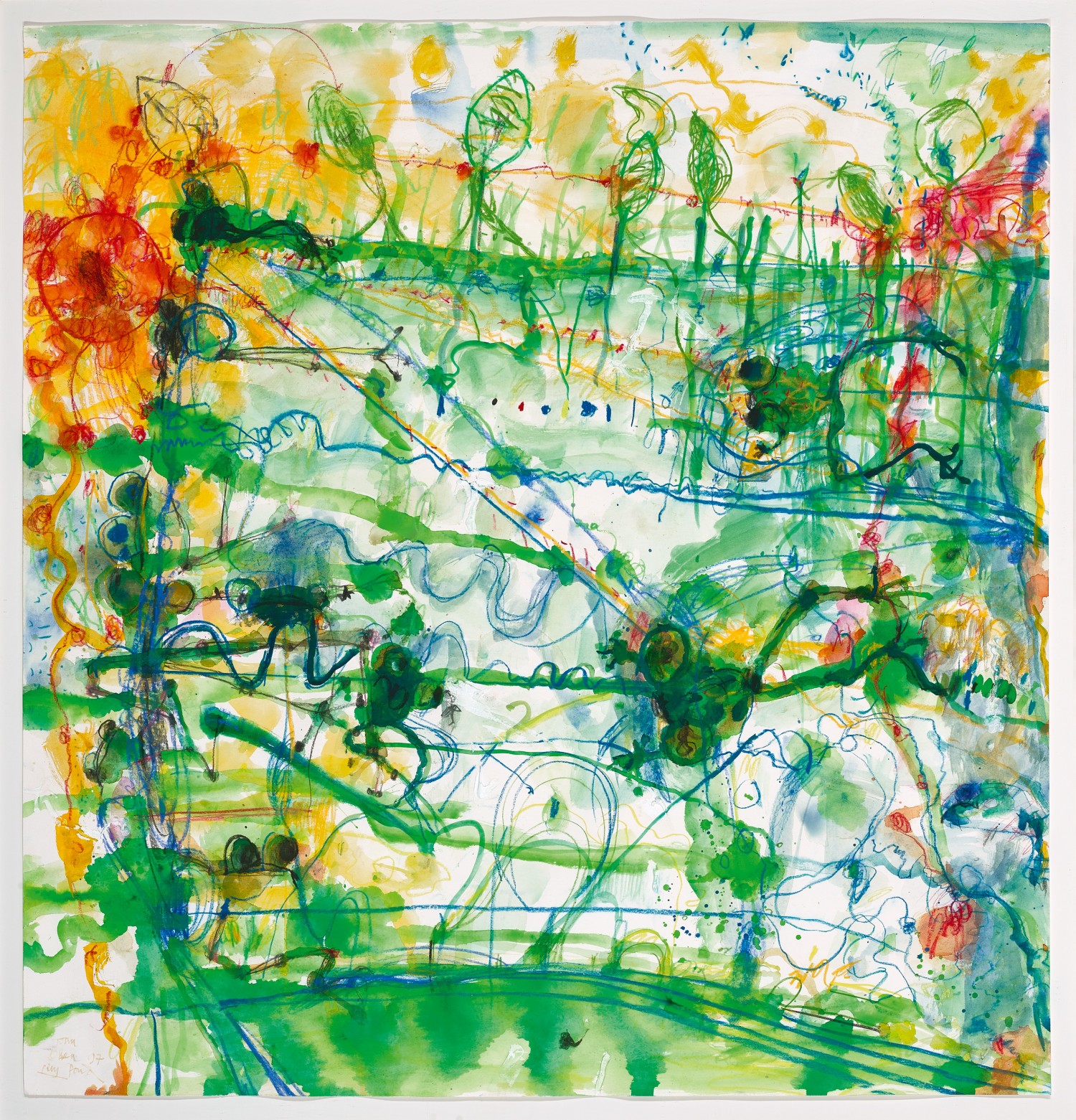
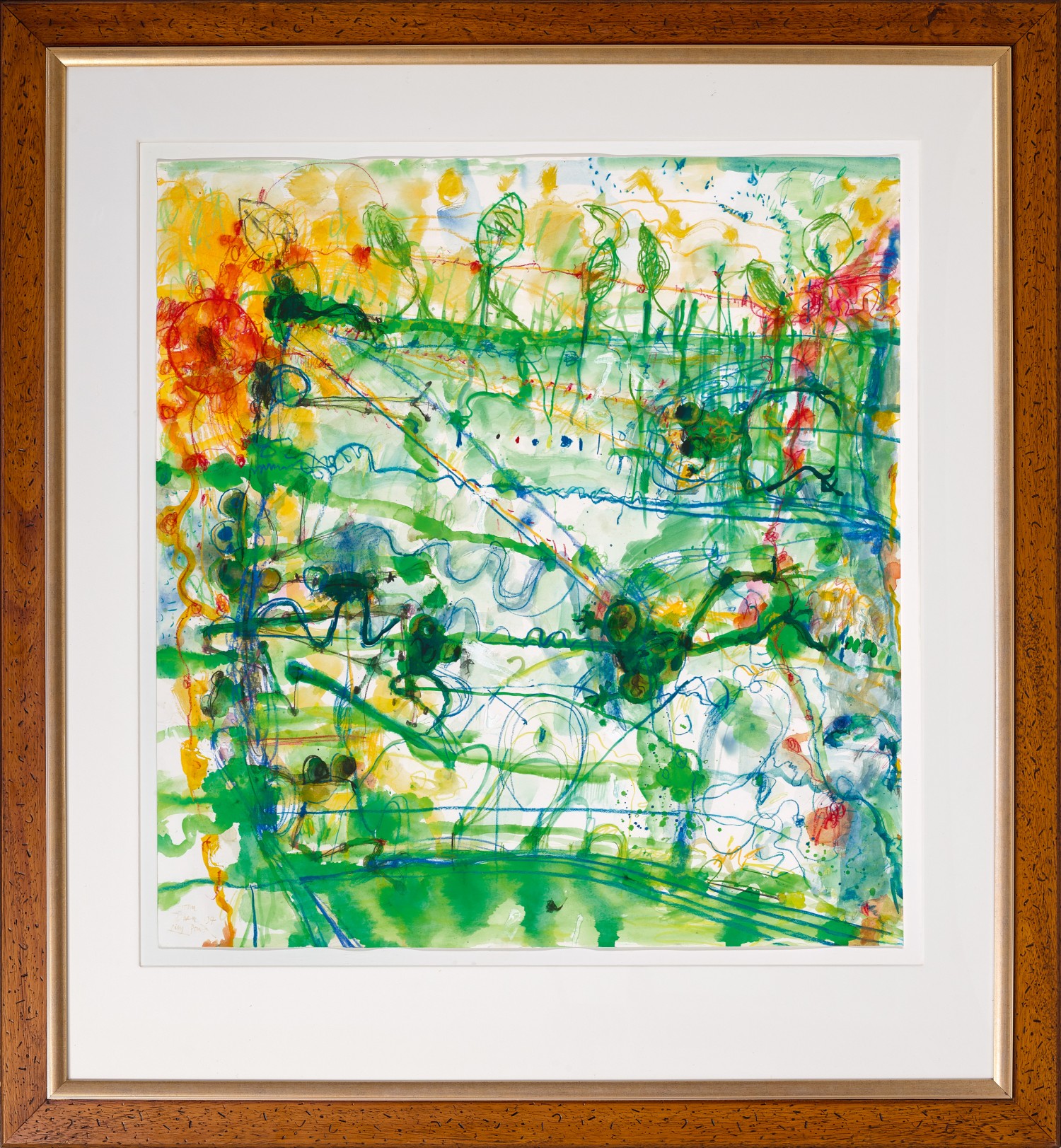
Morning sun and lily pond, 1997
John Olsen
watercolour, gouache and pastel on paper
100.0 x 95.0 cm
signed, dated and inscribed with title lower left: John / Olsen 97 / Lily Pond
signed, dated, titled and inscribed with title verso: Morning Sun & Lily Pond / John Olsen 97 / Southbank Gallery
Australian Art Resources, Melbourne (inscribed verso)
Private collection, Melbourne
Deutscher and Hackett, Melbourne, 31 August 2011, lot 21
Private collection, Melbourne
‘The urge for life is a staggering thing and we just ought to take notice… There is such fecundity in this universe called a lily pond.’1
With his distinctive meandering line, exuberant mark-making and masterful command of colour, John Olsen is widely revered as one of the most significant figures of a generation that reshaped Australia’s perception of its natural environment. Across a career spanning more than seven decades, he sustained an unerring fascination with the natural world in all its myriad forms, producing evocative visions of the landscape that arguably captured the spirit and character of the country more eloquently than any other non-Indigenous artist before him. Self-described as a ‘wandering minstrel’2, Olsen travelled extensively throughout Australia and beyond, absorbing each terrain with poetic attentiveness; yet it was the extraordinary fecundity of the continent’s fertile waterways – its teeming wetlands, estuaries and lily ponds – that would emerge as his most enduring muse.
Olsen’s first sustained encounter with the Australian interior occurred in the early 1970s, when he was invited by filmmakers Ken Duncan and Robert Raymond, together with esteemed naturalist Vince Serventy, to participate in the ‘Wild Australia’ film series commissioned by the Australian Broadcasting Commission. Immediately awestruck by the incredible diversity of ecosystems he encountered during the journey, Olsen thus began his lifelong fascination with observing and painting not only individual species, but a sense of the whole, pulsating mass – ‘a carnival of life’. Indeed, Olsen’s sheer wonderment at the miracle of mother nature and her life-affirming properties reached its apogee in 1974 upon travelling to Lake Eyre where he witnessed the arid, salt-encrusted plains of the South Australian desert erupt into abundance following the extraordinary floods of 1973 (only the second such occurrence since white settlement): ‘… I draw studies of insects, animals and birds that will eventually be realised as prints and watercolours. My devotion to Chinese art and philosophy finds a fulfilment in this experience. Nothing too small or too strange should escape my attention – an insect’s wing, the leap of a frog, the flight pattern of dragonflies. They all induce poetic rapture.’3 Equally too, Olsen became acutely aware of the vast cycle of death that ensued when the water receded – thus reiterating his Taoist belief in the total interconnectedness of all living forms and heralding a new spirituality in his art.
Over the ensuing decades, repeated visits to Lake Eyre and North Queensland would provide the impetus for some of Olsen’s most lyrical meditations on this fertile universe. Encouraging contemplation of the relationship between the tiny and the vast, the microcosm and the macrocosm, Morning sun and lily pond, 1997 is one such enchanting example from his mature period of watercolours on this theme. Now confronted with the realities of old age, significantly Olsen does not abandon hope in the redemptive, life-enhancing possibilities of nature; to the contrary, he embraces the principle of ecological integration and its capacity to enliven the spirit. As he had poignantly mused earlier that decade, ‘A search for completeness and ecstasy so lacking in our time. Probably will fail… Examination of different frogs, some sleek and streamlined with delicate fingers. Tiny tree frogs that hang from wet leaves, green on top and yellow underbelly, with spongy pads on feet and hands.’4 A luminous work teeming with his emblematic amphibians – sleek, streamlined or delicately suspended mid-leap – thus Olsen here captures with joyous abandon the fleeting instant when morning sunlight breaks after rain, evoking both the jewel-like richness and the exquisite fragility of this watery world he so revered.
1. John Olsen, cited in Hart, D., John Olsen, Craftsman House, Sydney, 1991, p. 123
2. John Olsen, cited ibid., p. 125
3. John Olsen, cited in Olsen, J., Drawn from Life, Duffy and Snellgrove, Sydney, 1997, p. 116
4. John Olsen cited ibid., pp. 307 – 08
VERONICA ANGELATOS