Sunflowers, 2000
John Perceval
oil on canvas
101.5 x 81.0 cm
signed lower right: Perceval
signed, dated and inscribed verso: flowers / Perceval / 00
Private collection
Savill Galleries, Sydney
Private collection, USA, acquired from the above
In the mid-1980s, John Perceval experienced a certain renaissance as a painter after an extended period of ill health. An exhibition in 1986 of drawings created during his convalescence generated much media attention and portrayed the ageing artist in the romantic stereotype of the troubled artist, ‘echoing myths of Van Gogh.’1 The subsequent paintings produced during Perceval’s twilight years were vibrant and high-keyed, their naive quality signalling a return to the artist’s earliest beginnings and the joie de vivre that had characterised his landscape paintings throughout the 1950s and 1960s.
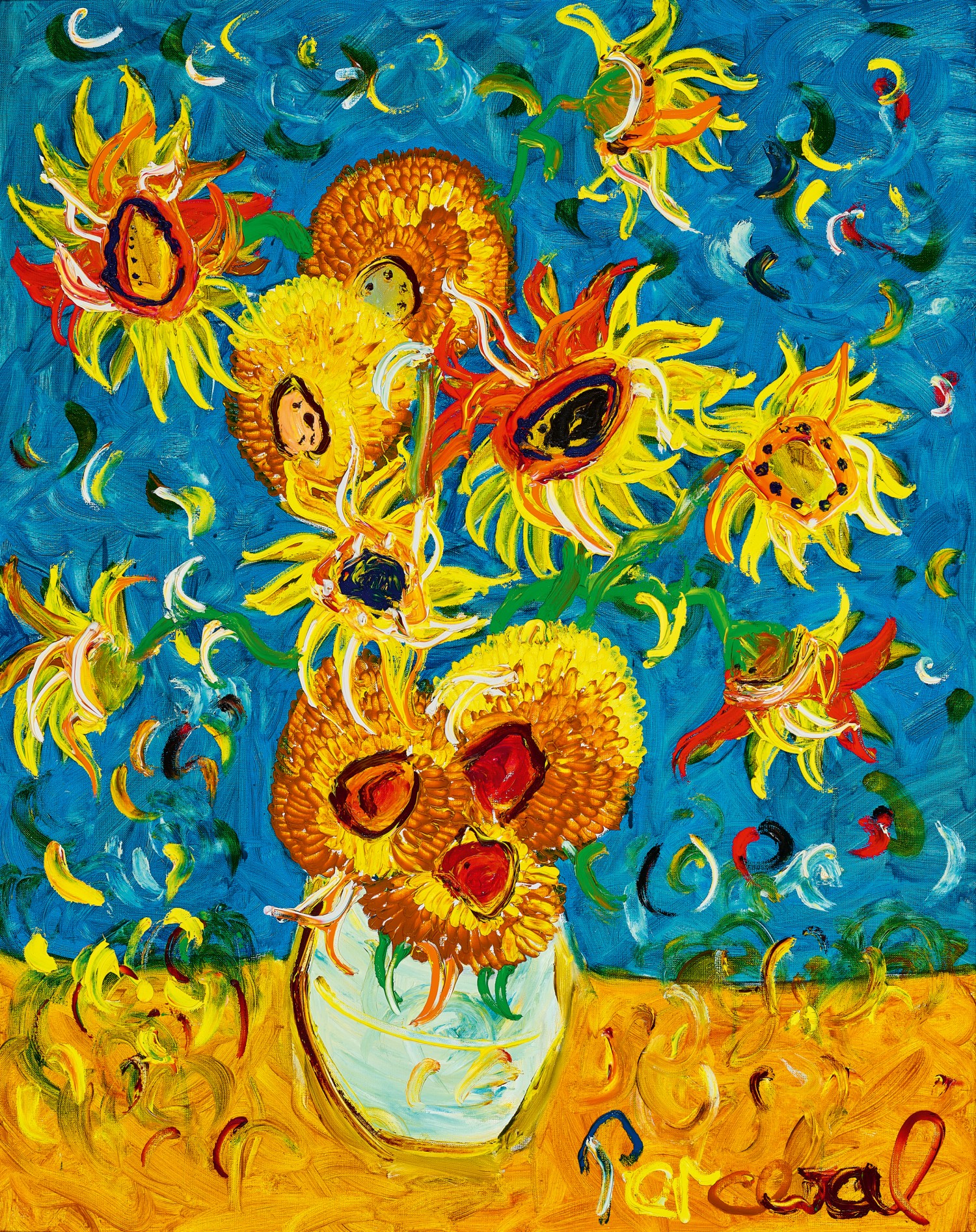
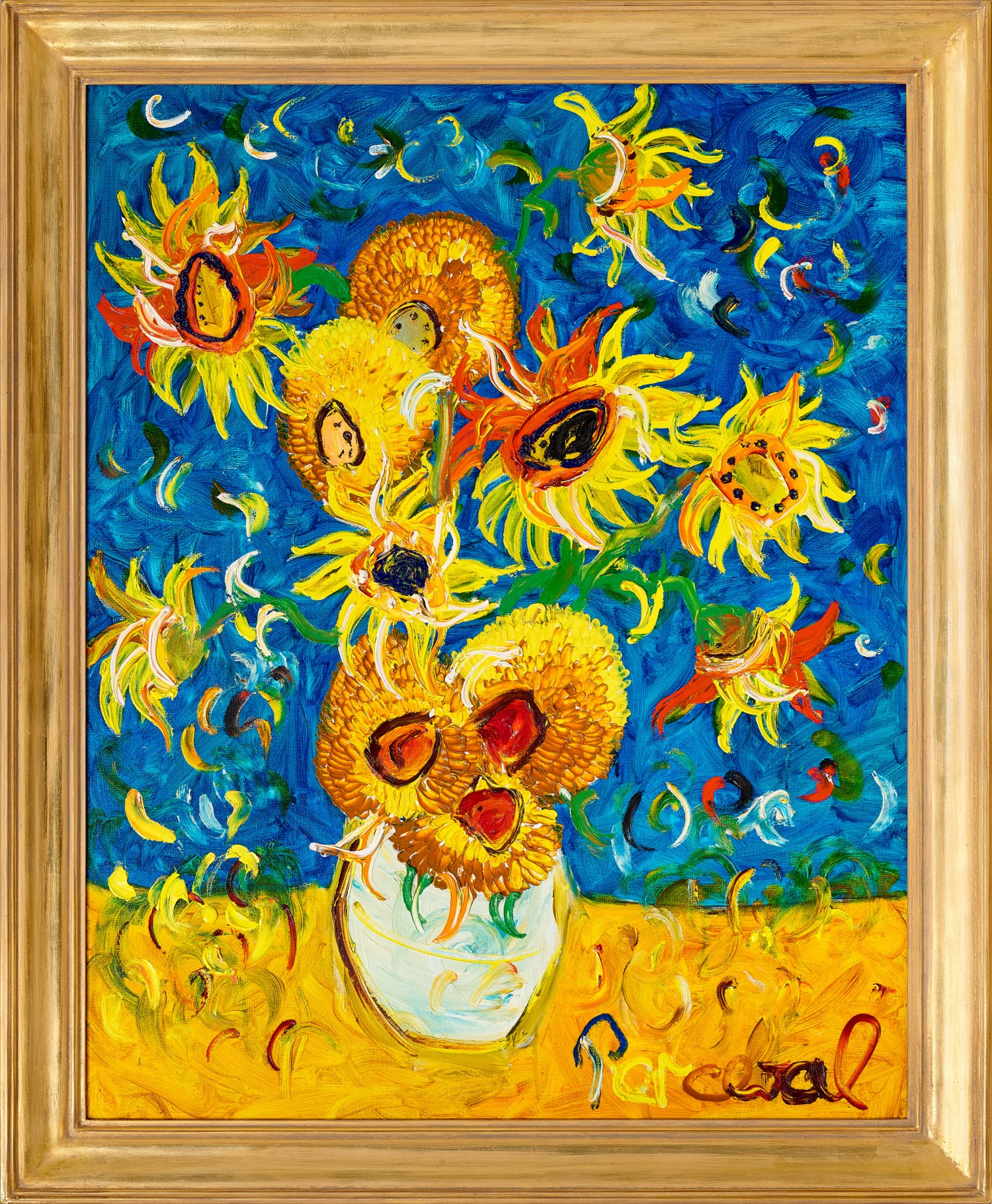
Sunflowers, 2000 was painted during the last year of Perceval’s storied life, rendering its ebullient expression all the more poignant. One of many still life compositions of these sunny blooms that proliferated in the artist’s later paintings, Sunflowers is a resolved and emphatic counterpoint to (Van Gogh) Sunflowers, c.1935 (private collection), recorded in Traudi Allen’s catalogue raisonné as Perceval’s first painting in oils, completed at the tender age of 13. An almost perfect copy of Vincent Van Gogh’s Sunflowers, 1888 held in the Neue Pinakothek, Munich, Perceval’s early painting emulated the celebrated post impressionist’s distinct and textured brushstrokes in the honoured tradition of self-education, exhibiting a precocious understanding of the artist’s handling of materials, colour and technique. Painted some sixty years later, Sunflowers, 2000, likewise loosely refers to the famous still life composition, featuring the same bisection of the canvas with a yellow table against a blue background, a bulbous, two-toned ceramic vase and a floral arrangement of two kinds of sunflowers – single-petaled and pompom, fully double blooms. The disposition of flowers within the vase no longer exactly corresponds to Van Gogh’s painting, but is instead an exuberant recollection, painted with joyful abandon.
Perceval’s high-keyed palette, applied with a brush loaded with unmixed colour or in calligraphic coils straight from the tube, creates a radiant composition, swirling with energy. The artist’s emulation of plein-air impressionist techniques throughout the 1960s gave him an understanding of spontaneous and immediate painting before the subject, applying his brushstrokes authoritatively, and without revision. Leading Robert Hughes to accuse Perceval’s art of being ‘roly-poly’, the vigorous and loose gestural quality of Perceval’s brushwork became his hallmark, particularly later in life.2 Here, far removed from Van Gogh’s crisp and static composition, Perceval’s idiosyncratic touch brings a life force, making the petals of the titular sunflowers tremble, as if fluttering away in a strong breeze.
1. Reid, B., Of Light and Dark: the art of John Perceval, National Gallery of Victoria, Melbourne, 1992, p. 37
2. Hughes, R., ‘Irrational Imagery in Australian Painting’, Art and Australia, Ure Smith, Sydney, vol. 1, no. 3, 1963, p. 157
LUCIE REEVES-SMITH