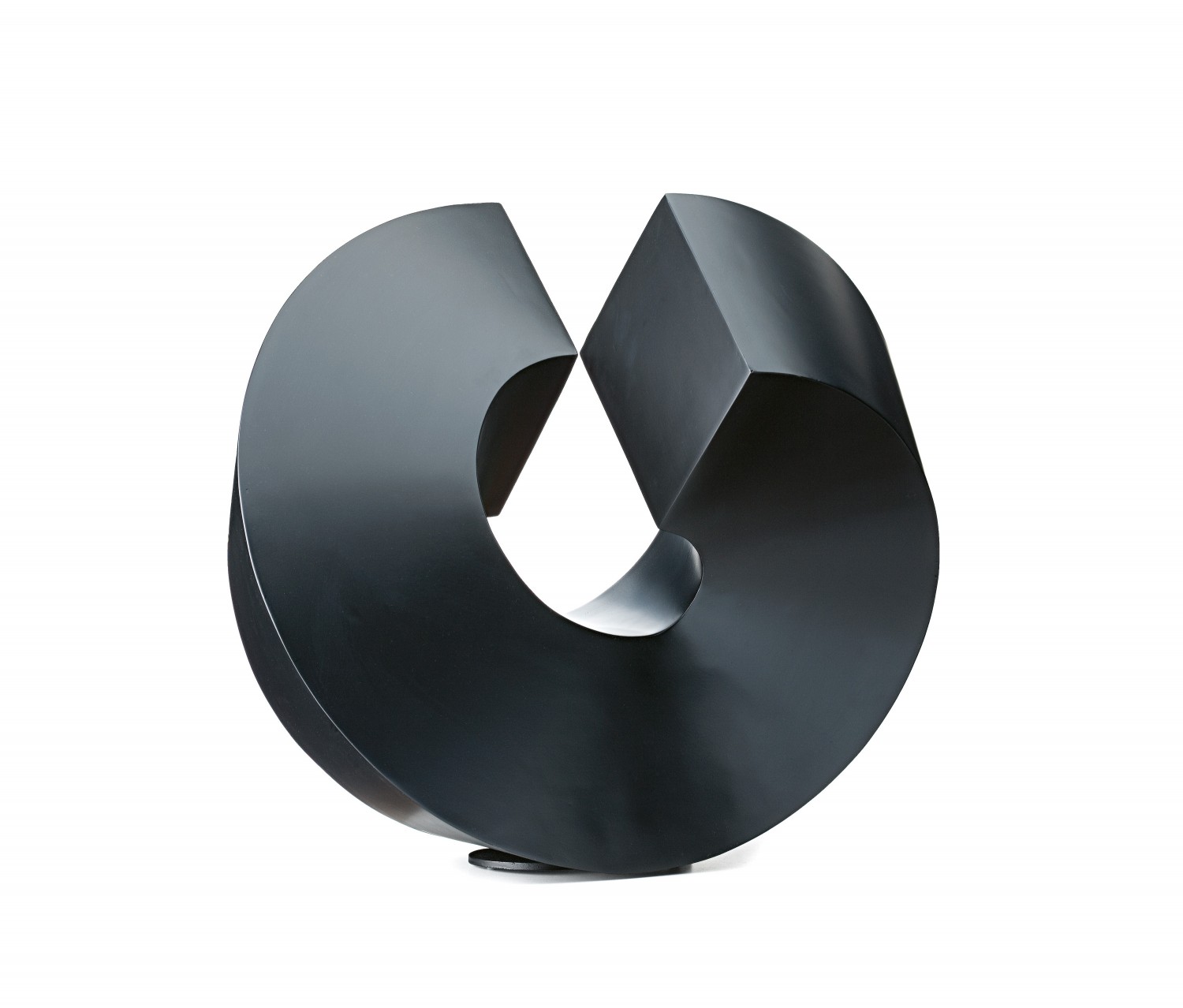
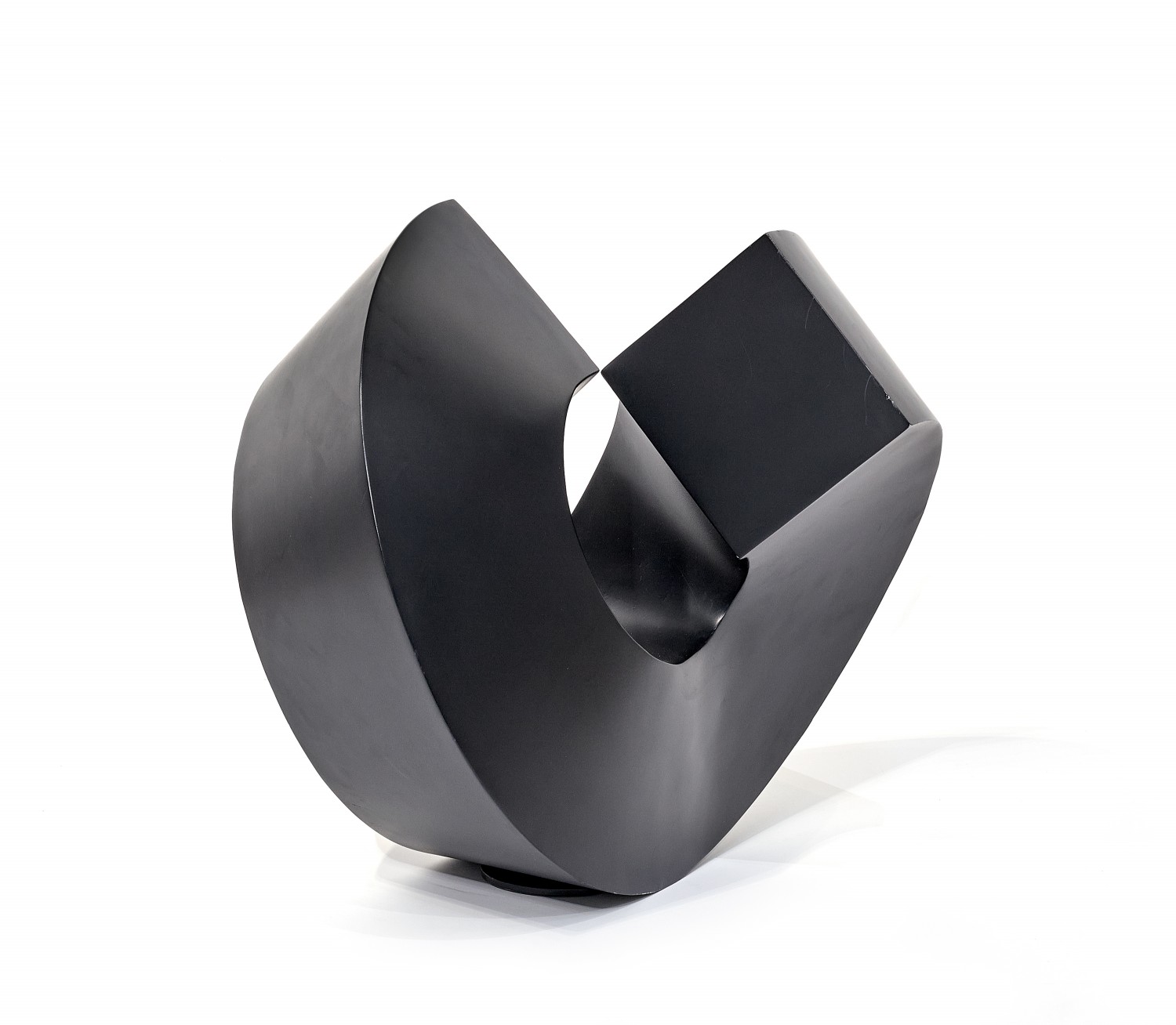
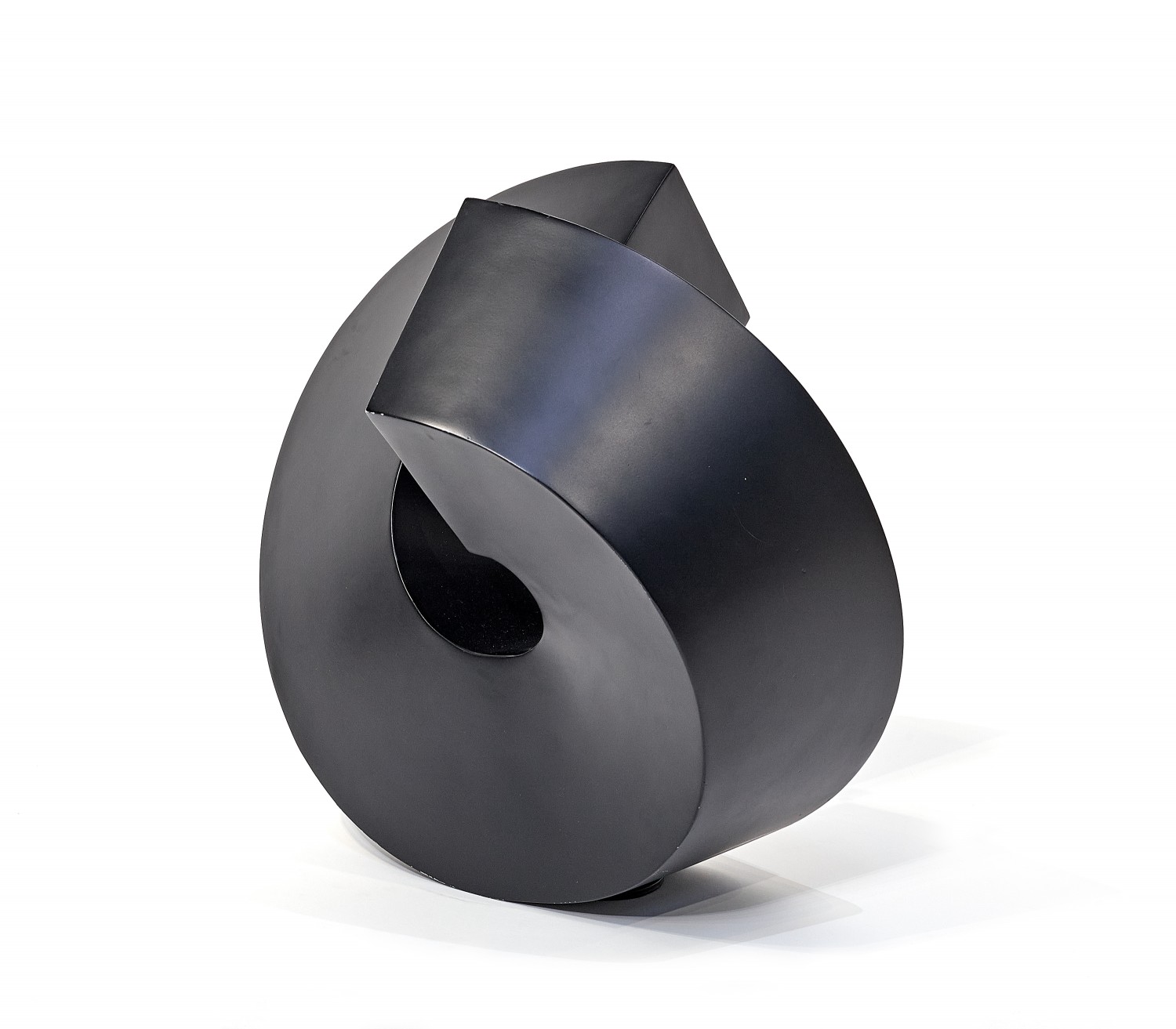
Split ring, 1968
Clement Meadmore
painted aluminium
58.0 cm (height)
signed, dated and numbered on base: Meadmore / 2/6 1968
Lillian Heidenberg Fine Art, New York, acquired directly from the artist
Private collection, Melbourne
Deutscher and Hackett, Melbourne, 16 April 2008, lot 4
Private collection, Sydney
‘I am interested in geometry as a grammar which, if understood, can be used with great flexibility and expressiveness.’1
One of the most highly regarded and internationally acclaimed Australian artists of his generation, Clement Meadmore remains revered for thoughtful, impeccably executed sculptures that unify pure stark geometry with expressive gesture. Invariably constructed from one single square-sectioned beam that has been bent and coiled to achieve his artistic aim, indeed Meadmore’s masterful constructions evince a seemingly implausible sense of dynamism and musical rhythm that belies their unyielding medium. Whether monumental outdoor commissions or smaller scale domestic maquettes, Meadmore’s forms typically twist, turn and writhe – their suggested animation thus adding a humanising balance to the all-too-often bland immobility and visual harshness of our modern built environments. As Gibson astutely observes, the opposition between line and mass lies at the very core of Meadmore’s sculptures: ‘…in their form they suggest the rapid motion through space of a limb or body… or the residue of such motion. They have more in common with purely aesthetic things such as a drawn line, than with a recognisable object existing in the world even though, by virtue of their sheer physical bulk and size and scale, they are undeniably that…’2
Closely related to the artist’s iconic Janus, 1968 – created the same year as a commission for the ‘Ruta de la Amistad’ (Route of Friendship) to commemorate the 1968 Olympic Games in Mexico City – the present maquette offers a superb example of Meadmore’s sculptures from 1967 to 1969 in which the general configuration recalls, in whole or in part, a circle or nascent coil. Subsequently realised on a monumental scale in multiple versions – including one now installed at the Portland Art Museum, Oregon – indeed Split ring encapsulates well the possibilities offered by this new torsional module. As Gibson elucidates,
‘…Meadmore made volumes turn and move through space in ways that were freer, more emphatic, and more expressive in character than previously. In the process, his sculpture became richer in feeling and more ambitious in outlook… Now, the combined actions of rotating the volume so that it was a horizontal, extending it and introducing more complexity all resulted in fully abstract sculpture in which the sculptural volume functioned in the manner of a line moving through space. Mass was transformed into line, and line into signified direction, an impulse of movement.’3
In this new work, thus Meadmore simultaneously contradicts and extends this Constructivist idea of ‘drawing in space’: ‘…contradicts it, because his ‘drawing’ retains, indeed is constituted by the mass characteristic of premodern sculpture, and extends it, because he sets that line in motion – imparting to it something of the velocity of a drawn line – yet without resort to kinetics or technological tricks. Meadmore’s sculptures displace, occupy space as much as had his Minimalist pieces... Yet at the same time, they begin to move through space in a variety of ways, freely and gracefully...’4
1. Clement Meadmore cited at: https://emuseum.toledomuseum.org/people/749/clement-meadmore/objects (accessed March 2026)
2. Gibson, E., The Sculpture of Clement Meadmore, Hudson Hills Press, New York, 1994, p. 52
3. ibid., p. 37
4. ibid.
VERONICA ANGELATOS