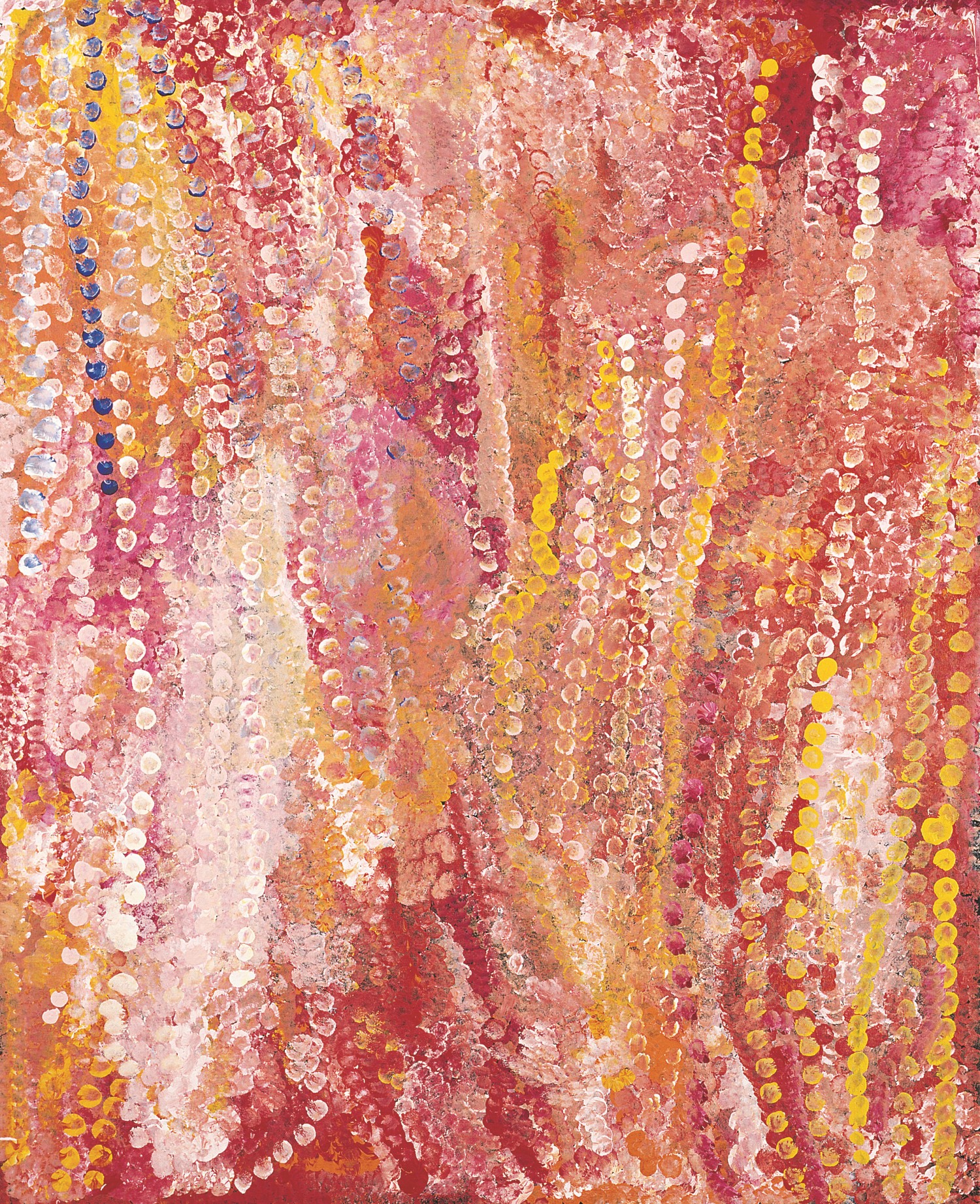
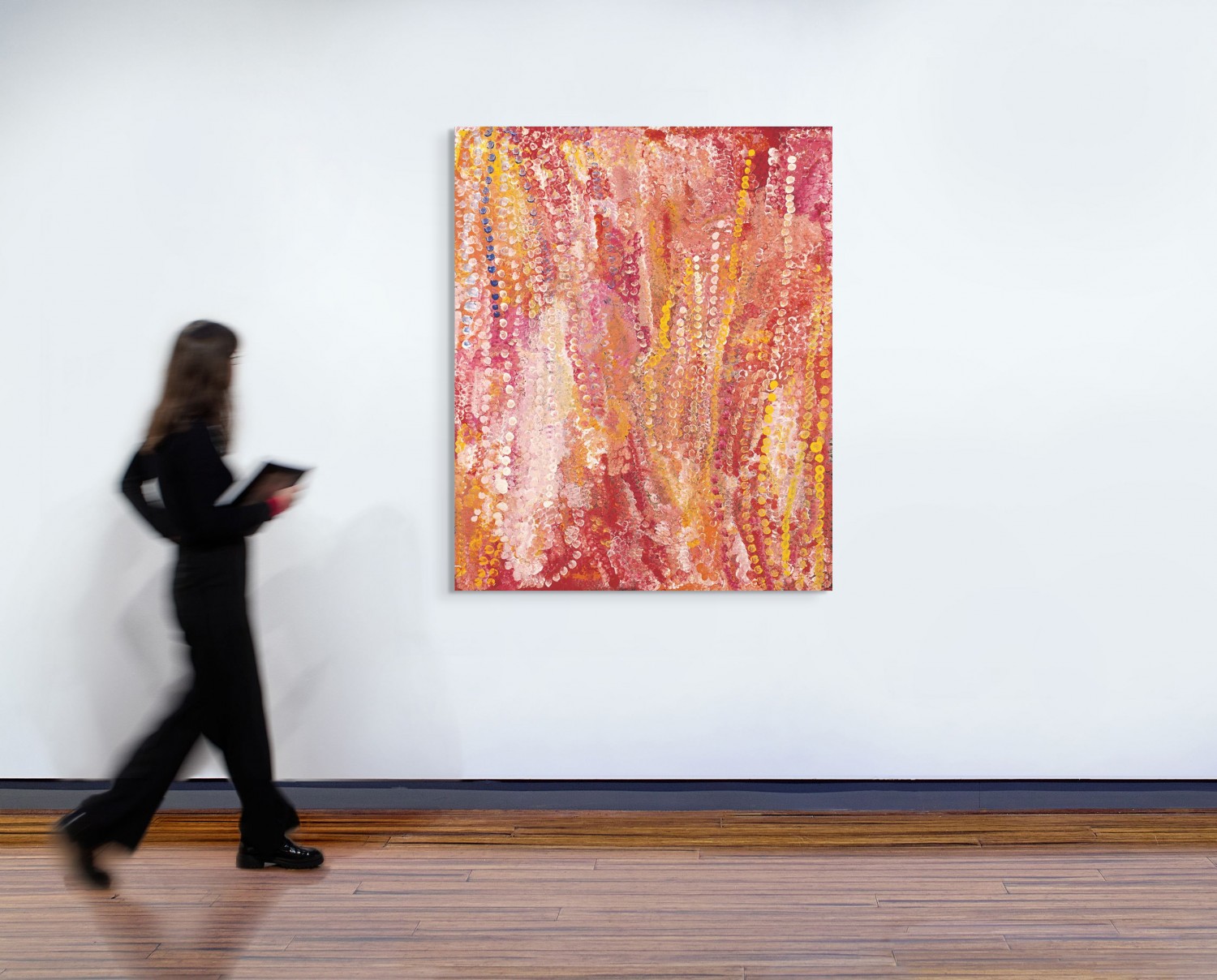
Untitled (Alalgura landscape/Yam flowers), 1995
Emily Kam Kngwarreye
synthetic polymer paint on canvas
151.0 x 121.0 cm
bears inscription verso: artist’s name and Delmore Gallery cat. 95K036
Commissioned by Delmore Gallery, Alice Springs, Northern Territory
Chapman Gallery, Canberra (inscribed verso)
The Laverty Collection, Sydney, acquired from the above in December 1996
Bonhams, Sydney, 24 March 2013, lot 118
Private collection, Hong Kong
Deutscher and Hackett, Melbourne, 25 May 2016, lot 17
Private collection, Indonesia
Southern Reflections – Ten Contemporary Australian Artists, Art Gallery of New South Wales, Sydney, 1998; Kulturhuset (Cultural Centre) Stockholm, Sweden, 1998, and touring to: Stenersen Museum, Oslo, Norway, 1999; Goteborgs Konsthall, Gothenberg, Sweden, 1999
Cross, E., Southern Reflections – Ten Contemporary Australian Artists, Art Gallery of New South Wales, Sydney, 1998, cat. 11, p.10 (illus.)
Laverty. C., 'Diversity and Strength: Contemporary Australian Aboriginal Art – A Private Collection', Arts of Asia, November - December 2003, cat. 17, p.88 (illus.)
Larkin, A., 'Perspectives - Hunters and Collectors', Arco Contemporary Art Magazine, Number 33, Spring 2005, p.18 (illus.)
Laverty, C. and Laverty, E., Beyond Sacred: Recent Painting from Australia's Remote Aboriginal Communities - The Collection of Colin and Elizabeth Laverty, Hardie Grant Books, Melbourne, 2008, p.94 (illus.)
Laverty, C. and Laverty, E., Beyond Sacred: Australian Aboriginal Art - The Collection of Colin and Elizabeth Laverty, Edition II, Kleimeyer Industries, Melbourne, 2011, p.101 (illus.)
For all her fame as an artist, remarkably, Emily Kngwarreye did not begin painting until she was 80 years old. Her creative career began as a founding member of the Utopia Women’s Batik Group, established in 1977, and significantly, her earliest paintings retain elements of her early batik work. Yet although Emily’s painting career spanned only seven years, she became one of the most outstanding and successful contemporary Indigenous artists. She is known for her use of vivid colours, lines, and dots that captivate the viewer. These stunning works are her individual response, rendered in acrylic, to the ever-changing landscape of her traditional homelands at Alhalker (Alalgura). Her keen observations detail the shifting fluctuations of the flora and landscape that surrounded her, while her technique of covering the canvas with fluid dots or blobs of colour to form pulsating layers powerfully embodies her sense of the ever-changing, yet ordered, rhythms of the natural world.
Painted in November 1995, Untitled (Alalgura Landscape/Yam Flowers) derives from the period critics often refer to as her ‘spiritual’ phase. A mixture of warm background colours is overlaid with cascading white fluid dots, varying in size and density. As discussed by Hetti Perkins, ‘literal interpretations of these works describe an idiosyncratic and microcosmic view of the desert floor, grass seeds and flowers overlaying the organic subterranean networks that lie below the surface of the land.’1 The sweeping lines and arcs of painted white dots in this work – intersecting, overlaying, and crossing in a series of gestural strokes – mirror the subject of her painting: the flowers and meandering rhizomatic edible roots of the Arlatyeye plant (the Desert Pencil Yam, Vigna lanceolata), as well as the cracks that form in the ground when the yam ripens. At the same time, they highlight the intimate process between artist and canvas: ‘Kngwarreye’s paintings of place are better understood as threshold objects that create openings into Anmatyerr lands, lifeways, life cycles, and life forces… Her wish to paint her country in all its contours was a devotional exercise that energised the places she was connected to and would ultimately return to.’2
1. Perkins, H., Fluent: Emily Kame Kngwarreye, Yvonne Koolmatrie, Judy Watson: XLVII esposizione internazionale d'arte La Biennale di Venezia, Art Gallery of New South Wales, Sydney, 1997, pp. 14 – 16
2. Gilchrist, S., ‘I am Kam’, in Cole, K. et al., Emily Kam Kngwarreye, National Gallery of Australia, Canberra, 2023, p. 169
CRISPIN GUTTERIDGE