Milŋiyawuy; The Milky Way, c.1958
Mawalan Marika
natural earth pigments on eucalyptus bark
140.0 x 39.5 cm (irregular)
bears inscription verso: artist’s name
bears inscription on obscured label attached verso: artist’s name, date, location and story
Painted at Yirrkala, North-East Arnhem Land, Northern Territory, c.1958
Private collection, Melbourne
Sotheby's, Sydney, 13 May 2010, lot 86
Private collection, Melbourne
The patriarch of a distinguished artistic dynasty – including his brother Mathaman, his son Wandjuk, his daughters Banduk and Dhuwarrwarr (notably, Mawalan broke with convention as one of the first Indigenous artists to teach his daughters to paint), and his brother-in-law Munggurrawuy Yunupiŋu – Mawalan Marika was the senior Rirratjingu ceremonial and community leader of the Dhuwa moiety clans of the Yolŋu people in north-east Arnhem Land.
A steadfast advocate for Yolŋu law and cultural continuity, particularly in the wake of expanding European influence following the establishment of the Yirrkala Mission in 1935, Mawalan played a instrumental role in several significant negotiations between the Yolŋu and the broader Australian community. In the 1940s, he produced a remarkable series of 365 crayon drawings for the anthropologists, Ronald Berndt and Catherine Berndt, who were researching Yolŋu culture and society. He was also a signatory to the landmark Yirrkala bark petitions presented to Federal Parliament in August 1963, and the leading Dhuwa moiety artist responsible for the painting of the Yirrkala Church Panels that same year. In 1959 and 1960, after being approached by the deputy director of the Art Gallery of New South Wales, Tony Tuckson, and Dr Stuart Scougall, Mawalan oversaw the production of a series of large-scale bark paintings for the Gallery.
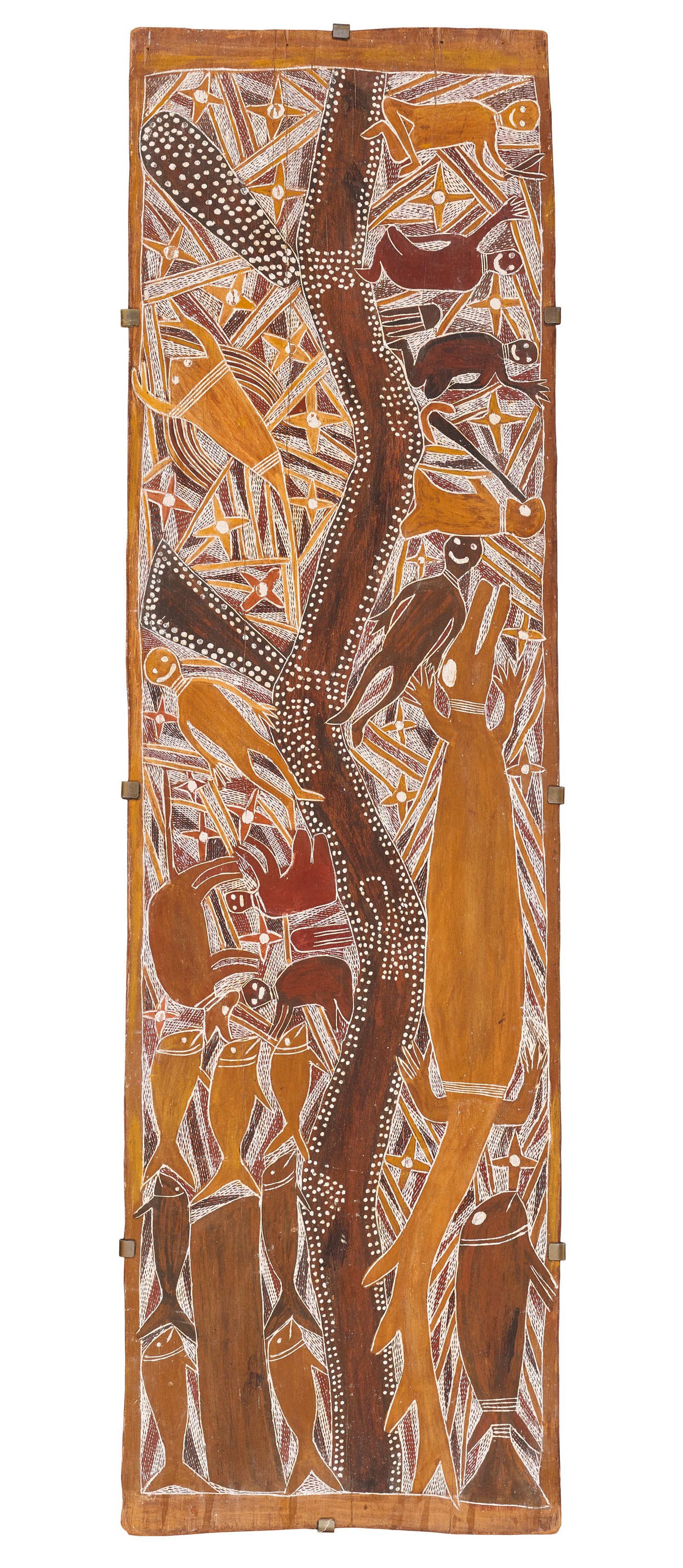
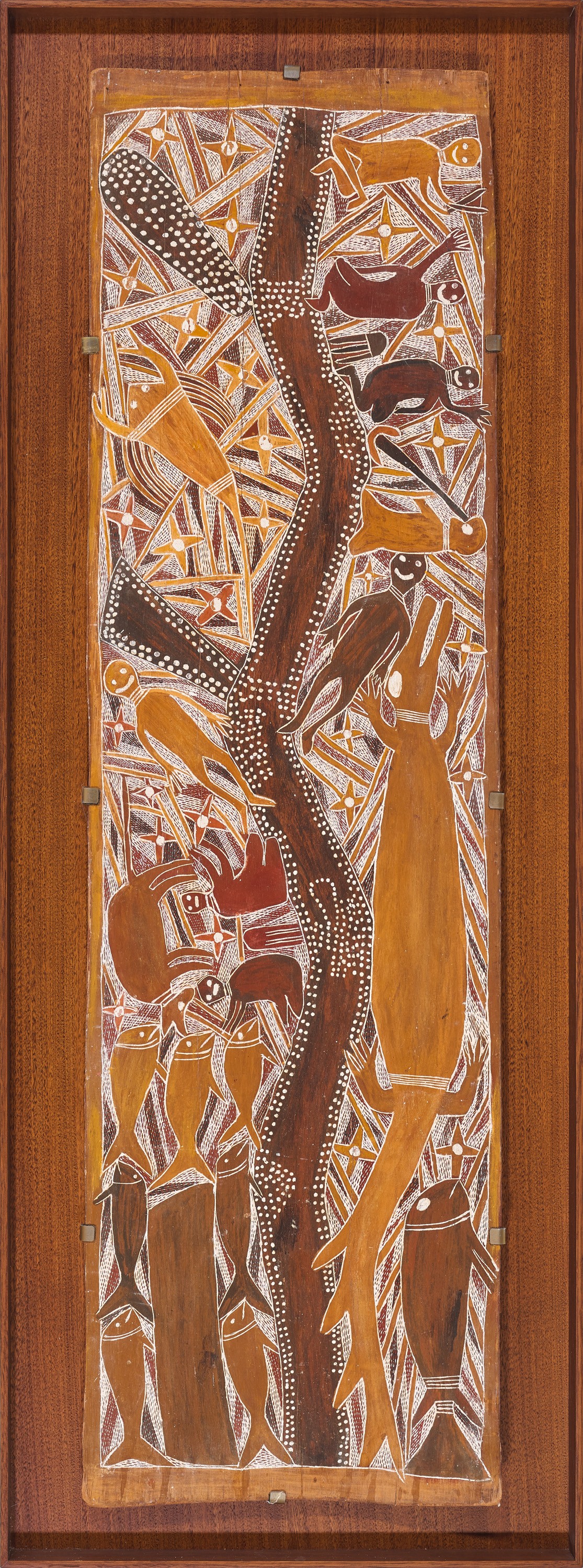
A rare monumental example of his work, Milŋiyawuy; The Milky Way, c.1958, carries a dual meaning. It depicts the mayaŋ’ (river) of stars that stretches across the night sky – known in English as ‘the Milky Way’ – while also referring to a mayaŋ’ on earth that flows into northern Blue Mud Bay.1 The constellations of Milŋiyawuy form a pathway for ancestral spirits and a celestial reflection of terrestrial life, encompassing ceremonies, canoes, and waters teeming with fish and other creatures. Thus, the painting simultaneously references earthly places and their parallel existence in the sky.
According to the traditions of the Rirratjingu and related Dhuwa clans, the composition illustrates the story of two brothers who were fishing in their bark canoe when it capsized in a strong wind. One brother’s body washed ashore, while the other sank beneath the water (lower left). The crocodile Baru, searching for food, detected the scent of the brother on the beach. Ultimately, the two brothers and Baru ascended into the night sky, becoming constellations (centre right).
Nearby, a group of Possum ancestors conducting a ceremony – men playing the didjeridu and clapsticks as women danced – saw the newly formed stars and likewise ascended into the heavens (top right). They were joined by the ancestral Native Cat, the submerged canoe, and the Scorpion, who was once a man. All were transformed into constellations. In the upper left, two star-filled bags extending from the Milky Way are known as Djulpan: the triangular bag is male, and the elliptical bag female.
1. Morphy, H. et al., ‘Milŋiyawuy; The Milky Way’ in Wanambi, W., Skerritt, H., and McDonald, K. (eds.), Madayin: Eight Decades of Aboriginal Australian Bark Painting from Yirrkala, Delmonico Books/Kluge-Ruhe Aboriginal Art Collection, Virginia, 2022, p. 168
CRISPIN GUTTERIDGE