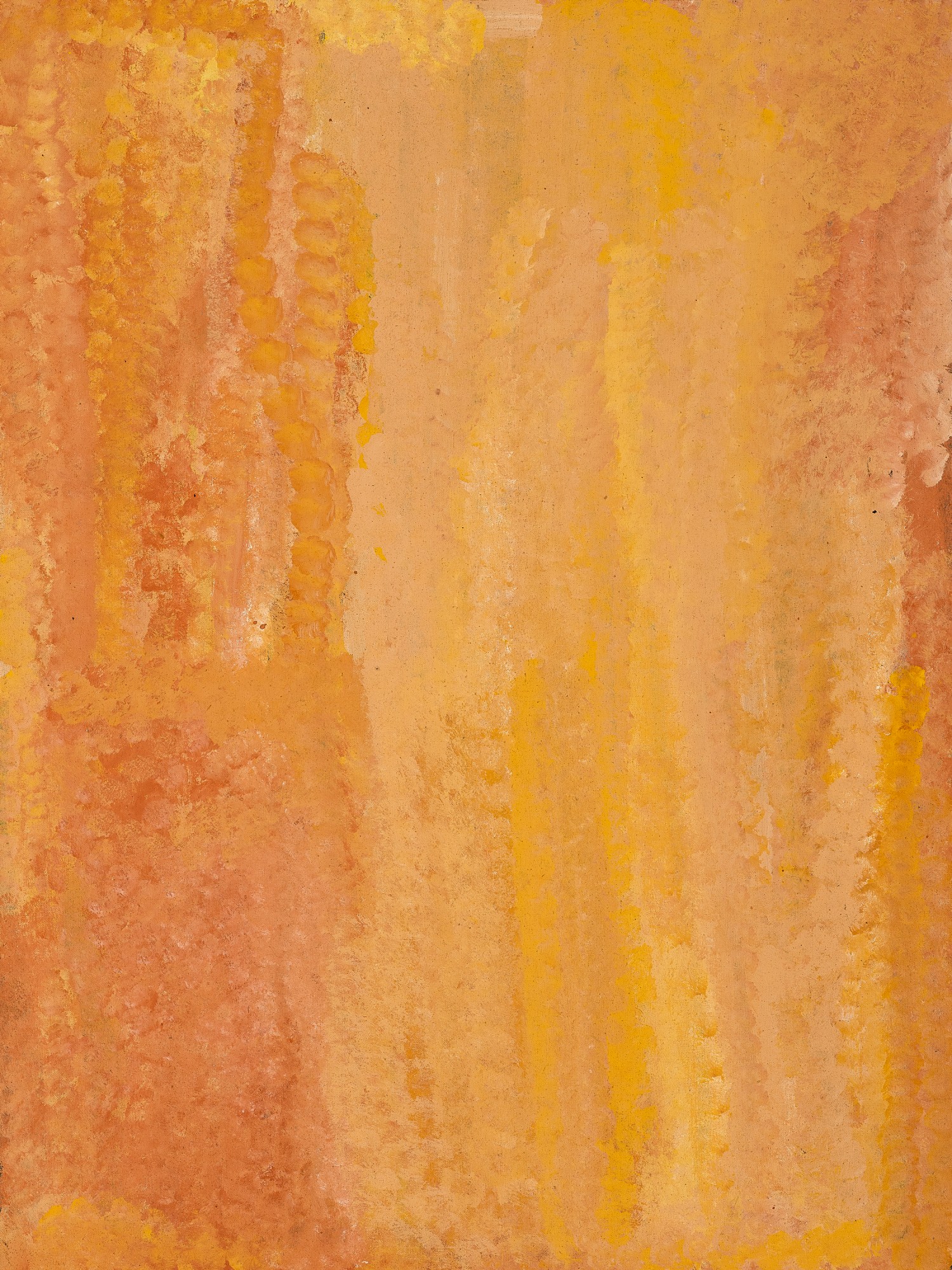
Untitled (Awelye), 1994

Emily Kam Kngwarreye
synthetic polymer paint on linen
121.0 x 90.0 cm
signed verso: Emily
bears inscription verso: artist's name and Delmore Gallery cat. 94A049
Commissioned by Delmore Gallery, via Alice Springs in January 1994
Private collection, Victoria
Renowned for her vibrant evocations of the ever-shifting desert landscape of Alhalker – her father’s and grandfather’s Country – Emily Kam Kngwarreye translated her custodial responsibilities for the Yam and the Emu into powerful painted forms. Her canvases reflect a profound connection to Country and to women’s ceremonial practices, expressed through body painting and dance. Located on the western edge of Utopia, this triangular tract of land was both her birthplace and her lifelong home where she lived according to the traditional lifeways of the eastern Anmatyerr people, maintaining cultural practices that had endured for countless generations prior to European settlement. Through her distinctive mark-making, she recorded the desert’s seasonal rhythms – at times subtle, at others dramatic – and the astonishing bursts of growth that followed rainfall.
With her distinctive command of pattern and colour, Kngwarreye drew upon seemingly inexhaustible variations in her depictions of Country. Her compositions often dissolve into expansive fields of layered pigment, achieved through accumulations of dot upon dot. In the present Untitled (Awelye), 1994, luminous yellow, red, and soft pink dots hover over a deep black ground, creating a sense of movement and vitality. Through such works, Kngwarreye bears witness to the abundance that blankets the earth after rain, while also expressing the spiritual significance of the women’s ceremonies known as Awelye. As curator Stephen Gilchrist notes, many of her paintings comprise ‘densely layered fields of dots within chords of colour harmonies. Layering is also an important conceptual part of Kngwarreye’s cultural practice. What can be seen is only half the world; the ancestral power beneath the ground gives meaning to what is above. It is the surfacing of these unseen forces, latent in the ground, moving through the body and onto the canvas, that gives the work its cultural signification.’1
1. Gilchrist, S., ‘I am Kam’, in Cole, K. et al., Emily Kam Kngwarreye, National Gallery of Australia, Canberra, 2023, p. 169
CRISPIN GUTTERIDGE