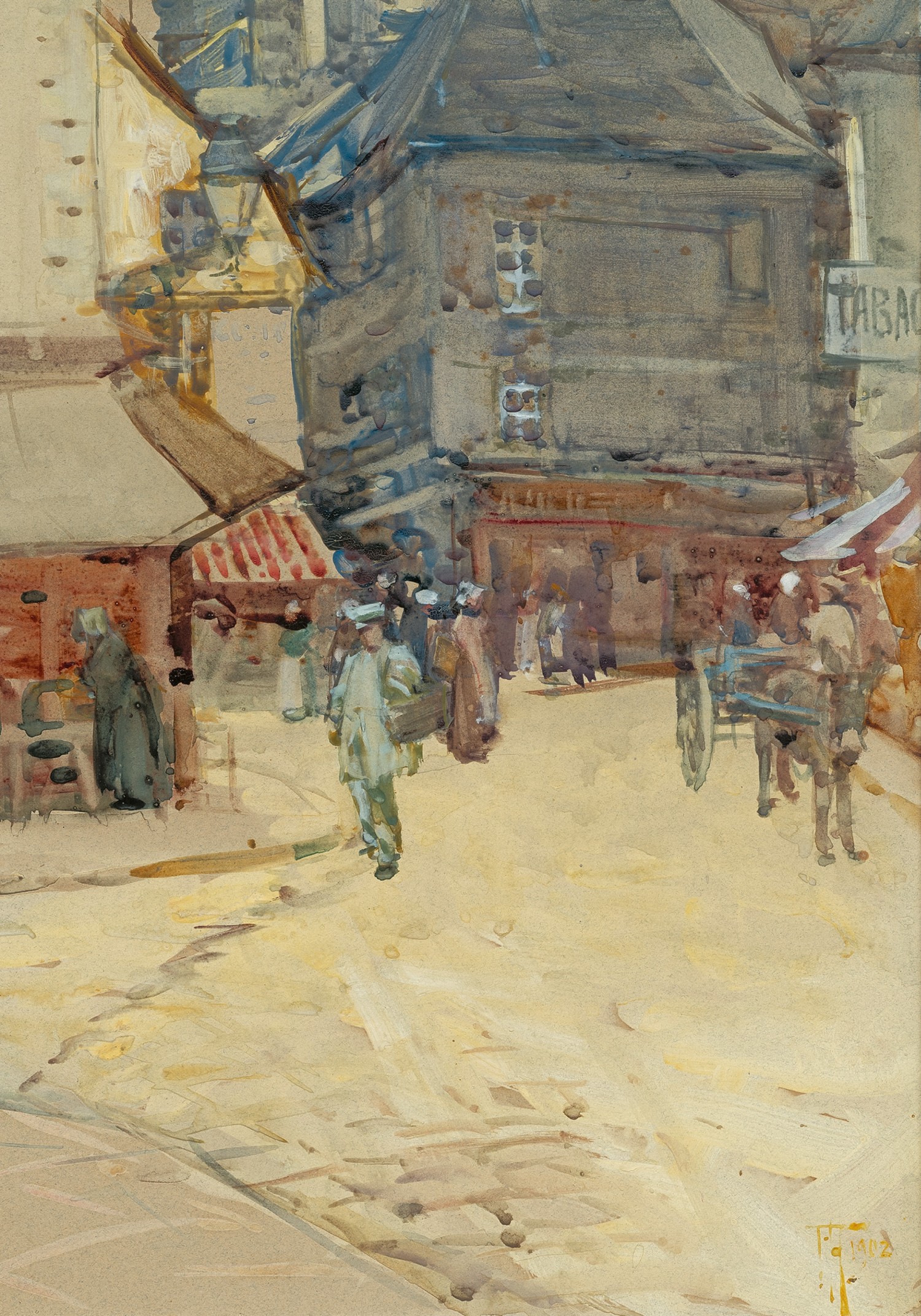
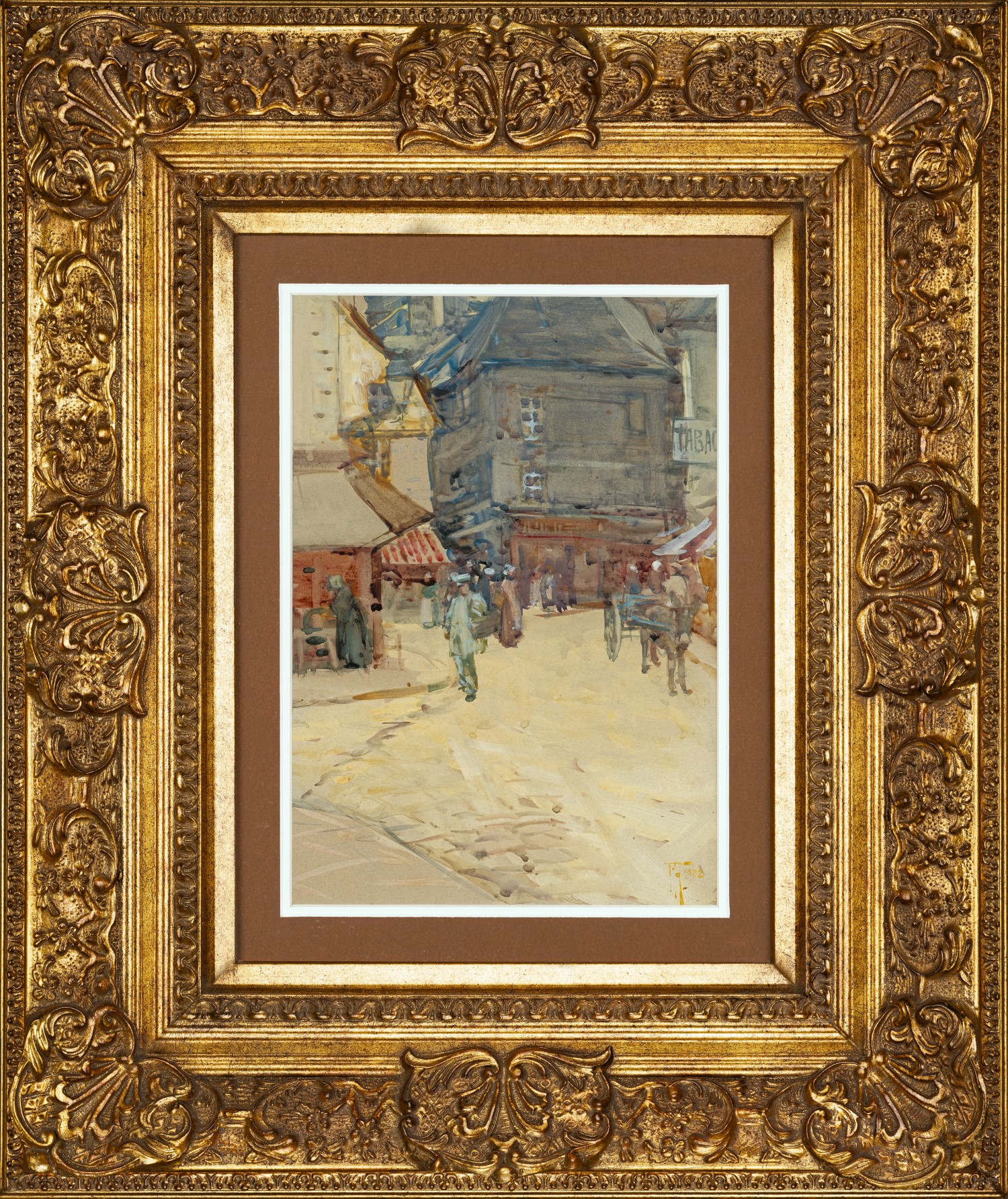
Old Street, Dinan, 1902
Frances Hodgkins
watercolour on paper
35.5 x 24.5 cm
signed with initials and dated lower right: FH / 1902
inscribed with title verso: Old Street / Dinan
Private collection, Sydney
possibly Frances Hogkins, McGregor Wright and Co., Auckland, opened 26 August 1902 [37 watercolours, 'chiefly scenes in France, Italy, and Cornwall']
Auckland Society of Arts, Auckland, opened 8 November 1902, cat. 193
McCormick, E. H., Works of Frances Hodgkins in New Zealand, Auckland City Gallery, New Zealand & Oxford University Press, London, 1954, p. 226
When Frances Hodgkins set off for Europe in 1901, she left with the intention of spending a couple of years gaining overseas experience before returning once more to Aotearoa New Zealand to teach. Having come from a childhood immersion in the Otago landscape, cities such as London and Paris seemed overwhelming, too crowded, and too expensive. Instead, it was the fishing villages of Cornwall and Brittany, with their picturesque architecture and traditions, that initially captured Hodgkins’ imagination.
She spent the summer of 1901 in Caudebec-en-Caux, Normandy, in the company of Irish artist Norman Garstin and his retinue of pupils, although Garstin, having seen her work, said there was nothing he could teach her. She enjoyed the company of other artists – not least the daily criticism (carried out with good humour) where they discussed the travails and successes of the day.
Hodgkins returned the following year to Dinan in Brittany, where Garstin had taken up residence for his summer school. She stayed throughout the summer, taking rooms above the famous Swiss-run Patisserie Taffatz, the advertisements for which boasted the best of English teas. She described to fellow artist Dorothy Kate Richmond how she liked to be painting out of doors by 7.30am, as the streets were ‘just as busy then, in fact busier than later in the day. Dinan is a first-rate place – a variety of everything – old streets, peasant women, fruit stalls, river scenery, feudal castles & 2 ‘dashing’ cavalry regiments…’1
The summer was plagued by constant rain, and Hodgkins was grateful for the shelter of the arcades that allowed her to overlook the local market and the comings and goings of the old medieval town. Old Street, Dinan, 1902 is an excellent example of Hodgkins’ practice at this time. The convergence of several cobbled streets that meandered through the haute ville provides an appropriate vanishing point, drawing the eye before the viewer settles on the activities taking place either side. The centre background is dominated by a dark, four storeyed building, standing in contrast to the pale awning of the shop on the left.
A woman wearing a traditional Breton cap attends to something on a table beneath it, the white of her bonnet serving as a visual counterpoint to her sombre gown and the brown shutters behind. Another shop is shaded by a red and white canvas awning, a detail that found their way into several of her watercolours of the time, the bold lines adding a dash of pattern and warmth to the blocks of colour either side.
A cluster of women emerge from the street beyond, while others stand further back, hastily sketched. Others gaze at what might be a vegetable stall on the right. Unlike much of Hodgkins’ work, only the man in white, his body tilted to balance the large basket on his arm, is in clear focus – captured before he turns the corner and moves out of sight. Across the expanse of street that opens out in front of the artist, a donkey patiently waits between the shafts of a blue wooden cart, but such is the rapidity of Hodgkins’ brushstrokes that we cannot tell if a figure is loading it or not. This motif of donkey and cart appears in a number of the artist’s French watercolours, including Rue de l’horloge, 1902 which was painted the same summer. A common form of transport, they allowed Hodgkins to deftly capture the circular structure of the wheels. Many of her Dinan watercolours focused on the streets adjacent to her lodgings. One has to focus closely to make out the gas lamp attached to the building on the corner, allowing us to imagine the same streets in the evening, softly illuminated in their glow.
1. Letter to Dorothy Kate Richmond, 22 July 1902 at: https://completefranceshodgkins.com/objects/29230/letter-from-frances-ho... (accessed March 2026)
MARY KISLER