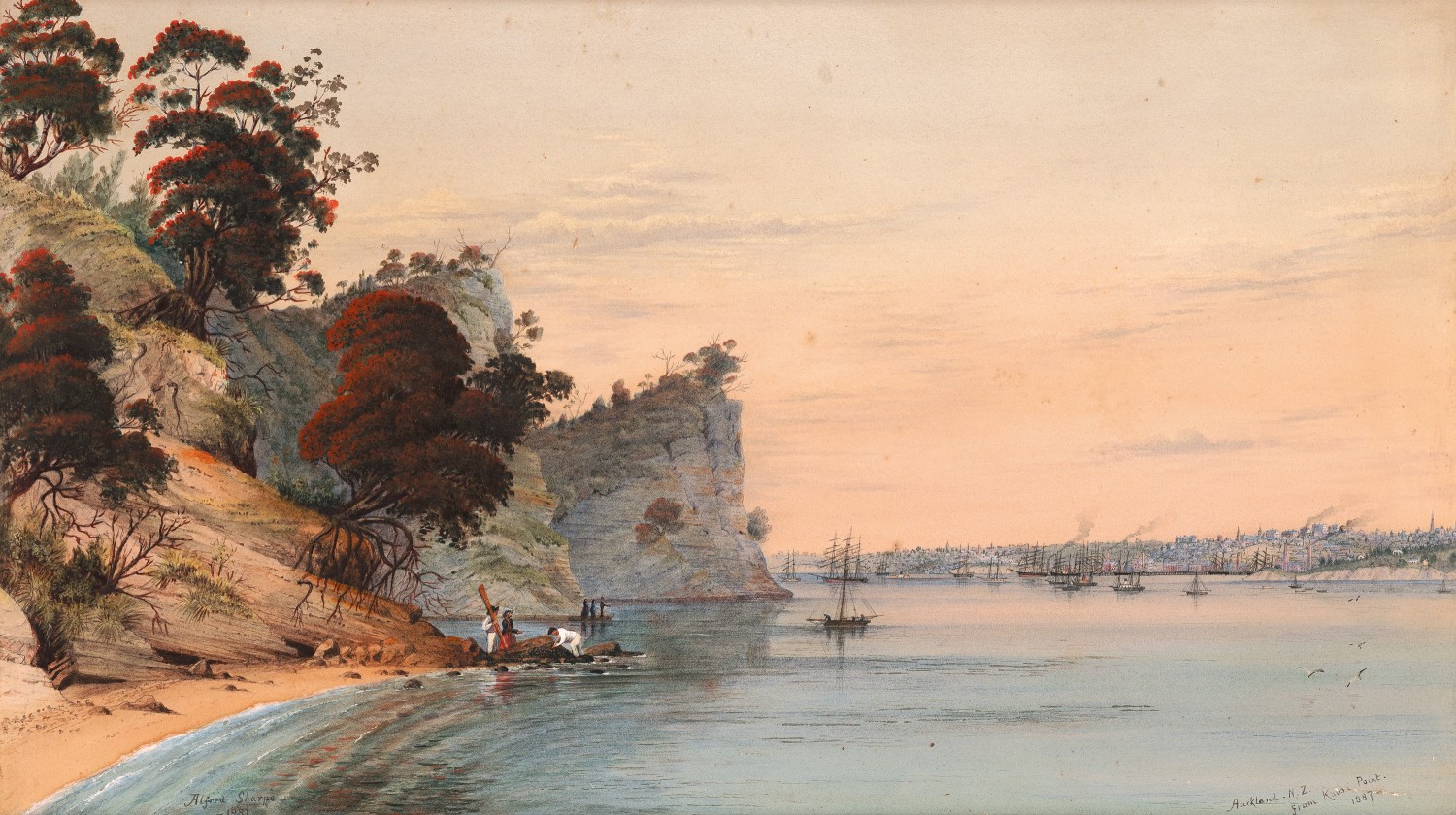
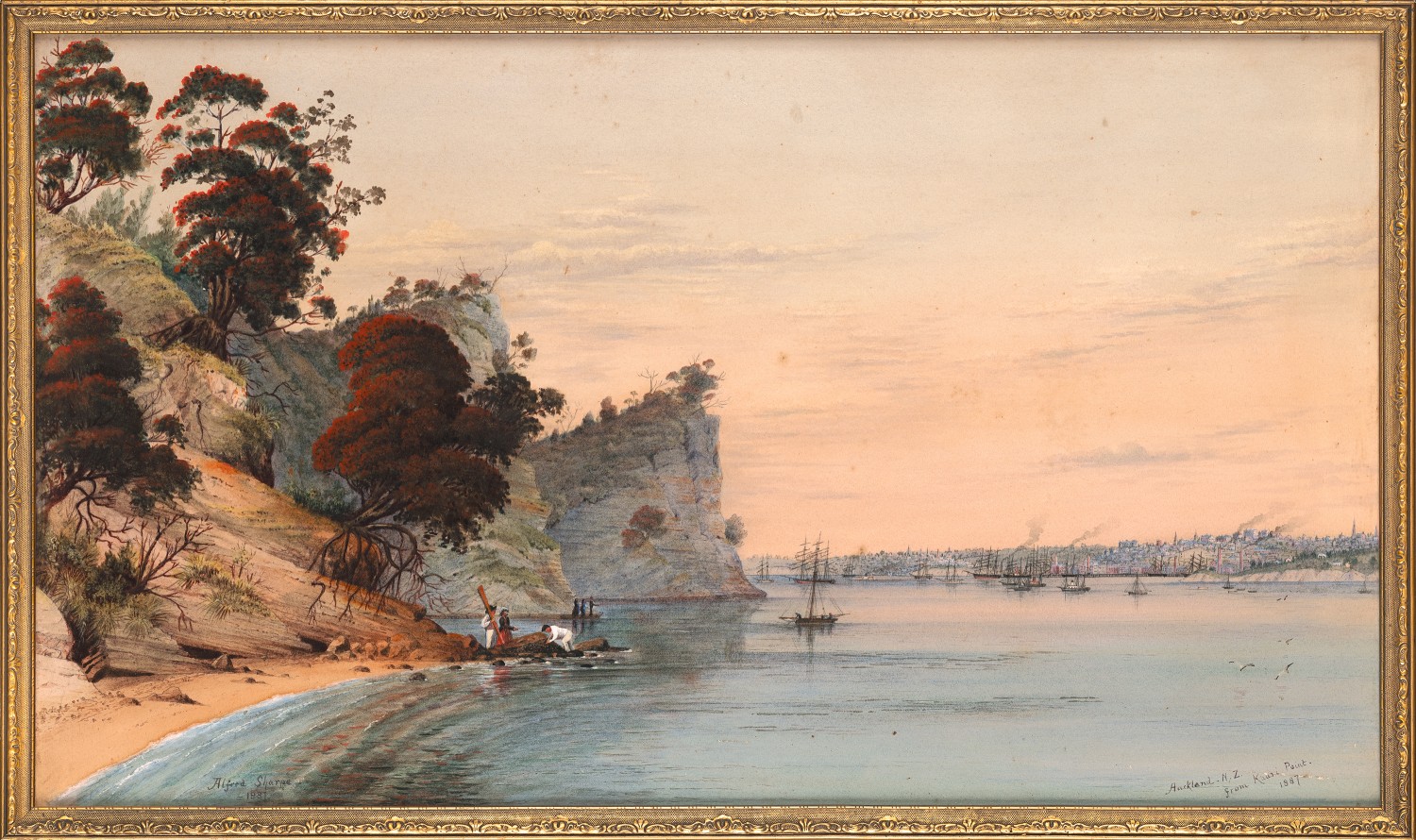
Auckland, New Zealand - from Kauri Point, 1887
Alfred Sharpe
watercolour on paper
37.0 x 64.0 cm
signed and dated lower left: Alfred Sharpe / - 1887
dated and inscribed with title lower right: Auckland. N. Z. / from Kauri Point. / 1887
James Hooke, Dungog, NSW, until 1912
Thence by descent
James Theodore “Theo” Morpeth Hooke, Dungog, NSW, until 1965
Thence by descent
James Calvert Hooke, Dungog, NSW, until 1979
Thence by descent
Lucy Scott, Dungog, NSW
Thence by descent
Private collection, NSW
‘Why is so little known of such a man, whose sense of colour was beyond that of [his] contemporaries? I think the answer is that he was born deaf and never taught to speak…’1
Few figures in nineteenth-century New Zealand art embody the paradox of obscurity and significance more compellingly than Alfred Sharpe. Although today recognised as one of the most accomplished watercolourists of the colonial period, for much of the twentieth century his works were regarded primarily as topographical curiosities or historical records rather than aesthetic achievements – their critical reception further overshadowed by Sharpe's reputed deafness and the perceived isolation of his life. In recent decades however, such assumptions have fortunately been replaced by a more nuanced understanding of the artist whose painterly vision and cultural sensitivity were exceptional among his contemporaries.
Born in Birkenhead, Cheshire, Sharpe arrived in Auckland in 1859, lured by the opportunities afforded to colonial settlers. Although his early farming venture at Mangapai proved unsuccessful, these formative years spent in Northland left an indelible imprint upon his imagination, with the dramatic transformation of the New Zealand landscape under settler expansion later becoming one of the defining preoccupations of his art. Indeed, Sharpe remarkably diverged from the prevailing colonial attitudes of his generation through his profound sensitivity to the destruction of native forests and Māori settlements – and as such, his landscapes are often imbued with a deeply melancholic and elegiac tone, betraying a rare empathy for the violence of Indigenous displacement.
Ironically perhaps given the silence imposed by his deafness, Sharpe has since emerged as a lively and articulate commentator upon nineteenth-century New Zealand art. As elucidated by the enduring authority on the artist, Robert Blackley, in his groundbreaking publication, recent scholarship has revealed Sharpe to be a prolific newspaper contributor in both New Zealand and Australia, publishing both in his name and, more candidly, under numerous pseudonyms including ‘Asmodeus’, ‘Censor’, and ‘A Well-Wisher to Art’.2 Moreover, through essays such as his ‘Hints for Landscape Students in Watercolour’, Sharpe also articulated sophisticated views on technique, atmosphere, and artistic theory – establishing him as arguably the era’s most vocal colonial artist.
Painted shortly after Sharpe’s departure from Auckland in 1887, Auckland, New Zealand – from Kauri Point, 1887 represents the culmination of his luminous mature style. Having relocated to Newcastle, New South Wales, following personal and professional disappointments, Sharpe continued to rework sketches brought from New Zealand into ambitious finished watercolours. In the present composition, his meticulously layered washes and heightened chromatic sensibility are brought to their fullest expression, with the atmospheric brilliance of the sky – likely inflected by the extraordinary sunsets witnessed globally after the 1883 eruption of Krakatoa – suffusing the harbour with an almost visionary radiance. Structured around a striking contrast between the rugged, tree-clad cliffs of Kauri Point in the foreground and the encroaching colonial settlement across the distant shoreline (where clustered masts and architecture signal Auckland’s expansion), Sharpe highlights the tension between untouched landscape and increasing urban presence – thus subtly articulating his awareness of colonial transformation and loss.
Significantly, the impeccable provenance of the present work further enhances its colonial resonance. First acquired by James Hooke of Wirragulla, near Dungog – approximately 80 kilometres north of Newcastle where Sharpe was based – the watercolour entered the collection of one of the district’s foundational settler families most likely towards the end of the nineteenth century, and has descended through subsequent generations of the family until the present. Having emigrated from England to Tasmania in 1817, before later establishing themselves in Dungog in 1828, the Hooke family were notably among the earliest European landholders in the region. With its provenance inextricably bound to the very processes of colonisation that Sharpe so poignantly recorded, the watercolour thus represents not only a work of considerable artistic distinction but, moreover, bears heightened historical appeal - encapsulating the layered complexities of colonial enterprise, cultural memory, and the transformation of place.
1. H.M., ‘Auckland discovering unrealised heritage’, Auckland Star, 12 September 1963, p. 4
2. Blackley, R., The Art of Alfred Sharpe, Auckland City Art Gallery, Auckland, 1993
VERONICA ANGELATOS