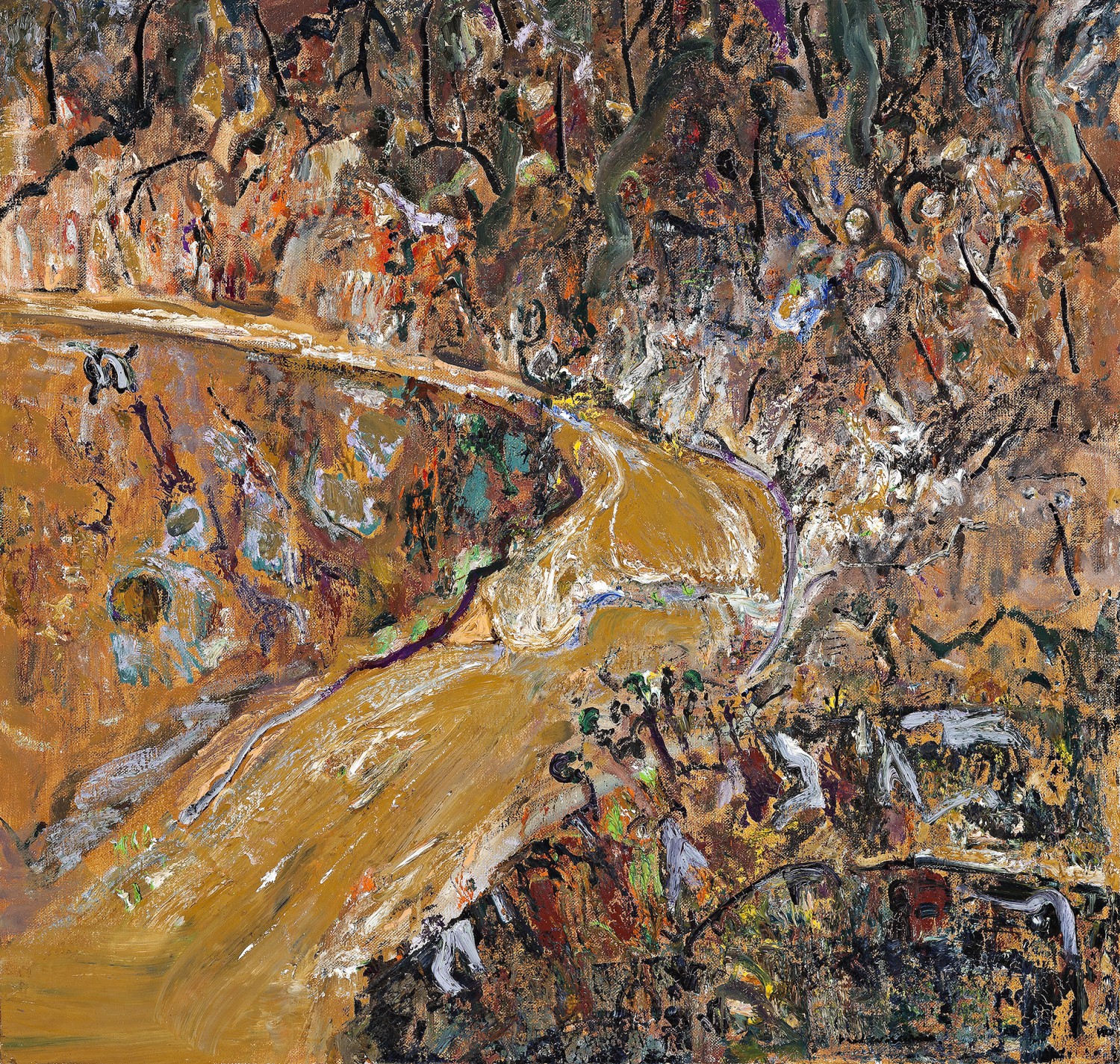
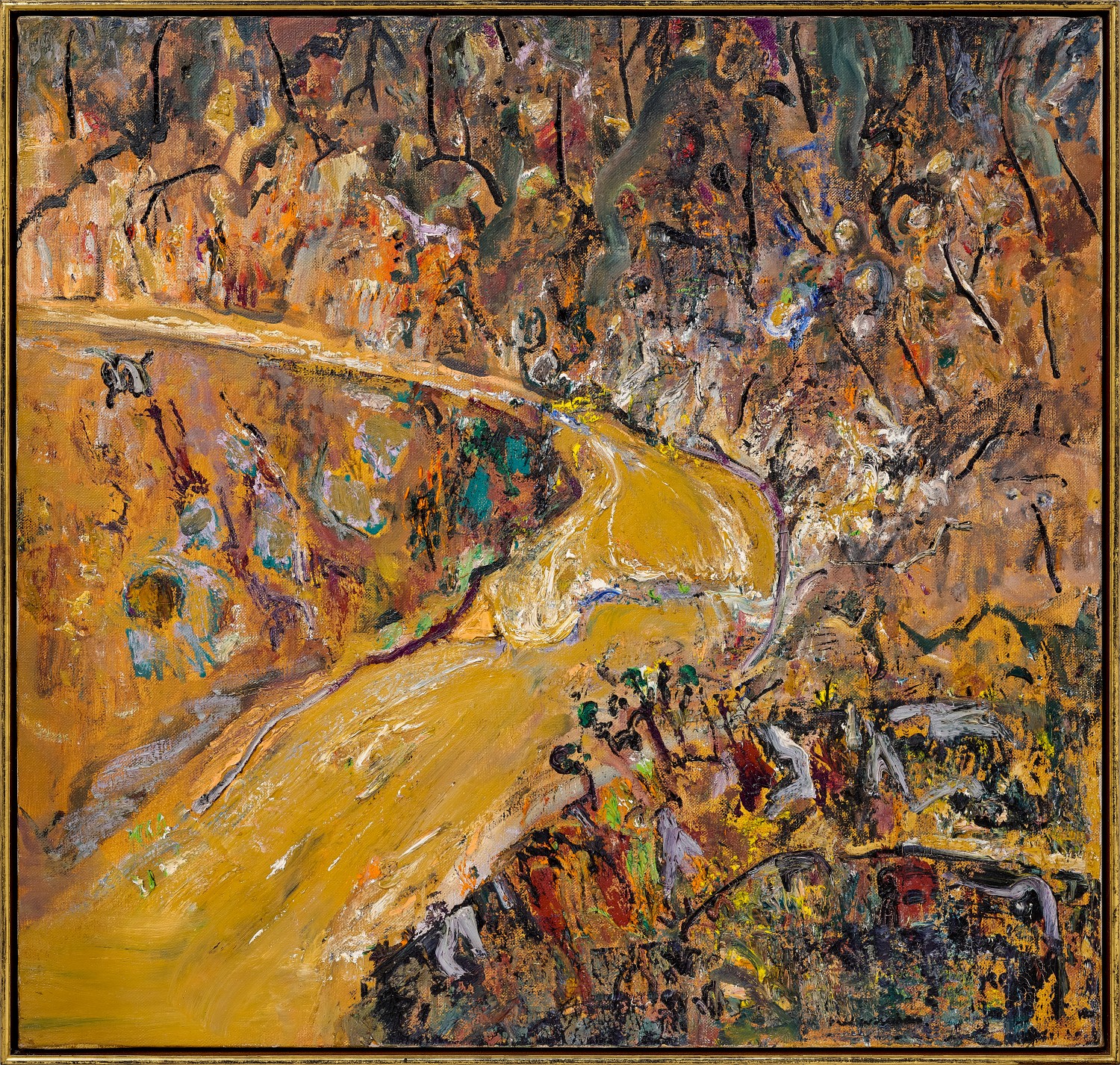
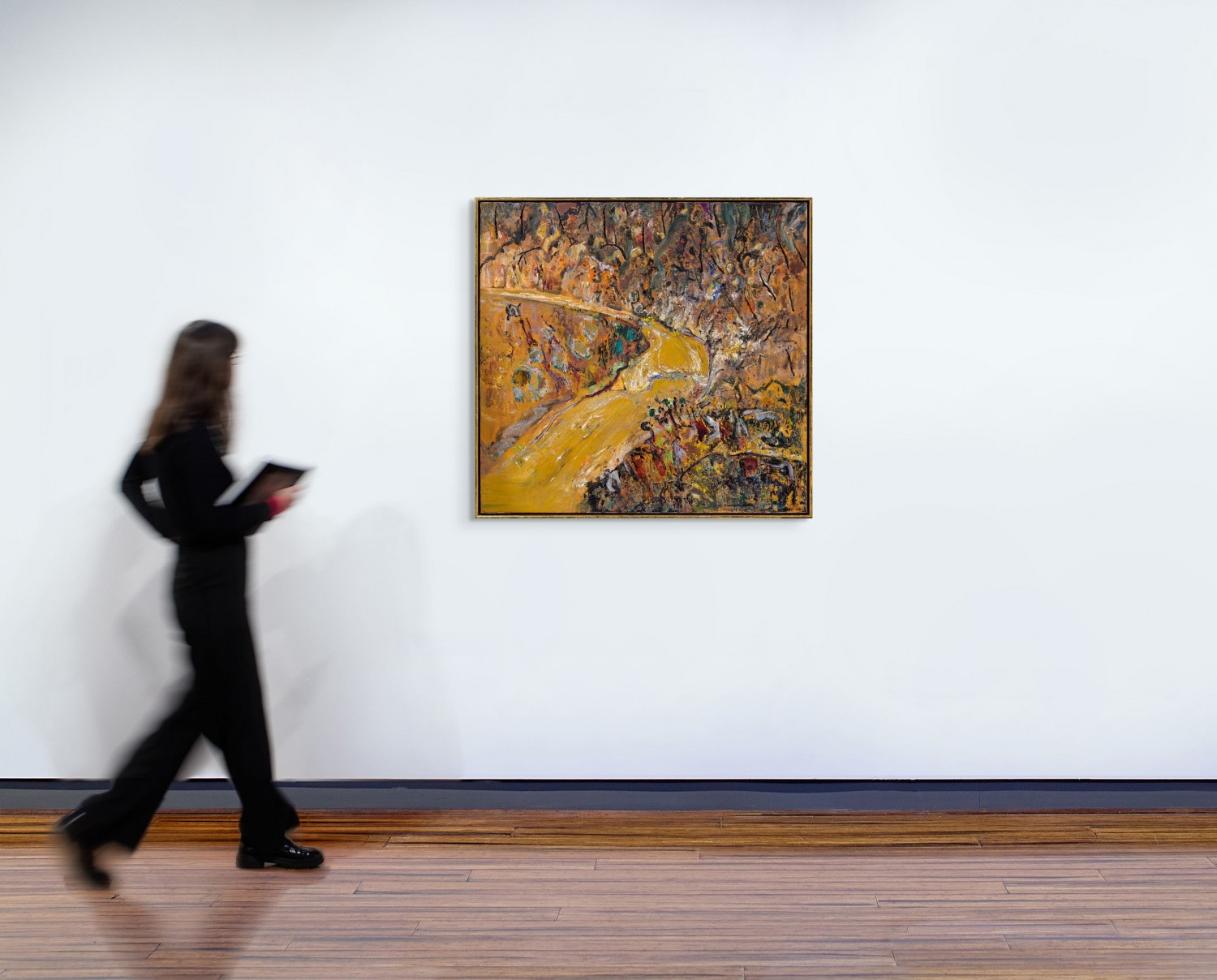
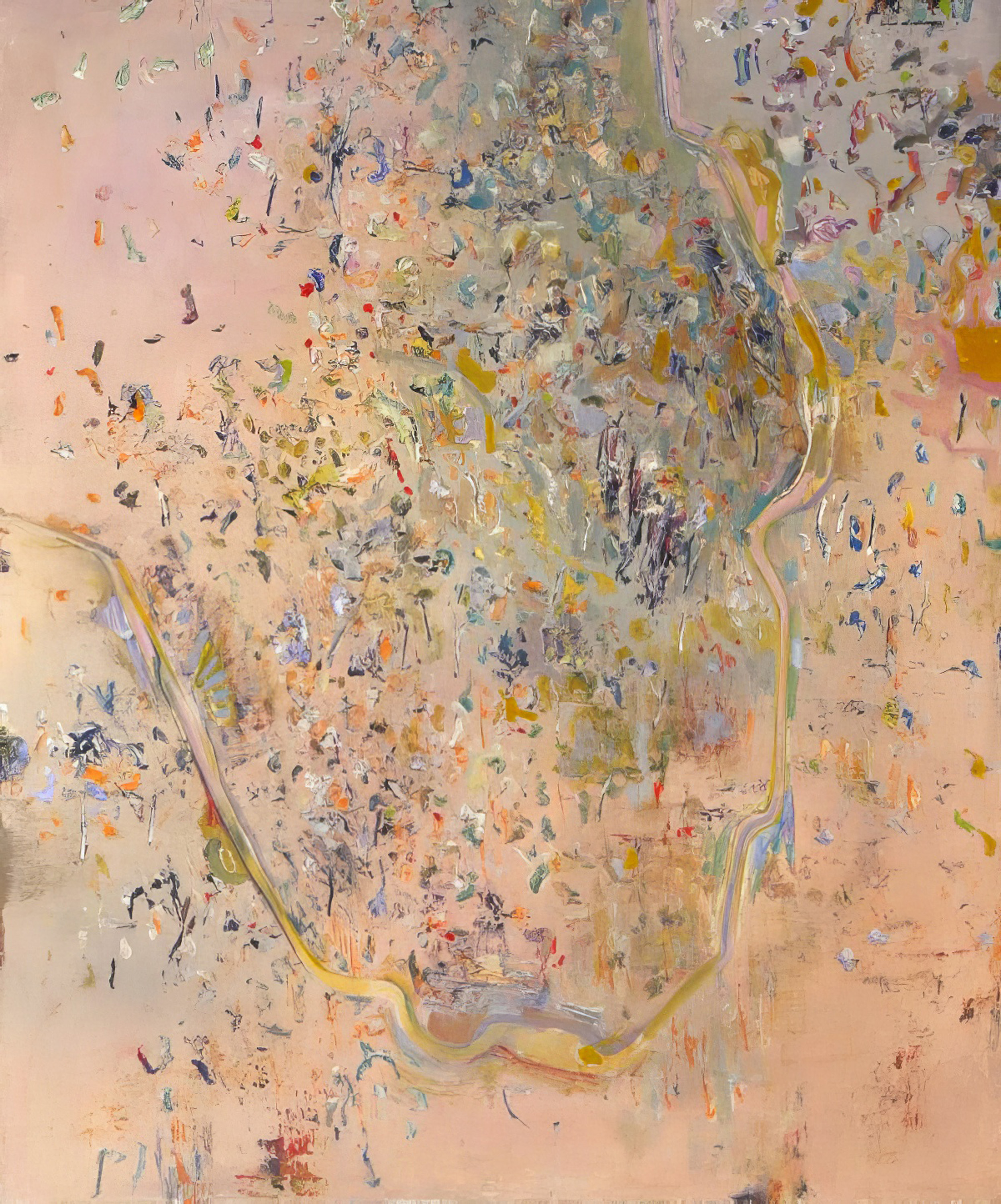
Flooded creek, 1977
Fred Williams
oil on canvas
101.5 x 107.0 cm
signed lower right: Fred Williams.
inscribed with artist's name, title and date on artist's label verso
bears inscription on artist's label verso: No-36
Private collection
Sotheby's, Melbourne, 19 April 1993, lot 310
Private collection, Melbourne
Private collection, Queensland
Deutscher and Hackett, Sydney, 2 December 2015, lot 53
Private collection, Indonesia
National Travelling Exhibition: Fred Williams – paintings, gouaches, lithographs (Adelaide Festival Exhibition), Contemporary Art Society of Australia (SA) Inc., Adelaide, 16 March – 6 April 1978, cat. 41
150573 Fred Williams Dry Creek Bed.jpg
Fred Williams
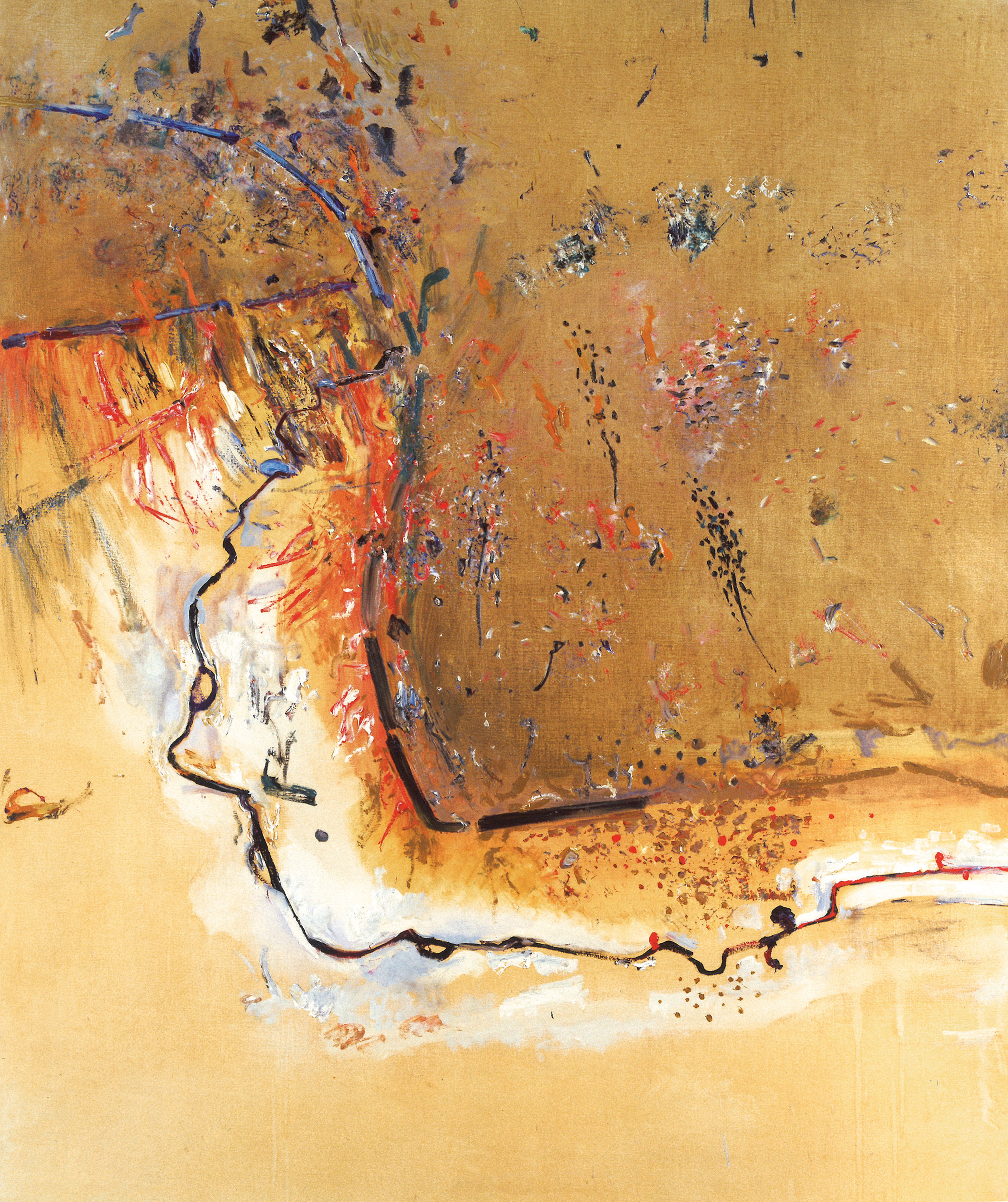
Dry Creek Bed, Werribee Gorge I, 1977
oil on canvas
182.3 x 152.2 cm
Tate, London
© Estate of Fred Williams/Copyright Agency
On returning to Australia in December 1956 following art studies in London, Fred Williams stopped at Fremantle en route to Melbourne where he ‘had a moment of revelation when he saw the landscape around Perth and realised that under this huge sky, with its sweeping horizontal distances, the landscape was never going to compose classically. He thought, if it doesn’t compose then I’ll capitalise on that, and make the paint the focus of the picture.’1 In so doing, he laid down the template which saw him become Australia’s most significant postwar landscape artist, elevating relatively humble patches of scrub into sophisticated, painterly essays. By the late 1960s, his paintings had become so sparse, lean and devoid of colour that they were almost minimalist. In 1971, however, he visited Albert Tucker at his property in Queensland and at his host’s suggestion, experimented with synthetic polymer paints triggering a suite of paintings full of unexpected verve and colour.2 Although he soon discarded the polymer, the experience unleashed what can only be considered as a second flowering in William’s career, with a disparate range of images bursting with richly hued vitality. He ‘became fascinated with the new palette and the properties of colour to the point of constructing colour charts and wheels. Yet these were largely discarded in the field. He followed his instinct.’3
To accomplish his ambitions, Williams, who had never learned to drive, initiated a weekly ritual whereby a fellow artist, beginning with John Perceval, would pick him up on a Wednesday and travel to the bush before setting up their easels ‘rain, sun or cold… [painting] feverishly for six hours.’4 In a newspaper interview, Williams said: ‘I accept any spot as a challenge. I find a trigger in the landscape for what I want to do.’5 The canvases would then be reworked wet-on-wet in the studio. Although the locations were usually non-heroic or epic, Williams was by 1976 increasingly attracted to gorges and waterfalls, ‘drawn to an elemental landscape where forces, which shaped the land, could be observed and painted.’6 These developed into what is now known as the ‘Gorge series’ of 1976 – 77, and Flooded creek, 1977, is one of his last responses to the motif before beginning a commission from Comalco Ltd to paint the Weipa district in far-north Queensland. It appears to be a companion to such works as Dry creek bed, Werribee Gorge I (Tate Gallery, London) and The river, Werribee Gorge (Art Gallery of New South Wales), both painted the same year, and is a vivid response to the raging torrent of water engorged by recent rains. A number of the ‘Gorge series’ paintings feature sharply angled bends, described by Patrick McCaughey as ‘the great-angle hooks (whose) wiry, irregular black line uncurves [sic] like a whiplash across the painting.’7 In Dry creek bed, Werribee Gorge I, an ancient creek bed lies exposed, deeply etched into the surface of the land. Although the landscape appears parched, Williams conveys a sense of renewal with signs of life seen in the scatter of plants around the creek bed. Flooded creek may well be from a similar location in Werribee Gorge, likely driven there by artist Fraser Fair – only now the vegetation blooms in response to the sudden amount of water.
150573 FRED WILLIAMS NEW-topaz-upscale-2x.jpg
Fred Williams
The river, Werribee Gorge, 1977
oil on canvas
182.4 x 152.0 cm
Art Gallery of New South Wales, Sydney
© Estate of Fred Williams/Copyright Agency
The paint surface of Flooded creek is animated and vital, benefiting from Williams’ unusual tactics. John Brack, for example, who shared a studio with Williams in the late 1940s, described his approach as ‘‘farouche’: Tubes of paint were not unscrewed, they were simply chopped in half. The procedure was frenetic. Frequently, when the brush seemed too slow, the paint was added impatiently… with a rag.’8 This same sense of energy, an impatience to get his ideas onto the canvas, percolates throughout Flooded creek. Williams was once quoted as saying he didn’t like the Australian bush and the constant repetition of this contradictory statement in articles on the artist caused his wife Lyn to compose a firm rebuttal, stating ‘(c)ertainly he did not like the bush the way a 19th century Banjo Paterson-man liked it, because he was a 20th century city-bred person, as 90% of us are. He was not involved with the romantic myths of our bush-bred past but about how he perceived it today... He tried to maintain his objectivity, but as one of our daughters said, you only have to look at his paintings to know whether he cared about the landscape.’9
Flooded creek was also painted in the same year that Fred Williams became the first Australian artist to have a solo exhibition at the prestigious Museum of Modern Art in New York, which his dealer Rudy Komon proudly announced had completely sold out.10
1. James Mollison, cited in Balla Starr, ‘Interview with James Mollison’, Fred Williams: Pilbara series, University of Melbourne, Victoria, 2000, p. 4
2. Mollison, J., ‘Williams, Frederick Ronald (Fred) (1927 – 1982)’, Australian Dictionary of Biography, Volume 18, Melbourne University Press, Melbourne, 2012
3. McCaughey, P., The Later Landscapes of Fred Williams, La Louver, California, 2005, p. 11
4. McGrath, S., ‘Williams just can’t relax’, The Australian, Canberra, 6 May 1978
5. Fred Williams, cited ibid.
6. McCaughey, op. cit.
7. McCaughey, P., Fred Williams 1927 – 1982, Murdoch Books, Sydney, 1984, p. 297
8. Mollison, J., Fred Williams, Australian National Gallery, Canberra, 1987, p. 4
9. Williams, L., ‘Letter to the Editor’, The National Times, Canberra, 9 – 15 May 1982, p. 33
10. Fred Williams: landscapes of a continent, Museum of Modern Art, New York, 11 March – 8 May 1977
ANDREW GAYNOR