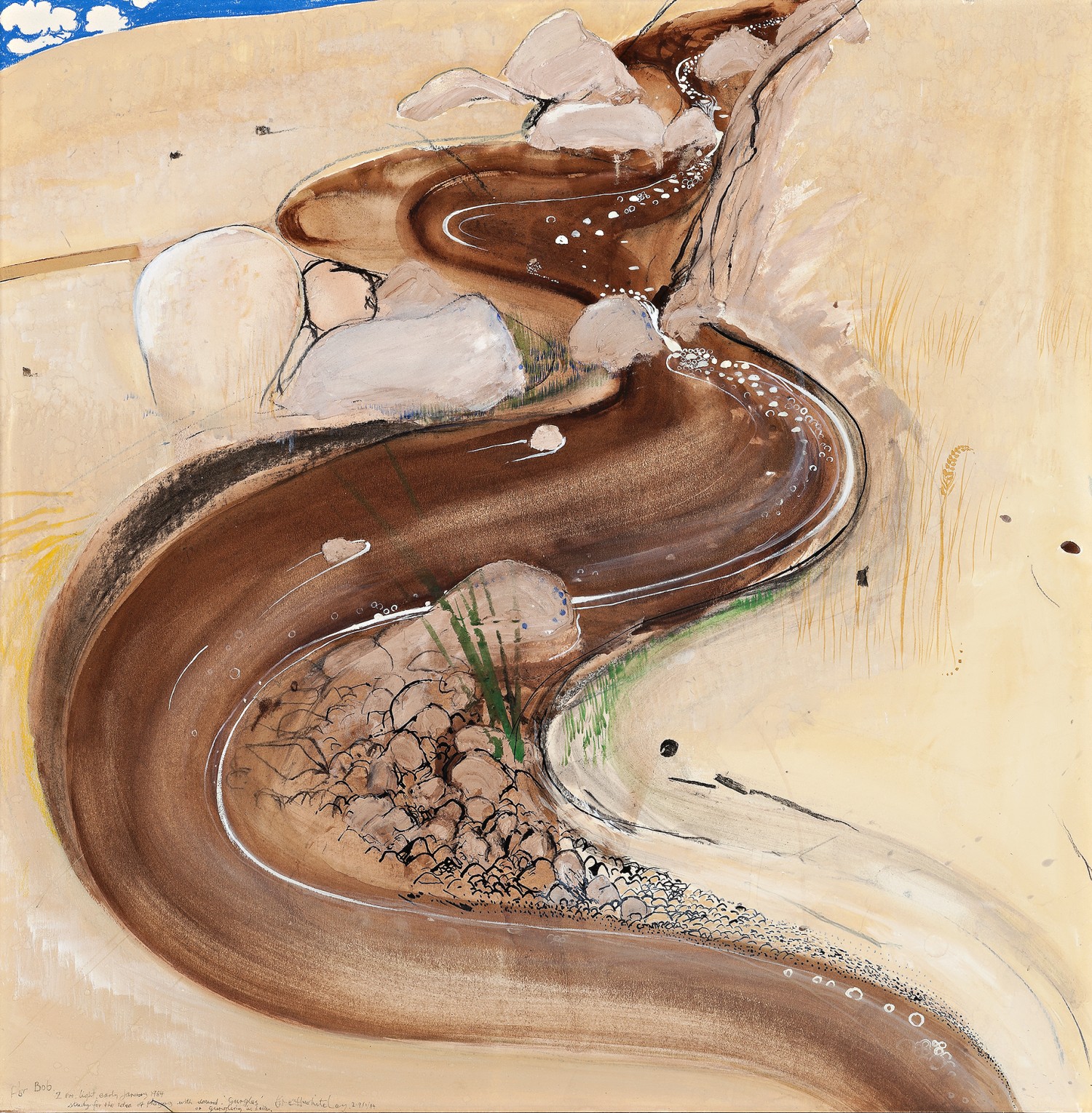
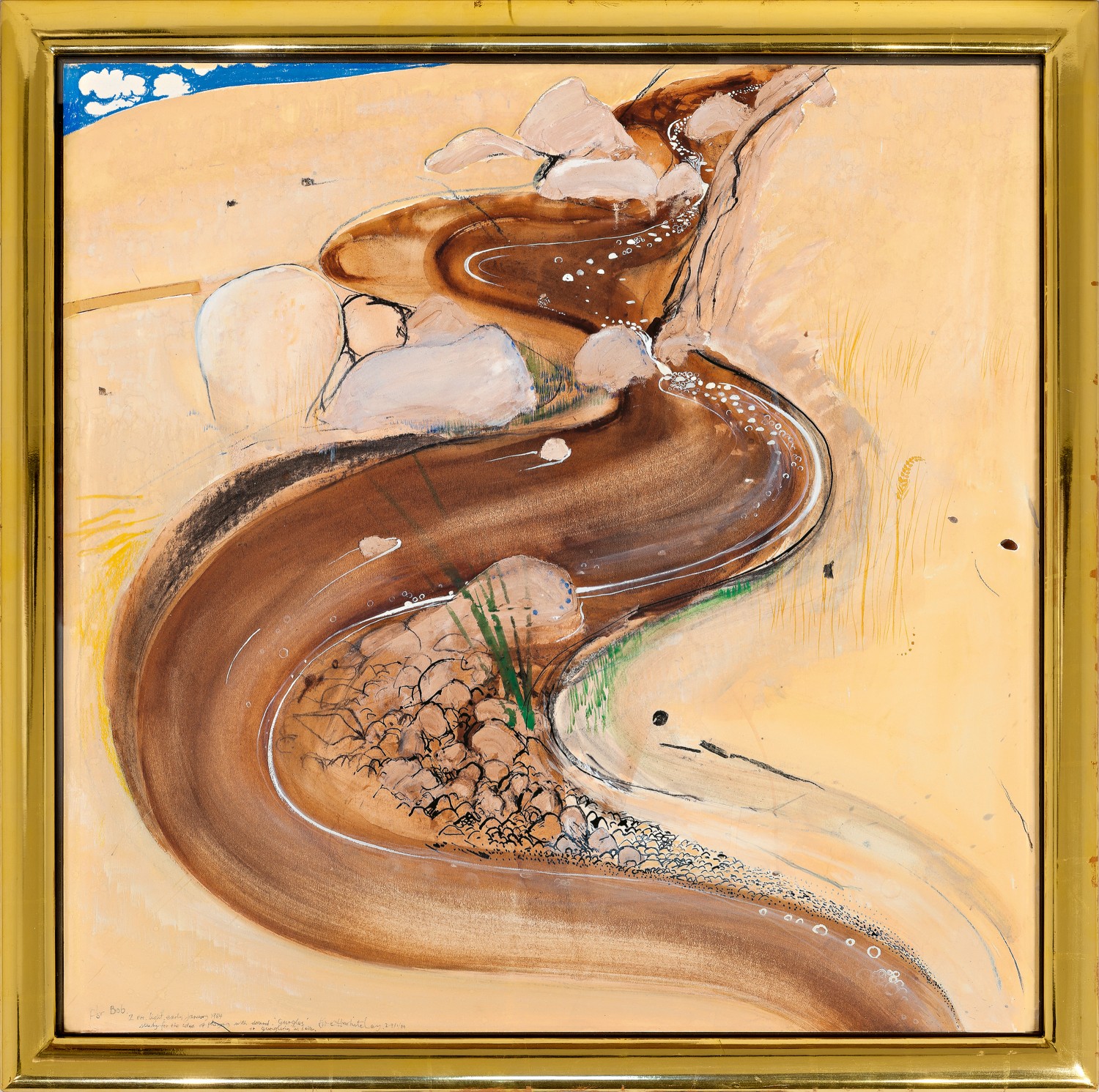
2pm light early January 1984, 1984
Brett Whiteley
mixed media on card on board
76.0 x 76.0 cm
signed, dated and inscribed lower left: 'For Bob / 2pm light early January 1984 / study for the idea of playing with sound. 'Gurgles' / or Gurgling is better. / brett whiteley 2 - 9/1/84
Private collection, Sydney, acquired directly from the artist
Sotheby’s, Melbourne, 4 May 2004, lot 5
Company collection, Sydney
Private collection, Sydney
Deutscher and Hackett, Sydney, 2 December 2015, lot 50
Private collection, Indonesia
Sutherland, K., Brett Whiteley: Catalogue Raisonné, Schwartz Publishing, Melbourne, 2020, cat. 154.84, vol. 4, p. 269 (illus.), vol. 7, p. 639
150451 Brett Whiteley_1.jpg
Brett Whiteley
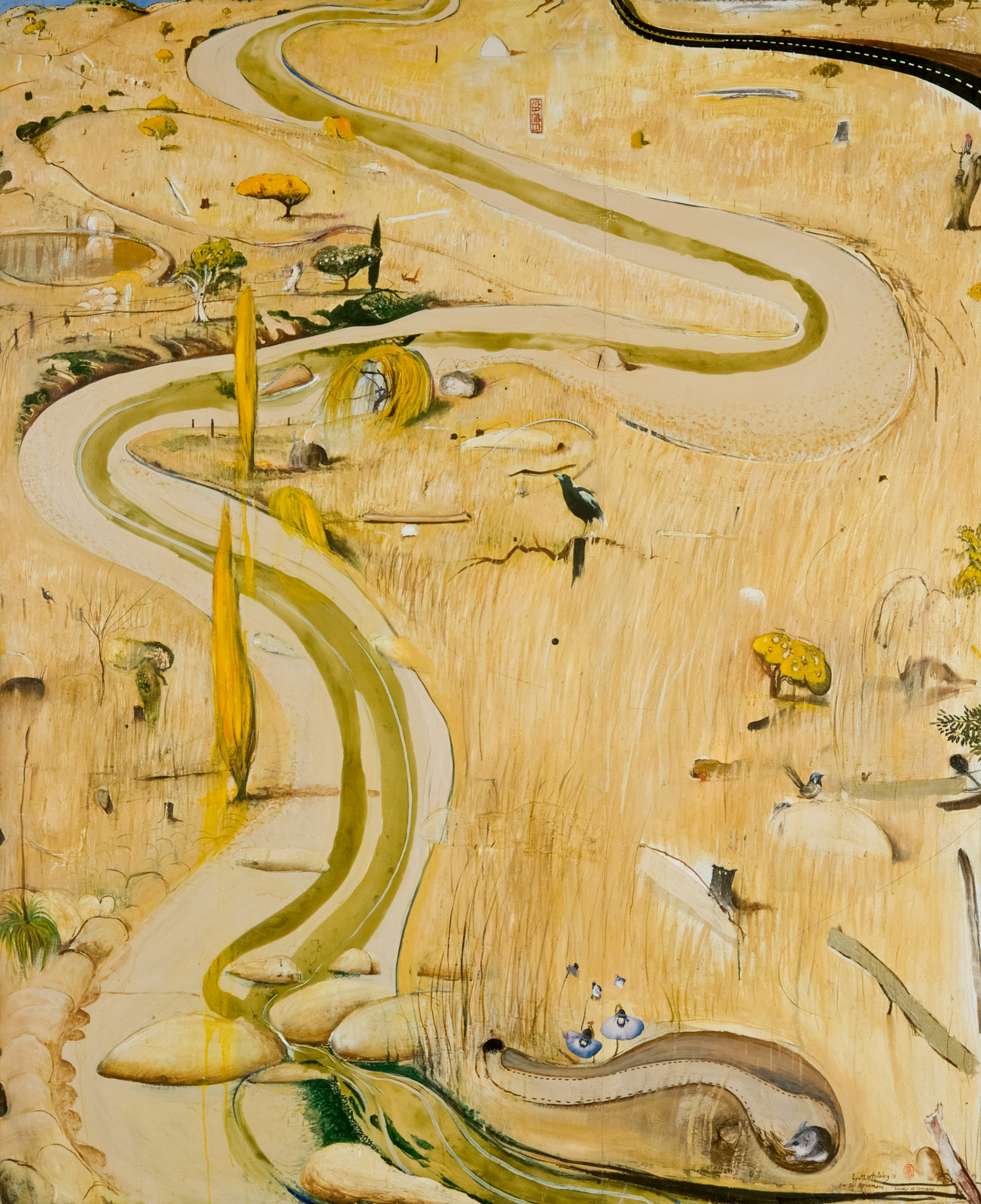
Summer at Carcoar, 1977
oil and mixed media on pineboard
244.0 x 198.7 cm
Newcastle Art Gallery, New South Wales
© Wendy Whiteley / Copyright Agency 2026
‘Of all the subjects Whiteley painted in his career, landscape gave him the greatest sense of release…’1 Brett Whiteley
From his auspicious start as the youngest non-British artist ever to have a work acquired by London’s prestigious Tate Gallery, Brett Whiteley’s artistic trajectory was nothing short of astounding. Hosting his first solo exhibition at Matthiesen Gallery, London in 1962 at the age of 22, the fiery, tousle-haired wunderkind quickly made a name for himself internationally as an urgent, flamboyantly talented artist. After launching himself on New York for a brief period of turbulence, in late 1969 Whiteley returned to Sydney and embarked upon an artistic pilgrimage to rediscover his homeland. Captivated afresh by the beauty, vastness and variety of the Australian landscape, he explored first the changing chromatic illusions and ‘optical ecstasy’ of Sydney’s Lavender Bay in sumptuous Matisse-inspired tableaux, before subsequently revisiting the rolling landscape of his boyhood in the Western New South Wales towns of Oberon, Kurrajong, Marulan, Carcoar and Bathurst. Significantly, within the decade he had won all three of Australia’s most coveted art awards – both the Archibald Prize for portraiture and Sulman Prize for genre painting in 1976; the Wynne Prize for landscape in 1977; and all three prizes again in 1978 (the only artist ever to be so honoured in the same year).
By the early eighties when Whiteley painted 2pm light early January 1984, 1984, his fame was at its zenith. Yet lurking below such myriad accolades and the ostensible serenity of his art during this period was an increasingly torturous struggle with addiction – a self-destructive legacy borne from a visceral need to test his gift that had now become inextricably intertwined with his prodigious creative efforts. Which makes all the more remarkable the inherent calm and lyricism of the present exquisite landscape that captures the tough, arid beauty of a drought-ravaged Australian landscape in mid-summer. Bereft of angst or any trace of the psychologically gruelling challenges plaguing his life at the time, indeed the work exudes a quietude that perhaps reflects the brief success of his treatment abroad only months earlier. As Barry Pearce, Emeritus Curator at the Art Gallery of New South Wales, has elaborated, nature offered both a conceptual and real escape from not only the realities of daily existence, but from the equally clamorous pressures of his successes and vices: ‘…if in many of his other themes Whiteley confronted the difficult questions of his psyche, landscape provided a means of escape, an unencumbered absorption into a painless, floating world.’2
150451 Brett Whiteley.jpg
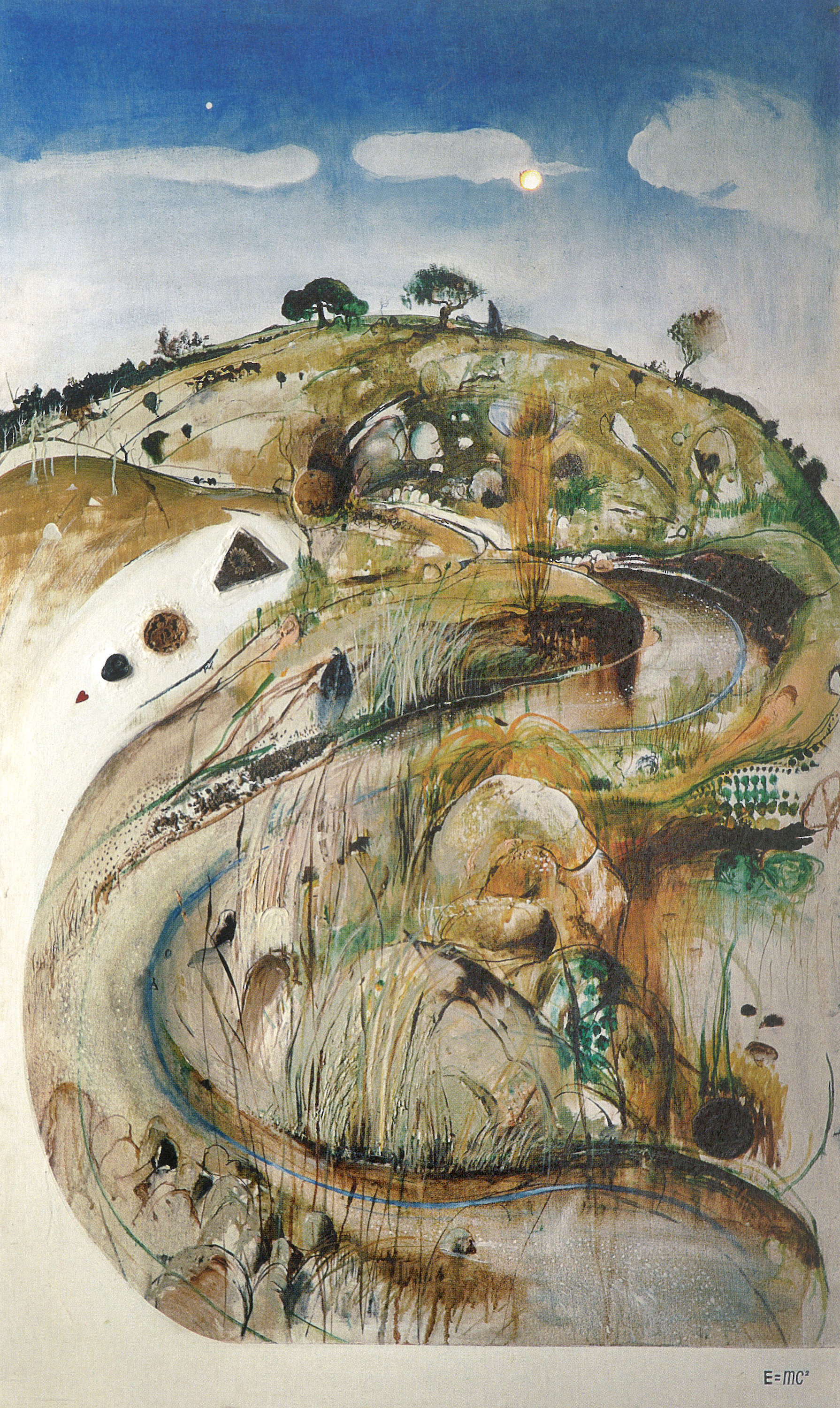
The river at Marulan (…Reading
Einstein’s geography), 1976
oil, electric light bulb and
stones on plywood
20.3.2 x 122.0 cm
TarraWarra Museum of Art, Victoria
© Wendy Whiteley /
Copyright Agency 2026
Oscillating between periods of extreme dependence on narcotics and restorative sojourns in the countryside (where the Whiteleys would invariably stay at the home of influential radio host, John Laws, in Oberon, or Michael Hobbs in Carcoar), significantly these years witnessed the production of some of the most beautiful, highly acclaimed landscapes of Whiteley’s career – aptly earning him the epithet of ‘chronologist of the golden paddocks, sensual hills and willow-strewn rivers of the central west.’ Culminating most famously in the two Wynne Prize-winning paintings – River at Marulan (…Reading Einstein’s geography), 1976 (private collection), and Summer at Carcoar, 1977 (Newcastle Art Gallery) – such works immortalised the sweeping landscape of his boarding school years in all its transient moods and seasons, bringing together birds, rivers, trees, rocks, skidding insects, and shy mammals (both painted and assemblage) with an elegiac majesty that defines the series.
Recalling the legacy bequeathed by artistic predecessors Russell Dysdale and Sidney Nolan in their stark portrayal of the country’s parched interior, thus 2pm light early January 1984 similarly evokes the colour and drama of drought – presenting a theatre of death and survival in the same reductive palette of pale desiccated yellows and browns that Whiteley had so favoured in masterworks such as To Yirrawalla, 1971 (Art Gallery of New South Wales). Equally influential were the compositions of Lloyd Rees which Whiteley had first admired at Macquarie Galleries one day after school – landscapes deeply poetic in their contemplation of soft, voluptuous curves and arabesques all rendered with impeccable tonality. As he later recalled in a letter to his artistic mentor, ‘…They contained nature and ideas, they contained naturalism but seemed also very invented, and the adventure of them was that they showed the decisions and revisions that had been made while they had been painted. I had never seen anything like that before… it set me on a path of discovery that I am still on today – namely that change of pace in a painting is where the poetry begins.’3
A romantic celebration of this region on a blazing summer afternoon, 2pm light early January 1984, encapsulates superbly such poeticism – featuring the artist’s signature stream meandering through the centre of the composition, amidst a sun-parched beige ground and rounded ochre boulders punctuated with the occasional hardy perennial. In stark contrast to his more troubled, visually demanding canvases of previous years, there is no artifice here – no anthropomorphic forms or flamboyant burlesques. To the contrary, the work is radiant with calm contemplation, lyrical lightness and keenly observed immediacy – a poignant homage to the landscape of his boyhood whose beauty had so profoundly influenced his choice of métier all those years ago. As Whiteley himself reflected upon these landscapes at the time, ‘…Sometimes I have to paint pictures that have an effortless naturalness, not artificial or synthetic, not manufactured – pictures that have no affectation through mental tricks, but graceful and according to nature.’4
1. Pearce, B., Brett Whiteley: Art and Life, The Art Gallery of New South Wales, Sydney, 1995, p. 196
2. ibid.
3. Whiteley cited in Klepac, L., Lloyd Rees – Brett Whiteley: On the Road to Berry, Heide Museum of Modern Art, Melbourne, 1993, p. 7
4. Whiteley cited in McGrath, S., Brett Whiteley, Bay Books, Sydney, 1979, p. 216
VERONICA ANGELATOS